Oracle

Oracles are essential infrastructure components that feed real-time, off-chain data (such as price feeds, weather, or sports results) into blockchain smart contracts. Without decentralized oracles like Chainlink and Pyth, DeFi could not function. In 2026, oracles have evolved to support verifiable randomness and cross-chain data synchronization. This tag covers the technical evolution of data availability, tamper-proof price feeds, and the critical role oracles play in ensuring the deterministic execution of complex decentralized applications.

5118 Articles
Created: 2026/02/02 18:52
Updated: 2026/02/02 18:52
Best Crypto to Buy as Peter Brandt Predicts $BTC Will Hit $200K

Best Crypto to Buy as Peter Brandt Predicts $BTC Will Hit $200K

Takeaways: Veteran trader Peter Brandt projects Bitcoin to reach approximately $200K around 2029. Before the next major rally, Brandt warns […] The post Best Crypto to Buy as Peter Brandt Predicts $BTC Will Hit $200K appeared first on Coindoo.

Author: Coindoo
Best crypto to buy now: 2025 altcoins poised for a Shiba Inu–style 2021 mega rally

Best crypto to buy now: 2025 altcoins poised for a Shiba Inu–style 2021 mega rally

Remittix is quickly emerging as the dark horse of this cycle, drawing heavy interest from Cardano (ADA), Stellar (XLM), and XRP investors who favor real utility over hype. With its price still at $0.1166 and analysts calling for a potential 50x run, RTX is becoming the most talked-about early-stage project of 2025. Remittix is surging […] The post Best crypto to buy now: 2025 altcoins poised for a Shiba Inu–style 2021 mega rally appeared first on CoinJournal.

Author: Coin Journal
The global market has experienced a massive crash, and even gold has not been spared. Why is this happening?

The global market has experienced a massive crash, and even gold has not been spared. Why is this happening?

Author: Liam, Deep Tide TechFlow November 21st, Black Friday. US stocks plunged, Hong Kong stocks plummeted, and A-shares followed suit. Bitcoin once fell below $86,000, and even safe-haven gold continued to decline. All risky assets collapsed simultaneously, as if held down by the same invisible hand. This is not a crisis of a particular asset, but a systemic, synchronized decline in global markets. What exactly happened? Global stock market crash, let's see who's worse off! Following the "Black Monday" crash, US stocks suffered another sharp decline. The Nasdaq 100 index plunged nearly 5% from its intraday high, ultimately closing down 2.4%, extending its pullback to 7.9% from its record high on October 29. Nvidia's stock price reversed course after rising more than 5% at one point, closing lower, and the entire market lost $2 trillion overnight. Hong Kong stocks and A-shares across the ocean were not spared. The Hang Seng Index fell 2.3%, and the Shanghai Composite Index fell below 3,900 points, a drop of nearly 2%. Of course, the worst off is the crypto market. Bitcoin fell below $86,000 and Ethereum fell below $2,800, with over 245,000 people liquidating $930 million in 24 hours. Starting from a high of $126,000 in October and even falling below $90,000 at one point, Bitcoin not only erased all its gains since 2025 but also fell 9% from the beginning of the year, and a sense of panic began to spread in the market. Even more alarming is that gold, intended as a hedge against risky assets, also failed to hold up, falling 0.5% on November 21 and hovering around $4,000 per ounce. Who is the culprit? The Federal Reserve will be the first to be affected. For the past two months, the market had been anticipating a December rate cut, but the Fed’s sudden shift in attitude was like a bucket of cold water poured over all risk assets. In their recent speeches, several Federal Reserve officials unusually adopted a hawkish stance, citing slow inflation, a resilient labor market, and the possibility of further tightening if necessary. This is tantamount to telling the market: "A December rate cut? Think again." CME FedWatch data confirms the speed of the emotional collapse: A month ago, the probability of an interest rate cut was 93.7%, but now it has dropped to 42.9%. The sudden collapse of expectations sent the US stock and cryptocurrency markets from a state of shock to one of extreme distress. After the Federal Reserve dashed expectations of an interest rate cut, the market's focus shifted to only one company: Nvidia. Nvidia delivered better-than-expected Q3 earnings, which should have ignited tech stocks. However, this "perfect" positive news didn't last long before the market quickly turned green and plummeted from its high. If good news doesn't lead to price increases, that's the biggest negative factor. Especially in a cycle of overvalued tech stocks, if positive news no longer pushes up stock prices, it becomes an opportunity to exit. At this point, Burry, a major short seller who had been consistently shorting Nvidia, added fuel to the fire. Burry has published a series of articles questioning the complex multi-billion dollar "circular financing" relationships between Nvidia and AI companies such as OpenAI, Microsoft, and Oracle. He stated: The actual end-user demand is ridiculously small, with almost all customers being funded by their distributors. Burry has previously warned of an AI bubble multiple times, comparing the AI boom to the dot-com bubble. John Flood, a partner at Goldman Sachs, stated bluntly in a report to clients that a single catalyst is insufficient to explain this dramatic reversal. He believes that market sentiment is currently battered, and investors have fully entered a profit and loss protection mode, focusing excessively on hedging risks. Goldman Sachs' trading team summarized nine factors contributing to the current decline in US stocks: Nvidia's gains have run out Despite better-than-expected Q3 earnings, Nvidia's stock price failed to maintain its upward trend. Goldman Sachs commented that "the real good news not being paid off is usually a bad sign," and the market had already priced in these positive factors. Concerns about private lending are rising. Federal Reserve Governor Lisa Cook publicly warned of potential asset valuation vulnerabilities in the private lending sector and the risks posed by its complex links to the financial system, triggering market vigilance and widening overnight credit market spreads. Employment data failed to reassure people. While the September nonfarm payroll report was solid, it lacked sufficient clarity to guide the Fed's December interest rate decision. The probability of a rate cut only increased slightly, failing to effectively soothe market concerns about the interest rate outlook. Cryptocurrency crash spread Bitcoin's drop below the psychological level of $90,000 triggered a broader sell-off in risk assets, with its decline even preceding the plunge in US stocks, suggesting that the transmission of risk sentiment may have started in high-risk sectors. CTA sell-off accelerates Commodity Trading Advisors (CTAs) were already extremely bullish. As the market fell below short-term technical thresholds, systemic selling by CTAs accelerated, exacerbating the selling pressure. Air Force re-enters the field The reversal of market momentum provided an opportunity for the bears, and short selling became active again, pushing the stock price down further. Poor performance in overseas markets The weak performance of key Asian technology stocks (such as SK Hynix and SoftBank) failed to provide positive external support for US stocks. Market liquidity depletion Goldman Sachs data shows that liquidity at the top of the S&P 500 index has deteriorated significantly, falling well below the year-to-date average. This near-liquidity makes the market extremely poor at absorbing sell orders, meaning even small sell-offs can cause significant volatility. Macro trading dominates the market The surge in the trading volume of exchange-traded funds (ETFs) as a percentage of total market volume indicates that market trading is driven more by a macro perspective and passive funds than by individual stock fundamentals, exacerbating the downward momentum of the overall trend. Has the bull market ended? To answer this question, let's first look at the latest views of Bridgewater Associates founder Ray Dalio on Thursday. He believes that although investments related to artificial intelligence (AI) are driving a market bubble, investors do not need to rush to liquidate their positions . The current market situation is not entirely similar to the bubble peaks investors witnessed in 1999 and 1929. On the contrary, according to some indicators he monitors, the US market is currently at about 80% of that level. This doesn't mean investors should sell their stocks. "I want to reiterate that many things may rise before the bubble bursts," Dalio said. In our view, the drop on November 21 was not a sudden "black swan" event, but a collective run on the market following highly consistent expectations, which also exposed some key issues. Real liquidity in global markets is extremely fragile. Currently, "technology + AI" has become a crowded track for global investment, and any small inflection point can trigger a chain reaction. In particular, the increasing use of quantitative trading strategies, ETFs, and passive funds to support market liquidity has also changed the market structure. The more automated the trading strategies become, the easier it is for a "stampede in the same direction" to form. Therefore, in our view, the essence of this decline is: The "structural crash" was caused by excessive automated trading and overcrowding of funds. Furthermore, an interesting phenomenon is that Bitcoin was the first to fall in this market, marking the first time that cryptocurrencies have truly entered the global asset pricing chain. BTC and ETH are no longer fringe assets; they have become the thermometer of global risk assets and the forefront of sentiment. Based on the above analysis, we believe that the market has not truly entered a bear market, but rather a phase of high volatility. The market needs time to recalibrate its expectations for "growth + interest rates". The investment cycle for AI will not end immediately, but the era of "mindless price increases" is over. The market will shift from expectation-driven to profit realization, whether in the US or A-share market. As the risky asset that fell earliest, had the highest leverage, and the weakest liquidity in this round of decline, cryptocurrencies experienced the most severe drops, but they also often rebounded first.

Author: PANews
Best Crypto To Buy Now: Smart Money Rotation Points Toward These Tokens (Why Remittix Is #1)

Best Crypto To Buy Now: Smart Money Rotation Points Toward These Tokens (Why Remittix Is #1)

Meme coins stay volatile as traders rotate into presales. Maxi Doge raises over $4M and gains traction with staking rewards and high risk appeal despite sector weakness.

Author: Blockchainreporter
Apple Supplier Foxconn Bets Billions on OpenAI Hardware Partnership

Apple Supplier Foxconn Bets Billions on OpenAI Hardware Partnership

TLDR Foxconn and OpenAI announced a partnership to design and manufacture AI data center hardware in the United States Foxconn plans to invest $1 billion to $5 billion in expanding its US manufacturing operations The partnership will focus on co-designing server racks, cabling, power systems, and cooling equipment for AI data centers Foxconn expects to [...] The post Apple Supplier Foxconn Bets Billions on OpenAI Hardware Partnership appeared first on CoinCentral.

Author: Coincentral
Gate Founder Dr. Han Speaks in Malta

Gate Founder Dr. Han Speaks in Malta

The post Gate Founder Dr. Han Speaks in Malta appeared on BitcoinEthereumNews.com. On the evening of November 20, Gate Founder and CEO Dr. Han delivered a keynote address at the Gate Europe Exclusive VIP Dinner in Malta, sharing the platform’s global strategic roadmap and insights into industry development. In his speech, Dr. Han reviewed Gate’s evolution since its founding in 2013 and explained how the company has built a worldwide crypto ecosystem guided by its three core principles: transparency, security, and compliance, while offering an in-depth outlook on future growth. A Twelve-Year Journey of Global Expansion Dr. Han noted that since its establishment in 2013, Gate has evolved from a small, early-stage team into a global crypto ecosystem platform. Beginning with spot trading as its core business and driven by user demand and continuous innovation, the platform has gradually developed a stable and reliable trading infrastructure, and extended it to the Web3 product system, covering trading, custody, payments, and on-chain services, and a wide range of ecosystem products. Today, Gate operates a comprehensive ecosystem that spans trading, custody, payments, and on-chain services. He emphasized that this development reflects not only Gate’s long-term commitment to technological innovation but also its strategic planning in global market expansion and diversified services. Through these efforts, Gate provides users worldwide with secure, efficient, and holistic crypto asset management solutions. Global Brand Partnerships: Strengthening International Presence Dr. Han highlighted Gate’s strategic partnerships with world-renowned brands, including the Oracle Red Bull Racing in F1 and FC Internazionale Milano. These collaborations have significantly strengthened Gate’s international brand visibility and further solidified its leadership position in the global crypto market. By working with global top-tier partners, Gate continues to bring its technological innovation and ecosystem vision to broader audiences, enhancing both user trust and industry recognition. Industry Insights: Growth and Opportunities in Crypto Markets According to Dr. Han, the crypto industry…

Author: BitcoinEthereumNews
RWA Weekly: HSBC to offer tokenized deposit services to select customers; Ant International and UBS to collaborate on blockchain-based cross-border payment and settlement.

RWA Weekly: HSBC to offer tokenized deposit services to select customers; Ant International and UBS to collaborate on blockchain-based cross-border payment and settlement.

Highlights of this episode This week's weekly report covers the period from November 14th to November 20th, 2025. The RWA market showed signs of a phase of adjustment this week, with the total on-chain market capitalization slightly increasing to $35.67 billion, a significant slowdown in growth. However, the number of holders bucked the trend, reflecting a shift in the market from scale expansion to cultivating existing users. The total market capitalization of stablecoins declined slightly, while transaction volume and monthly active addresses remained high, highlighting the rigid demand for on-chain payment settlement, indicating the market has entered a "stock optimization" phase. Regulatory oversight continues to improve: the US FDIC is working on guidelines for tokenized deposit insurance, and a Russian court will rule on the property rights of USDT, solidifying the legal foundation for stablecoins and RWA from both judicial and insurance perspectives. At the project level, companies under Jack Ma are making frequent moves: Alibaba's cross-border business unit plans to launch a stablecoin-like payment system, Ant International and UBS will cooperate in the field of cross-border payment settlement, and Ondo Finance has received EU approval to operate, indicating the industry is entering a phase of business integration and institutional convergence. Data Perspective RWA Track Panorama According to the latest data disclosed by RWA.xyz, as of November 21, 2025, the total market capitalization of RWA on-chain reached US$35.67 billion, a slight increase of 2.91% compared to the same period last month. The growth rate slowed significantly compared to the previous month, indicating a weakening growth momentum. The total number of asset holders increased against the trend to 539,900, a 9.54% increase compared to the same period last month. The total number of asset issuers was 251, with almost zero growth. The investor base expanded, but the asset supply stagnated. Stablecoin Market The total market capitalization of stablecoins reached $297.72 billion, a slight decrease of 0.47% compared to the same period last month; monthly transaction volume remained high at $4.94 trillion, a significant increase of 18.44% compared to the same period last month; the total number of monthly active addresses further increased to 39.85 million, a significant increase of 32.56% compared to the same period last month; and the total number of holders steadily increased to 203 million, a slight increase of 3.03% compared to the same period last month. Both of these factors jointly verify the continuous optimization of market operating efficiency—despite a slight contraction in scale, the efficiency of capital turnover and user activity remain strong, highlighting the rigidity of on-chain payment and settlement demand. Data indicates that the market has entered a phase of stock optimization. The steady growth in transaction volume and the increase in active addresses demonstrate the resilience of the ecosystem, but the continuous contraction in market capitalization may reflect that institutional allocation funds have not yet entered the market. The leading stablecoins are USDT, USDC, and USDS. Among them, the market capitalization of USDT increased slightly by 0.22% compared to the same period last month; the market capitalization of USDC decreased slightly by 1.92% compared to the same period last month; and the market capitalization of USDS increased by 2.98% compared to the same period last month. Regulatory news The Federal Deposit Insurance Corporation (FDIC) is developing guidelines for tokenized deposit insurance. According to Bloomberg, the head of the Federal Deposit Insurance Corporation (FDIC) stated that the agency is developing guidelines for tokenized deposit insurance to help financial institutions expand their digital asset business. Acting Chairman Travis Hill stated that the shift of deposits from the traditional financial world to the blockchain or distributed ledger world should not change their legal nature. Hill made these remarks at a time when a debate was raging over how fintech companies not directly insured by the FDIC should fully compensate consumers if their funds are lost. Many fintech companies partner with FDIC-insured banks to offer products covered by "look-through deposit insurance," but this protection can be challenged if the third party goes bankrupt, failing to effectively safeguard consumer rights. The U.S. government's deposit insurance fund is a cornerstone of the financial system, designed to protect depositors in the event of bank failure. The Russian Constitutional Court will rule on whether USDT has "property rights," potentially setting a judicial precedent for stablecoins. According to DL News, the Russian Constitutional Court is hearing a case concerning a loan dispute involving 1,000 USDT, with the core issue being whether citizens have property rights to stablecoins (such as USDT). Previously, three courts ruled that USDT is not subject to Russia's "Digital Financial Assets" (DFA) regulations, prompting the plaintiff to appeal to the Constitutional Court. The case has drawn significant attention from the Russian Central Bank, the Ministry of Finance, and anti-money laundering agencies, and the court will issue a closed-door ruling within several weeks. If the ruling finds that stablecoins do not fall under DFA, it may make them more suitable for everyday transactions, but their legal protection will be limited. India plans to launch its debt-backed stablecoin ARC in early 2026. According to CoinDesk, India plans to launch ARC, a stable digital asset pegged 1:1 to the rupee, in the first quarter of 2026. Developed jointly by Polygon and local fintech company Anq, ARC will operate on top of a central bank digital currency (CBDC), employing a two-tier structure and being issued only through corporate accounts. Its aim is to curb capital flows to dollar-denominated stablecoins and support domestic debt demand. This mechanism, combined with Uniswap v4 whitelist controls, strengthens compliance and safeguards monetary sovereignty. Local News Alibaba's cross-border e-commerce division plans to launch an AI subscription service and a stablecoin-like payment system. According to CNBC, Alibaba Group Holding Ltd.'s cross-border e-commerce division is planning to launch an AI-based subscription service and is partnering with JPMorgan Chase & Co. to pilot a "stablecoin-like" payment solution aimed at improving the efficiency of cross-border settlements. This plan may allow customers to use this digital payment tool for international trade and service transactions, thereby reducing the risks associated with exchange rate fluctuations and settlement times. Ant International and UBS will collaborate in the field of blockchain-based cross-border payment and settlement. According to the South China Morning Post, Singapore-based Ant International (a spin-off of Ant Group) is accelerating its global cash management business through a strategic partnership with UBS Group AG, while the two companies also hope to explore blockchain-based tokenized deposit innovations. The two companies said Monday that, according to a memorandum of understanding signed at UBS's Singapore office, Ant International will use UBS Digital Cash, its blockchain payment platform launched last year, for global fund management operations to improve efficiency, transparency, and security. The collaboration will also explore joint innovation in tokenized deposits, including an interconnected solution involving Ant's self-developed blockchain-based Whale platform—its internal fund management system. Project progress MoonPay will issue and manage stablecoins on behalf of its clients. According to Bloomberg, cryptocurrency payments company MoonPay Inc. will begin issuing and managing stablecoins on behalf of its clients. Zach Kwartler, MoonPay's newly appointed head of stablecoin business, stated in an interview that the New York-based company will leverage its existing money transmission license to offer the service across U.S. states. Kwartler said that issuing its own stablecoins will help MoonPay's clients better manage their payment operations. In a statement released Thursday, MoonPay said the issuance service will target enterprise clients in the U.S., Asia, and Latin America, and will cover multiple blockchains. The American Community Bankers Association is urging the OCC to block Sony Bank's trust from applying for a stablecoin license. According to Decrypt, the Independent Community Bankers Association (ICBA) has sent a letter to the Office of the Comptroller of the Currency (OCC) requesting that Sony Bank's Connectia Trust apply for a national trust license to issue a US dollar stablecoin. The ICBA argues that the stablecoin possesses "deposit-like" characteristics but is not subject to Federal Deposit Insurance or the Canada Revenue Agency (CRA), potentially triggering restrictions under the Bank Holding Company Act through debit cards and other means. The ICBA also questions the influence of the Sony Group over Sony Financial. Other companies seeking federal licenses include Coinbase, Circle, Ripple, Paxos, and Bridge (Stripe's stablecoin division). The Trump Organization plans to develop tokenized resorts in the Maldives with its Saudi partners. According to Bloomberg, the Trump Organization is planning to develop a luxury resort in the Maldives with its Saudi Arabian partners and intends to tokenize the hotel development project. In a joint statement Monday, the two companies said the Trump International Hotel Maldives project will include 80 ultra-luxury beach villas and overwater villas, and will be jointly developed by the Trump Organization and Dar Global Plc. Dar Global is a London-listed subsidiary of a Saudi developer. The Maldives resort, scheduled to open by the end of 2028, is just a 25-minute speedboat ride from the capital, Malé. The project's tokenization will allow investors to participate in the development phase, offering digital shares that investors can purchase in token form. Grab and StraitsX signed a memorandum of understanding to jointly build a Web3 wallet and stablecoin settlement network. Southeast Asian ride-hailing giant Grab has signed a memorandum of understanding with Singapore-based stablecoin platform StraitsX to develop a Web3 wallet and stablecoin clearing network for the Asian market. The two companies will work together to integrate the Web3 wallet into the Grab App, enabling GrabPay merchants to accept stablecoins such as XSGD and XUSD, and facilitating cross-border, real-time, and compliant settlements. The system will incorporate smart contracts and on-chain fund management, with all user assets managed in non-custodial wallets, complying with regulatory requirements. Deutsche Börse adds Société Générale's stablecoin to its core market system. According to CoinDesek, Deutsche Börse Group (DB1) and SG-FORGE, the digital asset subsidiary of Société Générale, announced on Tuesday their plans to integrate regulated euro and dollar stablecoins into their infrastructure. The two companies have signed an agreement to integrate SG-FORGE's euro and dollar stablecoin, CoinVertible, with DB1's backend systems, including Clearstream. The first phase will test CoinVertible's performance as a settlement asset for securities and collateral workflows and explore its role in fund management functions. Deutsche Börse also plans to list these tokens on its digital trading platform to improve liquidity. The two companies will explore the possibility of using stablecoins across Deutsche Börse's broader service offerings, including clearing, custody, and data tools for banks, asset managers, and crypto firms. This collaboration is progressing concurrently with the two companies' participation in a wholesale central bank digital currency pilot project. Circle launches xReserve, an interoperability infrastructure, to help developers deploy USDC-backed stablecoins. According to its official blog, stablecoin issuer Circle announced the launch of its new interoperability infrastructure, Circle xReserve, enabling blockchain teams to deploy USDC-backed stablecoins that are fully interoperable with USDC. Powered by the xReserve Authentication Service, xReserve allows developers and users to seamlessly transfer value between USDC-backed stablecoins and USDC on supported blockchains without relying on third-party bridging services. Its partners, Canton and Stacks, will integrate with xReserve in the coming weeks. HSBC will offer tokenized deposit services to customers in the United States and the United Arab Emirates. According to Bloomberg, HSBC Holdings Plc will begin offering tokenized deposit services to corporate clients in the U.S. and the United Arab Emirates in the first half of next year. Manish Kohli, head of global payments solutions at HSBC, stated that the tokenized deposit service will allow clients to make domestic and cross-border fund transfers 24/7 with instant processing, without being limited to business hours. He added that the system will help large enterprises manage liquidity more efficiently. HSBC's tokenization service has been launched in Hong Kong, Singapore, the UK, and Luxembourg, and currently supports transactions in euros, pounds sterling, US dollars, Hong Kong dollars, and Singapore dollars. Kohli stated that when the service expands to the Middle East next year, it will add the UAE dirham. According to Kohli, HSBC plans to expand the application of tokenized deposits in programmable payments and autonomous vaults, systems that utilize automation and artificial intelligence to independently manage cash and liquidity risks. Furthermore, HSBC is also exploring the stablecoin industry and is currently in talks with several stablecoin issuers to offer reserve management and settlement account services. Ondo Finance has received EU approval to offer on-chain US stocks and ETFs to retail investors in 30 countries. Ondo Finance announced that its subsidiary, Ondo Global Markets, has received approval from the Liechtenstein Financial Markets Authority (FMA) to offer tokenized US stocks and ETFs in the European Economic Area (EEA). This regulatory approval means that Ondo can compliantly offer on-chain stocks and ETFs to over 500 million retail investors in 30 markets, including all EU countries, Iceland, Liechtenstein, and Norway. Apex Group plans to acquire brokerage firm Globacap to boost its tokenization business in the United States. According to CoinDesk, two sources familiar with the matter revealed that Apex Group, a financial services provider with over $3 trillion in assets under management, plans to acquire Globacap, a London-based investment platform that owns a U.S.-regulated broker-dealer. This acquisition would help Apex lead the way in tokenizing regulated funds in the U.S., amid growing interest from professional investors in blockchain-based real-world assets (RWAs). In March of this year, UK cryptocurrency exchange Archax announced that it had acquired Globacap's US operations. However, a recent report citing sources familiar with the matter indicates that the deal fell through and new bidders have entered the fray. Robinhood plans to allow DeFi app users to use tokenized stocks without permission. According to Cryptopolitan, Robinhood has announced a three-phase plan to enable DeFi app users to use tokenized stocks permissionlessly, leveraging Arbitrum Stylus for compatibility. The final phase will make stock tokens completely permissionless, allowing users to use them across various dApps. AJ Warner, Head of Strategy at Offchain Labs, stated that Robinhood is laying the foundation for the transition of traditional finance to a permissionless ecosystem. The recent launch of its tokenized stock product in Europe is a first step, covering approximately 800 publicly traded securities, with plans to expand into private equity. Currently in Phase One, EU users can buy tokenized shares within the app, but cannot transfer them out; they are for in-app use only. Phase Two focuses on infrastructure, leveraging the acquired Bitstamp to enable 24/7 trading of stock tokens, breaking traditional trading time limitations. In Phase Three, users and DeFi protocols will be free to use permissionless tokens, such as buying Apple tokenized shares and using them as collateral. This marks a shift in retail investment methods, with tokenized shares becoming programmable modules in the open financial system; this phase represents a long-term strategic move. Swiss precious metals giant MKS PAMP plans to relaunch its gold token project. According to Bloomberg, Swiss precious metals giant MKS PAMP SA is set to relaunch its gold token program after a failed attempt six years ago, aiming to capitalize on growing market interest in digital physical gold. MKS PAMP has acquired Gold Token SA in an effort to revive its digital gold project. MKS PAMP was one of the initial players to launch the DGLD token in 2019, a collaboration that also included CoinShares International Ltd. MKS PAMP CEO James Emmett stated that the initial launch was "premature," and the token remained largely dormant for many years afterward. This relaunch will involve the company's trading arm purchasing the tokens and providing liquidity on exchanges. MKS PAMP will issue DGLD tokens only to accredited institutions, who can then sell them on secondary cryptocurrency exchanges, operating similarly to other gold tokens. According to the company, the tokens can be exchanged for a corresponding amount of physical gold in quantities as low as 1 gram. Securitize expands RWA coverage with the help of Plume. According to CoinDesk, Plume, a modular Layer 2 blockchain centered on Real-World Assets (RWA), announced on Wednesday that tokenization giant Securitize will expand its global reach in the RWA space by launching institutional-grade assets on Plume's Nest staking protocol. The asset launch will begin with assets related to the Hamilton Lane Fund and continue until 2026, targeting a capital size of $100 million. As part of the deal, Bitcoin finance platform Solv plans to invest up to $10 million in Plume's RWA vault, broadening its Bitcoin-based yield products through regulated RWA exposure. MSX, a tokenized stock trading platform, has launched spot and contract trading products across multiple sectors. According to official sources, MSX has completed spot and contract trading for clean energy storage solutions provider $EOSE.M, century-old multinational pharmaceutical company $MRK.M, and US biotechnology company $ABBV.M; spot trading for space exploration company $LUNR.M, IIoT and drone system solutions provider $ONDS.M, and contract trading for S&P 500 ETF $SPY.M have also been launched. Insights Highlights Obex Raises $37 Million to Build Interest-Rating Stablecoin Infrastructure, Aiming to Become the "YC of Stablecoins" PANews Overview: Web3 incubator Obex has secured a significant $37 million in funding, aiming to become the "YC of stablecoins." Through a professional incubation model, it systematically supports and invests in projects that bring real-world assets onto the blockchain, aiming to drive the development of next-generation "interest-bearing stablecoins." It also seeks to provide the sector, which has gained attention due to high-risk exposure from events like Stream Finance, with much-needed institutional-grade risk control and underwriting standards, thereby building a safer and more scalable interest-bearing stablecoin infrastructure. Why will RWA become a key narrative in 2025? PANews Overview: Real-world cryptocurrencies (RWAs) transform valuable assets in the real world (such as government bonds, houses, gold, corporate loans, and even stocks) into digital tokens that can be traded on the blockchain. Its significance in 2025 is primarily due to its massive scale and rapid growth (the total value of on-chain RWAs excluding stablecoins has reached $35 billion, with an annual growth rate exceeding 150%), and the validation of traditional financial giants (such as BlackRock's BUIDL fund). Its core value lies in improving efficiency: through blockchain technology, it can reduce transaction costs, enable 24/7 trading, and make previously indivisible and illiquid assets (such as private lending and real estate) more accessible to global investors. Currently, the market is mainly dominated by two asset classes: private lending (offering higher yields) and US Treasury bonds (offering stable, low-risk returns), while the tokenization of gold, stocks, and real estate is also rapidly developing. However, the article also cautions that RWAs are not a panacea; they cannot create liquidity out of thin air, and their success heavily relies on clear regulation, reliable underlying assets, and strong market confidence. In conclusion, RWA's long-term story is not about disrupting traditional finance, but about enabling traditional financial assets to operate "on-chain," thereby building a more efficient and inclusive new financial market. Technical Adaptation and Implementation Bottlenecks for On-Chain RWA of Assets such as Real Estate and Government Bonds PANews Overview: Real-world asset tokenization (RWA) uses blockchain technology to transform traditional assets such as government bonds and real estate into tradable digital tokens, aiming to improve asset liquidity and trading efficiency. Technically, it relies on smart contracts for automated management, oracles for trusted data, and cross-chain protocols to connect compliant and public chains for global circulation. However, RWA implementation still faces multiple bottlenecks: legally, there is a disconnect between token rights and off-chain asset ownership, with prominent issues of cross-border regulation and data sovereignty; technically, cross-chain bridges and oracles pose security risks, and performance and decentralization are difficult to balance; in the market, non-standard assets are difficult to value, liquidity is prone to mismatch, and institutional compliance costs are high, resulting in RWA currently primarily based on standardized assets such as government bonds. In the future, breakthroughs in RWA will depend on "embedded compliance," a multi-layered cross-chain architecture, and the continued participation of institutional capital to gradually build a trust system connecting traditional finance with the on-chain ecosystem. The "Dual-Track" Future of Japanese Yen Stablecoins: Deconstructing JPYC's DeFi Path and the Institutional Path of Collaborative Stablecoins PANews Overview: Japan's stablecoin market is developing in a regulatory-driven "dual-track" pattern. The first track is the DeFi path represented by JPYC, based on a "funds transfer business" license. While compliant and redeemable, it is limited by the legal regulation that "a single transaction cannot exceed 1 million yen," thus primarily serving small-scale transactions, arbitrage, and on-chain micropayments within the global DeFi ecosystem. The second track is stablecoins jointly promoted by three major banks, including Mitsubishi UFJ, based on the "Trust Law" and issued through the Progmat platform. These stablecoins have no trading cap and aim to address pain points in traditional finance, such as large-scale cross-border B2B settlements, modernization of core banking systems, and ultimately, providing compliant on-chain settlement tools for the already multi-billion yen security token (RWA) market. This dual-track system is essentially a strategic design of Japan's top-level financial system. On the one hand, it restricts Web3 innovation to the retail and small-scale sectors to control risk; on the other hand, it ensures that high-value systemic financial businesses remain firmly in the hands of traditional financial institutions, thereby building a "compliance moat for traditional finance."

Author: PANews
Injective Integrates Chainlink to Deliver Ultra-Fast, On-Chain Data Feeds

Injective Integrates Chainlink to Deliver Ultra-Fast, On-Chain Data Feeds

Injective has announced the integration of Chainlink (LINK) Data Streams to ensure its developers enjoy one of the fastest times-to-market.  The price of LINK has, however, declined below a crucial support level of $13 amidst the broad market pullback.  Injective is the latest to integrate Chainlink (LINK) Data Streams as part of its effort to [...]]]>

Author: Crypto News Flash
PA Daily News | Bitcoin pulls back 35% to $82,000; Bitcoin ETF sees second-highest single-day net outflow of $903 million.

PA Daily News | Bitcoin pulls back 35% to $82,000; Bitcoin ETF sees second-highest single-day net outflow of $903 million.

Today's top news highlights: US stocks closed: Nasdaq fell more than 2%, Nvidia opened higher but closed lower. Japanese and South Korean stocks closed lower, with the KOSPI index falling approximately 3.8%. Bitwise: BTC bottom may be in the BlackRock IBIT cost price range of $84,000 and Strategy cost price range of $73,000. CryptoQuant CEO: Strategy will not go bankrupt even if Bitcoin falls to $10,000. Irys announces IRYS token economics: 20% initial circulating supply, 8% allocated for airdrops and future incentives. On Polymarket, the probability of BTC falling to $80,000 in November is 58%, and the probability of it falling to $75,000 is 21%. Bitcoin spot ETFs saw a net outflow of $903 million yesterday, marking the second-highest single-day outflow in history. Data shows that Bitcoin has retraced 35% from its new high, far below the 78% retracement level in 2021 and the 84% retracement level in 2017. Macro Japanese and South Korean stocks closed lower, with the KOSPI index falling approximately 3.8%. The Nikkei 225 index closed down 1,198.06 points, or 2.40%, at 48,625.88 on Friday. The South Korean KOSPI index closed down 151.4 points, or 3.78%, at 3,853.45. Director of the Trading and Markets Division of the U.S. Securities and Exchange Commission: "Trustless" mechanisms for digital assets need to operate in "trusted" markets. Jamie Selway, Director of the Trading and Markets Division of the U.S. Securities and Exchange Commission (SEC), stated at the SIFMA Market Structure Conference that although crypto assets are built on a "trustless" decentralized mechanism, healthy trading still depends on a market structure based on "trust." Selway pointed out that the SEC will promote clear regulatory rules through "Project Crypto," supporting competition and innovation, and avoiding regulatory distortions that could distort fair market competition. He emphasized that policymakers should treat all market participants, old and new, fairly, and that the market itself is the ultimate arbiter of value. US stocks closed: Nasdaq fell more than 2%, Nvidia opened higher but closed lower. U.S. stocks closed lower on Thursday, with the Dow Jones Industrial Average down 0.84%, the S&P 500 down 1.55%, and the Nasdaq Composite down 2.15%. Nvidia (NVDA.O) fell 3.1%, after rising as much as 5% during the session, Micron Technology (MU.O) fell more than 10%, and Oracle (ORCL.N) fell more than 6%. Blockchain concept stocks generally declined, with Coinbase falling more than 7% and Circle falling about 4%. Opinion Bitwise: BTC bottom may be in the BlackRock IBIT cost price range of $84,000 and Strategy cost price range of $73,000. Bitcoin is nearing its "pain point" range. Bitwise's research director points to $84,000 to $73,000 as a potential "pain point" selling range, which includes BlackRock's IBIT cost price of $84,000 and Strategy's BTC cost price of $73,000. He believes the final bottom is likely to occur between these two prices, describing them as "clearance prices," similar to a reset of the entire cycle. IBIT saw a single-day outflow of $523 million this week, with a cumulative outflow of $3.3 billion over the past month, representing 3.5% of its total assets under management. Strategy's net asset value has fallen below $1, and a retest of the $73,000 cost price could further exacerbate market tensions. Furthermore, increased uncertainty surrounding the Fed's December rate cut could lead to continued tightening of market liquidity. Despite this, stablecoin reserves on exchanges have reached $72 billion. If the macroeconomic environment improves, analysts predict BTC may fluctuate between $60,000 and $80,000 by the end of the year. Related reading: Trading Moment: Non-farm payrolls and Nvidia's positive news fail, Bitcoin may fall to the $73,000-$82,000 range . JPMorgan Chase: If Strategy is removed from major indices such as MSCI, it could trigger an outflow of up to $2.8 billion. According to Bloomberg, JPMorgan Chase warned that if Strategy (MSTR) is removed from major indices such as MSCI USA or Nasdaq 100, it could trigger a withdrawal of up to $2.8 billion, which could be further amplified by passive fund sell-offs. Currently, nearly $9 billion in passive funds are linked to MSTR. MSCI plans to decide by January 15, 2026, whether to exclude companies with digital asset holdings exceeding 50% of their total assets from its indices. MSTR's market capitalization is now close to its Bitcoin reserves, and rising yields on its funding instruments highlight the potential systemic risks from declining market confidence. It is understood that MSCI has extended the consultation period for whether "digital asset vault companies" should be included in its global investable market indices to December 31, 2025. In a previous statement on October 10, some market participants pointed out that such companies are more like investment funds, and MSCI proposed excluding companies with digital assets exceeding 50% of their total assets, and may introduce additional criteria such as "self-definition" and "funding purpose." The final decision will be announced on January 15, 2026, and will take effect during the review in February of the same year. CryptoQuant CEO: Strategy will not go bankrupt even if Bitcoin falls to $10,000. CryptoQuant founder and CEO Ki Young Ju stated in an article on the X platform that Strategy will only go bankrupt if an asteroid hits Earth. He argued that any claim that Michael Saylor is selling Bitcoin needs evidence, otherwise it's nonsense. He stated that Michael Saylor will not sell Bitcoin unless approved by Strategy shareholders, a point he has repeatedly made clear, because selling even a single BTC would damage the company's reputation and trigger a "death spiral" for both Bitcoin and Strategy. Ki Young Ju added that failing to convert debt on time does not equate to liquidation. Strategy has multiple ways to address this, such as refinancing, issuing new notes, obtaining secured loans, or using operating cash flow. It could also issue new shares to pay dividends or raise funds by pledging Bitcoin. Therefore, there is no real risk of liquidation or bankruptcy. He concluded by stating that even if the price of Bitcoin falls to $10,000, Strategy will not go bankrupt, but will simply undergo debt restructuring, nothing more. Project Updates Binance Alpha will launch MineD and Kyuzo's Friends. According to Binance Wallet, the Binance Alpha platform will launch MineD (DIGI) on November 22nd and Kyuzo's Friends (KO) on November 23rd. Eligible users can use Alpha Points to claim airdrops on the Alpha Events page after the projects open for trading. Irys announces IRYS token economics: 20% initial circulating supply, 8% allocated for airdrops and future incentives. Irys, a programmable data chain, announced its IRYS token economics: The total supply of IRYS tokens is 10 billion, with an initial circulating supply of 20%. The allocation is as follows: Ecosystem 30%, Foundation 9.9%, Airdrop and Incentives 8%, Liquidity and Launch Partners 8%, Team and Advisors 18.8%, and Investors 25.3%. Team and investor tokens will be locked for the first year. Validators will receive a 2% inflation reward annually, halving every four years; 50% of execution fees and 95% of regular storage fees will be burned. Sign launches a sovereign nation Layer 2 solution based on BNB Chain, supporting stablecoins and RWA on-chain. The Sign team has released the "SIGN Stack," a sovereign Layer 2 architecture built on BNB Chain and opBNB, designed specifically for national deployments of digital infrastructure and compliant stablecoins. This solution features customizable sequencer permissions, a DID identity system, gas-free stablecoin transfers, and the ability to put national physical assets (RWA) onto the blockchain. The goal is to establish BNB Chain as the settlement layer for global sovereign blockchain infrastructure. MOVE's buyback tokens continue to flow back into the company, with Movement transferring another 50 million tokens to Binance. According to Ember, the Movement project team transferred another 50 million MOVE tokens (approximately $2.51 million) that had been repurchased to Binance today. Previously, the project conducted a $38 million buyback in March as required by regulations, during which 180 million MOVE tokens were withdrawn from Binance to a public address, with an average buyback price of approximately $0.21. Currently, 115 million MOVE tokens (approximately $10.91 million) have flowed back to Binance. Jesse Creator Coin was targeted immediately upon launch, with 26% of the supply being bought up in the same block, generating $1.3 million in arbitrage profits. According to Arkham tracking data, Base co-founder and protocol lead Jesse Pollak's creator token was targeted on its launch day. After 50 million tokens were injected into the liquidity pool, 262 million tokens (26% of the supply) were bought up in the same block. Two attacker addresses profited approximately $707,700 and $619,600 respectively. Address 0x9F59…d8bB purchased a 7.6% share for $191,000, paid a $44,000 tip to the Base sequencer, and then sold all of it, making a profit of approximately $619,600. This action was achieved through Flashbots deployed on the Base chain, allowing users to preview the next block's transaction content. Coinbase will launch a spot trading pair for BOB (BOBBOB). According to Coinbase Markets, BOB (BOBBOB) will be listed on the Coinbase platform on November 20th (Eastern Time). If liquidity conditions are met, the BOBBOB-USD trading pair will be launched on the same day. Important data On Polymarket, the probability of BTC falling to $80,000 in November is 58%, and the probability of it falling to $75,000 is 21%. According to data from the decentralized prediction market platform Polymarket, as of now, there is a 58% probability that Bitcoin will reach $80,000 in November 2025, a 21% probability that it will reach $75,000, and a 10% probability that it will reach $70,000. Data shows that Bitcoin has retraced 35% from its new high, far below the 78% retracement level in 2021 and the 84% retracement level in 2017. According to historical Bitcoin pullback data provided by Charlie Bilello, as of November 21, 2025, Bitcoin has pulled back from its all-time high of $126,000 in early October to its current price of $82,000, a drop of approximately 35%. This is one of many significant pullbacks in Bitcoin's history, comparable to the 32% drop at the beginning of 2025, but far lower than the pullbacks of 78% and 84% in 2021 and 2017, respectively. Data shows that Bitcoin has experienced several pullbacks exceeding 50% in its history, but each was followed by a significant price rebound, with the highest rebound reaching 1504%. The current pullback is within the normal range of Bitcoin's historical fluctuations. Huang Licheng's accounts were completely liquidated, resulting in losses exceeding US$20.23 million. According to Lookonchain monitoring, Huang Licheng's Machi (@machibigbrother) account has been completely liquidated, with a balance of only $15,538 remaining, and a total loss of over $20.23 million. Five accounts on Hyperliquid were liquidated, totaling over $10 million, with the largest liquidation amount reaching $36.78 million. According to analyst ai_9684xtpa, Coinglass data shows that at 15:34 Beijing time, BTC briefly fell to $82,000 and ETH fell to $2,669. During this period, there were 5 accounts liquidated on Hyperliquid with a total liquidation amount exceeding $10 million, with the largest liquidation amount reaching $36.78 million. Abraxas Capital's short positions have unrealized profits exceeding $269 million. According to Onchain Lens monitoring, market sentiment is extremely bearish. Abraxas Capital holds short positions in two of its wallets, with floating profits currently at $76.83 million and total short profits exceeding $269.13 million. Bitcoin spot ETFs saw a net outflow of $903 million yesterday, marking the second-highest single-day outflow in history. According to SoSoValue, Bitcoin spot ETFs saw a net outflow of $903 million yesterday (Eastern Time), the second-highest single-day outflow in history. BlackRock's IBIT saw a net outflow of $355 million, with a cumulative net inflow of $62.826 billion; Grayscale's GBTC saw a net outflow of $199 million, with a cumulative net outflow of $25.095 billion. Currently, the total net asset value of Bitcoin spot ETFs is $113.02 billion, representing 6.55% of Bitcoin's total market capitalization, with a cumulative net inflow of $57.397 billion. Ethereum spot ETFs saw net outflows of $262 million yesterday, marking the eighth consecutive day of net outflows. According to SoSoValue, Ethereum spot ETFs saw a net outflow of $262 million yesterday, marking the eighth consecutive day of net outflows. BlackRock's ETHA saw a net outflow of $123 million, while Fidelity's FETH saw a net outflow of $90.547 million. Currently, ETHA has accumulated a net inflow of $12.944 billion, and FETH has accumulated a net inflow of $2.446 billion. As of press time, the total net asset value of Ethereum spot ETFs is $17.429 billion, representing 5.09% of Ethereum's total market capitalization, with a cumulative net inflow of $12.577 billion. Investment and Financing/Acquisition DWFLabs plans to launch a new fund of $30 million to $75 million, focusing on investing in DeFi and CeDeFi products. DWFLabs co-founder Andrei Grachev stated that the current market correction presents the perfect opportunity to collaborate with outstanding developers. The team is about to launch a new fund of $30 million to $75 million, entirely funded by DWFLabs, focusing on investments in DeFi and CeDeFi products. More details will be released soon. Market news: Polymarket plans to raise a new round of funding at a valuation of $12 billion. According to market sources, prediction market Polymarket plans to raise a new round of funding at a valuation of $12 billion, an increase from its previous valuation of $10 billion. Tether announced an investment in Parfin, accelerating USDT adoption by institutional users in Latin America. According to its official blog, stablecoin issuer Tether announced an investment in Parfin, aiming to accelerate institutional adoption of its USD stablecoin USDT and enhance Latin America's access to efficient blockchain settlement solutions. Parfin is described as a Latin American digital asset custody, tokenization, trading, and management platform, providing financial institutions with tools to securely explore the potential of digital assets and blockchain technology. Mu Digital has raised $1.5 million in Pre-Seed funding to focus on bringing high-yield credit from Asia onto the blockchain. Mu Digital has announced the completion of a $1.5 million Pre-Seed funding round, with investors including UOB Venture Management, Signum Capital, CMS Holdings, Cointelegraph Accelerator, and Echo. Mu Digital focuses on bringing real-world assets from Asia's $20 trillion credit market onto the blockchain and plans to launch its Monad mainnet on November 24th. Products include the Asia Dollar (AZND), offering yields of 6-7%, and muBOND, offering yields up to 15%. HelloTrade, a blockchain trading platform founded by a former BlackRock executive, has raised $4.6 million in funding, led by Dragonfly Capital. HelloTrade, a blockchain trading platform founded by former BlackRock executives, has completed a $4.6 million Series A funding round, led by Dragonfly Capital, with participation from Mirana Ventures and several angel investors. The company was co-founded by Kevin Tang, former Senior Director of BlackRock's Digital Assets team, and Wyatt Raich, former Head of Engineering at the Digital Asset Labs. Its aim is to provide overseas investors in Vietnam, Indonesia, and other countries with convenient access to US stocks and commodities through blockchain technology. The platform will support derivatives such as perpetual futures and is scheduled to launch between the end of this year and early next year. Kalshi raised $1 billion in funding at a valuation of $11 billion, led by Sequoia and CapitalG. According to TechCrunch, citing sources familiar with the matter, prediction market platform Kalshi has completed a $1 billion funding round, valuing the company at $11 billion. The round was led by Sequoia and CapitalG. This funding round comes less than two months after its previous $300 million round, valuing the company at $5 billion. Kalshi allows users to place bets on various events and operates within legal boundaries, with annualized trading volume exceeding $50 billion. Its main competitor, Polymarket, is also reportedly planning a funding round with a valuation of $12-15 billion. Institutional holdings Bitmine purchased another 17,242 ETH, worth approximately $49.07 million. According to Onchain Lens monitoring, Bitmine has further purchased 17,242 ETH from FalconX and BitGo, which is worth approximately $49.07 million at the current price. The US government transferred assets seized in the FTX and Bitfinex hacks to a new wallet address. According to Onchain Lens monitoring, the US government transferred some of the assets seized in the FTX-Alameda and Bitfinex hacks to new wallets in the past 6 hours, including 15.13 million TRX (approximately US$4.2 million), 545,000 FTT (approximately US$348,900), 744,000 KNC (approximately US$206,800), and 1,066 WETH (approximately US$3.01 million). ANPA, a US-listed company, plans to purchase up to $50 million worth of EDU tokens within 24 months. According to an announcement by Animoca Brands, Open Campus and Animoca Brands have entered into a strategic partnership agreement with Nasdaq-listed ANPA (Rich Sparkle Holdings). ANPA will purchase up to $50 million worth of EDU tokens through marketplaces and OTC transactions over the next 24 months as part of its EduFi (education finance) market strategy. Animoca Brands will provide $3 million worth of EDU tokens to support this partnership. This strategy aims to promote the institutional application and sustainable financing of blockchain technology in education, and expand the practical use cases of EDU tokens. FG NEXUS has reduced its holdings by approximately 10,000 ETH since the end of Q3, and currently holds approximately 40,000 ETH. According to Globenewswire, Ethereum treasury company FG NEXUS released its Q3 financial report, stating that it held 50,778 ETH at the end of Q3, but as of November 19, it held 40,005 ETH, a reduction of approximately 10,000 ETH. In addition, the company also disclosed holding approximately $37 million worth of cash and USDC.

Author: PANews
Nvidia’s Financial Anomaly Sparks Crypto Market Turmoil

Nvidia’s Financial Anomaly Sparks Crypto Market Turmoil

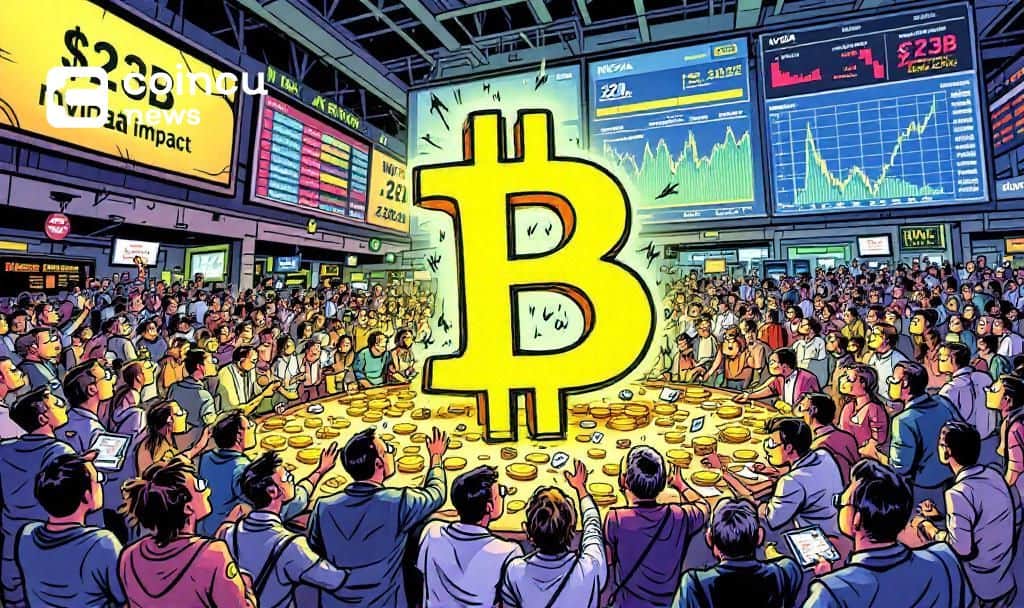
The post Nvidia’s Financial Anomaly Sparks Crypto Market Turmoil appeared on BitcoinEthereumNews.com. Key Points: Nvidia’s financial data anomaly affects technology and crypto markets. Institutional investors show caution amid financial shifts. Potential $23 billion Bitcoin liquidation risk due to market instability. On November 21, financial researcher Shanaka Anslem Perera revealed anomalies in Nvidia’s financial data, raising concerns about potential repercussions for tech stocks and cryptocurrencies. This raises questions about Nvidia’s valuation, indicating possible market volatility and potential cryptocurrency market effects if tech equities adjust. Nvidia’s Financial Irregularities Prompt Market Reactions Independent researcher Shanaka Anslem Perera reported a severe discrepancy in Nvidia’s financial data, including an 89% increase in accounts receivable and a 75% cash conversion rate, which falls short of industry standards. Nvidia’s alleged revenue inflations through circular funding loops with xAI, OpenAI, Microsoft, and Oracle were highlighted. Market uncertainty has prompted significant institutional sell-offs, including actions by Peter Thiel and SoftBank, with Michael Burry acquiring put options, all reflecting caution. The projected impact if Nvidia’s stock drops further could lead to a $23 billion Bitcoin liquidation, causing severe crypto market disturbances. “AI hype cycles always end with volatility crossing over into crypto. Watch for forced liquidations if big tech cracks.” – Arthur Hayes, Co-founder, BitMEX Bitcoin Faces Potential $23 Billion Liquidation Amid Instability Did you know? Nvidia’s cash conversion rate of 75% highlights a financial anomaly not seen since the tech industry’s rapid growth phases in the 2000s, when similar patterns triggered significant market collapses. Bitcoin’s price stands at $85,980.45, with a market cap of $1.72 trillion and dominance of 58.30%, according to CoinMarketCap. It has seen a 7.19% decline over 24 hours, 11.65% over seven days, and a 20.52% drop over 30 days, reflecting market volatility. The 24-hour trading volume has increased by 22.19%. Bitcoin(BTC), daily chart, screenshot on CoinMarketCap at 05:48 UTC on November 21, 2025. Source: CoinMarketCap The Coincu…

Author: BitcoinEthereumNews