Launchpad

Launchpads are decentralized platforms that facilitate early-stage fundraising for new Web3 projects through Initial DEX Offerings (IDOs). They provide investors with curated access to token sales while offering startups a community-driven capital injection. In 2026, launchpads have evolved into full-stack incubators, focusing on project quality and long-term sustainability. Follow this tag for the latest in token distribution models, tier-based participation, and the emergence of the next generation of "unicorn" protocols across various blockchain ecosystems.

2929 Articles
Created: 2026/02/02 18:52
Updated: 2026/02/02 18:52
Even If Shiba Inu Achieved Cardano’s Market Cap and Entered Top 10, It Still Wouldn’t Hit $0.0001, Best Meme Coin to Buy Instead

Even If Shiba Inu Achieved Cardano’s Market Cap and Entered Top 10, It Still Wouldn’t Hit $0.0001, Best Meme Coin to Buy Instead

Even if Shiba Inu ($SHIB) mirrored Cardano’s ($ADA) market cap, reaching $29.85 billion, the token would still trade far below $0.0001. Calculations suggest $SHIB would only climb to $0.00005065, reflecting a mere 4.15x increase from its current $0.00001222.  Meanwhile, Cardano’s ATH at $3.08377 highlights how substantial market cap alone cannot drive meme coin price explosions. [...]]]>

Author: Crypto News Flash
Altcoins Face Billions in Unlocks Just as Q4 Rally Season Begins

Altcoins Face Billions in Unlocks Just as Q4 Rally Season Begins

Instead of focusing on just one project, the spotlight is spread across several major names. Aster is set for the […] The post Altcoins Face Billions in Unlocks Just as Q4 Rally Season Begins appeared first on Coindoo.

Author: Coindoo
Why Do You Always Lose the Meme Coin Trade? Galaxy Reveals

Why Do You Always Lose the Meme Coin Trade? Galaxy Reveals

The post Why Do You Always Lose the Meme Coin Trade? Galaxy Reveals appeared on BitcoinEthereumNews.com. A new Galaxy Research report finds that the primary beneficiaries of the meme coins are not the traders, but the infrastructure providers.  Platforms such as launchpads, decentralized exchanges (DEXs), and automated trading bots capture substantial revenues. Meanwhile, the majority of individual participants incur losses in what is called a zero-sum game with negative expected value (EV). The Meme Coin Paradox: Mass Participation, Concentrated Profits  Sponsored Sponsored Meme coins, often described as tokens created around internet jokes or cultural trends with no utility, have been around for over a decade. Notably, the surge in popularity and ease of creation has sparked a full-scale boom. Millions of new tokens have flooded the market in the past few years. Traders are frequently drawn to this space by the promise of quick profits. Nonetheless, Galaxy Digital noted that,  “Trading them is less about fundamentals and more about what can be described as ‘cultural arbitrage’: predicting or front-running attention cycles, e.g., buying the token for a viral TikTok trend before the market recognizes it is viral. In the long run, the vast majority of market participants end up losing money trading meme coins, and in many respects, it’s just plain gambling.” In the latest report, Galaxy Digital’s research analyst Will Owens explained that the meme coin ecosystem functions as a stack. Here, the flow of money is mostly concentrated in the infrastructure that supports creation and trading. Meme Coin Ecosystem Structure. Source: Galaxy Digital At the base level, blockchains like Solana dominate. It hosts over 32 million tokens, a more than 300% increase since early 2024. The blockchain accounts for 56% of the 57 million meme coins across major chains, including Ethereum, Base, and BNB Chain.  “Base and BSC also host significant activity, while Ethereum hosts bigger tokens and a less cutthroat culture,” the report…

Author: BitcoinEthereumNews
Who Really Profits From Meme Coins? Galaxy Says It’s Not the Traders

Who Really Profits From Meme Coins? Galaxy Says It’s Not the Traders

A new Galaxy Research report finds that the primary beneficiaries of the meme coins are not the traders, but the infrastructure providers.  Platforms such as launchpads, decentralized exchanges (DEXs), and automated trading bots capture substantial revenues. Meanwhile, the majority of individual participants incur losses in what is called a zero-sum game with negative expected value (EV). The Meme Coin Paradox: Mass Participation, Concentrated Profits  Meme coins, often described as tokens created around internet jokes or cultural trends with no utility, have been around for over a decade. Notably, the surge in popularity and ease of creation has sparked a full-scale boom. Millions of new tokens have flooded the market in the past few years. Traders are frequently drawn to this space by the promise of quick profits. Nonetheless, Galaxy Digital noted that,  “Trading them is less about fundamentals and more about what can be described as ‘cultural arbitrage’: predicting or front-running attention cycles, e.g., buying the token for a viral TikTok trend before the market recognizes it is viral. In the long run, the vast majority of market participants end up losing money trading meme coins, and in many respects, it’s just plain gambling.” In the latest report, Galaxy Digital’s research analyst Will Owens explained that the meme coin ecosystem functions as a stack. Here, the flow of money is mostly concentrated in the infrastructure that supports creation and trading. Meme Coin Ecosystem Structure. Source: Galaxy Digital At the base level, blockchains like Solana dominate. It hosts over 32 million tokens, a more than 300% increase since early 2024. The blockchain accounts for 56% of the 57 million meme coins across major chains, including Ethereum, Base, and BNB Chain.  “Base and BSC also host significant activity, while Ethereum hosts bigger tokens and a less cutthroat culture,” the report reads. Solana’s low fees and high throughput have made it the preferred venue, with meme coins accounting for approximately 20- 30% of its DEX trading volume, down from 60% in January. Next, launchpads form a critical layer, enabling rapid token deployment. Solana’s Pump.fun, which debuted in early 2024, exemplifies this trend by industrializing the process through bonding curves that guarantee liquidity at minimal cost.  The platform has created about 12.9 million tokens, which make up 40.31% of the total 32 million Solana tokens. Tokens launched on Pump.fun boast an aggregated fully diluted market cap (FDMC) exceeding $4.8 billion, though this peaked above $10 billion earlier in the year.  “The power-law distribution of value among Pump.fun tokens is astonishing. Out of nearly 12.9 million tokens launched on the platform, just 12 account for more than half of all fully diluted market cap (FDMC). Those dozen tokens collectively represent $2.69 billion, or 56% of the total $4.8 billion FDMC, while the other 44% is split among the remaining millions of tokens,” Owens noted. Furthermore, Pump.fun has generated significant fees from creation and trading. In summer 2024, it briefly lost ground to competitors like LetsBonk. Nonetheless, the launchpad reclaimed dominance through innovations such as Project Ascend, which introduces dynamic fee models for creators, and integrations with streamers for interactive launches. Meanwhile, DEX aggregators and automated market makers (AMMs) like Jupiter, Raydium, Orca, and Pump.fun’s in-house PumpSwap further extract value by handling immediate post-launch trading. These platforms benefit from high volumes, with meme coins fueling user acquisition and ecosystem growth. Trading bots, including Axiom, BONKbot, and Trojan, enhance this by enabling sniping—purchasing tokens at inception—and rapid execution, contributing to a hyper-competitive, player-versus-player (PvP) environment.  “Axiom, for example, has broken $200 million in cumulative revenue with a team of less than 10 individuals,” the report highlighted. Lastly, token deployers, insiders, and key opinion leaders (KOLs) also reap rewards. Developers and insiders often retain large supply portions in hidden wallets, dumping into retail liquidity for gains. KOLs on platforms like X amplify narratives through coordinated campaigns. “X (formerly Twitter) communities and Telegram groups amplify memes and coordinate shilling campaigns. Communities are incentivized to push their token higher, with collective belief substituting for fundamentals. KOLs are a huge part of this layer,” the analyst wrote. Key Crypto KOLs on X. Source: Galaxy Digital Are Retail Traders the Biggest Losers in the Meme Coin Boom?  In contrast, most traders face structural disadvantages. The report revealed that the median hold time for Solana meme coins is around 100 seconds. This is quite a drop from 300 seconds a year prior. “This means that the average participant isn’t ‘holding’ a token for hours, let alone days. Instead, they’re rotating rapidly, scalping a few percent profit against other traders in what is essentially a PvP trading game,” Owens detailed. Risks abound, including honeypots—tokens that allow buys but block sells—rug pulls, where insiders withdraw liquidity, and vamping, where copycats siphon value from originals. High-profile incidents, such as the LIBRA token incident, have resulted in millions in trader losses while insiders profited.  This ecosystem paradox highlights a broader trend: while meme coins serve as onramps to cryptocurrency, drawing new users into wallets and DEXs, the speculative frenzy primarily enriches a concentrated group of infrastructure owners.  For most participants, trading remains negative EV. Thus, meme coins may look like a casino, but it’s the house — not the players — that always wins.

Author: Coinstats
The Hidden Winners of the Memecoin Boom: Platforms, Not Traders

The Hidden Winners of the Memecoin Boom: Platforms, Not Traders

The post The Hidden Winners of the Memecoin Boom: Platforms, Not Traders appeared on BitcoinEthereumNews.com. Altcoins The wild world of memecoins may look like a gold rush for retail investors, but new research shows the bigger payday is happening elsewhere. According to Galaxy Research, the platforms that launch, trade, and automate these tokens are quietly raking in hundreds of millions while most speculators end up holding losses. Instead of being driven by long-term communities or utility, the memecoin trade has become dominated by bots and scalpers. On Solana, where activity is most intense, the average lifespan of a trade has shrunk to under two minutes – a clear signal that automation, not human conviction, is steering the market. One striking beneficiary is Axiom, a lean trading service with fewer than ten staff that has already collected more than $200 million in fees. Other players like BONKbot and Trojan are profiting by charging users for sniping capabilities that can grab tokens the instant they go live. At the center of this ecosystem sits Pump.fun, the Solana-based launchpad that has industrialized token creation. Nearly 13 million of Solana’s 32 million tokens now trace back to Pump.fun, and the combined value of its projects has ballooned to almost $5 billion. In September, it handled over a billion dollars in trading in just a single day. The platform has even launched its own coin, PUMP, which raised $500 million in minutes during its July sale. Revenue figures are equally dramatic – DefiLlama data shows around $120 million in fees in the past month alone. Galaxy’s report suggests that while memecoins remain culturally explosive and capable of drawing waves of new users into crypto, the sustainable business is being built around the infrastructure. In other words, the casinos are cashing in far more reliably than the gamblers. The information provided in this article is for educational purposes only and does…

Author: BitcoinEthereumNews
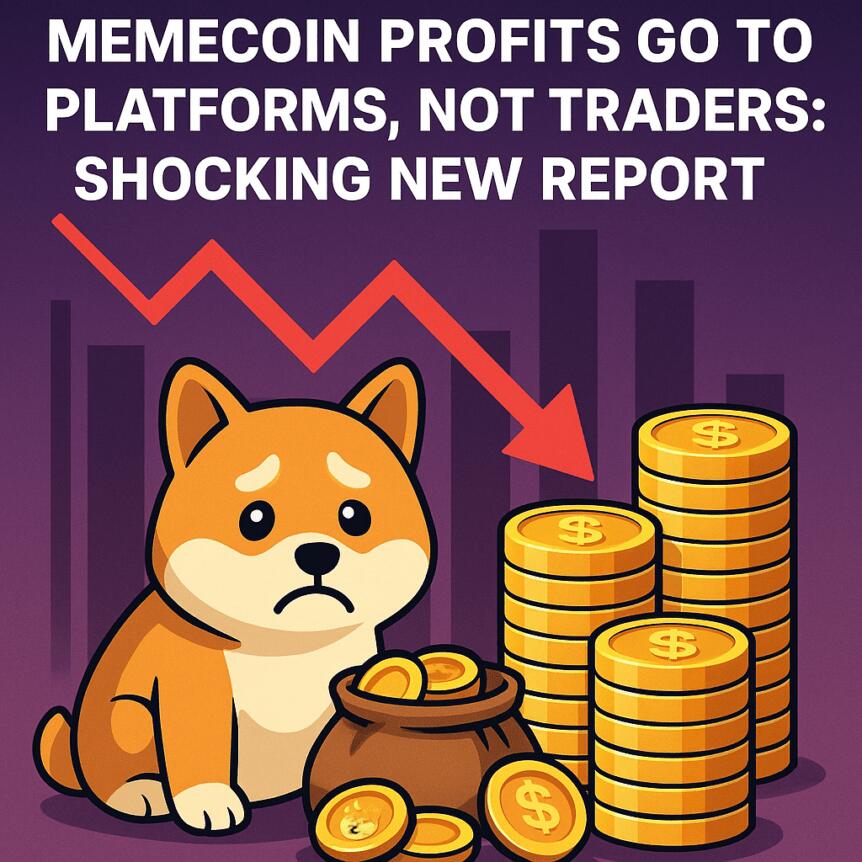
Memecoin Profits Go to Platforms, Not Traders: Shocking New Report

Memecoin Profits Go to Platforms, Not Traders: Shocking New Report

Recent research highlights the lucrative side of the memecoin frenzy within the cryptocurrency ecosystem. While traders often face losses in the highly speculative market, blockchain infrastructure providers—such as launchpads, exchanges, and trading bots—are raking in significant revenues. Platforms like Pump.fun exemplify how memecoins, despite limited utility, continue to dominate trading volumes and generate substantial profits [...]

Author: Crypto Breaking News
Memecoins attract users, but platforms reap the profits: Report

Memecoins attract users, but platforms reap the profits: Report

                                                                               Galaxy Research’s latest report finds that memecoins draw new users into crypto, but the spoils go to enrich launchpads, exchanges and bots rather than traders themselves.                     Memecoins may attract new users to blockchains, but the profits largely flow to the platforms that launch and trade the tokens, according to a new report from Galaxy Research.The study released on Wednesday shows that while most traders lose money in a short-term gambling market, infrastructure providers such as launchpads, decentralized exchanges and trading bots capture millions in revenue by facilitating memecoin trading.Solana’s Pump.fun, a memecoin launchpad that debuted in early 2024, has been a major beneficiary, with tokens on the platform representing a combined $4.8 billion in fully diluted market value, as per the report. Read more

Author: Coinstats
The Search for the Next Solana (SOL)

The Search for the Next Solana (SOL)

The post The Search for the Next Solana (SOL) appeared on BitcoinEthereumNews.com. SPONSORED POST* Little Pepe (LILPEPE) is fast becoming one of the most talked-about crypto projects of 2025. With many investors searching for the next Solana (SOL), the token is capturing strong attention. Unlike most meme coins that rely solely on branding, Little Pepe is building real infrastructure. The project is developing an Ethereum Layer-2 blockchain dedicated entirely to meme tokens. LILPEPE Tackles Key Issues in the Meme Coin Market Little Pepe (LILPEPE) is not just another meme coin—it is a full-fledged Ethereum-compatible Layer 2 network designed to fix the problems that hold back most meme tokens. The blockchain guarantees quicker transactions, ultra-low fees, and built-in anti-sniper protection, creating a fair environment for retail traders who usually struggle against automated systems.  On top of that, Little Pepe offers zero-tax trading, staking rewards, and DAO governance, ensuring long-term value and community-driven decisions. Its ecosystem also features a meme launchpad for new tokens and an NFT marketplace for digital collectibles, extending its use beyond speculation. By blending real blockchain tools with meme culture, Little Pepe is carving out a unique niche in an oversaturated altcoin market—appealing both to internet culture enthusiasts and everyday investors. LILPEPE Presale Nears $26M Raised at $0.0022 The LILPEPE presale is progressing rapidly, showing significant market confidence. Currently in Stage 13, each token is priced at $0.0022, with the next stage set at $0.0023. The project has already raised more than $26.22 million out of a target of $28.7 million. Over 16.08 billion tokens have been sold, pushing presale Stage 13 completion to 93.21%. These figures place Little Pepe among the most successful token launches of the year. Many traders now view it as a strong candidate for the next breakout altcoin. LILPEPE Boosts Trust With Giveaways and Security Community support is central to the project’s strategy. A major…

Author: BitcoinEthereumNews
Can the memecoin hit $1?

Can the memecoin hit $1?

The post Can the memecoin hit $1? appeared on BitcoinEthereumNews.com. Disclosure: This article does not represent investment advice. The content and materials featured on this page are for educational purposes only. Little Pepe emerges as a Layer-2 memecoin challenger to DOGE, SHIB, and PEPE ahead of the bull run. Summary Little Pepe is building its own Layer-2 for speed, fairness, and growth. With 93.5% of presale sold, LILPEPE nears $28.7m raised as investors eye its $0.10 bull-run target. Zero-tax tokenomics, a meme-driven community, and upcoming CEX listings fuel LILPEPE’s breakout potential. The memecoin market has entered a new golden era, and at the forefront of this movement is Little Pepe (LILPEPE). It’s a Layer-2 blockchain engineered for speed, ultra-low fees, and meme-fueled innovation.  As the broader crypto market gears up for the next bull run in 2025–2026, investors are closely watching how LILPEPE positions itself among giants like Dogecoin, Shiba Inu, and Pepe. With its combination of cutting-edge technology, strong tokenomics, and cultural branding, Little Pepe is increasingly viewed as a potential breakout project for the upcoming cycle. A meme-powered layer-2 built for the future Unlike most memecoins, which exist solely as speculative assets, Little Pepe is launching its own Layer-2 blockchain dedicated entirely to memecoins.  This chain is built to be the fastest and cheapest option on the market, with a unique mechanism to prevent sniper bots, giving retail investors a fairer trading experience At the heart of the ecosystem lies the LILPEPE token, which powers all network activity, from transactions to launchpad participation. Zero taxes on buys and sells ensure a clean and efficient system, staying true to DeFi’s core principle of financial freedom. Tokenomics: Designed for growth and Community Token distribution is carefully structured to balance liquidity, community engagement, and long-term sustainability: 26.5% Presale: Rewarding Early Believers. 30% Chain Reserves: supporting the Layer-2 infrastructure. 10% Liquidity: ensuring…

Author: BitcoinEthereumNews
How Base memecoins are reshaping web3 culture on Coinbase’s L2 in 2025

How Base memecoins are reshaping web3 culture on Coinbase’s L2 in 2025

Based Eggman rises on Coinbase’s Base, signaling memecoins’ shift to cultural web3 experiments. Memecoins have long been more than just internet jokes; they represent the cultural side of finance where communities, humor, and speculation merge.  In 2025, Coinbase’s Layer 2…

Author: Crypto.news