Index

A crypto Index provides a way for investors to gain diversified exposure to a specific basket of digital assets through a single tokenized product. These indices often track specific sectors, such as DeFi, DePIN, or RWA, and are automatically rebalanced via smart contracts. In 2026, AI-managed thematic indices have become the gold standard for passive investing, allowing users to track the "blue chips" of the Web3 economy without manual portfolio management. This tag covers index methodology, rebalancing frequency, and the benefits of diversified crypto baskets.

25777 Articles
Created: 2026/02/02 18:52
Updated: 2026/02/02 18:52
Exploring CratD2C layer-1 blockchain with Founder and CEO Dr. Sammy Arogundade

Exploring CratD2C layer-1 blockchain with Founder and CEO Dr. Sammy Arogundade

CratD2C is a next-generation Layer-1 blockchain connecting businesses and consumers through real-world utility. Founded by Dr. Sammy Arogundade, the project combines speed, security, and sustainability with applications spanning e-commerce, real estate, DeFi, and more.  In this interview, Dr. Sammy shares the journey behind CratD2C, the launch of $CRAT coin, and how the project will shape […]

Author: Cryptopolitan
Mercedes and BMW bring top European sellers into EV era to crush Tesla and BYD

Mercedes and BMW bring top European sellers into EV era to crush Tesla and BYD

The post Mercedes and BMW bring top European sellers into EV era to crush Tesla and BYD appeared on BitcoinEthereumNews.com. BMW and Mercedes are done watching Tesla and BYD play kings. The two biggest luxury brands from Europe have just thrown down the gauntlet with all-electric SUVs meant to take back the market. After Tesla’s Model Y exploded into the scene and crushed every legacy automaker’s pride, the Germans are now swinging back, with range, software, and billions in development cash, according to The Wall Street Journal. As Cryptopolitan previously reported, BMW showed off its new iX3 at a splashy event, with CEO Oliver Zipse calling it a “once-in-a-lifetime moment.” Two days later, Mercedes revealed the electric GLC inside a damn royal palace in Munich, because why not? Both launches were timed just before Europe’s biggest auto event, IAA Mobility. These SUVs are built to push out Tesla, shut down BYD’s quiet takeover, and rewire how buyers think about tech, design, and status in the EV era. Mercedes roll out high-range tech-heavy SUVs The GLC from Mercedes hits 457 miles. Both easily beat the long-range Tesla Model Y, which only gets 387 miles. That alone will pull attention fast, especially with EV buyers increasingly worried about range in the real world. These cars are packed with chips, AI, and digital assistants. BMW teamed up with Qualcomm. Mercedes worked with Nvidia, plus Google and OpenAI. That combo lets the new GLC do stuff like open windows, find restaurants, and chat back using ChatGPT. Tesla’s lead came from doing everything in-house. BMW and Mercedes, meanwhile, leaned on Silicon Valley to leap forward. It’s a different route to the same goal: smart, fast, digital cars. And it’s not just for EVs. This tech will eventually go into gas and diesel models too. The two German SUVs aren’t cheap. BMW’s iX3 will sell for around $80,000 in Germany. The Model Y sits closer to…

Author: BitcoinEthereumNews
JUST IN! Major Bull Michael Saylor Makes His Long-Anticipated Bitcoin (BTC) Announcement! Here Are the Details…

JUST IN! Major Bull Michael Saylor Makes His Long-Anticipated Bitcoin (BTC) Announcement! Here Are the Details…

The post JUST IN! Major Bull Michael Saylor Makes His Long-Anticipated Bitcoin (BTC) Announcement! Here Are the Details… appeared on BitcoinEthereumNews.com. Continuing its weekly purchases, MicroStrategy (Strategy) made its weekly Bitcoin (BTC) purchase and announced that it purchased 1,955 BTC last week. Accordingly, MicroStrategy purchased 1,955 BTC worth $217.4 million at an average price of $111,196. Strategy founder Michael Saylor announced the news via a post on his X account. “Strategy purchased 1,955 BTC for approximately $217.4 million, at approximately $111,196 per Bitcoin, generating a 25.8% BTC Return in 2025 YTD. As of 07/09/2025, we hold 638,460 BTC purchased for approximately $47.17 billion at approximately $73,880 per Bitcoin.” *This is not investment advice. Follow our Telegram and Twitter account now for exclusive news, analytics and on-chain data! Source: https://en.bitcoinsistemi.com/just-in-major-bull-michael-saylor-makes-his-long-anticipated-bitcoin-btc-announcement-here-are-the-details/

Author: BitcoinEthereumNews
Strategy Inc. (MSTR): Adds 1,955 BTC for $217M, Lifting Holdings to 638,460 BTC

Strategy Inc. (MSTR): Adds 1,955 BTC for $217M, Lifting Holdings to 638,460 BTC

TLDR Strategy boosts Bitcoin stash to 638,460 BTC after $217M equity-funded buy. Strategy adds $217M in Bitcoin, raising total holdings to 638,460 BTC. Bitcoin giant: Strategy nears 640K BTC with $217M equity-fueled purchase. Strategy scoops 1,955 BTC for $217M, pushing total haul past 638,000 BTC. Equity to crypto: Strategy grows Bitcoin stash to 638,460 BTC [...] The post Strategy Inc. (MSTR): Adds 1,955 BTC for $217M, Lifting Holdings to 638,460 BTC appeared first on CoinCentral.

Author: Coincentral
Crypto Markets Enter Their Most Crucial Macro Week In 2025 Yet

Crypto Markets Enter Their Most Crucial Macro Week In 2025 Yet

Crypto markets head into what could be a regime-setting macro week as “this week could reshape everything for the Fed and markets,” warned the @_Investinq account in a weekend thread that laid out a dense sequence of US macro catalysts landing between Tuesday and Friday. While the posts weren’t about crypto per se, the chain of events they describe—labor‐market revisions, wholesale and consumer inflation, jobless claims, energy inventories, and consumer expectations—map almost one-for-one onto the key drivers of the US dollar and Treasury yields. Those, in turn, are the two macro levers that most reliably move digital assets, with bitcoin historically trading inversely to both the dollar and real yields. Crypto Volatility Alert: Fed’s Make-Or-Break Data Week Is Here The week opens with an unusually consequential Tuesday: at 10:00 a.m. ET on September 9, the US Bureau of Labor Statistics will publish its preliminary benchmark revision to March 2025 payrolls alongside the QCEW. This is the annual “fact check” of the establishment survey that anchors jobs data to unemployment-insurance tax records covering more than 95% of payroll jobs. BLS has already flagged the timing; outside research shops have spent weeks priming markets for a significant down-adjustment. Goldman Sachs estimates a reduction on the order of 550,000 to 950,000 jobs for the twelve months through March 2025—potentially the largest 12-month markdown since 2010—an expectation echoed across several market digests and news outlets. Related Reading: Crypto Bull Run: Probability Of Fed Rate Cuts In September Almost At 100% The context matters: last year’s preliminary benchmark for March 2024 carved 818,000 jobs off previously reported totals, the biggest hit since the Great Financial Crisis, and it drove a reassessment of labor momentum into the fall. @_Investinq framed it this way: “Think of it as a yearly ‘fact check’ on job growth.” For crypto, a sizable downward revision would validate the “growth-is-slowing” narrative now feeding rate-cut bets into the September FOMC, a backdrop that has historically coincided with softer USD and more supportive cross-asset liquidity. Wednesday morning brings the wholesale inflation check. July’s Producer Price Index re-accelerated to +0.9% m/m and +3.3% y/y, with “final demand” goods up 0.7% and services up 1.1%; the BLS singled out a near 39% jump in fresh and dry vegetable prices and noted that financial services, lodging, and airfares contributed to the services surge. Under the hoods, “core PPI” ex-food and energy rose 0.9% m/m and 3.7% y/y, while the broader trimmed core (excluding food, energy and trade services) advanced 0.6% m/m and 2.8% y/y. @_Investinq cautioned: “Both goods and services are running hot, making it harder for the Fed to dismiss inflation.” Another firm print for August PPI would stiffen the dollar, push up yields, and typically pressure rate-sensitive risk assets—including high-beta crypto. Conversely, a cool-down would ease those headwinds. The August PPI is due Wednesday, Sept. 10 at 8:30 a.m. ET. Energy is the second macro input mid-week. The EIA Weekly Petroleum Status Report hits Wednesday at 10:30 a.m. ET. Draws in crude stocks tend to push oil higher at the margin; higher energy costs feed directly into headline inflation and indirectly into core via transport and production costs. That’s not a crypto-specific datapoint, but it shapes inflation expectations and, by extension, real-yield dynamics that crypto trades against. All Eyes On The CPI The main event is Thursday’s Consumer Price Index, the last inflation read before the Fed’s September 16–17 meeting. In July, headline CPI rose +0.2% m/m and +2.7% y/y, while core CPI ticked up to 3.1% y/y from 2.9%, with sticky categories including shelter, healthcare, recreation, and auto insurance offsetting cheaper energy. “This CPI is the final inflation report before the September Fed meeting,” @_Investinq reminded followers. The August CPI lands Thursday, Sept. 11 at 8:30 a.m. ET. A softer-than-expected print would strengthen the case for a larger policy move, while a surprise re-acceleration—particularly in services—could cap a dovish reaction even if the Fed still cuts. For digital assets, the sign of the surprise matters: cool CPI tends to mean a weaker dollar and flatter real yields, both historically constructive for Bitcoin and the entire crypto market; hot CPI often does the opposite and usually hits altcoins hardest. Also Thursday at 8:30 a.m. ET, weekly jobless claims arrive—a high-frequency pulse on labor slack. “Low claims = strong labor = hawkish Fed. Rising claims = cracks in labor = dovish tilt,” as the @_Investinq thread put it. Markets increasingly treat this series as a tie-breaker when inflation is ambiguous. Officially, the Labor Department’s unemployment-insurance release hits every Thursday morning at 8:30. Friday closes with the University of Michigan preliminary September sentiment and inflation expectations at 10:00 a.m. ET. August sentiment fell to 58.2 (final) from 61.7, while 1-year inflation expectations rose to 4.8%, up from 4.5% in July—what the @_Investinq thread labeled a “toxic combo” of weaker mood and firmer expectations. Related Reading: Spot Crypto Trading Gets Major Green Light From US Regulators The Fed watches expectations closely because they tend to shape wage/price behavior; for crypto, higher expected inflation can be a double-edged sword: if it lifts yields and the dollar it’s a near-term drag, but in more extreme risk-off episodes it has also coincided with flows into “anti-debasement” narratives around BTC and gold. FOMC Looms Over Crypto All of this lands in a Fed blackout window ahead of the September decision. The FOMC calendar confirms a September 16–17 meeting, and after Friday’s soft jobs report (nonfarm payrolls +22,000, unemployment 4.3%), several banks moved to price in a cut, with some houses openly debating 25 vs 50 basis points depending on the CPI/PPI path this week. That debate is exactly why “a small decimal swing here could shift trillions,” as @_Investinq put it. From a crypto-specific lens, the distinction matters: a standard 25 bps cut with benign inflation likely weakens the dollar modestly and supports Bitcoin and crypto on the margin; a surprise-large 50 bps cut on the heels of large jobs revisions would underscore growth risk and could flatten the entire curve. The immediate setup therefore looks binary for crypto assets. If Tuesday’s benchmark revision is large and Thursday’s CPI cools, the “USD down / yields down” impulse that crypto likes could reassert into the FOMC, potentially reinforcing a swing back to net inflows into crypto asset funds after episodic outflows in late August. If, however, PPI and CPI print hot, expect the dollar bid to harden, real yields to back up, and the pressure to fall disproportionately on high-beta altcoins while bitcoin’s relative strength—and spot ETF demand—acts as a cushion. As @_Investinq summarized, “This week isn’t just data, it’s the Fed’s last look before September… and markets will trade every decimal.” For crypto, that translation is straightforward: every tenth of a percentage point in PPI/CPI and every hundred thousand jobs in the benchmark revision will be read through the dollar–yields prism and priced first into BTC liquidity, then into altcoin beta. The calendar is set; the pivots will be macro. At press time, the total crypto market cap stood at $3.82 trillion. Featured image created with DALL.E, chart from TradingView.com

Author: NewsBTC
All eyes on CPI and PPI as Fed’s final inflation check comes in a globally-packed week

All eyes on CPI and PPI as Fed’s final inflation check comes in a globally-packed week

The post All eyes on CPI and PPI as Fed’s final inflation check comes in a globally-packed week appeared on BitcoinEthereumNews.com. Every trader is locked in right now, and every desk is watching. The final inflation prints before the Fed’s September meeting are coming, and they’re coming in hot. This week is loaded. We got six big U.S. releases, political drama in Europe, and an ECB rate decision all packed into five trading days, so the whole world is trying to price risk right now. The main events start Tuesday with a 12-month revision of BLS jobs data, a key reset that may change how the labor market has been viewed. Then comes the August Producer Price Index on Wednesday, which will show if supply-side pressures are building again. But the most critical data hit on Thursday, when the August Consumer Price Index drops alongside the OPEC monthly report. And to end the week, we’re going to get the University of Michigan’s Consumer Sentiment and Inflation Expectations surveys on Friday, the final pieces of the puzzle before the Fed’s rate decision. Fed watches inflation prints as traders prepare for a rate cut The Fed is stuck in a strange spot. Inflation is still above 2%, but the economy is bleeding out slowly. August payrolls missed big, coming in over 33% below expectations. Unemployment jumped from 4.2% to 4.3%. But that wasn’t due to layoffs. The labor force got bigger; 436,000 people entered the job market. So technically, more Americans are looking for jobs, not losing them. The market saw that and immediately started betting on a rate cut. As of late Sunday, the CME FedWatch tool shows an 8% chance of a 50bps cut, something that had a 0% chance just one month ago. A 25bps cut is now priced in as nearly guaranteed. This is where CPI and PPI become make-or-break. If both show progress, if prices are slowing, then…

Author: BitcoinEthereumNews
Strategy Adds More Bitcoin Amid S&P 500 Snub; MSTR Stock Falls

Strategy Adds More Bitcoin Amid S&P 500 Snub; MSTR Stock Falls

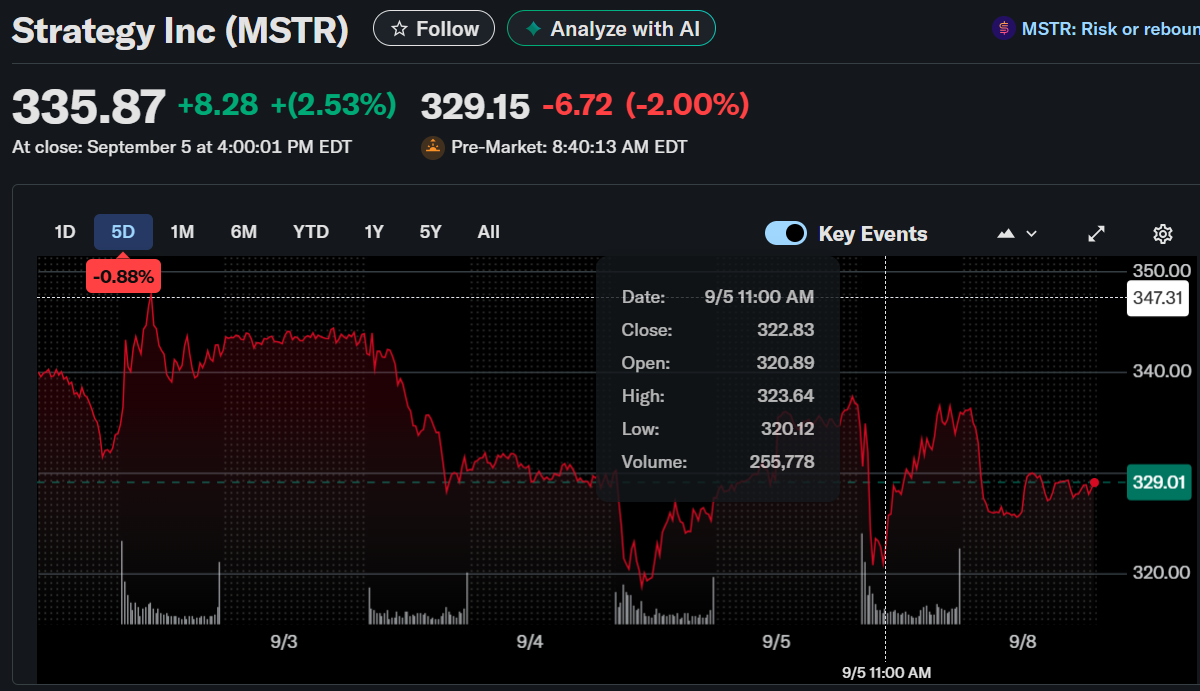
The post Strategy Adds More Bitcoin Amid S&P 500 Snub; MSTR Stock Falls appeared on BitcoinEthereumNews.com. Strategy, previously MicroStrategy, has announced another weekly Bitcoin purchase despite failing to make the S&P 500 last week. This comes as the Bitcoin price rebounds, breaking above $112,00 today, although the MSTR stock is still down in premarket trading. Strategy Acquires 1,955 BTC For $217 Million In a press release, the company announced that it had acquired 1,955 BTC for $217.4 million last week at an average price of $111,196 per Bitcoin. It has also achieved a BTC yield of 25.8% year-to-date (YTD) and now holds 638,460 BTC, which it acquired for $41.17 billion at an average price of $73,880 per Bitcoin. The SEC filing shows that Strategy again mainly sold MSTR shares to fund this purchase. The company raised $200.5 million from the sale of 591,606 MSTR shares and an additional $11.6 million and $5.2 million from the sale of STRF and STRK shares. Source: Strategy’s SEC Filing Notably, this latest purchase comes amid the company’s failure to make the S&P 500 last week. It had met all the criteria for a potential inclusion in the stock index. However, the Committee picked Robinhood, AppLovin, and Emcor over Michael Saylor’s company. Meanwhile, Saylor had hinted about the purchase yesterday in his conventional X post. He shared a picture of Strategy’s Bitcoin portfolio tracker, with the caption, “Needs More Orange,” which indicated a new purchase. Needs More Orange pic.twitter.com/yvgqvmKtOb — Michael Saylor (@saylor) September 7, 2025 This marks the company’s sixth consecutive weekly Bitcoin purchase. Last week, it announced a purchase of 4,048 BTC for $444 million. It is worth noting that Strategy now holds over 3% of BTC’s total supply with these latest purchases. MSTR Stock Down Over 2% The Strategy stock is down over 2% in premarket trading amid the announcement of this latest Bitcoin purchase. TradingView data shows…

Author: BitcoinEthereumNews
Luxury rivals BMW and Mercedes target Tesla and BYD with new electric SUVs

Luxury rivals BMW and Mercedes target Tesla and BYD with new electric SUVs

BMW and Mercedes are done watching Tesla and BYD play kings. The two biggest luxury brands from Europe have just thrown down the gauntlet with all-electric SUVs meant to take back the market. After Tesla’s Model Y exploded into the scene and crushed every legacy automaker’s pride, the Germans are now swinging back, with range, […]

Author: Cryptopolitan
Strategy founder: Confident that MSTR will be included in the S&P 500 index

Strategy founder: Confident that MSTR will be included in the S&P 500 index

PANews reported on September 8 that according to CNBC, Strategy founder Michael Saylor said: "I am confident that MSTR will be included in the S&P 500 index. The market is undergoing digital transformation. This is a brand new concept. MSTR has new supporters every quarter. We have received more support from banks, politicians and credit rating agencies."

Author: PANews
Crypto Market Weekly Review (September 1-7): US employment data supports a resumption of interest rate cuts in September, while new SEC regulations cool down treasury companies.

Crypto Market Weekly Review (September 1-7): US employment data supports a resumption of interest rate cuts in September, while new SEC regulations cool down treasury companies.

Author: 0xBrooker BTC daily trend BTC opened at $108,247.95 this week and closed at $113,478.00, with a low of $111,129.61 and a high of $113,390.00, a decrease of 3.41% and an increase of 2.66%. The trading volume shrank compared with last week. From a medium-term perspective, BTC remains mired in market turmoil, fueled by the "revision of interest rate cuts" and the "Federal Reserve independence debate." From a short-term perspective, BTC prices have fluctuated over the past week, driven by employment data and changes in industrial policy. The overall employment data is in line with the expectation of a "mild cold snap", which pushes the probability of a rate cut in September to around 90%. The expectation of three rate cuts this year has rebounded, but is still very low. The SEC said it will strengthen supervision of crypto treasury companies' issuance of additional shares to acquire cryptocurrencies. This has suppressed the financing activities of treasury companies, the current largest source of purchasing power in the market, and is also one of the reasons for the market's decline. EMC Labs maintains a cautiously optimistic attitude in the medium term. The rebalancing of market forces before and after the interest rate cut is bound to be bumpy, but the overall US economy is safe, and the restart of the interest rate cut cycle will support the upward pricing of risky assets, which is still certain. Policy, macro-financial and economic data On September 4, the JOLTS job vacancy data was first released. The announced value of 8.4 million was lower than the expected 8.7 million and the previous value of 8.9 million, and it fell to a three-year low, further confirming that labor demand is cooling. On September 5th, the weekly initial jobless claims data came in at 232,000, slightly exceeding market expectations of 230,000. Continuing claims were also slightly higher at 1.751 million, also slightly exceeding market expectations of 1.740 million. Both figures suggest a slowing labor market. On September 6th, non-farm payroll data showed that 173,000 new jobs were added in August, below market expectations of 180,000 and the previous reading of 190,000. The unemployment rate also rose from 4.0% to 4.1%, reaching its highest point since 2021, indicating a significant cooling in the labor market. The mild cooling of the employment data suggests that the economy and employment are cooling, which has reaffirmed market expectations of a September rate cut. FedWatch shows a near 90% probability of a September rate cut, with a small probability of a 75 basis point cut. This is a slight revision to last week's expectations. This correction led to a rebound in US stocks after two consecutive weeks of decline. The Nasdaq rose 1.14% and the S&P 500 rose 0.33%, with all three major indexes hitting record highs. Yields on both long- and short-term US Treasury bonds continued to decline, falling by 2.3% and 2.03%, respectively. There's no risk of an interest rate cut, and the magnitude and frequency of these cuts remain priced in. The US dollar index, while fluctuating, fell 0.11% this week to 97.737. Gold surged 3.52% to $3,639 per ounce. Crypto Market Following a sharp decline last week, BTC rebounded 2.66% this week, barely breaking through the "Trump bottom" (90,000-110,000 US dollars frame), but was still suppressed by the "bull market first rising trend line" and still fell below the 20-day line. Over the past two months, BTC's attempt to start the "fourth wave of rise" ultimately failed and returned to the adjustment range. In addition to the impact of the interest rate cut cycle, it is also related to the shift of funds and the "cold reception" of policies. According to eMerge Engine data, BTC Spot ETF channel funds have weakened for several consecutive weeks, and the procurement scale of treasury companies has also declined significantly. On the regulatory front, the SEC this week issued updated guidance on crypto treasury companies (DATs), adding them to the regulatory agenda for national exchanges/ATSs and requiring them to obtain shareholder approval before diluting their holdings to finance crypto asset purchases. This new regulation will undoubtedly slow the pace and scale of acquisitions by treasury companies, and the market sees it as a significant negative. The stock prices of many DATs have plummeted, negatively impacting the trading prices of Bitcoin, Ether, and other cryptocurrencies. In addition to cooling industrial policies and a cooling capital inflow, long-term selling also played a significant role in the weakening BTC price. According to on-chain data, long-term holders reduced their holdings by over 40,000 BTC this week, significantly higher than last week. The current price of the currency is close to the short-term holding price, indicating that the downside risk has been reduced. Cycle indicators According to eMerge Engine, the EMC BTC Cycle Metrics indicator is 0.375, which is in the rising relay period.

Author: PANews