Dapp

Dapps are digital applications that run on a P2P network of computers rather than a single server, typically utilizing smart contracts to ensure transparency and uptime. In 2026, Dapps have achieved mass-market appeal through Account Abstraction, allowing for a "Web2-like" user experience with the security of Web3. This tag covers the entire ecosystem of decentralized software—from social media and productivity tools to governance platforms and identity management.

5002 Articles
Created: 2026/02/02 18:52
Updated: 2026/02/02 18:52
Price Increases in Under 48hrs

Price Increases in Under 48hrs

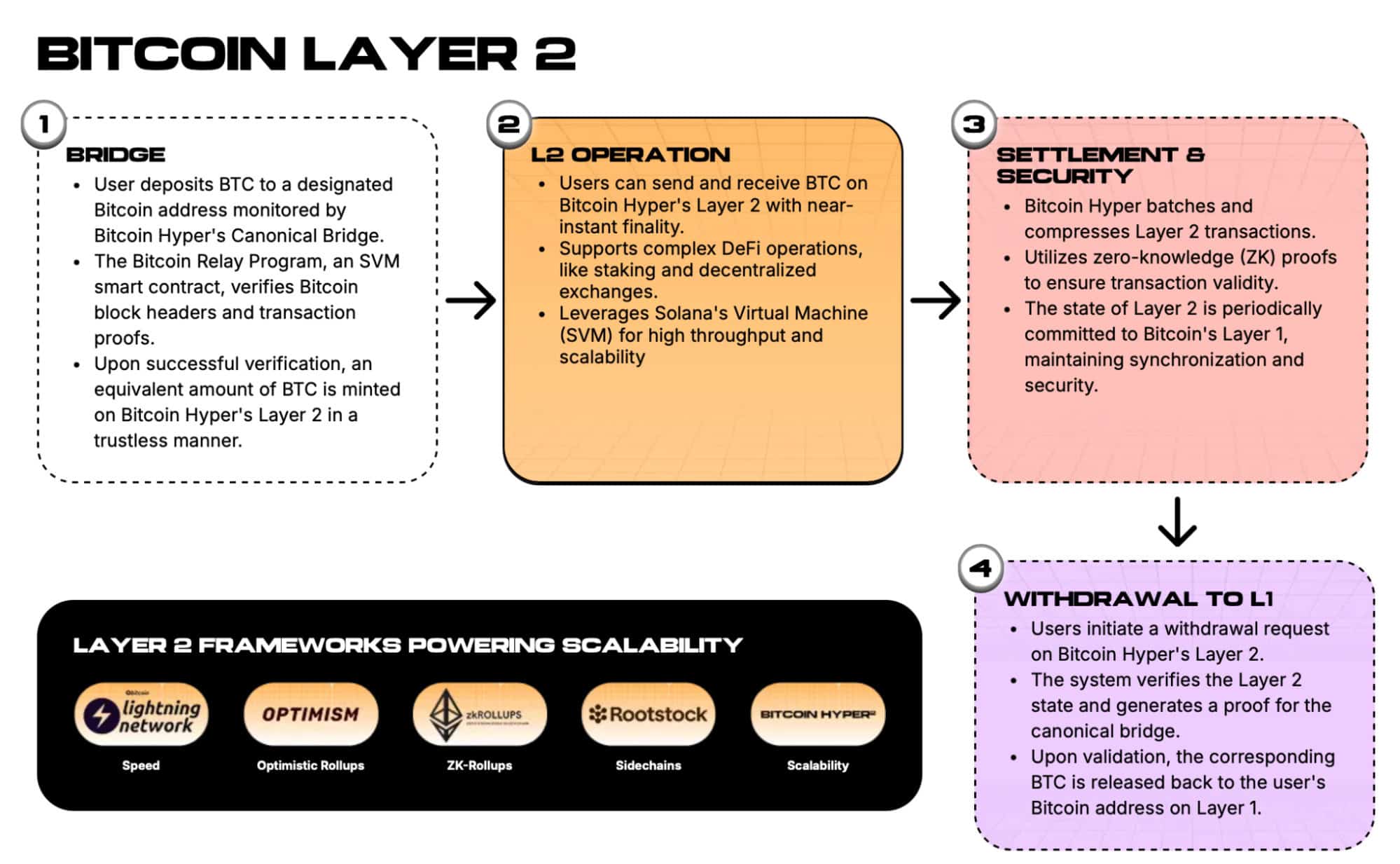
The post Price Increases in Under 48hrs appeared on BitcoinEthereumNews.com. Early backers know the secret to fortune in crypto: Unearth underrated gems. And when they find one, they don’t hesitate to go all in. The latest crypto whale magnet is Bitcoin Hyper ($HYPER)–the upcoming layer-2 solution designed to enhance speed and programmability on the Bitcoin blockchain. The project expands Bitcoin’s reach to the broader Web3 market, including dApps, DeFi, NFTs, and even meme coins. Having raised $15.2M already, the clock is ticking on the $HYPER presale. So here is a closer look at what makes it one of the most promising altcoins this season. $HYPER Mania: Why Bitcoin Hyper is Trending Bitcoin Hyper is building a Layer-2 solution for Bitcoin using the Solana Virtual Machine and a decentralized Canonical Bridge. Although Bitcoin is the world’s largest crypto, the Bitcoin blockchain is outdated. It doesn’t stand a chance against blockchains like Ethereum and Solana that support smart contracts. That explains why $BTC remains a store of value, while Ethereum and Solana keep expanding their ecosystems with Web3 innovation. Bitcoin Hyper addresses Bitcoin’s issues, making it faster, cheaper, and scalable without sacrificing security. The Layer-2 architecture is simple, yet sophisticated, as shown below: Basically, you send your $BTC to a specific wallet address monitored by the Canonical Bridge. Once confirmed, it will be minted on Layer-2 as wrapped $BTC, ready for DeFi, staking, and nearly anything else in Web3. Thanks to the SVM, transactions are extremely fast and inexpensive. In fact, it can sometimes be faster than Solana itself. The best part is, you can withdraw your $BTC back to Bitcoin’s native Layer-1 whenever you want. It’s Not Just a Promise; Tech Progress Inspires Confidence The crypto market is crowded with early-stage coins that promise everything under the sky, only to keep investors waiting for months after the TGE for a product…

Author: BitcoinEthereumNews
Best AI Crypto Coins To Invest in 2026

Best AI Crypto Coins To Invest in 2026

Best AI Crypto Coins List for High Returns in 2026Best AI Crypto Coins The combination of artificial intelligence (AI) and cryptocurrency represents one of the greatest disruptions in the current digital economy. While AI has already transformed industries like healthcare, finance, and retail, it is now reshaping the world of crypto. Investors and traders are paying close attention to AI-powered cryptocurrencies, such as Fetch.ai and SingularityNET, because they bring smarter trading strategies, stronger security, and breakthrough innovations to the blockchain space. At the core of this trend is the convergence of two game-changing technologies: AI and blockchain. Together, they power digital assets that can handle advanced data analysis, predictive modeling, and decision-making, all while ensuring transparency and security through decentralized networks. By 2026, projects competing for the title of the best AI crypto coin are not only gaining popularity but are also expected to become a driving force in the future of digital finance. In this guide, I’ll introduce the best AI crypto coins for 2026, explain what makes them stand out, and show how they’re changing trading, DeFi, NFTs, and DAOs. Additionally, I’ll provide actionable investment considerations and tips to equip you with practical insights for effective decision-making in this rapidly evolving space. Let’s get started. Why AI in Cryptocurrencies is the Future AI and crypto complement each other in ways that make the combination especially powerful. Blockchain provides transparency, immutability, and trust, while AI contributes intelligence, automation, and adaptability. This means data stored on a blockchain can be analyzed by AI for deeper insights, fraud detection, and smarter predictions, all without compromising security. Together, they create a foundation for digital systems that are both trustworthy and intelligent. This synergy is what gives the best AI crypto coin projects their edge in the market. Role of AI in Crypto Artificial intelligence is revolutionizing the crypto industry by automating repetitive tasks, improving efficiency, and introducing new forms of innovation. AI-driven algorithms can analyze massive amounts of market data in real time, enabling automated trading strategies that reduce human error. They also help optimize blockchain networks, streamline processes in decentralized finance (DeFi), and ensure better resource allocation across projects. An ever-changing crypto environment has to be fast, cheap, and agile, qualities that the best AI crypto coin initiatives deliver. Real-World Applications of AI in Crypto Trading: AI-powered bots can process market signals instantly, predict trends, and execute trades at lightning speed for better returns. DeFi: Managing liquidity pool, reducing risks, and optimizing lending/borrowing rates by DeFi protocols NFTs: In the NFT space, AI is used for generative art, personalized collections, and intelligent pricing models that help creators and buyers alike. DAOs: By analyzing data and patterns, AI supports decentralized autonomous organizations (DAOs) with fairer governance, automated proposals, and smarter community decisions. These use cases strengthen why the best AI crypto coin projects are in high demand. Key Benefits of AI in cryptocurrencies AI is adding real value to the world of digital assets. By combining intelligence with blockchain’s transparency, it creates safer, smarter, and more efficient systems. When selecting the best AI crypto coin, consider: Fraud Detection & Security — AI continuously monitors blockchain transactions to identify unusual patterns and prevent fraudulent activities. This adds an extra layer of protection against hacks, scams, and cyberattacks. Smarter Trading Decisions — AI-powered algorithms analyze vast amounts of market data in real time to predict price movements. This will help the traders make the trading faster and make profitable decisions. Improved Scalability & Efficiency — By optimizing blockchain operations, AI reduces network congestion and enhances transaction speed. This ensures a smoother and more reliable crypto ecosystem. Personalized Financial Services — AI will customize investment strategies and portfolio suggestions based on individual user behavior. Such personalization makes crypto investment easier for and within the reach of the common man. Data-Driven Insights — AI transforms complex blockchain data into meaningful analytics and predictions. These insights help investors, developers, and businesses make smarter decisions in the market. These benefits make AI in cryptocurrencies stand out compared to traditional digital assets. But before jumping into the top projects, it’s important to know what factors you should consider when choosing the right AI crypto project to invest in. Factors to Consider Before Choosing AI Crypto Coin Projects Not every AI crypto coin offers the same value. To make informed investment decisions, it’s crucial to look beyond the hype and evaluate the fundamentals of each project. Technology & Use Case — A strong project should solve a real-world problem with practical AI applications. If it lacks utility, it may struggle to gain long-term traction. Market Adoption & Community Support — Widespread adoption and an active community indicate a project’s credibility. Strong partnerships also signal higher growth potential. Token Utility and Ecosystem Growth — Tokens must serve a genuine purpose within their ecosystems. Utility-driven tokens are more likely to maintain demand over time. Team & Partnerships — Projects backed by experienced teams and reputable partners inspire trust. Innovation may be sustainable with strong management. By carefully considering these factors, investors can minimize risks and focus on projects with real potential. Now that you know what to look for, the main picture, let’s explore the best AI crypto coins in 2026 that are making a real impact in the blockchain space. Best AI Crypto Coins Projects in 2026 AI and blockchain together are reshaping digital finance, with several projects leading the way in 2026. Each coin brings unique innovations, from marketplaces to data sharing and creative platforms. Now let’s watch the best AI crypto coins powering the transformation.

  1. SingularityNET (AGIX) SingularityNET works as the premier decentralized AI marketplace, whereby developers and businesses jointly develop and share AI services. The project has received recognition for its engagement in powering the Artificial Superintelligence Alliance. Market Cap & Performance: Continues to stay strong among top AI tokens, showing steady adoption.Chain: Ethereum & CardanoActive Users: Growing developer and research communityToken Utility: AI service payments, staking, governance participation
  2. Fetch.ai (FET) Fetch.ai builds autonomous AI agents to streamline industries like DeFi, mobility, and IoT. Through the Artificial Superintelligence Alliance, FET hopes to foster a united AI ecosystem. Market Cap & Performance: Experienced major growth in 2024–25, ranking high in AI crypto categories.Chain: Cosmos-based networkActive Users: Thousands of developers and enterprisesToken Utility: Agent deployment, transactions, governance
  3. Render Network (RENDER) Render Network decentralizes GPU power, enabling creators and developers to access affordable rendering for AI, AR/VR, and 3D projects. Its creator economy appeal is massive. Market Cap & Performance: One of the fastest-growing AI-linked tokens with solid performance.ll Chain: Solana Active Users: Over 45,000 creators and node operatorsToken Utility: Functions as payment for rendering tasks, compensation for node operators, and participation in governance.
  4. Ocean Protocol (OCEAN) Data can be shared and monetized on Ocean Protocol for the purpose of AI and Web3. It gives businesses secure access to tokenized datasets for AI model training. Market Cap & Performance: Maintains a stable market position, appealing to data-driven industries. Chain: EthereumActive Users: Data providers, enterprises, and developersToken Utility: Buying/selling datasets, staking, governance
  5. Numeraire (NMR) The funds are powered by crowdsourced AI trading models that predict the stock market. Data scientists compete to build the best predictive algorithms. Market Cap & Performance: Holds a niche spot with consistent engagement in AI-powered finance.Chain: EthereumActive Users: Global network of data scientists and tradersToken Utility: Staking on predictions, rewarding model accuracy
  6. Artificial Superintelligence Alliance (ASI — FET) The Artificial Superintelligence Alliance is a collaboration between Fetch.ai, SingularityNET, and Ocean Protocol to create a unified AI ecosystem. It seems to be one of the strongest moves in the AI crypto. Market Cap & Performance: Expected to surge as AI collaboration grows across networks.Chain: Multi-chain (Ethereum, Cosmos, Cardano)Active Users: Communities of partner projects combinedToken Utility: Governance, interoperability, AI agent operations
  7. Cortex (CTXC) Cortex makes it possible to develop AI-powered decentralised applications by integrating AI models into smart contracts. It focuses on real-world AI adoption in DeFi and Web3. Market Cap & Performance: Holds mid-cap value with potential growth in AI-enhanced dApps.Chain: Ethereum-compatibleActive Users: AI developers and dApp buildersToken Utility: Gas fees, governance, deploying AI models
  8. Velas (VLX) Velas combines AI with blockchain scalability, delivering high throughput for Web3 apps, DeFi, and AI-driven dApps. It claims to enhance speed and efficiency using AI optimizations. Market Cap & Performance: A smaller-cap project but promising in performance-focused ecosystems.Chain: EVM-compatible Velas blockchainActive Users: Web3 and DeFi developersToken Utility: Staking, fees, governance
  9. Internet Computer (ICP) Internet Computer by DFINITY provides a decentralized cloud for building AI and Web3 applications at scale. It supports AI model hosting directly on-chain. Market Cap & Performance: Maintains a strong top-30 position, with increasing developer adoption.Chain: Internet Computer ProtocolActive Users: Tens of thousands of developers worldwideToken Utility: Computation cycles, governance, staking
  10. InSilico / Newer Projects Emerging AI-focused crypto projects like InSilico are bringing biotech, drug discovery, and AI-powered innovations to Web3. They represent the next wave of AI-blockchain synergy. Market Cap & Performance: Early-stage but shows high-growth potential as AI research meets blockchain.Chain: Varies by projectActive Users: Early-stage researchers and biotech innovatorsToken Utility: Research funding, staking, ecosystem utility. These represent the best AI crypto coin selections with real potential for investors. With these groundbreaking projects paving the way, the next important question is, should I invest in AI crypto coins, and what does the future hold for them? Investment Potential of AI Crypto Coins The territory of AI cryptocurrencies is enormous, and so are the risks. The best AI crypto coin can bring high growth but also high volatility.
Market Growth Predictions (2026–2030) — Analysts expect AI crypto markets to grow significantly as adoption rises across industries. Risks & Volatility — Like all digital assets, AI coins are subject to market swings and speculative hype. How to Evaluate Before Investing — Study whitepapers, check token utility, research the team, and monitor community activity. Smart investors treat AI crypto coins as high-growth but high-risk assets best approached with careful research. Now you know. The risks and growth opportunities are crucial, but the bigger picture lies ahead. How will AI and blockchain evolve beyond 2026? Future of AI and Crypto Beyond 2026 The best AI crypto coin projects are expected to continue shaping industries ,Let’s look ahead: Industry Integration — Finance, healthcare, and supply chains will adopt AI + blockchain for efficiency and transparency. Role of Regulations — Clearer global regulations could bring more trust and mainstream adoption. Impact on Web3, DeFi, DAOs, and the Metaverse — AI will drive smarter contracts, self-learning DAOs, and personalized virtual experiences. Long-Term Vision — The combination of AI and crypto could redefine how industries manage data, governance, and digital assets. Clearly, AI will continue transforming industries and shaping digital ecosystems. With this in mind, businesses and investors must prepare today to lead in the AI-powered blockchain future. Conclusion AI and blockchain together represent one of the most exciting opportunities in digital finance. In 2026, the best AI crypto coins are not just trending; they’re shaping the future of trading, DeFi, NFTs, and beyond. If you’re considering entering this market, take time to evaluate each project’s technology, team, and ecosystem. And if you’re a business looking to build your own AI-powered cryptocurrency or blockchain solution, working with the top cryptocurrency development company can help turn your vision into reality. Whether you’re an investor, trader, or entrepreneur, 2026 is the year to watch and possibly invest in the next wave of AI crypto innovation. Best AI Crypto Coins To Invest in 2026 was originally published in Coinmonks on Medium, where people are continuing the conversation by highlighting and responding to this story

Author: Medium
Web3 Game Dev: WASM Solves Limits for Next-Gen On-Chain Logic

Web3 Game Dev: WASM Solves Limits for Next-Gen On-Chain Logic

From On-Chain Bottlenecks to an Off-Chain Superhighway The Core Problem: Why “Fully On-Chain” Games Are Stuck in the Slow Lane Most on-chain games today face a fundamental performance ceiling. The Ethereum Virtual Machine (EVM) and other smart contract platforms, while revolutionary for asset ownership and simple transactions, were not designed for the complex, high-speed computations that engaging games require. This limitation forces developers into a difficult compromise: either build a simplistic game that can run entirely on-chain, or move the core game logic to centralized servers, sacrificing the transparency and verifiability that makes blockchain gaming compelling. The Clear Solution: WASM as a High-Performance Off-Chain Coprocessor WebAssembly (WASM) provides a direct solution to this performance bottleneck. As a portable, high-performance binary instruction format, WASM acts as a compilation target for mature languages like Rust and C++. Instead of replacing the blockchain’s virtual machine, WASM can be used as an off-chain coprocessor. Complex game mechanics, physics engines, and sophisticated AI can be executed at near-native speeds off-chain, with only the verifiable results being posted back to the main blockchain. This hybrid model delivers the performance of a traditional game server with the trust and security of a decentralized ledger. The Proof: Race Protocol as a Pioneer in WASM-Powered Gaming RACE Protocol exemplifies the power of this hybrid approach. By building its architecture around a WASM-based “Game Handler Model,” Race enables developers to write intricate game logic in Rust and execute it in a high-performance off-chain environment run by a network of nodes. The results of this off-chain execution are cryptographically committed to the main blockchain (like Solana, Sui, or an EVM chain) as verifiable checkpoints. This delivers the speed needed for real-time competitive games without sacrificing the decentralized integrity that players demand. The On-Chain Bottleneck: Why Blockchain Execution Can’t Handle Complex Games Defining “True” Verifiable Game Logic Verifiable game logic means that the rules of the game, the state transitions, and the outcome resolutions can be independently proven to be correct and fair. This is a stark contrast to many current “Web3” titles where the blockchain merely acts as a registry for NFTs or in-game currency. While asset ownership is vital, verifiable game mechanics are what guarantee fairness. A game where the core logic runs on a private, opaque server is fundamentally no more transparent than a traditional Web2 game. A Technical Breakdown of On-Chain Virtual Machine Limitations Blockchain virtual machines like the EVM are optimized for security and deterministic settlement, not for the high-throughput computation required by modern games. Computational Inefficiency: The High Cost of Every Step Every computational step on a blockchain costs gas or transaction fees. For a game, which may require thousands of calculations for a single turn or action, the cumulative fees of running this logic directly on-chain would be astronomical. This economic barrier makes it infeasible to deploy games with deep strategic elements, real-time interactions, or fair random number generation directly on-chain. Throughput Limitations: The Blockchain Traffic Jam Blockchains have limited block space and processing capacity. A complex game generating thousands of state updates per second would quickly overwhelm a public blockchain, leading to slow confirmation times and a poor user experience for both players and other users of the network. A Walled Garden for Developers: Niche Languages and Limited Ecosystems Developing for platforms like the EVM requires specialized knowledge of languages like Solidity or Vyper. While powerful for smart contracts, they lack the extensive libraries, mature tooling, and massive developer communities of languages like Rust and C++. This steep learning curve creates a barrier to entry for the millions of developers who could otherwise bring their skills to the web3 space. The Engine for the Next Generation: A Primer on WebAssembly (WASM) What is WASM? From Web Browser Powerhouse to a Universal Standard WebAssembly is a low-level, binary instruction format designed as a portable compilation target for high-level languages. Initially created to bring near-native performance to web browsers, its core features — speed, security, and portability — have made it an ideal standard for verifiable computation. It functions as a stack-based virtual machine that allows code written in languages like C++ and Rust to run efficiently and securely in any compliant environment. Key Characteristics Making WASM Ideal for Off-Chain Game Logic WASM’s design directly addresses the need for performant and secure off-chain computation, making it the perfect choice for the hybrid model. Benefit 1: Near-Native Execution Speed for Complex Calculations Because WASM is a pre-compiled binary format, it can be executed far more efficiently than interpreted languages. It leverages common hardware capabilities and runs at speeds that approach native machine code. This performance is critical for off-chain game servers that handle real-time physics, complex state updates, and dynamic interactions. Benefit 2: Developer Freedom with Rust, C++, and Go WASM breaks down the walled garden of blockchain-specific languages. It allows developers to use established, high-performance languages they already know, including Rust, C++, and Go. As seen in the Race Protocol repository, game logic is written in Rust, leveraging its powerful type system and performance features. This access to a mature ecosystem dramatically accelerates the development of sophisticated applications. Benefit 3: A “Fort Knox” Sandbox for Secure, Isolated Execution Security is paramount. WASM runs code in a sandboxed environment, which means the program has no access to the host system outside of a specific set of imported functions. This memory isolation, a key feature of the Wasmer runtime used in Race Protocol’s transactor, ensures that game logic from different developers can run safely on the same node without interfering with one another or the host system. Benefit 4: Proven in the Wild (Figma, Unity, Cloudflare) WASM is not a theoretical technology; it is battle-tested at a massive scale. Industry leaders rely on it for their most demanding applications. Figma uses WASM to power its high-performance, web-based design tool. Unity’s WebGL platform compiles games to WASM for smooth browser experiences. Cloudflare uses it for its serverless edge computing, demonstrating its efficiency and security in high-stakes environments. Case Study: How Race Protocol Leverages WASM for High-Performance Gaming Introducing Race Protocol: A Serverless Coprocessor for Verifiable Gaming RACE Protocol is a multi-chain infrastructure designed specifically to facilitate secure and fair web3 games. It functions as a serverless coprocessor network, using WASM to handle complex game logic off-chain while anchoring trust and asset management on existing blockchains. This hybrid approach solves the performance-security trade-off for gaming, delivering speed, fairness, and decentralization. The Architecture: Unpacking the “Game Handler Model” At the heart of Race Protocol is its “Game Handler Model,” an architecture that separates high-frequency game logic from slower on-chain transactions. As defined in the race-api crate, developers implement a GameHandler trait in Rust, which is then compiled into a WASM module. Off-Chain WASM Execution for Speed and Low Cost The WASM game logic runs in a secure, sandboxed environment on Race Protocol’s network of community-hosted Transactor and Validator nodes. This off-chain execution happens at near-native speed, enabling real-time gameplay without incurring gas fees for every single in-game action. This is what allows for complex calculations and rapid state changes that would be impossible on a Layer 1 chain. On-Chain Verification for Trust and Security While execution is off-chain, the results and critical state changes are committed to the blockchain as verifiable checkpoints. The GameAccount smart contract (defined in both race-solana and race-sui repositories) stores a cryptographic Merkle root of the settled game state. This ensures that the game’s outcome is transparent and immutable. Players can be certain that the off-chain execution adheres strictly to the publicly available WASM game logic, as any deviation would produce a different state hash and be rejected by the network. Key Features Unlocked by WASM in Race Protocol Executing Complex Logic: Physics, Advanced RNG, and Dynamic Game States The performance of WASM is what empowers Race Protocol to support games with genuine complexity. This includes games that require physics simulations, advanced and fair random number generation, or dynamic game states that change rapidly based on multiple player inputs. These are features largely out of reach for purely on-chain games. Ensuring Provably Fair Play with a P2P Randomization Module Fairness is critical in competitive gaming. Race Protocol includes a dedicated peer-to-peer randomization module that uses a mental poker algorithm for multi-party computation to generate random outcomes. This entire cryptographic process — involving Mask, Lock, and ShareSecrets events — is managed by the off-chain nodes and executed within WASM, ensuring that no single party can predict or manipulate results like a card shuffle. The Developer Advantage: Building with Race’s SDK for Solana, Sui, and EVM To streamline development, Race Protocol offers a specialized Software Development Kit (SDK). This SDK provides a high-level API that abstracts away the complexities of interacting with both the off-chain nodes and the on-chain contracts. As seen in the race-repo file structure, there are dedicated transport layers for Solana, Sui, and EVM, allowing developers to build for multiple ecosystems from a unified logical framework. Proof of Concept: The Race Poker dApp’s Performance in Action The protocol’s capabilities are demonstrated by its flagship application, RACE Poker, a fully functional decentralized poker dApp. This application showcases the performance and security of the P2P randomization module, handling the complex logic of shuffling and dealing cards in a verifiably fair manner. The dApp’s performance serves as a tangible example of how this hybrid WASM architecture can deliver a smooth and responsive user experience. The Next Frontier: Combining WASM with Zero-Knowledge Proofs (zkWASM) What is zkWASM? The Power of Provable Computation Explained zkWASM represents the convergence of WebAssembly and zero-knowledge cryptography. It is a virtual machine that executes WASM code and simultaneously generates a zkSNARK proof of the execution trace. This proof cryptographically guarantees that the program was executed correctly without needing validators to re-run the computation. Case in Point: Blade Games and the “Trustless Game Engine” The blockchain gaming studio Blade Games is a key innovator in this space, building a “Trustless Game Engine” in collaboration with Delphinus Lab. This engine uses zkWASM to power an “off-chain execution, on-chain verification” model — the same architectural pattern as Race Protocol, but with the potential for even greater efficiency. How zkWASM Can Enhance the Off-Chain, On-Chain Model When a game runs in a zkWASM environment, it generates a succinct proof that certifies the game’s outcome. This small proof is then sent to an on-chain smart contract, which can quickly and cheaply verify its validity. This replaces the need for a consensus mechanism among validator nodes with a single, irrefutable cryptographic proof, further streamlining the off-chain component. The Future is Now: What a WASM-Powered Gaming World Looks Like Unlocking New Possibilities: Fully On-Chain Strategy Games & Autonomous Worlds A future powered by hybrid models like Race Protocol, potentially enhanced by zkWASM, enables the creation of fully verifiable, persistent worlds. Complex real-time strategy (RTS) games, intricate simulations, and autonomous worlds with emergent behavior become possible. These are games where the entire universe and its rules are transparent and enforceable on the blockchain, creating truly decentralized and community-owned experiences. Onboarding the Next Wave: Lowering the Barrier for Traditional Game Studios By supporting mainstream languages like Rust and C++, WASM significantly lowers the barrier to entry for experienced game developers. They can leverage their existing expertise and codebases to enter the Web3 space, accelerating innovation and bringing higher production quality to blockchain gaming. Challenges on the Horizon: Adoption, Tooling, and Security Best Practices Despite its potential, the WASM ecosystem for off-chain computation is still maturing. Wider adoption depends on the continued development of developer-friendly tooling, comprehensive debuggers, and established security best practices. As the technology grows, creating robust auditing processes for WASM game logic will be crucial for ensuring the security of this new gaming frontier. Conclusion: Why Developers Should Bet on WASM Today Recap: WASM is the Engine for Complex, Verifiable Off-Chain Logic Blockchain virtual machines pioneered on-chain computation, but WebAssembly is the key to unlocking its true potential for gaming. For the industry to move beyond simple asset management and deliver compelling, complex experiences, it needs a high-performance, secure, and flexible execution environment for its core logic. The hybrid model, using WASM for off-chain computation and the blockchain for verification, provides a clear path forward. Your Next Steps: Exploring the WASM Gaming Ecosystem and Protocols like Race For developers looking to build the next generation of decentralized games, the time to engage with WASM is now. Exploring infrastructure solutions like Race Protocol will provide a significant advantage. By embracing this technology, builders can finally create the rich, performant, and provably fair on-chain games that players have been waiting for. Web3 Game Dev: WASM Solves Limits for Next-Gen On-Chain Logic was originally published in Coinmonks on Medium, where people are continuing the conversation by highlighting and responding to this story

Author: Medium
Will Cardano Still Be a Top 10 Crypto in 2030?

Will Cardano Still Be a Top 10 Crypto in 2030?

Cardano (ADA) has been one of the top coins by market cap since the launch in 2017. The project is well-known for its unparalleled robustness in the crypto space, focusing on academia, research, peer-reviewed development, and public governance. Cardano is entering a Milestone or Era of Voltaire, or the governance era under which holders of […]

Author: Cryptopolitan
Whales Circle Viral Bitcoin Hyper Presale As Layer-2 Sparks FOMO – Next Price Surge Under 48hrs Away

Whales Circle Viral Bitcoin Hyper Presale As Layer-2 Sparks FOMO – Next Price Surge Under 48hrs Away

Early backers know the secret to fortune in crypto: Unearth underrated gems.

Author: Brave Newcoin
Cardano Price Prediction: ADA Whales Are Rushing To Enter The Early Stages Of This Record Breaking Presale

Cardano Price Prediction: ADA Whales Are Rushing To Enter The Early Stages Of This Record Breaking Presale

The latest Cardano Price Prediction has bulls watching closely as ADA edges toward $1.00. Whale accumulation is picking up, and some long-term holders are feeling optimistic. But for traders who aren’t content to wait for slow climbs, there’s another name grabbing attention fast: Layer Brett. Built for speed and rewards, it’s quickly becoming 2025’s wildcard […] The post Cardano Price Prediction: ADA Whales Are Rushing To Enter The Early Stages Of This Record Breaking Presale appeared first on Live Bitcoin News.

Author: LiveBitcoinNews
Top 6 Crypto Presales Set to Explode [2025 Picks]

Top 6 Crypto Presales Set to Explode [2025 Picks]

Tapzi, Solaxy, Remittix, Best Wallet, Rexas Finance, and Troller Cat are 2025’s top presales, combining utility, transparency, and 100x potential to shape Web3’s future.

Author: Blockchainreporter
LEASH V2 Cross-Chain Rollout Sparks SHIB Price Forecast: Could a 200% Jump Be Next?

LEASH V2 Cross-Chain Rollout Sparks SHIB Price Forecast: Could a 200% Jump Be Next?

SHIB’s LEASH V2 migration boosts cross-chain reach with integrations on ETH, SOL, and Base, expanding SHIB’s utility across blockchains.   Shiba Inu (SHIB) is eyeing a potential 200% rally, driven by a rounded double-bottom formation and the upcoming LEASH V2 migration. The price of SHIB has shown signs of strength, trading above key accumulation levels, […] The post LEASH V2 Cross-Chain Rollout Sparks SHIB Price Forecast: Could a 200% Jump Be Next? appeared first on Live Bitcoin News.

Author: LiveBitcoinNews
Solana vs. Ozak AI: $500 Breakout or 100x Presale Upside?

Solana vs. Ozak AI: $500 Breakout or 100x Presale Upside?

Crypto investors in 2025 are breaking up between betting on established blue-chip altcoins and chasing early-stage presale possibilities with explosive upside. Solana (SOL), trading close to $220, has proven itself as one of the strongest blockchain ecosystems and is once more drawing interest as analysts are expecting a move in the direction of the $500 […] The post Solana vs. Ozak AI: $500 Breakout or 100x Presale Upside? appeared first on Live Bitcoin News.

Author: LiveBitcoinNews
Inflation US vs XRP : vers une explosion du cours ?

Inflation US vs XRP : vers une explosion du cours ?

L’inflation US peut-elle être l’étincelle qui fait enfin décoller XRP ? Le marché scrute chaque chiffre du CPI, chaque mot de la Fed. Si les prix ralentissent et que la banque centrale se montre plus souple, l’appétit pour le risque revient vite. XRP, coincé sur une zone clé, n’attend qu’un signal. À l’inverse, si l’inflation […]

Author: Bitcoinist