Bitcoin may no longer be moving in lockstep with the S&P 500 over a short time frame, but that does not mean it has escaped the broader risk-off regime. In AxelBitcoin may no longer be moving in lockstep with the S&P 500 over a short time frame, but that does not mean it has escaped the broader risk-off regime. In Axel

Bitcoin Isn’t Decoupling From Stocks Yet, And This Chart Shows Why

2026/04/01 04:00
Okuma süresi: 3 dk
Bu içerikle ilgili geri bildirim veya endişeleriniz için lütfen crypto.news@mexc.com üzerinden bizimle iletişime geçin.

Bitcoin may no longer be moving in lockstep with the S&P 500 over a short time frame, but that does not mean it has escaped the broader risk-off regime. In Axel Adler Jr.’s latest morning brief, the more important signal is not the breakdown in short-term correlation, but Bitcoin’s continued relative weakness against US equities.

Bitcoin Weakens Against The S&P 500

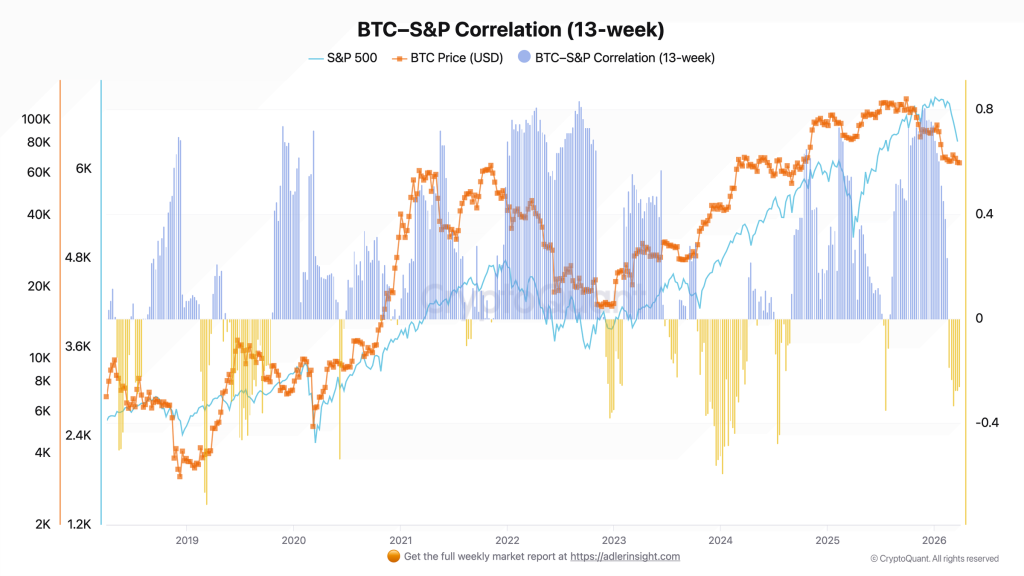
Adler’s argument rests on two charts that, taken together, push back on the increasingly familiar claim that a lower BTC-equity correlation automatically points to decoupling. The first is the 13-week BTC-S&P correlation, which has recently turned negative and stayed below zero. On the surface, that could look constructive for Bitcoin. But Adler argues that the reading is easy to misinterpret.
BTC-S&P Correlation (13-week)

“The 13-week correlation measures how closely the weekly returns of BTC and the S&P 500 have moved together over a short window,” he wrote. “Over recent weeks, the short-term correlation has turned negative and has been holding below zero. At first glance this might look like a loosening of the link between BTC and equities – but in practice it more likely reflects the choppy nature of recent weeks, where isolated Bitcoin bounces have alternated with continued weakness in the index.”

That distinction is central to the note. A falling or negative correlation only says that the two assets are no longer moving neatly together over that window. It does not say Bitcoin is strong. It does not say capital is treating BTC as a defensive asset. And it does not confirm that the market has begun to price Bitcoin independently of the same macro pressures hitting equities.

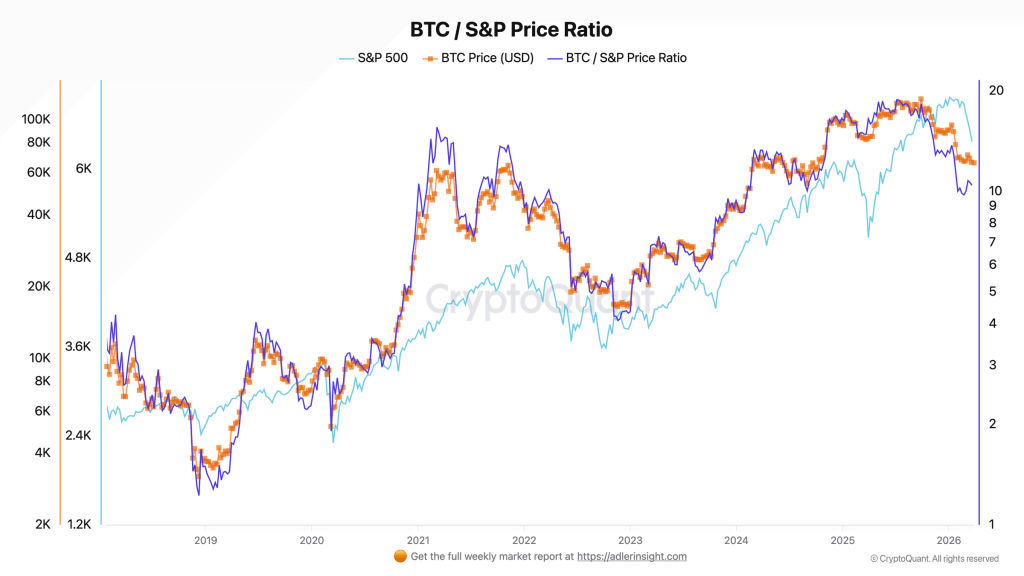
For that, Adler points to the second chart: the BTC/S&P price ratio. This is where the case for decoupling breaks down. The ratio, which tracks Bitcoin’s performance relative to the S&P 500, has declined since the start of the year and remains under pressure. In practical terms, that means Bitcoin has been underperforming stocks even during periods when the short-term correlation has weakened.
BTC / S&P Price Ratio

“What matters to the market here is not the fact of negative correlation per se, but whether it is accompanied by sustained BTC outperformance over the S&P,” Adler wrote. “That confirmation is not there yet, so it is too early to talk about Bitcoin achieving genuine independence from the risk-off regime.”

That framing matters because it shifts the focus away from a single statistical measure and back toward market behavior. If Bitcoin were truly decoupling, the relative-strength picture would likely be improving. Instead, Adler argues, the market is still assigning Bitcoin the role of a higher-beta risk asset, one with “higher risk and a larger drawdown amplitude” than the index.

He makes the point even more explicitly in the note’s conclusion. “The market is currently sending an uncomfortable but fairly honest signal,” Adler wrote. “The S&P 500 continues to decline, and BTC is not merely staying vulnerable to external risk-off pressure – it continues to underperform the index in relative terms. The prevailing regime remains risk-off.”

In that framework, the more useful trigger to watch is not whether correlation stays negative for another week, but whether the BTC/S&P ratio can reverse and hold higher. Adler says only “a new stable regime” of relative outperformance would support a real decoupling thesis. Until then, the market message remains straightforward: the relationship between Bitcoin and equities may have become less linear, but not less risk-sensitive.

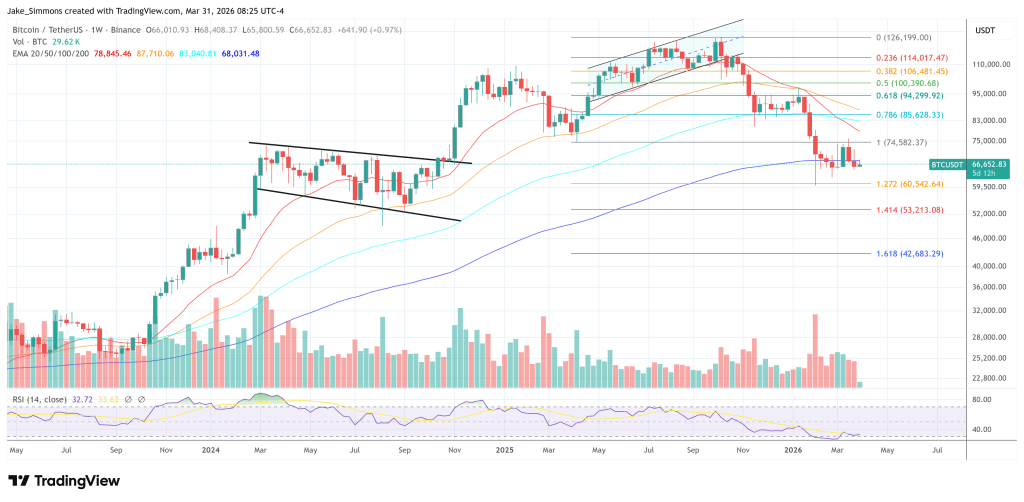
At press time, BTC traded at $66,652.
Bitcoin price chart
Sorumluluk Reddi: Bu sitede yeniden yayınlanan makaleler, halka açık platformlardan alınmıştır ve yalnızca bilgilendirme amaçlıdır. MEXC'nin görüşlerini yansıtmayabilir. Tüm hakları telif sahiplerine aittir. Herhangi bir içeriğin üçüncü taraf haklarını ihlal ettiğini düşünüyorsanız, kaldırılması için lütfen crypto.news@mexc.com ile iletişime geçin. MEXC, içeriğin doğruluğu, eksiksizliği veya güncelliği konusunda hiçbir garanti vermez ve sağlanan bilgilere dayalı olarak alınan herhangi bir eylemden sorumlu değildir. İçerik, finansal, yasal veya diğer profesyonel tavsiye niteliğinde değildir ve MEXC tarafından bir tavsiye veya onay olarak değerlendirilmemelidir.

Ayrıca Şunları da Beğenebilirsiniz

3 Paradoxes of Altcoin Season in September

3 Paradoxes of Altcoin Season in September

The post 3 Paradoxes of Altcoin Season in September appeared on BitcoinEthereumNews.com. Analyses and data indicate that the crypto market is experiencing its most active altcoin season since early 2025, with many altcoins outperforming Bitcoin. However, behind this excitement lies a paradox. Most retail investors remain uneasy as their portfolios show little to no profit. This article outlines the main reasons behind this situation. Altcoin Market Cap Rises but Dominance Shrinks Sponsored TradingView data shows that the TOTAL3 market cap (excluding BTC and ETH) reached a new high of over $1.1 trillion in September. Yet the share of OTHERS (excluding the top 10) has declined since 2022, now standing at just 8%. OTHERS Dominance And TOTAL3 Capitalization. Source: TradingView. In past cycles, such as 2017 and 2021, TOTAL3 and OTHERS.D rose together. That trend reflected capital flowing not only into large-cap altcoins but also into mid-cap and low-cap ones. The current divergence shows that capital is concentrated in stablecoins and a handful of top-10 altcoins such as SOL, XRP, BNB, DOG, HYPE, and LINK. Smaller altcoins receive far less liquidity, making it hard for their prices to return to levels where investors previously bought. This creates a situation where only a few win while most face losses. Retail investors also tend to diversify across many coins instead of adding size to top altcoins. That explains why many portfolios remain stagnant despite a broader market rally. Sponsored “Position sizing is everything. Many people hold 25–30 tokens at once. A 100x on a token that makes up only 1% of your portfolio won’t meaningfully change your life. It’s better to make a few high-conviction bets than to overdiversify,” analyst The DeFi Investor said. Altcoin Index Surges but Investor Sentiment Remains Cautious The Altcoin Season Index from Blockchain Center now stands at 80 points. This indicates that over 80% of the top 50 altcoins outperformed…
Paylaş
BitcoinEthereumNews2025/09/18 01:43
Vitalik Buterin Reveals Ethereum’s Long-Term Focus on Quantum Resistance

Vitalik Buterin Reveals Ethereum’s Long-Term Focus on Quantum Resistance

TLDR Ethereum focuses on quantum resistance to secure the blockchain’s future. Vitalik Buterin outlines Ethereum’s long-term development with security goals. Ethereum aims for improved transaction efficiency and layer-2 scalability. Ethereum maintains a strong market position with price stability above $4,000. Vitalik Buterin, the co-founder of Ethereum, has shared insights into the blockchain’s long-term development. During [...] The post Vitalik Buterin Reveals Ethereum’s Long-Term Focus on Quantum Resistance appeared first on CoinCentral.

Paylaş
Coincentral2025/09/18 00:31
Trump downplays Iran conflict’s gas price effect, ceasefire odds fall

Trump downplays Iran conflict’s gas price effect, ceasefire odds fall

The post Trump downplays Iran conflict’s gas price effect, ceasefire odds fall appeared on BitcoinEthereumNews.com. President Trump claims the Iran conflict’s impact
Paylaş
BitcoinEthereumNews2026/04/02 10:22

Trade GOLD, Share 1,000,000 USDT

Trade GOLD, Share 1,000,000 USDTTrade GOLD, Share 1,000,000 USDT

0 fees, up to 1,000x leverage, deep liquidity


