Tether froze more than $182 million worth of USDT across five wallet addresses on the Tron blockchain on Jan. 11, according to on-chain data and alerts tracked Tether froze more than $182 million worth of USDT across five wallet addresses on the Tron blockchain on Jan. 11, according to on-chain data and alerts tracked

Tether Freezes $182M on Tron in Massive ‘Coordinated’ Wallet Blacklist

Tether froze more than $182 million worth of USDT across five wallet addresses on the Tron blockchain on Jan. 11, according to on-chain data and alerts tracked by Whale Alert.

The freezes were actually done on the same day and involved single wallet balances with amounts of about $12 to about 50 million, which made the move one of the biggest synchronized wallet blacklistings on Tron in recent months.

A Tether spokesperson said in a report that the funds were frozen following a formal request from law enforcement as part of an ongoing investigation. The company added that authorities had been working on the case for months and reiterated its policy of cooperating with global agencies by freezing illicit or санкtion-linked addresses when legally required.

Tether’s Wallet Freezes Accelerate Under Sanctions Pressure

The move on Jan. 11 is consistent with Tether’s policy of voluntarily freezing the wallets that the company officially implemented in December 2023 to meet the requirements of the sanctions regime of the Office of Foreign Assets Control of the U.S. Treasury.

Under its terms of service, Tether states it may freeze assets or share user information when ordered to do so or when it determines such actions are reasonable and necessary.

Since adopting this approach, Tether has emerged as the most active stablecoin issuer in assisting enforcement efforts.

The company’s report and blockchain analytics firm AMLBot statistics indicate that since 2023, Tether has been granted access to block well over 3 billion USDT, collaborating with over 310 law enforcement agencies in 62 locations.

In its estimation of the blacklisted funds around 2023 and late 2025, AMLBot estimates that some $3.3 billion of funds are blacklisted, with approximately 1.75 billion of the funds being linked to Tron-based USDT.

The latest asset freeze reflects the growing role of stablecoins in countries facing sanctions and prolonged economic stress, particularly Venezuela and Iran.

In both markets, USDT has become a widely used substitute for local currencies, serving everyday payment needs and helping households preserve value amid inflation and banking distrust.

Blockchain Analytics Fuel Surge in Wallet Freezes for Sanctions Violators

In Venezuela, years of bolivar depreciation and limited access to reliable financial services have pushed individuals and businesses to rely on USDT for transactions ranging from basic services to commercial trade.

At the same time, investigations have linked the country’s state-owned oil company to the use of USDT to settle cross-border payments and bypass sanctions.

These findings prompted coordinated wallet blacklisting actions by Tether in cooperation with U.S. authorities.

Iran has shown similar patterns, with protests and political tension intensified alongside the collapse of the rial; Tron-based USDT emerged as one of the most commonly used digital assets.

While stablecoins offer civilians protection against inflation and capital controls, blockchain analysts report that sanctioned entities tied to Iran’s Revolutionary Guard have also moved funds through stablecoin channels.
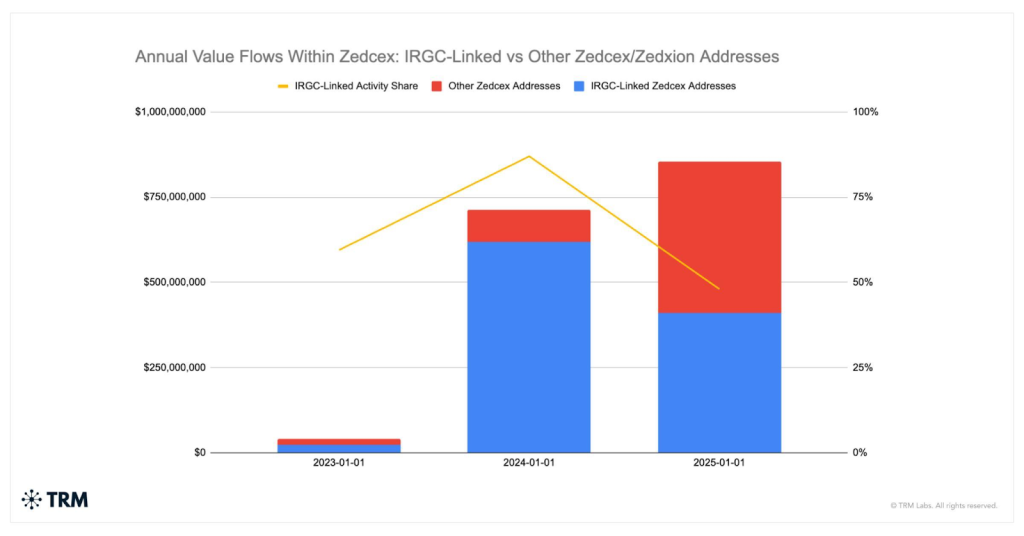
Source: TRMLabs

As a result, enforcement actions have increased rather than eased, driving a rise in wallet freezes.

Despite frequent attempts to evade sanctions using crypto, asset freezing has become more common because it is viewed by regulators as an effective, targeted tool.

Rather than showing failure, evasion efforts have led to tighter coordination, better analytics, and broader information sharing.

Source: DefiLlama

With the global stablecoin market now valued at roughly $307.8 billion and USDT alone accounting for about 60.7% of that total, enforcement actions carry growing weight.

Further growth in crypto asset freezes is expected in 2026, as regulators in the U.S., EU, and other major markets move from drafting rules to enforcing them, aided by stronger blockchain analytics and tighter AML and sanctions controls.

Piyasa Fırsatı
Ambire Wallet Logosu
Ambire Wallet Fiyatı(WALLET)
$0,01286
$0,01286$0,01286
-1,22%
USD
Ambire Wallet (WALLET) Canlı Fiyat Grafiği
Sorumluluk Reddi: Bu sitede yeniden yayınlanan makaleler, halka açık platformlardan alınmıştır ve yalnızca bilgilendirme amaçlıdır. MEXC'nin görüşlerini yansıtmayabilir. Tüm hakları telif sahiplerine aittir. Herhangi bir içeriğin üçüncü taraf haklarını ihlal ettiğini düşünüyorsanız, kaldırılması için lütfen service@support.mexc.com ile iletişime geçin. MEXC, içeriğin doğruluğu, eksiksizliği veya güncelliği konusunda hiçbir garanti vermez ve sağlanan bilgilere dayalı olarak alınan herhangi bir eylemden sorumlu değildir. İçerik, finansal, yasal veya diğer profesyonel tavsiye niteliğinde değildir ve MEXC tarafından bir tavsiye veya onay olarak değerlendirilmemelidir.

Ayrıca Şunları da Beğenebilirsiniz

The Channel Factories We’ve Been Waiting For

The Channel Factories We’ve Been Waiting For

The post The Channel Factories We’ve Been Waiting For appeared on BitcoinEthereumNews.com. Visions of future technology are often prescient about the broad strokes while flubbing the details. The tablets in “2001: A Space Odyssey” do indeed look like iPads, but you never see the astronauts paying for subscriptions or wasting hours on Candy Crush.  Channel factories are one vision that arose early in the history of the Lightning Network to address some challenges that Lightning has faced from the beginning. Despite having grown to become Bitcoin’s most successful layer-2 scaling solution, with instant and low-fee payments, Lightning’s scale is limited by its reliance on payment channels. Although Lightning shifts most transactions off-chain, each payment channel still requires an on-chain transaction to open and (usually) another to close. As adoption grows, pressure on the blockchain grows with it. The need for a more scalable approach to managing channels is clear. Channel factories were supposed to meet this need, but where are they? In 2025, subnetworks are emerging that revive the impetus of channel factories with some new details that vastly increase their potential. They are natively interoperable with Lightning and achieve greater scale by allowing a group of participants to open a shared multisig UTXO and create multiple bilateral channels, which reduces the number of on-chain transactions and improves capital efficiency. Achieving greater scale by reducing complexity, Ark and Spark perform the same function as traditional channel factories with new designs and additional capabilities based on shared UTXOs.  Channel Factories 101 Channel factories have been around since the inception of Lightning. A factory is a multiparty contract where multiple users (not just two, as in a Dryja-Poon channel) cooperatively lock funds in a single multisig UTXO. They can open, close and update channels off-chain without updating the blockchain for each operation. Only when participants leave or the factory dissolves is an on-chain transaction…
Paylaş
BitcoinEthereumNews2025/09/18 00:09
SUI Price Eyes Breakout, Targets $11 Says Analyst

SUI Price Eyes Breakout, Targets $11 Says Analyst

The post SUI Price Eyes Breakout, Targets $11 Says Analyst appeared on BitcoinEthereumNews.com. SUI price shows a technical setup for a macro breakout with analyst Dan Gambardello targeting $10-$11 levels. Recent partnership with Google’s Agentic Payments Protocol adds fundamental support to the technical analysis as SUI moves closer to potential breakout levels. SUI Price Analysis Points to $10-$11 Breakout Target Dan Gambardello has identified a clear ascending triangle formation on SUI price daily chart with upside targets around $10.79. The analyst simplified this target range to $10-$11 for practical trading purposes. The pattern shows sustained higher lows meeting resistance at current levels before a potential breakout. VanEck maintains more aggressive SUI crypto targets ranging from $13-$25 according to Gambardello’s research. SUI Price Analysis | Source: Dan Gambardello, X The $10 level is a more conservative higher high area for the current cycle. Midterm targets point to $7.50 in the 1.618 Fibonacci extension zone before longer-term objectives. The monthly RSI shows extreme compression that Gambardello describes as “screaming for a macro breakout to the upside.” This momentum oscillator behavior typically precedes major price movements in the crypto market. SUI crypto risk model currently sits at 51 and matches pre-bull market levels seen in coins like Ethereum. Gambardello compared this to Ethereum’s December 2020 reading of 51 before its major breakout. The March 2017 Ethereum reading of 53 preceded that cycle’s parabolic move. The analyst also noted that SUI price trades near the same levels from almost a year ago in November 2024. Bollinger Bands Signal Historic Compression CryptoBullet has identified the tightest Bollinger Bands in SUI’s entire trading history on the weekly chart. The BBW indicator compression reached levels that were historically followed by major price movements. This setup mirrors conditions before SUI’s previous major rallies. Historical data shows SUI price delivered +253% gains between December 2023 and March 2024 following similar compression. SUI…
Paylaş
BitcoinEthereumNews2025/09/18 11:32
How Zero Knowledge Proof Is Changing Blockchain Performance Forever

How Zero Knowledge Proof Is Changing Blockchain Performance Forever

The post How Zero Knowledge Proof Is Changing Blockchain Performance Forever appeared on BitcoinEthereumNews.com. Crypto Projects Learn how Zero Knowledge Proof
Paylaş
BitcoinEthereumNews2026/01/13 04:11