

Must Read
CIVIL SOCIETY DISCUSSION. Senate finance committee chairman Sherwin Gatchalian speaks to budget watchdogs regarding the national budget process in a hearing on CIVIL SOCIETY DISCUSSION. Senate finance committee chairman Sherwin Gatchalian speaks to budget watchdogs regarding the national budget process in a hearing on
Bicam reconciles education, health, agri 2026 budgets on first day
MANILA, Philippines – The proposed 2026 budgets of the education, health, and agriculture sectors took centerstage during the first day of the bicameral conference committee (bicam) meetings on Saturday, December 13.
It is during these bicam meetings that the House of Representatives and the Senate reconcile their versions of the proposed budget.
This was also the first time in history that the bicam deliberations were livestreamed following public scrutiny due to the flood control corruption scandal linked to budget insertions.
Farm-to-market roads
Bicam discussions were at a deadlock for nearly an hour on Saturday night as House lawmakers and senators butt heads over proposed funding for farm-to-market roads.
Under the Senate’s version of the spending plan, the Department of Agriculture (DA) would receive P16 billion in funding to construct farm-to-market roads. However, the House contingent appealed to nearly double the funding to P33 billion to cover projects in far-flung areas of the country.
Senators, however, questioned whether the DA was ready to take on the additional funding as it takes over construction of the roads from the Department of Public Works and Highways.
Senator Imee Marcos flagged that the DA had only 65 people nationwide for the task, while Senators Pia Cayetano and Erwin Tulfo raised concerns that farm-to-market roads would become the next target for infrastructure corruption.
“Kung iisipin, wala nga ‘yung flood control, dito naman sa farm-to-market. Ito naman ang iisipin mo na dito magkaroon ng problema. I mean, lumipat lang from flood control dito naman sa farm-to-market. Magiging source of corruption,” Tulfo said.
(If you think about it, there are no flood control projects but there are farm-to-market roads. You will suspect it will cause problems. I mean, it may have just moved from flood control to farm-to-market. It will be a source of corruption.)
While the bicam eventually agreed to nearly double funding for farm-to-market roads at P33 billion, Cayetano, Legarda, and Tulfo voiced their reservations surrounding the move.
Play Video 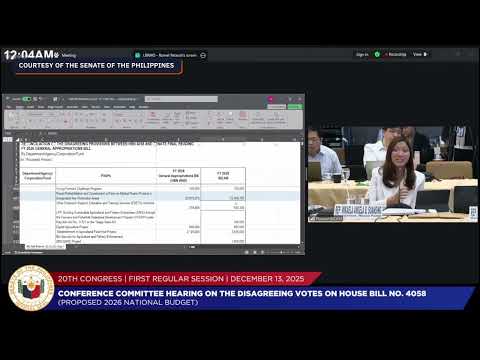
“I want to see countryside development. Rest assured, that is what’s in my heart. But I cannot stand to see corruption continue to happen,” Cayetano said.
‘Soft pork’ in health?
House and Senate lawmakers agreed to increase funding for the Department of Health’s (DOH) MAIFIP program (Medical Assistance for Indigent and Financially Incapacitated Patients) to P51 billion from P49 billion.
The program offers financial assistance to cover the medical costs for indigent patients. It is also among the four social aid programs criticized by budget watchdogs as a form of pork.
Senators raised concerns that the program would perpetuate political patronage since recipients often relied on guarantee letters from politicians to receive funds. But the House contingent argued that reducing funding for MAIFIP would affect some 1.1 million patients since the universal healthcare law has yet to be fully implemented.
“Until such time that the UHC law is really completely properly implemented and PhilHealth is able to handle all of this, I believe that we must provide for the poorest of the poor,” said Senator Loren Legarda.
Lawmakers from both chambers of Congress also agreed to tighten the wording of a general provision that prohibits elected officials from participating in ayuda (social aid) distribution since the current language only covers cash transfers.
From PhilHealth to foreign-assisted projects
Senator Imee Marcos also questioned how the Department of Finance used the P60 billion in “excess” Philippine Health Insurance Corporation (PhilHealth) funds that were transferred to the national treasury in 2024.
Bataan 2nd District Representative Abet Garcia explained that the funding went to the following programs:
- Health emergency allowance for frontline health workers during the COVID-19 pandemic – P27.45 billion
- Foreign-assisted projects – P13 billion
- MAIFIP – P10 billion
- Procurement of various medical equipment for DOH hospitals – P4.1 billion
- Funding for three DOH health facilities – P3.37 billion
- Health Facilities Enhancement Program – P1.69 billion
Marcos’ remarks come after the Supreme Court ordered the return of P60 billion, which will be done through an appropriation in the 2026 spending plan.
Garcia also said they would require PhilHealth to submit a detailed breakdown and clarify how future appropriations would comply with the high court’s ruling.
Education gets lion’s share
The bicam approved a whopping P1.38 trillion in funding for agencies in the education sector, which includes the Department of Education (DepEd), state universities and colleges (SUCs), and the Commission on Higher Education (CHED).
DepEd’s Office of the Secretary will receive P961 billion in funding, SUCs will get P138 billion, while CHED will receive P47 billion.
Lawmakers from both the House and Senate also agreed to transfer P2 billion of funding for the Tulong Dunong student assistance program to CHED from the SUCs. They believed the move would streamline implementation and allow more students to access assistance.
Under the Tulong Dunong program, eligible students with a combined gross income of less than P400,000 can receive P15,000 in assistance per academic year.
The Bicam meeting will resume on Sunday, December 14, at 2 pm. – Rappler.com
Sorumluluk Reddi: Bu sitede yeniden yayınlanan makaleler, halka açık platformlardan alınmıştır ve yalnızca bilgilendirme amaçlıdır. MEXC'nin görüşlerini yansıtmayabilir. Tüm hakları telif sahiplerine aittir. Herhangi bir içeriğin üçüncü taraf haklarını ihlal ettiğini düşünüyorsanız, kaldırılması için lütfen service@support.mexc.com ile iletişime geçin. MEXC, içeriğin doğruluğu, eksiksizliği veya güncelliği konusunda hiçbir garanti vermez ve sağlanan bilgilere dayalı olarak alınan herhangi bir eylemden sorumlu değildir. İçerik, finansal, yasal veya diğer profesyonel tavsiye niteliğinde değildir ve MEXC tarafından bir tavsiye veya onay olarak değerlendirilmemelidir.
Ayrıca Şunları da Beğenebilirsiniz

How Football Became Crypto’s Biggest Gateway Drug
The post How Football Became Crypto’s Biggest Gateway Drug appeared on BitcoinEthereumNews.com. In little over a month between October and November of 2025, the
Paylaş
BitcoinEthereumNews2025/12/15 00:11

Zero Knowledge Proof’s Presale Auction Goes Viral While Chainlink & Ethereum Trade Flat
The post Zero Knowledge Proof’s Presale Auction Goes Viral While Chainlink & Ethereum Trade Flat appeared on BitcoinEthereumNews.com. Crypto Projects See how Chainlink
Paylaş
BitcoinEthereumNews2025/12/14 23:58

Summarize Any Stock’s Earnings Call in Seconds Using FMP API
Turn lengthy earnings call transcripts into one-page insights using the Financial Modeling Prep APIPhoto by Bich Tran
Earnings calls are packed with insights. They tell you how a company performed, what management expects in the future, and what analysts are worried about. The challenge is that these transcripts often stretch across dozens of pages, making it tough to separate the key takeaways from the noise.
With the right tools, you don’t need to spend hours reading every line. By combining the Financial Modeling Prep (FMP) API with Groq’s lightning-fast LLMs, you can transform any earnings call into a concise summary in seconds. The FMP API provides reliable access to complete transcripts, while Groq handles the heavy lifting of distilling them into clear, actionable highlights.
In this article, we’ll build a Python workflow that brings these two together. You’ll see how to fetch transcripts for any stock, prepare the text, and instantly generate a one-page summary. Whether you’re tracking Apple, NVIDIA, or your favorite growth stock, the process works the same — fast, accurate, and ready whenever you are.
Fetching Earnings Transcripts with FMP API
The first step is to pull the raw transcript data. FMP makes this simple with dedicated endpoints for earnings calls. If you want the latest transcripts across the market, you can use the stable endpoint /stable/earning-call-transcript-latest. For a specific stock, the v3 endpoint lets you request transcripts by symbol, quarter, and year using the pattern:
https://financialmodelingprep.com/api/v3/earning_call_transcript/{symbol}?quarter={q}&year={y}&apikey=YOUR_API_KEY
here’s how you can fetch NVIDIA’s transcript for a given quarter:
import requestsAPI_KEY = "your_api_key"symbol = "NVDA"quarter = 2year = 2024url = f"https://financialmodelingprep.com/api/v3/earning_call_transcript/{symbol}?quarter={quarter}&year={year}&apikey={API_KEY}"response = requests.get(url)data = response.json()# Inspect the keysprint(data.keys())# Access transcript contentif "content" in data[0]: transcript_text = data[0]["content"] print(transcript_text[:500]) # preview first 500 characters
The response typically includes details like the company symbol, quarter, year, and the full transcript text. If you aren’t sure which quarter to query, the “latest transcripts” endpoint is the quickest way to always stay up to date.
Cleaning and Preparing Transcript Data
Raw transcripts from the API often include long paragraphs, speaker tags, and formatting artifacts. Before sending them to an LLM, it helps to organize the text into a cleaner structure. Most transcripts follow a pattern: prepared remarks from executives first, followed by a Q&A session with analysts. Separating these sections gives better control when prompting the model.
In Python, you can parse the transcript and strip out unnecessary characters. A simple way is to split by markers such as “Operator” or “Question-and-Answer.” Once separated, you can create two blocks — Prepared Remarks and Q&A — that will later be summarized independently. This ensures the model handles each section within context and avoids missing important details.
Here’s a small example of how you might start preparing the data:
import re# Example: using the transcript_text we fetched earliertext = transcript_text# Remove extra spaces and line breaksclean_text = re.sub(r'\s+', ' ', text).strip()# Split sections (this is a heuristic; real-world transcripts vary slightly)if "Question-and-Answer" in clean_text: prepared, qna = clean_text.split("Question-and-Answer", 1)else: prepared, qna = clean_text, ""print("Prepared Remarks Preview:\n", prepared[:500])print("\nQ&A Preview:\n", qna[:500])
With the transcript cleaned and divided, you’re ready to feed it into Groq’s LLM. Chunking may be necessary if the text is very long. A good approach is to break it into segments of a few thousand tokens, summarize each part, and then merge the summaries in a final pass.
Summarizing with Groq LLM
Now that the transcript is clean and split into Prepared Remarks and Q&A, we’ll use Groq to generate a crisp one-pager. The idea is simple: summarize each section separately (for focus and accuracy), then synthesize a final brief.
Prompt design (concise and factual)
Use a short, repeatable template that pushes for neutral, investor-ready language:
You are an equity research analyst. Summarize the following earnings call sectionfor {symbol} ({quarter} {year}). Be factual and concise.Return:1) TL;DR (3–5 bullets)2) Results vs. guidance (what improved/worsened)3) Forward outlook (specific statements)4) Risks / watch-outs5) Q&A takeaways (if present)Text:<<<{section_text}>>>
Python: calling Groq and getting a clean summary
Groq provides an OpenAI-compatible API. Set your GROQ_API_KEY and pick a fast, high-quality model (e.g., a Llama-3.1 70B variant). We’ll write a helper to summarize any text block, then run it for both sections and merge.
import osimport textwrapimport requestsGROQ_API_KEY = os.environ.get("GROQ_API_KEY") or "your_groq_api_key"GROQ_BASE_URL = "https://api.groq.com/openai/v1" # OpenAI-compatibleMODEL = "llama-3.1-70b" # choose your preferred Groq modeldef call_groq(prompt, temperature=0.2, max_tokens=1200): url = f"{GROQ_BASE_URL}/chat/completions" headers = { "Authorization": f"Bearer {GROQ_API_KEY}", "Content-Type": "application/json", } payload = { "model": MODEL, "messages": [ {"role": "system", "content": "You are a precise, neutral equity research analyst."}, {"role": "user", "content": prompt}, ], "temperature": temperature, "max_tokens": max_tokens, } r = requests.post(url, headers=headers, json=payload, timeout=60) r.raise_for_status() return r.json()["choices"][0]["message"]["content"].strip()def build_prompt(section_text, symbol, quarter, year): template = """ You are an equity research analyst. Summarize the following earnings call section for {symbol} ({quarter} {year}). Be factual and concise. Return: 1) TL;DR (3–5 bullets) 2) Results vs. guidance (what improved/worsened) 3) Forward outlook (specific statements) 4) Risks / watch-outs 5) Q&A takeaways (if present) Text: <<< {section_text} >>> """ return textwrap.dedent(template).format( symbol=symbol, quarter=quarter, year=year, section_text=section_text )def summarize_section(section_text, symbol="NVDA", quarter="Q2", year="2024"): if not section_text or section_text.strip() == "": return "(No content found for this section.)" prompt = build_prompt(section_text, symbol, quarter, year) return call_groq(prompt)# Example usage with the cleaned splits from Section 3prepared_summary = summarize_section(prepared, symbol="NVDA", quarter="Q2", year="2024")qna_summary = summarize_section(qna, symbol="NVDA", quarter="Q2", year="2024")final_one_pager = f"""# {symbol} Earnings One-Pager — {quarter} {year}## Prepared Remarks — Key Points{prepared_summary}## Q&A Highlights{qna_summary}""".strip()print(final_one_pager[:1200]) # preview
Tips that keep quality high:
Keep temperature low (≈0.2) for factual tone.
If a section is extremely long, chunk at ~5–8k tokens, summarize each chunk with the same prompt, then ask the model to merge chunk summaries into one section summary before producing the final one-pager.
If you also fetched headline numbers (EPS/revenue, guidance) earlier, prepend them to the prompt as brief context to help the model anchor on the right outcomes.
Building the End-to-End Pipeline
At this point, we have all the building blocks: the FMP API to fetch transcripts, a cleaning step to structure the data, and Groq LLM to generate concise summaries. The final step is to connect everything into a single workflow that can take any ticker and return a one-page earnings call summary.
The flow looks like this:
Input a stock ticker (for example, NVDA).
Use FMP to fetch the latest transcript.
Clean and split the text into Prepared Remarks and Q&A.
Send each section to Groq for summarization.
Merge the outputs into a neatly formatted earnings one-pager.
Here’s how it comes together in Python:
def summarize_earnings_call(symbol, quarter, year, api_key, groq_key): # Step 1: Fetch transcript from FMP url = f"https://financialmodelingprep.com/api/v3/earning_call_transcript/{symbol}?quarter={quarter}&year={year}&apikey={api_key}" resp = requests.get(url) resp.raise_for_status() data = resp.json() if not data or "content" not in data[0]: return f"No transcript found for {symbol} {quarter} {year}" text = data[0]["content"] # Step 2: Clean and split clean_text = re.sub(r'\s+', ' ', text).strip() if "Question-and-Answer" in clean_text: prepared, qna = clean_text.split("Question-and-Answer", 1) else: prepared, qna = clean_text, "" # Step 3: Summarize with Groq prepared_summary = summarize_section(prepared, symbol, quarter, year) qna_summary = summarize_section(qna, symbol, quarter, year) # Step 4: Merge into final one-pager return f"""# {symbol} Earnings One-Pager — {quarter} {year}## Prepared Remarks{prepared_summary}## Q&A Highlights{qna_summary}""".strip()# Example runprint(summarize_earnings_call("NVDA", 2, 2024, API_KEY, GROQ_API_KEY))
With this setup, generating a summary becomes as simple as calling one function with a ticker and date. You can run it inside a notebook, integrate it into a research workflow, or even schedule it to trigger after each new earnings release.
Free Stock Market API and Financial Statements API...
Conclusion
Earnings calls no longer need to feel overwhelming. With the Financial Modeling Prep API, you can instantly access any company’s transcript, and with Groq LLM, you can turn that raw text into a sharp, actionable summary in seconds. This pipeline saves hours of reading and ensures you never miss the key results, guidance, or risks hidden in lengthy remarks. Whether you track tech giants like NVIDIA or smaller growth stocks, the process is the same — fast, reliable, and powered by the flexibility of FMP’s data.
Summarize Any Stock’s Earnings Call in Seconds Using FMP API was originally published in Coinmonks on Medium, where people are continuing the conversation by highlighting and responding to this story
Paylaş
Medium2025/09/18 14:40