The post Stacks Price Prediction 2025, 2026 – 2030: Is STX Crypto Ready For A Surge? appeared first on Coinpedia Fintech News Story Highlights The live price of the Stacks token is . The Stacks price could reach a high of $1.7226 in 2025. With a potential surge, the price may hit $13.93 by 2030. STX Network shows up as a unique identity, leading to a massive increase in its market values. Stacks uses the Proof-of-Transfer (PoX) …The post Stacks Price Prediction 2025, 2026 – 2030: Is STX Crypto Ready For A Surge? appeared first on Coinpedia Fintech News Story Highlights The live price of the Stacks token is . The Stacks price could reach a high of $1.7226 in 2025. With a potential surge, the price may hit $13.93 by 2030. STX Network shows up as a unique identity, leading to a massive increase in its market values. Stacks uses the Proof-of-Transfer (PoX) …

Stacks Price Prediction 2025, 2026 – 2030: Is STX Crypto Ready For A Surge?
2025/11/20 19:30
Stacks (STX) price prediction

The post Stacks Price Prediction 2025, 2026 – 2030: Is STX Crypto Ready For A Surge? appeared first on Coinpedia Fintech News

Story Highlights

  • The live price of the Stacks token is  $ 0.34249478.
  • The Stacks price could reach a high of $1.7226 in 2025.
  • With a potential surge, the price may hit $13.93 by 2030.

STX Network shows up as a unique identity, leading to a massive increase in its market values. Stacks uses the Proof-of-Transfer (PoX) algorithm. It is practical because stakers could acquire Bitcoin by storing STX in their wallets, while miners could perhaps invest Bitcoin and receive STX in exchange.

So, if you are planning to buy Stacks, follow the forecast to the end to know more about the Stacks Price Prediction 2025 and the years to come!

Table of contents

  • Story Highlights
  • STX Price Chart
    • Technical Analysis
  • STX Short-Term Price Prediction
    • Stacks Price Prediction 2025
  • STX Mid-Term Price Prediction
    • Stacks Price Forecast for 2026
    • STX Price Forecast for 2027
  • Stacks Long-Term Price Prediction
    • Stacks Price Prediction for 2028
    • STX Price Prediction for 2029
    • Stacks Price Prediction for 2030
  • Market Analysis
  • CoinPedia’s Stacks Coin Price Prediction
  • FAQs

Stacks Price Today

CryptocurrencyStacks
TokenSTX
Price$0.3425 down -1.23%
Market Cap$ 620,618,089.10
24h Volume$ 17,445,701.1267
Circulating Supply1,812,051,249.5576
Total Supply1,812,051,249.5576
All-Time High$ 3.8406 on 01 April 2024
All-Time Low$ 0.0450 on 13 March 2020

*The statistics are from press time.

STX Price Chart
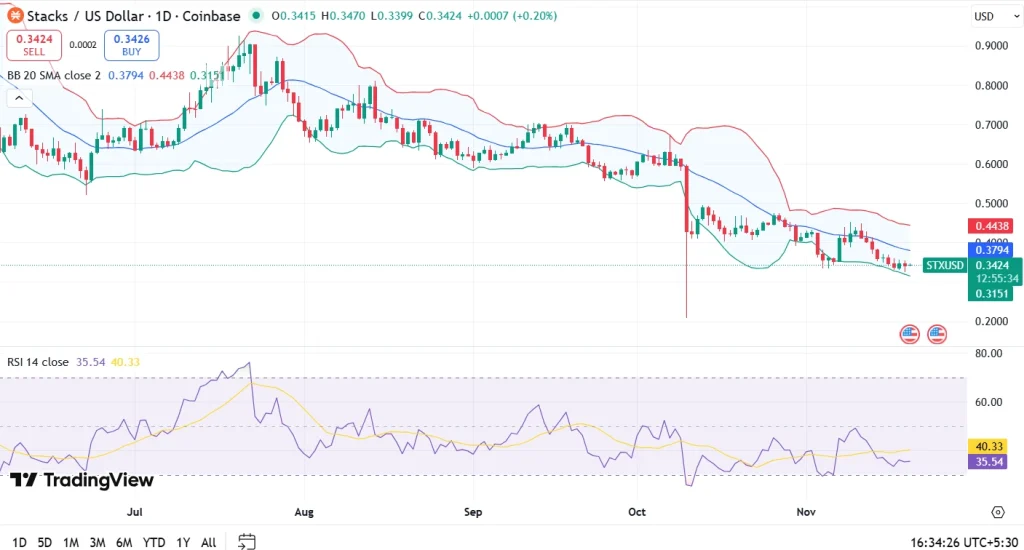
STX price chart 20-11-25

Technical Analysis

Stacks (STX) is trading at $0.3424, just above the lower Bollinger Band at $0.3151. Technicals indicate:

  • Key Support: $0.3151 (lower Bollinger Band), price is stabilizing near this support.
  • Resistance: $0.3794 (20 SMA zone), then $0.4438 (upper Bollinger Band).
  • Indicators: RSI at 35.54 suggests weak bearish momentum, with current conditions closer to the oversold region

STX Short-Term Price Prediction

Stacks Price Prediction 2025

In July 2025, the Stacks Foundation rolled out the “Satoshi Upgrades.” This opens the doors to Dual staking with BTC and STX, programmable Bitcoin vaults, and sBTC fee abstraction to simplify transactions. These updates aim to make Stacks more scalable, faster, and better integrated with Bitcoin.

All these facets will induce its price in 2025 to a maximum of $1.7226. However, pressure in the buying and selling could pull back the price to a minimum of $0.5742, with an average of $1.1484.

YearPotential LowAverage PricePotential High
2025$0.5742$1.1484$1.7226

STX Mid-Term Price Prediction

YearPotential Low ($)Average Price ($)Potential High ($)
20260.86131.72262.5839
20271.29202.58393.8759

Stacks Price Forecast for 2026

Growing interest in mid-cap tokens and improving market conditions could keep the asset between $0.8613 and $2.5839, averaging $1.7226, as traders rotate into projects showing steady activity and liquidity.

STX Price Forecast for 2027

If market momentum strengthens and project engagement improves, the token may rise toward $1.2920–$3.8759, averaging $2.5839, supported by broader participation from long-term holders and renewed speculative demand.

Stacks Long-Term Price Prediction

YearPotential Low ($)Average Price ($)Potential High ($)
20281.93803.87595.8139
20292.90705.81398.7209
20304.36058.720913.93

Stacks Price Prediction for 2028

If the project maintains consistent progress and market sentiment stays supportive, the token may trade between $1.9380 and $5.8139, averaging $3.8759, helped by growing interest in mid-cycle accumulation.

STX Price Prediction for 2029

Stronger liquidity and expanding utility could guide the token toward $2.9070–$8.7209, averaging $5.8139, as investors look for assets with steady development and clearer long-term positioning.

Stacks Price Prediction for 2030

If adoption improves and broader market conditions remain favorable, the token might settle between $4.3605 and $13.93, averaging $8.7209, driven by maturing ecosystem activity and increasing holder confidence.

Market Analysis

Firm Name202520262030
Wallet Investor$2.873$3.926
priceprediction.net$2.64$3.80$17.11
DigitalCoinPrice$4.12$6.04$12.72

*The targets mentioned above are the average targets set by the respective firms.

CoinPedia’s Stacks Coin Price Prediction

Stacks grew in popularity, demonstrating its capability to implement real-world smart contracts on the Bitcoin ecology and platform. As per our price prediction for STX, investing in it can be an excellent long-term asset.

Furthermore, STX added a massive price to its valuation of the year, indicating a strong fundamental for this project. The maximum price of STX can be around $1.7226 by the year-end, with a minimum price margin of $0.5742. Also, the coin will average at $1.1484.

YearPotential LowAverage PricePotential High
2025$0.5742$1.1484$1.7226

FAQs

Is Stacks (STX) a good investment?

With smart contract-based use cases, Stacks represents a significant edge in mining Bitcoin. Hence, it can be an excellent long-term investment.

Is STX legit to buy?

STX is an entirely legit-to-buy coin and is a fully secure official cryptocurrency of Stacks.

How high will the price of STX go by 2030?

With a potential surge, the price may go as high as $13.93 by 2030.

How to buy Stacks?

You can purchase or sell Stacks STX tokens from multiple prominent cryptocurrency exchanges like Binance, KuCoin, Gate.io, OKEx, etc…

What will the maximum price of Stacks be during 2025?

The altcoin could catapult to a maximum of $1.7226 in 2025.

STX
BINANCE
Piyasa Fırsatı
Stacks Logosu
Stacks Fiyatı(STX)
$0.2645
$0.2645$0.2645
-0.11%
USD
Stacks (STX) Canlı Fiyat Grafiği
Sorumluluk Reddi: Bu sitede yeniden yayınlanan makaleler, halka açık platformlardan alınmıştır ve yalnızca bilgilendirme amaçlıdır. MEXC'nin görüşlerini yansıtmayabilir. Tüm hakları telif sahiplerine aittir. Herhangi bir içeriğin üçüncü taraf haklarını ihlal ettiğini düşünüyorsanız, kaldırılması için lütfen service@support.mexc.com ile iletişime geçin. MEXC, içeriğin doğruluğu, eksiksizliği veya güncelliği konusunda hiçbir garanti vermez ve sağlanan bilgilere dayalı olarak alınan herhangi bir eylemden sorumlu değildir. İçerik, finansal, yasal veya diğer profesyonel tavsiye niteliğinde değildir ve MEXC tarafından bir tavsiye veya onay olarak değerlendirilmemelidir.

Ayrıca Şunları da Beğenebilirsiniz

South Korea Launches Innovative Stablecoin Initiative

South Korea Launches Innovative Stablecoin Initiative

The post South Korea Launches Innovative Stablecoin Initiative appeared on BitcoinEthereumNews.com. South Korea has witnessed a pivotal development in its cryptocurrency landscape with BDACS introducing the nation’s first won-backed stablecoin, KRW1, built on the Avalanche network. This stablecoin is anchored by won assets stored at Woori Bank in a 1:1 ratio, ensuring high security. Continue Reading:South Korea Launches Innovative Stablecoin Initiative Source: https://en.bitcoinhaber.net/south-korea-launches-innovative-stablecoin-initiative
Paylaş
BitcoinEthereumNews2025/09/18 17:54
Trump Cancels Tech, AI Trade Negotiations With The UK

Trump Cancels Tech, AI Trade Negotiations With The UK

The US pauses a $41B UK tech and AI deal as trade talks stall, with disputes over food standards, market access, and rules abroad.   The US has frozen a major tech
Paylaş
LiveBitcoinNews2025/12/17 01:00
Summarize Any Stock’s Earnings Call in Seconds Using FMP API

Summarize Any Stock’s Earnings Call in Seconds Using FMP API

Turn lengthy earnings call transcripts into one-page insights using the Financial Modeling Prep APIPhoto by Bich Tran Earnings calls are packed with insights. They tell you how a company performed, what management expects in the future, and what analysts are worried about. The challenge is that these transcripts often stretch across dozens of pages, making it tough to separate the key takeaways from the noise. With the right tools, you don’t need to spend hours reading every line. By combining the Financial Modeling Prep (FMP) API with Groq’s lightning-fast LLMs, you can transform any earnings call into a concise summary in seconds. The FMP API provides reliable access to complete transcripts, while Groq handles the heavy lifting of distilling them into clear, actionable highlights. In this article, we’ll build a Python workflow that brings these two together. You’ll see how to fetch transcripts for any stock, prepare the text, and instantly generate a one-page summary. Whether you’re tracking Apple, NVIDIA, or your favorite growth stock, the process works the same — fast, accurate, and ready whenever you are. Fetching Earnings Transcripts with FMP API The first step is to pull the raw transcript data. FMP makes this simple with dedicated endpoints for earnings calls. If you want the latest transcripts across the market, you can use the stable endpoint /stable/earning-call-transcript-latest. For a specific stock, the v3 endpoint lets you request transcripts by symbol, quarter, and year using the pattern: https://financialmodelingprep.com/api/v3/earning_call_transcript/{symbol}?quarter={q}&year={y}&apikey=YOUR_API_KEY here’s how you can fetch NVIDIA’s transcript for a given quarter: import requestsAPI_KEY = "your_api_key"symbol = "NVDA"quarter = 2year = 2024url = f"https://financialmodelingprep.com/api/v3/earning_call_transcript/{symbol}?quarter={quarter}&year={year}&apikey={API_KEY}"response = requests.get(url)data = response.json()# Inspect the keysprint(data.keys())# Access transcript contentif "content" in data[0]: transcript_text = data[0]["content"] print(transcript_text[:500]) # preview first 500 characters The response typically includes details like the company symbol, quarter, year, and the full transcript text. If you aren’t sure which quarter to query, the “latest transcripts” endpoint is the quickest way to always stay up to date. Cleaning and Preparing Transcript Data Raw transcripts from the API often include long paragraphs, speaker tags, and formatting artifacts. Before sending them to an LLM, it helps to organize the text into a cleaner structure. Most transcripts follow a pattern: prepared remarks from executives first, followed by a Q&A session with analysts. Separating these sections gives better control when prompting the model. In Python, you can parse the transcript and strip out unnecessary characters. A simple way is to split by markers such as “Operator” or “Question-and-Answer.” Once separated, you can create two blocks — Prepared Remarks and Q&A — that will later be summarized independently. This ensures the model handles each section within context and avoids missing important details. Here’s a small example of how you might start preparing the data: import re# Example: using the transcript_text we fetched earliertext = transcript_text# Remove extra spaces and line breaksclean_text = re.sub(r'\s+', ' ', text).strip()# Split sections (this is a heuristic; real-world transcripts vary slightly)if "Question-and-Answer" in clean_text: prepared, qna = clean_text.split("Question-and-Answer", 1)else: prepared, qna = clean_text, ""print("Prepared Remarks Preview:\n", prepared[:500])print("\nQ&A Preview:\n", qna[:500]) With the transcript cleaned and divided, you’re ready to feed it into Groq’s LLM. Chunking may be necessary if the text is very long. A good approach is to break it into segments of a few thousand tokens, summarize each part, and then merge the summaries in a final pass. Summarizing with Groq LLM Now that the transcript is clean and split into Prepared Remarks and Q&A, we’ll use Groq to generate a crisp one-pager. The idea is simple: summarize each section separately (for focus and accuracy), then synthesize a final brief. Prompt design (concise and factual) Use a short, repeatable template that pushes for neutral, investor-ready language: You are an equity research analyst. Summarize the following earnings call sectionfor {symbol} ({quarter} {year}). Be factual and concise.Return:1) TL;DR (3–5 bullets)2) Results vs. guidance (what improved/worsened)3) Forward outlook (specific statements)4) Risks / watch-outs5) Q&A takeaways (if present)Text:<<<{section_text}>>> Python: calling Groq and getting a clean summary Groq provides an OpenAI-compatible API. Set your GROQ_API_KEY and pick a fast, high-quality model (e.g., a Llama-3.1 70B variant). We’ll write a helper to summarize any text block, then run it for both sections and merge. import osimport textwrapimport requestsGROQ_API_KEY = os.environ.get("GROQ_API_KEY") or "your_groq_api_key"GROQ_BASE_URL = "https://api.groq.com/openai/v1" # OpenAI-compatibleMODEL = "llama-3.1-70b" # choose your preferred Groq modeldef call_groq(prompt, temperature=0.2, max_tokens=1200): url = f"{GROQ_BASE_URL}/chat/completions" headers = { "Authorization": f"Bearer {GROQ_API_KEY}", "Content-Type": "application/json", } payload = { "model": MODEL, "messages": [ {"role": "system", "content": "You are a precise, neutral equity research analyst."}, {"role": "user", "content": prompt}, ], "temperature": temperature, "max_tokens": max_tokens, } r = requests.post(url, headers=headers, json=payload, timeout=60) r.raise_for_status() return r.json()["choices"][0]["message"]["content"].strip()def build_prompt(section_text, symbol, quarter, year): template = """ You are an equity research analyst. Summarize the following earnings call section for {symbol} ({quarter} {year}). Be factual and concise. Return: 1) TL;DR (3–5 bullets) 2) Results vs. guidance (what improved/worsened) 3) Forward outlook (specific statements) 4) Risks / watch-outs 5) Q&A takeaways (if present) Text: <<< {section_text} >>> """ return textwrap.dedent(template).format( symbol=symbol, quarter=quarter, year=year, section_text=section_text )def summarize_section(section_text, symbol="NVDA", quarter="Q2", year="2024"): if not section_text or section_text.strip() == "": return "(No content found for this section.)" prompt = build_prompt(section_text, symbol, quarter, year) return call_groq(prompt)# Example usage with the cleaned splits from Section 3prepared_summary = summarize_section(prepared, symbol="NVDA", quarter="Q2", year="2024")qna_summary = summarize_section(qna, symbol="NVDA", quarter="Q2", year="2024")final_one_pager = f"""# {symbol} Earnings One-Pager — {quarter} {year}## Prepared Remarks — Key Points{prepared_summary}## Q&A Highlights{qna_summary}""".strip()print(final_one_pager[:1200]) # preview Tips that keep quality high: Keep temperature low (≈0.2) for factual tone. If a section is extremely long, chunk at ~5–8k tokens, summarize each chunk with the same prompt, then ask the model to merge chunk summaries into one section summary before producing the final one-pager. If you also fetched headline numbers (EPS/revenue, guidance) earlier, prepend them to the prompt as brief context to help the model anchor on the right outcomes. Building the End-to-End Pipeline At this point, we have all the building blocks: the FMP API to fetch transcripts, a cleaning step to structure the data, and Groq LLM to generate concise summaries. The final step is to connect everything into a single workflow that can take any ticker and return a one-page earnings call summary. The flow looks like this: Input a stock ticker (for example, NVDA). Use FMP to fetch the latest transcript. Clean and split the text into Prepared Remarks and Q&A. Send each section to Groq for summarization. Merge the outputs into a neatly formatted earnings one-pager. Here’s how it comes together in Python: def summarize_earnings_call(symbol, quarter, year, api_key, groq_key): # Step 1: Fetch transcript from FMP url = f"https://financialmodelingprep.com/api/v3/earning_call_transcript/{symbol}?quarter={quarter}&year={year}&apikey={api_key}" resp = requests.get(url) resp.raise_for_status() data = resp.json() if not data or "content" not in data[0]: return f"No transcript found for {symbol} {quarter} {year}" text = data[0]["content"] # Step 2: Clean and split clean_text = re.sub(r'\s+', ' ', text).strip() if "Question-and-Answer" in clean_text: prepared, qna = clean_text.split("Question-and-Answer", 1) else: prepared, qna = clean_text, "" # Step 3: Summarize with Groq prepared_summary = summarize_section(prepared, symbol, quarter, year) qna_summary = summarize_section(qna, symbol, quarter, year) # Step 4: Merge into final one-pager return f"""# {symbol} Earnings One-Pager — {quarter} {year}## Prepared Remarks{prepared_summary}## Q&A Highlights{qna_summary}""".strip()# Example runprint(summarize_earnings_call("NVDA", 2, 2024, API_KEY, GROQ_API_KEY)) With this setup, generating a summary becomes as simple as calling one function with a ticker and date. You can run it inside a notebook, integrate it into a research workflow, or even schedule it to trigger after each new earnings release. Free Stock Market API and Financial Statements API... Conclusion Earnings calls no longer need to feel overwhelming. With the Financial Modeling Prep API, you can instantly access any company’s transcript, and with Groq LLM, you can turn that raw text into a sharp, actionable summary in seconds. This pipeline saves hours of reading and ensures you never miss the key results, guidance, or risks hidden in lengthy remarks. Whether you track tech giants like NVIDIA or smaller growth stocks, the process is the same — fast, reliable, and powered by the flexibility of FMP’s data. Summarize Any Stock’s Earnings Call in Seconds Using FMP API was originally published in Coinmonks on Medium, where people are continuing the conversation by highlighting and responding to this story
Paylaş
Medium2025/09/18 14:40