World Liberty Financial (WLFI), the Trump-linked DeFi project, is scrambling to stop a market collapse after its token lost over 50% of its value in September. On Friday, the project unveiled a full buyback-and-burn program, directing all treasury liquidity fees to absorb selling pressure. According to a governance post on X, the community approved the plan overwhelmingly, with WLFI pledging full transparency for every burn. The urgency of the move reflects WLFI’s steep losses in recent weeks. WLFI is trading Friday at $0.19, down from its September 1 peak of $0.46, according to CoinMarketCap, a 58% drop in less than a month. Weekly losses stand at 12.85%, with a 15.45% decline for the month. This isn’t the project’s first attempt at intervention. Just days after launch, WLFI burned 47 million tokens on September 3 to counter a 31% sell-off, sending the supply to a verified burn address. For World Liberty Financial, the buyback-and-burn program represents both a damage-control measure and a test of community faith. While tokenomics adjustments can provide short-term relief, the project will need to convince investors that WLFI has staying power beyond interventions. WLFI Launches Buyback-and-Burn Plan, Linking Token Scarcity to Platform Growth According to the governance proposal, WLFI will use fees generated from its protocol-owned liquidity (POL) pools on Ethereum, BNB Chain, and Solana to repurchase tokens from the open market. Once bought back, the tokens will be sent to a burn address, permanently removing them from circulation.WLFI Proposal Source: WLFI The project stressed that this system ties supply reduction directly to platform growth. As trading activity rises, more liquidity fees are generated, fueling larger buybacks and burns. This seeks to create a feedback loop where adoption drives scarcity, and scarcity strengthens token value. Importantly, the plan applies only to WLFI’s protocol-controlled liquidity pools. Community and third-party liquidity pools remain unaffected, ensuring the mechanism doesn’t interfere with external ecosystem contributions. In its proposal, the WLFI team argued that the strategy aligns long-term holders with the project’s future by systematically reducing supply and discouraging short-term speculation. Each burn increases the relative stake of committed investors, reinforcing confidence in WLFI’s tokenomics. To bolster credibility, WLFI has pledged full transparency: every buyback and burn will be verifiable on-chain and reported to the community in real time. WLFI Joins Hyperliquid, Jupiter, and Sky as Buyback Craze Spills Into Wall Street WLFI’s decision to adopt a full buyback-and-burn strategy places it among the most ambitious tokenomic models in crypto. While partly a response to its sharp September price decline, the move also reflects a trend of DeFi protocols leveraging revenue streams to cut supply, align incentives, and strengthen token value. Hyperliquid illustrates the model at scale. Nearly all of its platform fees are funneled into automated $HYPE buybacks via its Assistance Fund, creating sustained demand. By mid-2025, more than 20 million tokens had been repurchased, with nearly 30 million held by Q3, worth over $1.5 billion. This consistency both increased scarcity and cemented Hyperliquid’s dominance in decentralized derivatives. Other protocols have adopted variations. Jupiter directs half its fees into $JUP repurchases, locking tokens for three years. Raydium earmarks 12% of fees for $RAY buybacks, already removing 71 million tokens, roughly a quarter of the circulating supply. Burn-based models push further, as seen with Sky, which has spent $75 million since February 2025 to permanently erase $SKY tokens, boosting scarcity and governance influence. But the buyback phenomenon isn’t limited to DeFi. Increasingly, listed companies with crypto treasuries are adopting aggressive repurchase programs, sometimes to offset losses as their digital assets decline. According to a report, at least seven firms, ranging from gaming to biotech, have turned to buybacks, often funded by debt, to prop up falling stock prices. One of the latest is Thumzup Media, a digital advertising company with a growing Web3 footprint. On Thursday, it launched a $10 million share repurchase plan, extending its capital return strategy through 2026, after completing a $1 million program that saw 212,432 shares bought at an average of $4.71. DeFi Development Corp, the first public company built around a Solana-based treasury strategy, also recently expanded its buyback program to $100 million, up from $1 million, making it one of the largest stock repurchase initiatives in the digital asset sector. Together, these cases show how buybacks, whether in tokenomics or equities, are emerging as a key mechanism for stabilizing value and signaling confidence, even as motivations and execution vary widelyWorld Liberty Financial (WLFI), the Trump-linked DeFi project, is scrambling to stop a market collapse after its token lost over 50% of its value in September. On Friday, the project unveiled a full buyback-and-burn program, directing all treasury liquidity fees to absorb selling pressure. According to a governance post on X, the community approved the plan overwhelmingly, with WLFI pledging full transparency for every burn. The urgency of the move reflects WLFI’s steep losses in recent weeks. WLFI is trading Friday at $0.19, down from its September 1 peak of $0.46, according to CoinMarketCap, a 58% drop in less than a month. Weekly losses stand at 12.85%, with a 15.45% decline for the month. This isn’t the project’s first attempt at intervention. Just days after launch, WLFI burned 47 million tokens on September 3 to counter a 31% sell-off, sending the supply to a verified burn address. For World Liberty Financial, the buyback-and-burn program represents both a damage-control measure and a test of community faith. While tokenomics adjustments can provide short-term relief, the project will need to convince investors that WLFI has staying power beyond interventions. WLFI Launches Buyback-and-Burn Plan, Linking Token Scarcity to Platform Growth According to the governance proposal, WLFI will use fees generated from its protocol-owned liquidity (POL) pools on Ethereum, BNB Chain, and Solana to repurchase tokens from the open market. Once bought back, the tokens will be sent to a burn address, permanently removing them from circulation.WLFI Proposal Source: WLFI The project stressed that this system ties supply reduction directly to platform growth. As trading activity rises, more liquidity fees are generated, fueling larger buybacks and burns. This seeks to create a feedback loop where adoption drives scarcity, and scarcity strengthens token value. Importantly, the plan applies only to WLFI’s protocol-controlled liquidity pools. Community and third-party liquidity pools remain unaffected, ensuring the mechanism doesn’t interfere with external ecosystem contributions. In its proposal, the WLFI team argued that the strategy aligns long-term holders with the project’s future by systematically reducing supply and discouraging short-term speculation. Each burn increases the relative stake of committed investors, reinforcing confidence in WLFI’s tokenomics. To bolster credibility, WLFI has pledged full transparency: every buyback and burn will be verifiable on-chain and reported to the community in real time. WLFI Joins Hyperliquid, Jupiter, and Sky as Buyback Craze Spills Into Wall Street WLFI’s decision to adopt a full buyback-and-burn strategy places it among the most ambitious tokenomic models in crypto. While partly a response to its sharp September price decline, the move also reflects a trend of DeFi protocols leveraging revenue streams to cut supply, align incentives, and strengthen token value. Hyperliquid illustrates the model at scale. Nearly all of its platform fees are funneled into automated $HYPE buybacks via its Assistance Fund, creating sustained demand. By mid-2025, more than 20 million tokens had been repurchased, with nearly 30 million held by Q3, worth over $1.5 billion. This consistency both increased scarcity and cemented Hyperliquid’s dominance in decentralized derivatives. Other protocols have adopted variations. Jupiter directs half its fees into $JUP repurchases, locking tokens for three years. Raydium earmarks 12% of fees for $RAY buybacks, already removing 71 million tokens, roughly a quarter of the circulating supply. Burn-based models push further, as seen with Sky, which has spent $75 million since February 2025 to permanently erase $SKY tokens, boosting scarcity and governance influence. But the buyback phenomenon isn’t limited to DeFi. Increasingly, listed companies with crypto treasuries are adopting aggressive repurchase programs, sometimes to offset losses as their digital assets decline. According to a report, at least seven firms, ranging from gaming to biotech, have turned to buybacks, often funded by debt, to prop up falling stock prices. One of the latest is Thumzup Media, a digital advertising company with a growing Web3 footprint. On Thursday, it launched a $10 million share repurchase plan, extending its capital return strategy through 2026, after completing a $1 million program that saw 212,432 shares bought at an average of $4.71. DeFi Development Corp, the first public company built around a Solana-based treasury strategy, also recently expanded its buyback program to $100 million, up from $1 million, making it one of the largest stock repurchase initiatives in the digital asset sector. Together, these cases show how buybacks, whether in tokenomics or equities, are emerging as a key mechanism for stabilizing value and signaling confidence, even as motivations and execution vary widely

Trump-Backed WLFI Plunges 58% – Buyback Plan Announced to Halt Freefall

World Liberty Financial (WLFI), the Trump-linked DeFi project, is scrambling to stop a market collapse after its token lost over 50% of its value in September.

On Friday, the project unveiled a full buyback-and-burn program, directing all treasury liquidity fees to absorb selling pressure. According to a governance post on X, the community approved the plan overwhelmingly, with WLFI pledging full transparency for every burn.

The urgency of the move reflects WLFI’s steep losses in recent weeks. WLFI is trading Friday at $0.19, down from its September 1 peak of $0.46, according to CoinMarketCap, a 58% drop in less than a month. Weekly losses stand at 12.85%, with a 15.45% decline for the month.

This isn’t the project’s first attempt at intervention. Just days after launch, WLFI burned 47 million tokens on September 3 to counter a 31% sell-off, sending the supply to a verified burn address.

For World Liberty Financial, the buyback-and-burn program represents both a damage-control measure and a test of community faith. While tokenomics adjustments can provide short-term relief, the project will need to convince investors that WLFI has staying power beyond interventions.

WLFI Launches Buyback-and-Burn Plan, Linking Token Scarcity to Platform Growth

According to the governance proposal, WLFI will use fees generated from its protocol-owned liquidity (POL) pools on Ethereum, BNB Chain, and Solana to repurchase tokens from the open market. Once bought back, the tokens will be sent to a burn address, permanently removing them from circulation.
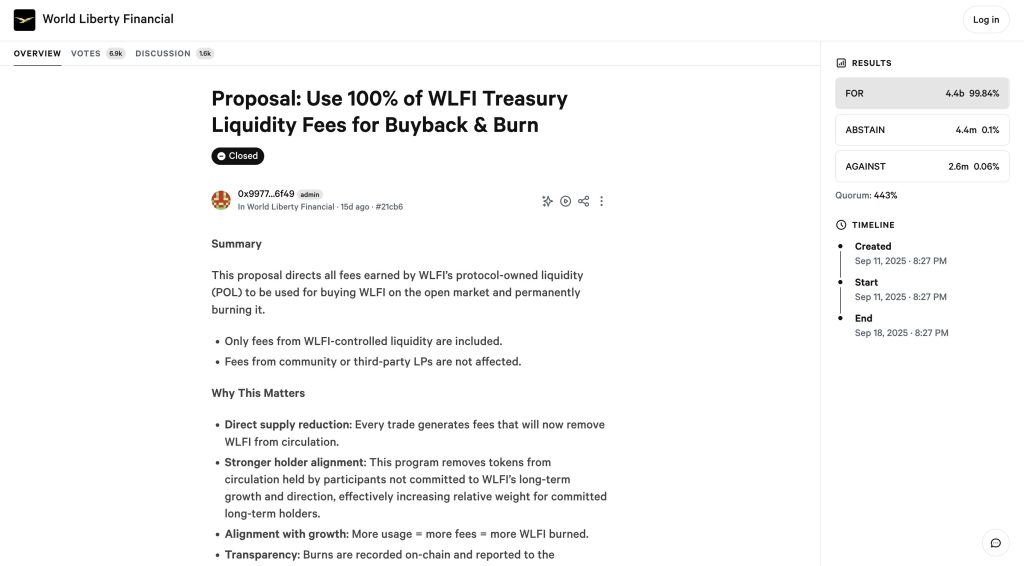
WLFI Proposal Source: WLFI

The project stressed that this system ties supply reduction directly to platform growth. As trading activity rises, more liquidity fees are generated, fueling larger buybacks and burns. This seeks to create a feedback loop where adoption drives scarcity, and scarcity strengthens token value.

Importantly, the plan applies only to WLFI’s protocol-controlled liquidity pools. Community and third-party liquidity pools remain unaffected, ensuring the mechanism doesn’t interfere with external ecosystem contributions.

In its proposal, the WLFI team argued that the strategy aligns long-term holders with the project’s future by systematically reducing supply and discouraging short-term speculation. Each burn increases the relative stake of committed investors, reinforcing confidence in WLFI’s tokenomics.

To bolster credibility, WLFI has pledged full transparency: every buyback and burn will be verifiable on-chain and reported to the community in real time.

WLFI Joins Hyperliquid, Jupiter, and Sky as Buyback Craze Spills Into Wall Street

WLFI’s decision to adopt a full buyback-and-burn strategy places it among the most ambitious tokenomic models in crypto. While partly a response to its sharp September price decline, the move also reflects a trend of DeFi protocols leveraging revenue streams to cut supply, align incentives, and strengthen token value.

Hyperliquid illustrates the model at scale. Nearly all of its platform fees are funneled into automated $HYPE buybacks via its Assistance Fund, creating sustained demand.

By mid-2025, more than 20 million tokens had been repurchased, with nearly 30 million held by Q3, worth over $1.5 billion. This consistency both increased scarcity and cemented Hyperliquid’s dominance in decentralized derivatives.

Other protocols have adopted variations. Jupiter directs half its fees into $JUP repurchases, locking tokens for three years.

Raydium earmarks 12% of fees for $RAY buybacks, already removing 71 million tokens, roughly a quarter of the circulating supply.

Burn-based models push further, as seen with Sky, which has spent $75 million since February 2025 to permanently erase $SKY tokens, boosting scarcity and governance influence.

But the buyback phenomenon isn’t limited to DeFi. Increasingly, listed companies with crypto treasuries are adopting aggressive repurchase programs, sometimes to offset losses as their digital assets decline.

According to a report, at least seven firms, ranging from gaming to biotech, have turned to buybacks, often funded by debt, to prop up falling stock prices.

One of the latest is Thumzup Media, a digital advertising company with a growing Web3 footprint. On Thursday, it launched a $10 million share repurchase plan, extending its capital return strategy through 2026, after completing a $1 million program that saw 212,432 shares bought at an average of $4.71.

DeFi Development Corp, the first public company built around a Solana-based treasury strategy, also recently expanded its buyback program to $100 million, up from $1 million, making it one of the largest stock repurchase initiatives in the digital asset sector.

Together, these cases show how buybacks, whether in tokenomics or equities, are emerging as a key mechanism for stabilizing value and signaling confidence, even as motivations and execution vary widely.

Piyasa Fırsatı
OFFICIAL TRUMP Logosu
OFFICIAL TRUMP Fiyatı(TRUMP)
$5,21
$5,21$5,21
-1,04%
USD
OFFICIAL TRUMP (TRUMP) Canlı Fiyat Grafiği
Sorumluluk Reddi: Bu sitede yeniden yayınlanan makaleler, halka açık platformlardan alınmıştır ve yalnızca bilgilendirme amaçlıdır. MEXC'nin görüşlerini yansıtmayabilir. Tüm hakları telif sahiplerine aittir. Herhangi bir içeriğin üçüncü taraf haklarını ihlal ettiğini düşünüyorsanız, kaldırılması için lütfen service@support.mexc.com ile iletişime geçin. MEXC, içeriğin doğruluğu, eksiksizliği veya güncelliği konusunda hiçbir garanti vermez ve sağlanan bilgilere dayalı olarak alınan herhangi bir eylemden sorumlu değildir. İçerik, finansal, yasal veya diğer profesyonel tavsiye niteliğinde değildir ve MEXC tarafından bir tavsiye veya onay olarak değerlendirilmemelidir.

Ayrıca Şunları da Beğenebilirsiniz

How to earn from cloud mining: IeByte’s upgraded auto-cloud mining platform unlocks genuine passive earnings

How to earn from cloud mining: IeByte’s upgraded auto-cloud mining platform unlocks genuine passive earnings

The post How to earn from cloud mining: IeByte’s upgraded auto-cloud mining platform unlocks genuine passive earnings appeared on BitcoinEthereumNews.com. contributor Posted: September 17, 2025 As digital assets continue to reshape global finance, cloud mining has become one of the most effective ways for investors to generate stable passive income. Addressing the growing demand for simplicity, security, and profitability, IeByte has officially upgraded its fully automated cloud mining platform, empowering both beginners and experienced investors to earn Bitcoin, Dogecoin, and other mainstream cryptocurrencies without the need for hardware or technical expertise. Why cloud mining in 2025? Traditional crypto mining requires expensive hardware, high electricity costs, and constant maintenance. In 2025, with blockchain networks becoming more competitive, these barriers have grown even higher. Cloud mining solves this by allowing users to lease professional mining power remotely, eliminating the upfront costs and complexity. IeByte stands at the forefront of this transformation, offering investors a transparent and seamless path to daily earnings. IeByte’s upgraded auto-cloud mining platform With its latest upgrade, IeByte introduces: Full Automation: Mining contracts can be activated in just one click, with all processes handled by IeByte’s servers. Enhanced Security: Bank-grade encryption, cold wallets, and real-time monitoring protect every transaction. Scalable Options: From starter packages to high-level investment contracts, investors can choose the plan that matches their goals. Global Reach: Already trusted by users in over 100 countries. Mining contracts for 2025 IeByte offers a wide range of contracts tailored for every investor level. From entry-level plans with daily returns to premium high-yield packages, the platform ensures maximum accessibility. Contract Type Duration Price Daily Reward Total Earnings (Principal + Profit) Starter Contract 1 Day $200 $6 $200 + $6 + $10 bonus Bronze Basic Contract 2 Days $500 $13.5 $500 + $27 Bronze Basic Contract 3 Days $1,200 $36 $1,200 + $108 Silver Advanced Contract 1 Day $5,000 $175 $5,000 + $175 Silver Advanced Contract 2 Days $8,000 $320 $8,000 + $640 Silver…
Paylaş
BitcoinEthereumNews2025/09/17 23:48
The aftermath of the energy war: As Microsoft, BlackRock monopolize infrastructure, Eden Miner becomes retail’s last backdoor to the “hashrate yield network”

The aftermath of the energy war: As Microsoft, BlackRock monopolize infrastructure, Eden Miner becomes retail’s last backdoor to the “hashrate yield network”

As mining goes institutional in 2025, Eden Miner opens retail access to hashrate investing through a new model. The year 2025 marks a watershed moment for global
Paylaş
Crypto.news2025/12/17 00:08
Why The Green Bay Packers Must Take The Cleveland Browns Seriously — As Hard As That Might Be

Why The Green Bay Packers Must Take The Cleveland Browns Seriously — As Hard As That Might Be

The post Why The Green Bay Packers Must Take The Cleveland Browns Seriously — As Hard As That Might Be appeared on BitcoinEthereumNews.com. Jordan Love and the Green Bay Packers are off to a 2-0 start. Getty Images The Green Bay Packers are, once again, one of the NFL’s better teams. The Cleveland Browns are, once again, one of the league’s doormats. It’s why unbeaten Green Bay (2-0) is a 8-point favorite at winless Cleveland (0-2) Sunday according to betmgm.com. The money line is also Green Bay -500. Most expect this to be a Packers’ rout, and it very well could be. But Green Bay knows taking anyone in this league for granted can prove costly. “I think if you look at their roster, the paper, who they have on that team, what they can do, they got a lot of talent and things can turn around quickly for them,” Packers safety Xavier McKinney said. “We just got to kind of keep that in mind and know we not just walking into something and they just going to lay down. That’s not what they going to do.” The Browns certainly haven’t laid down on defense. Far from. Cleveland is allowing an NFL-best 191.5 yards per game. The Browns gave up 141 yards to Cincinnati in Week 1, including just seven in the second half, but still lost, 17-16. Cleveland has given up an NFL-best 45.5 rushing yards per game and just 2.1 rushing yards per attempt. “The biggest thing is our defensive line is much, much improved over last year and I think we’ve got back to our personality,” defensive coordinator Jim Schwartz said recently. “When we play our best, our D-line leads us there as our engine.” The Browns rank third in the league in passing defense, allowing just 146.0 yards per game. Cleveland has also gone 30 straight games without allowing a 300-yard passer, the longest active streak in the NFL.…
Paylaş
BitcoinEthereumNews2025/09/18 00:41