The post Is This the Start of an Altseason? 3 Indicators to Watch Right Now appeared first on Coinpedia Fintech News Altcoins have begun to show early signs of The post Is This the Start of an Altseason? 3 Indicators to Watch Right Now appeared first on Coinpedia Fintech News Altcoins have begun to show early signs of

Is This the Start of an Altseason? 3 Indicators to Watch Right Now


2026/03/17 18:42
3 min read
For feedback or concerns regarding this content, please contact us at crypto.news@mexc.com
Altcoin Season

The post Is This the Start of an Altseason? 3 Indicators to Watch Right Now appeared first on Coinpedia Fintech News

Altcoins have begun to show early signs of strength after weeks of consolidation and weak sentiment. Key market-wide indicators, including OTHERS (cryptos excluding top 10), TOTAL3 (market cap excluding BTC & ETH), and the ETH/BTC pair, have broken out of their respective accumulation structures. This movement suggests a potential shift in market dynamics, with capital gradually rotating from Bitcoin into altcoins. 

While the broader market still reflects a recovery phase, the emerging structure points toward the early stages of an altcoin expansion. With momentum now building across multiple segments of the market, the question arises whether it is the beginning of an Altseason?

OTHERS Breakout Signals Strength Beyond Top 10

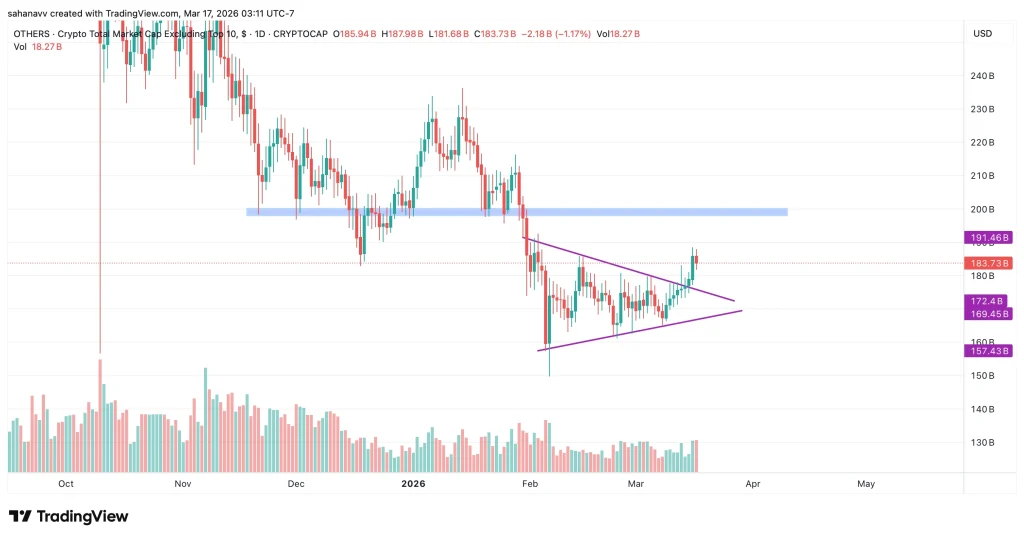
The OTHERS index, which tracks altcoins outside the top 10, has broken out of a descending triangle pattern after weeks of compression. This breakout signals a shift in momentum, with capital beginning to flow into mid- and low-cap assets.
altseason

The move also reflects a transition from a period of lower highs and weak sentiment to early-stage expansion. If sustained, this breakout could push the index toward reclaiming the $200 billion range, marking a broader improvement in altcoin participation beyond large-cap tokens.

TOTAL3 Reclaims Resistance, Reinforcing Market Structure Shift

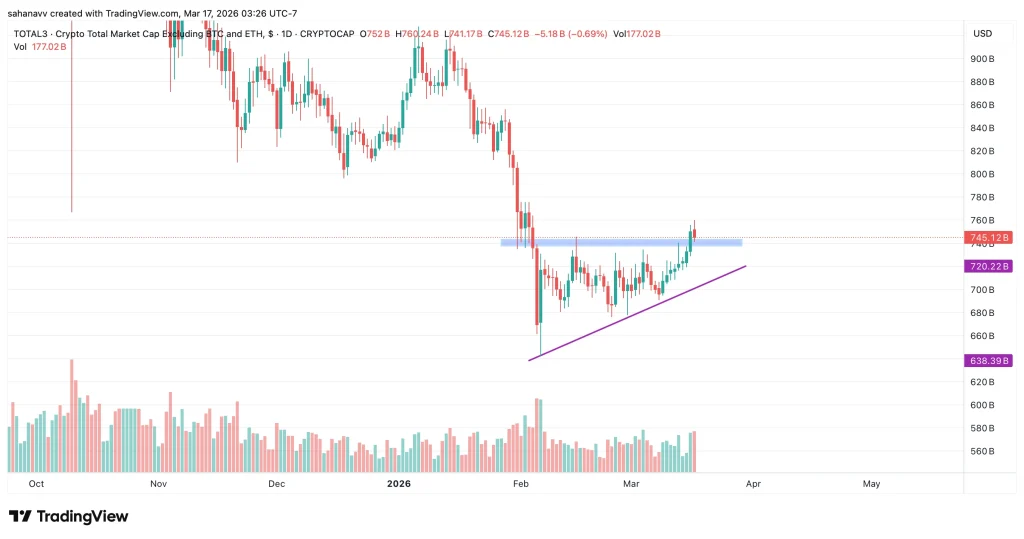
TOTAL3, representing the total market capitalization of altcoins excluding Bitcoin and Ethereum, has moved above a key resistance zone after forming a series of higher lows. This structure indicates strengthening demand and a gradual transition toward a bullish trend.
altseason

The breakout suggests that the market is shifting away from a distribution phase and entering accumulation, with buyers stepping in at higher levels. A sustained move above current levels could open the path toward the $800 billion zone, reinforcing the case for a broader altcoin recovery.

ETH/BTC Strength Signals Early Capital Rotation

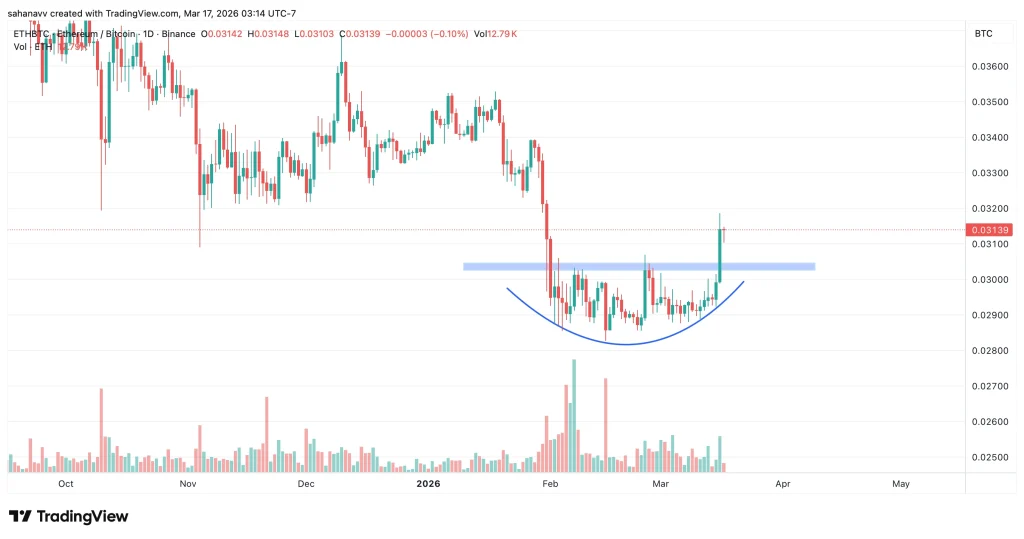
The ETH/BTC pair has also shown a notable shift in structure, forming a rounded bottom and reclaiming a key resistance level. This move indicates improving relative strength for Ethereum against Bitcoin, a critical signal often associated with early altcoin outperformance.
altseason

Sustained strength in this pair is essential for a broader altcoin expansion. If Ethereum continues to gain against Bitcoin, it could act as a leading indicator for further capital rotation into the altcoin market.

Key Levels to Watch for Confirmation

Despite the improving structure, confirmation of a sustained altcoin rally will depend on holding above key levels.

  • OTHERS: Reclaim of $200B+
  • TOTAL3: Sustaining above the $800B zone
  • ETH/BTC: Continued strength above breakout levels

Failure to hold these levels could weaken the current setup and delay further expansion.

Wrapping it Up!

Altcoins are showing early signs of expansion, supported by breakouts across multiple key indicators and improving market structure. However, this remains a developing trend rather than a confirmed altseason. Sustained strength and follow-through above key levels will be critical in determining whether this move evolves into a broader and more durable altcoin rally.

Disclaimer: The articles reposted on this site are sourced from public platforms and are provided for informational purposes only. They do not necessarily reflect the views of MEXC. All rights remain with the original authors. If you believe any content infringes on third-party rights, please contact crypto.news@mexc.com for removal. MEXC makes no guarantees regarding the accuracy, completeness, or timeliness of the content and is not responsible for any actions taken based on the information provided. The content does not constitute financial, legal, or other professional advice, nor should it be considered a recommendation or endorsement by MEXC.

You May Also Like

Steel Dynamics (STLD) Stock Dips Following Disappointing Q1 Earnings Forecast

Steel Dynamics (STLD) Stock Dips Following Disappointing Q1 Earnings Forecast

Steel Dynamics (STLD) stock dropped 1.3% premarket after issuing Q1 EPS guidance of $2.73–$2.77, significantly below the $3.24 Wall Street consensus. The post Steel
Share
Blockonomi2026/03/17 21:45
EUR/CHF slides as Euro struggles post-inflation data

EUR/CHF slides as Euro struggles post-inflation data

The post EUR/CHF slides as Euro struggles post-inflation data appeared on BitcoinEthereumNews.com. EUR/CHF weakens for a second straight session as the euro struggles to recover post-Eurozone inflation data. Eurozone core inflation steady at 2.3%, headline CPI eases to 2.0% in August. SNB maintains a flexible policy outlook ahead of its September 25 decision, with no immediate need for easing. The Euro (EUR) trades under pressure against the Swiss Franc (CHF) on Wednesday, with EUR/CHF extending losses for the second straight session as the common currency struggles to gain traction following Eurozone inflation data. At the time of writing, the cross is trading around 0.9320 during the American session. The latest inflation data from Eurostat showed that Eurozone price growth remained broadly stable in August, reinforcing the European Central Bank’s (ECB) cautious stance on monetary policy. The Core Harmonized Index of Consumer Prices (HICP), which excludes volatile items such as food and energy, rose 2.3% YoY, in line with both forecasts and the previous month’s reading. On a monthly basis, core inflation increased by 0.3%, unchanged from July, highlighting persistent underlying price pressures in the bloc. Meanwhile, headline inflation eased to 2.0% YoY in August, down from 2.1% in July and slightly below expectations. On a monthly basis, prices rose just 0.1%, missing forecasts for a 0.2% increase and decelerating from July’s 0.2% rise. The inflation release follows last week’s ECB policy decision, where the central bank kept all three key interest rates unchanged and signaled that policy is likely at its terminal level. While officials acknowledged progress in bringing inflation down, they reiterated a cautious, data-dependent approach going forward, emphasizing the need to maintain restrictive conditions for an extended period to ensure price stability. On the Swiss side, disinflation appears to be deepening. The Producer and Import Price Index dropped 0.6% in August, marking a sharp 1.8% annual decline. Broader inflation remains…
Share
BitcoinEthereumNews2025/09/18 03:08
New York Regulators Push Banks to Adopt Blockchain Analytics

New York Regulators Push Banks to Adopt Blockchain Analytics

New York’s top financial regulator urged banks to adopt blockchain analytics, signaling tighter oversight of crypto-linked risks. The move reflects regulators’ concern that traditional institutions face rising exposure to digital assets. While crypto-native firms already rely on monitoring tools, the Department of Financial Services now expects banks to use them to detect illicit activity. NYDFS Outlines Compliance Expectations The notice, issued on Wednesday by Superintendent Adrienne Harris, applies to all state-chartered banks and foreign branches. In its industry letter, the New York State Department of Financial Services (NYDFS) emphasized that blockchain analytics should be integrated into compliance programs according to each bank’s size, operations, and risk appetite. The regulator cautioned that crypto markets evolve quickly, requiring institutions to update frameworks regularly. “Emerging technologies introduce evolving threats that require enhanced monitoring tools,” the notice stated. It stressed the need for banks to prevent money laundering, sanctions violations, and other illicit finance linked to virtual currency transactions. To that end, the Department listed specific areas where blockchain analytics can be applied: Screening customer wallets with crypto exposure to assess risks. Verifying the origin of funds from virtual asset service providers (VASPs). Monitoring the ecosystem holistically to detect money laundering or sanctions exposure. Identifying and assessing counterparties, such as third-party VASPs. Evaluating expected versus actual transaction activity, including dollar thresholds. Weighing risks tied to new digital asset products before rollout. These examples highlight how institutions can tailor monitoring tools to strengthen their risk management frameworks. The guidance expands on NYDFS’s Virtual Currency-Related Activities (VCRA) framework, which has governed crypto oversight in the state since 2022. Regulators Signal Broader Impact Market observers say the notice is less about new rules and more about clarifying expectations. By formalizing the role of blockchain analytics in traditional finance, New York is reinforcing the idea that banks cannot treat crypto exposure as a niche concern. Analysts also believe the approach could ripple beyond New York. Federal agencies and regulators in other states may view the guidance as a blueprint for aligning banking oversight with the realities of digital asset adoption. For institutions, failure to adopt blockchain intelligence tools may invite regulatory scrutiny and undermine their ability to safeguard customer trust. With crypto now firmly embedded in global finance, New York’s stance suggests that blockchain analytics are no longer optional for banks — they are essential to protecting the financial system’s integrity.
Share
Coinstats2025/09/18 08:49