The post Solana’s Alpenglow Upgrade Secures Approval, but Faces Challenges appeared on BitcoinEthereumNews.com. Solana validators approved an update that aims to settle transactions in just 150 milliseconds. Solana validators last week approved a consensus upgrade for the network that would cut transaction finality dramatically. But some experts are concerned that faster finality brings tradeoffs, including in security. Over 98% of nodes backed the new Alpenglow upgrade, according to a Sept. 2 post from Solana Status on X. The updated consensus protocol for Solana, developed by Anza, a spinoff from Solana Labs, is expected to bring near-instant finality to transactions, reducing the current 12-second wait to just 150 milliseconds. For Solana, Alpenglow marks one of its boldest technical moves since the network’s outages in 2022 and 2023. If it works as intended, the upgrade will replace older systems like proof-of-history voting and gossip messaging, with a leaner design where most of the consensus runs off-chain. Rather than each validator pushing votes directly onto the chain, they’ll bundle them into compact certificates. Muriel Médard, an award-winning professor of software science and engineering at MIT, as well as the co-founder of blockchain infra company Optimum, told The Defiant that latency reduction and the desire to be at speeds compatible with web2 lie at the heart of Alpenglow. “This an important goal and one that per se much of the Web3 community applauds. The question is not so much whether this is a reasonable desideratum but whether the tech can actually achieve it,” Médard said. Security Compromises There’s no fixed timeline yet for Alpenglow, as it still needs to go through testing to verify security. If everything stays on track, Solana RPC firm Helius expects the upgrade to reach the mainnet by early 2026. Other networks, including Coinbase’s Base, Unichain, and BNB Chain, are also pushing for faster finality. For instance, in mid-July, Base rolled out Flashblocks,… The post Solana’s Alpenglow Upgrade Secures Approval, but Faces Challenges appeared on BitcoinEthereumNews.com. Solana validators approved an update that aims to settle transactions in just 150 milliseconds. Solana validators last week approved a consensus upgrade for the network that would cut transaction finality dramatically. But some experts are concerned that faster finality brings tradeoffs, including in security. Over 98% of nodes backed the new Alpenglow upgrade, according to a Sept. 2 post from Solana Status on X. The updated consensus protocol for Solana, developed by Anza, a spinoff from Solana Labs, is expected to bring near-instant finality to transactions, reducing the current 12-second wait to just 150 milliseconds. For Solana, Alpenglow marks one of its boldest technical moves since the network’s outages in 2022 and 2023. If it works as intended, the upgrade will replace older systems like proof-of-history voting and gossip messaging, with a leaner design where most of the consensus runs off-chain. Rather than each validator pushing votes directly onto the chain, they’ll bundle them into compact certificates. Muriel Médard, an award-winning professor of software science and engineering at MIT, as well as the co-founder of blockchain infra company Optimum, told The Defiant that latency reduction and the desire to be at speeds compatible with web2 lie at the heart of Alpenglow. “This an important goal and one that per se much of the Web3 community applauds. The question is not so much whether this is a reasonable desideratum but whether the tech can actually achieve it,” Médard said. Security Compromises There’s no fixed timeline yet for Alpenglow, as it still needs to go through testing to verify security. If everything stays on track, Solana RPC firm Helius expects the upgrade to reach the mainnet by early 2026. Other networks, including Coinbase’s Base, Unichain, and BNB Chain, are also pushing for faster finality. For instance, in mid-July, Base rolled out Flashblocks,…

Solana’s Alpenglow Upgrade Secures Approval, but Faces Challenges

Solana validators approved an update that aims to settle transactions in just 150 milliseconds.

Solana validators last week approved a consensus upgrade for the network that would cut transaction finality dramatically. But some experts are concerned that faster finality brings tradeoffs, including in security.

Over 98% of nodes backed the new Alpenglow upgrade, according to a Sept. 2 post from Solana Status on X. The updated consensus protocol for Solana, developed by Anza, a spinoff from Solana Labs, is expected to bring near-instant finality to transactions, reducing the current 12-second wait to just 150 milliseconds.

For Solana, Alpenglow marks one of its boldest technical moves since the network’s outages in 2022 and 2023.

If it works as intended, the upgrade will replace older systems like proof-of-history voting and gossip messaging, with a leaner design where most of the consensus runs off-chain. Rather than each validator pushing votes directly onto the chain, they’ll bundle them into compact certificates.

Muriel Médard, an award-winning professor of software science and engineering at MIT, as well as the co-founder of blockchain infra company Optimum, told The Defiant that latency reduction and the desire to be at speeds compatible with web2 lie at the heart of Alpenglow.

“This an important goal and one that per se much of the Web3 community applauds. The question is not so much whether this is a reasonable desideratum but whether the tech can actually achieve it,” Médard said.

Security Compromises

There’s no fixed timeline yet for Alpenglow, as it still needs to go through testing to verify security. If everything stays on track, Solana RPC firm Helius expects the upgrade to reach the mainnet by early 2026.

Other networks, including Coinbase’s Base, Unichain, and BNB Chain, are also pushing for faster finality. For instance, in mid-July, Base rolled out Flashblocks, a new feature that cuts block times from two seconds to 200 milliseconds.

And even though faster finality promises more efficient markets and smoother user experiences, it also raises questions about tradeoffs. Back in May, Bitcoin developer Jeff Garzik told The Defiant that achieving such speeds is impossible without security compromises.

Asked about blockchain security, he said at the time that “there’s a certain speed beyond which you literally can’t go over a fiber optic cable through the ocean to another continent and then back again within a certain number of milliseconds. And if you’re faster than that, you’re just giving up decentralization for speed. And when you do that, you’re also giving up security for speed.”

Médard, who is one of the key inventors of random linear network coding, also highlighted a limitation in the Alpenglow execution related to propagation, handled by a component of Alpenglow called Rotor. In the case of blockchain, propagation refers to the transmission and distribution of new data, aka blocks, across the network.

“Let us concentrate on the aspect of Alpenglow that the protocol generally cannot control, which is the propagation, embodied by Rotor in Alpenglow. In this part of the Alpenglow execution, the uncertainty in connections that are occurring over Web2 cannot be controlled and therefore that can seriously impact the fast finality sought by Alpenglow,” she said.

Extra Data Can Slow Network

Rotor uses a coding method that sends extra data to cover for any pieces that arrive late, Médard explained. She added that the approach Alpenglow’s Rotor takes is to use “a 1950-60s code” called Reed-Solomon, originally “designed for a different purpose and at a time when computation was paltry, placing all sorts of constraints that are currently irrelevant.”

“The instantiation of RS Rotor uses is a rate ½ code. What that means is half of the bandwidth is sacrificed to transmitting pieces that are there to make up for the pieces that were supposed to arrive on time but did not,” Médard said.

The MIT professor added further that Rotor sends extra pieces of data to cover for delays, noting that this wastes resources if the network is clear and makes things slower if the network is busy.

She added: “The redundancy/repair should be carefully tuned. Sometimes, but seldom, rate ½ will be the right redundancy for a single validator. The probability that rate is the correct one for all the validators, that the route from the supplier to each destination has exactly the same characteristics, is basically nil. The only code known to be optimal for erasures independently of the road network and its condition is random linear network coding (RLNC).”

The Defiant reached out to Alpenglow developer Anza for comment on both Médard’s and Garzik’s concerns around the consensus protocol, but has not heard back by press time.

Solana’s ecosystem has continued to grow in recent months, with total value locked (TVL) on the network breaking new highs, led by USDC issuer circle and lending protocol Kamino.

Source: https://thedefiant.io/news/blockchains/solana-alpenglow-upgrade-secures-approval-but-faces-challenges

Market Opportunity
NEAR Logo
NEAR Price(NEAR)
$1.0827
$1.0827$1.0827
+1.85%
USD
NEAR (NEAR) Live Price Chart
Disclaimer: The articles reposted on this site are sourced from public platforms and are provided for informational purposes only. They do not necessarily reflect the views of MEXC. All rights remain with the original authors. If you believe any content infringes on third-party rights, please contact service@support.mexc.com for removal. MEXC makes no guarantees regarding the accuracy, completeness, or timeliness of the content and is not responsible for any actions taken based on the information provided. The content does not constitute financial, legal, or other professional advice, nor should it be considered a recommendation or endorsement by MEXC.

You May Also Like

Cashing In On University Patents Means Giving Up On Our Innovation Future

Cashing In On University Patents Means Giving Up On Our Innovation Future

The post Cashing In On University Patents Means Giving Up On Our Innovation Future appeared on BitcoinEthereumNews.com. “It’s a raid on American innovation that would deliver pennies to the Treasury while kneecapping the very engine of our economic and medical progress,” writes Pipes. Getty Images Washington is addicted to taxing success. Now, Commerce Secretary Howard Lutnick is floating a plan to skim half the patent earnings from inventions developed at universities with federal funding. It’s being sold as a way to shore up programs like Social Security. In reality, it’s a raid on American innovation that would deliver pennies to the Treasury while kneecapping the very engine of our economic and medical progress. Yes, taxpayer dollars support early-stage research. But the real payoff comes later—in the jobs created, cures discovered, and industries launched when universities and private industry turn those discoveries into real products. By comparison, the sums at stake in patent licensing are trivial. Universities collectively earn only about $3.6 billion annually in patent income—less than the federal government spends on Social Security in a single day. Even confiscating half would barely register against a $6 trillion federal budget. And yet the damage from such a policy would be anything but trivial. The true return on taxpayer investment isn’t in licensing checks sent to Washington, but in the downstream economic activity that federally supported research unleashes. Thanks to the bipartisan Bayh-Dole Act of 1980, universities and private industry have powerful incentives to translate early-stage discoveries into real-world products. Before Bayh-Dole, the government hoarded patents from federally funded research, and fewer than 5% were ever licensed. Once universities could own and license their own inventions, innovation exploded. The result has been one of the best returns on investment in government history. Since 1996, university research has added nearly $2 trillion to U.S. industrial output, supported 6.5 million jobs, and launched more than 19,000 startups. Those companies pay…
Share
BitcoinEthereumNews2025/09/18 03:26
China Blocks Nvidia’s RTX Pro 6000D as Local Chips Rise

China Blocks Nvidia’s RTX Pro 6000D as Local Chips Rise

The post China Blocks Nvidia’s RTX Pro 6000D as Local Chips Rise appeared on BitcoinEthereumNews.com. China Blocks Nvidia’s RTX Pro 6000D as Local Chips Rise China’s internet regulator has ordered the country’s biggest technology firms, including Alibaba and ByteDance, to stop purchasing Nvidia’s RTX Pro 6000D GPUs. According to the Financial Times, the move shuts down the last major channel for mass supplies of American chips to the Chinese market. Why Beijing Halted Nvidia Purchases Chinese companies had planned to buy tens of thousands of RTX Pro 6000D accelerators and had already begun testing them in servers. But regulators intervened, halting the purchases and signaling stricter controls than earlier measures placed on Nvidia’s H20 chip. Image: Nvidia An audit compared Huawei and Cambricon processors, along with chips developed by Alibaba and Baidu, against Nvidia’s export-approved products. Regulators concluded that Chinese chips had reached performance levels comparable to the restricted U.S. models. This assessment pushed authorities to advise firms to rely more heavily on domestic processors, further tightening Nvidia’s already limited position in China. China’s Drive Toward Tech Independence The decision highlights Beijing’s focus on import substitution — developing self-sufficient chip production to reduce reliance on U.S. supplies. “The signal is now clear: all attention is focused on building a domestic ecosystem,” said a representative of a leading Chinese tech company. Nvidia had unveiled the RTX Pro 6000D in July 2025 during CEO Jensen Huang’s visit to Beijing, in an attempt to keep a foothold in China after Washington restricted exports of its most advanced chips. But momentum is shifting. Industry sources told the Financial Times that Chinese manufacturers plan to triple AI chip production next year to meet growing demand. They believe “domestic supply will now be sufficient without Nvidia.” What It Means for the Future With Huawei, Cambricon, Alibaba, and Baidu stepping up, China is positioning itself for long-term technological independence. Nvidia, meanwhile, faces…
Share
BitcoinEthereumNews2025/09/18 01:37
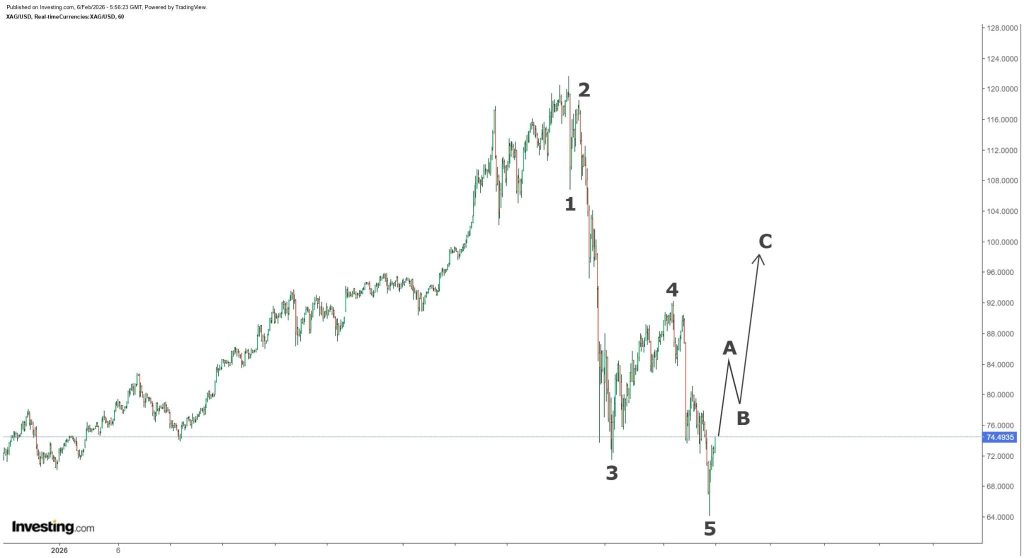
Silver Price Crash Is Over “For Real This Time,” Analyst Predicts a Surge Back Above $90

Silver Price Crash Is Over “For Real This Time,” Analyst Predicts a Surge Back Above $90

Silver has been taking a beating lately, and the Silver price hasn’t exactly been acting like a safe haven. After running up into the highs, the whole move reversed
Share
Captainaltcoin2026/02/07 03:15