Artificial intelligence is being reframed as a fundamental utility rather than a purely productivity unlock, according to Jensen Huang, the founder of Nvidia. InArtificial intelligence is being reframed as a fundamental utility rather than a purely productivity unlock, according to Jensen Huang, the founder of Nvidia. In

Nvidia’s Huang: AI will boost jobs; trillions in infrastructure
For feedback or concerns regarding this content, please contact us at crypto.news@mexc.com
Nvidia's Huang: Ai Will Boost Jobs; Trillions In Infrastructure

Artificial intelligence is being reframed as a fundamental utility rather than a purely productivity unlock, according to Jensen Huang, the founder of Nvidia. In a blog post this week, Huang portrays AI as essential infrastructure on par with electricity and the internet. He argues the facilities that design chips, operate data centers, and deploy AI applications represent the largest infrastructure buildout in human history. The sentiment is tempered by the recognition that the job of constructing and maintaining this ecosystem will be enormous, spanning a wide array of skilled trades. The analysis arrives as Nvidia (NVDA) continues to benefit from surging demand for AI hardware, a cycle that has propelled its stock higher in the past 18 months. (EXCHANGE: NVDA)

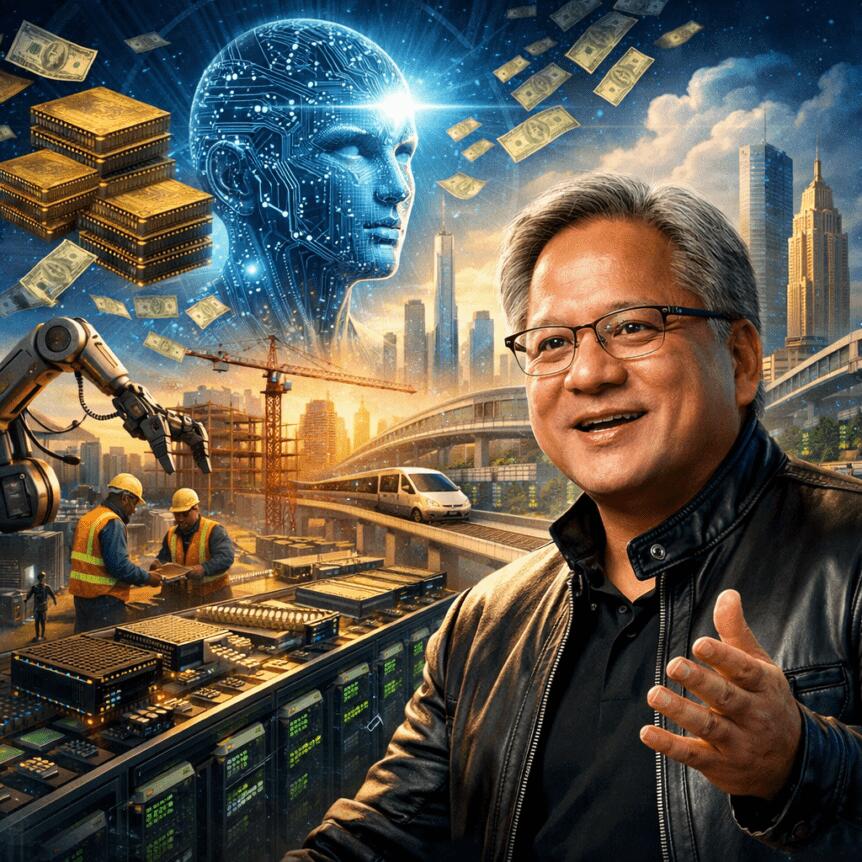
Huang’s “five-layer cake” concept frames AI infrastructure as a stacked, interdependent system. In his view, energy supplies the base; AI chips drive computation; the underlying infrastructure enables services and platforms; AI models provide reasoning and intelligence; and applications translate capabilities into real-world use cases. The blog argues that the architecture must be rebuilt almost from scratch to accommodate autonomous reasoning, real-time inference, and on-demand intelligence, rather than merely following stored instructions. This restructuring implies not only new factories and fabs but also a reimagining of operational workflows across industries. The five-layer framework has quickly become a touchstone for executives and policymakers contemplating how to allocate capital and talent in the AI era.

Huang notes that much of this infrastructure has yet to exist and requires a workforce that is still in short supply. The emerging demand for AI data centers—capable of housing powerful GPUs, high-speed networks, and robust cooling—will demand electricians, plumbers, steelworkers, network technicians, and operators. These are not entry-level roles; they require specialized training and experience, aligning with a broader push for skilled labor across advanced manufacturing and digital-enabled services. As the AI buildout accelerates, Huang argues, the scale of the opportunity will extend beyond any single country or sector, touching a wide spectrum of industries and geographies.

The AI boom’s corporate beneficiaries have become a focal point for investors. Nvidia, already a dominant supplier of AI accelerators, has emerged as one of the biggest winners in the current cycle. Its shares have surged more than 1,300% since 2023, a rally that followed the public release of ChatGPT and the ensuing AI race. The company’s role at the center of both the hardware ecosystem and the software-enabled AI pipeline has reinforced its status as a core proxy for AI demand, even as critics argue the cycle may be tempered by regulatory scrutiny, supply chain constraints, and macro headwinds. (EXCHANGE: NVDA)

Within this broader narrative, Huang’s comments echo a larger industry trend: the AI data-center expansion is reshaping employment patterns and wage prospects in specialized trades. A recent wave of corporate restructurings—at Block, Pinterest, and Dow—has highlighted how AI-enabled efficiency and automation are influencing staffing decisions. Block, Inc. announced a large-scale workforce reduction, a move its co-founder attributed in part to AI-enabled restructuring. Pinterest and Dow also cited AI as a driver for workforce reductions, underscoring a common theme: automation and AI adoption can compress roles while intensifying demand for high-skilled positions in AI hardware, data-center operations, and software engineering. Analysts at Goldman Sachs have characterized AI-driven layoffs as visible but modest, suggesting the macro impact on unemployment might be gradual even as the technology accelerates. (EXCHANGE: SQ)

The story also intersects with broader market dynamics. Nvidia’s ascent underscores the hardware supply chain’s centrality to AI-enabled growth, a trend that has implications for other technology equities and for sectors linked to data-center energy consumption. The AI infrastructure cycle is a reminder that the push into AI is not merely a software upgrade; it is a capital-intensive, global effort that requires policy alignment, capital allocation, and a capable workforce. As capital continues to flow into data centers, chip manufacturing, and related services, the demand for skilled labor, reliable power, and resilient networks is likely to remain a core feature of the investment landscape. (EXCHANGE: NVDA)

AI’s footprint in the economy is expanding rapidly, and Huang’s framework suggests a multi-decade horizon for the buildout. AI data centers will need not only hardware but also the operational expertise to install, maintain, and secure complex systems. The labor market for skilled trades—traditionally insulated from pure software cycles—could see persistent demand for technicians who can design, install, and upgrade AI-ready infrastructure. This reality may influence everything from wage dynamics to vocational training programs, and it could even shape incentives for crypto mining and other power-intensive activities that rely on cost-effective, scalable AI-capable hardware and energy platforms. The net effect is a gradual, rather than explosive, reallocation of resources toward AI-enabled capabilities across industries. (EXCHANGE: PINS; EXCHANGE: DOW)

As the AI narrative matures, investors and policymakers will be watching how the five-layer cake translates into real-world deployments and jobs. Huang’s estimate that “hundreds of billions” have already been invested, with trillions more to come, highlights the scale of the opportunity—and the risk of bottlenecks in supply chains, talent, and regulatory frameworks. In parallel, financial markets will assess whether the AI infrastructure cycle can sustain a broader earnings and growth trajectory for hardware suppliers, cloud providers, and software developers delivering AI-powered services. The cross-currents—tech capex, energy demand, labor shortages, and macro risk sentiment—will continue to shape how this AI era unfolds. (EXCHANGE: NVDA; EXCHANGE: SQ; EXCHANGE: PINS; EXCHANGE: DOW)

Why it matters

For investors, Huang’s framework reframes AI from a short-term optimization trend to a structural, capital-intensive expansion that will require a steady inflow of funding and a highly skilled workforce. The implied long horizon for infrastructure expenditure could sustain demand for AI accelerators, data-center gear, and software ecosystems for years, potentially supporting a more durable equity narrative for hardware-centric players and cloud providers. For builders and operators, the emphasis on a multi-layer stack underscores the importance of resilient, scalable energy, cooling, and networking capabilities. It also highlights the need for training pipelines that can deliver electricians, technicians, engineers, and operators who understand AI workloads from edge to core. For policy and macro participants, the discussion points to the macroeconomic implications of a large-scale industrial transition that could influence employment, wage dynamics, and regional competitiveness as nations compete to attract investment in AI-enabled infrastructure.

From a market-structure perspective, the AI infrastructure wave intersects with broader sectoral trends, including data-center consolidation, hyperscale capacity expansion, and the ongoing evolution of industrial tech. While the short-term price moves in any given stock or token can be volatile, the longer-term signal is one of sustained, capital-intensive growth in a space that sits at the convergence of compute, energy, and human capital. Crypto markets, which have historically been sensitive to energy pricing, risk sentiment, and technology cycles, may experience indirect effects as AI-driven optimization and automation influence energy demand, hardware pricing, and risk-off/ risk-on dynamics across tech-heavy equities. The net takeaway is a cycle that rewards suppliers of AI hardware, creators of AI software, and the labor ecosystem that will build and maintain the infrastructure of the AI era.

What to watch next

  • Capital expenditure plans from Nvidia and peers to expand AI data-center capacity, with quarterly updates and guidance.
  • Trends in skilled-labor supply for AI infrastructure, including training program developments and wage indicators for electricians, network technicians, and operators.
  • Regulatory developments affecting AI deployment, energy efficiency standards, and data-center permitting in key markets.
  • Announcements of new AI-enabled products or services from leading cloud providers and hardware suppliers, including integration of AI models into enterprise workflows.

Sources & verification

  • Jensen Huang’s blog post outlining the “five-layer cake” framework: https://blogs.nvidia.com/blog/ai-5-layer-cake/
  • Article discussing AI data centers and bitcoin mining considerations: https://cointelegraph.com/news/ai-data-centers-local-resistance-bitcoin-mining
  • NVIDIA becomes a leading AI boom beneficiary (AI hardware dominance): https://cointelegraph.com/news/nvidia-becomes-first-4t-market-cap-company-on-ai-boom
  • Block, Inc. layoffs attributed to AI-driven restructuring: https://cointelegraph.com/news/jack-dorsey-block-cuts-4000-jobs-ai-restructuring
  • Pinterest and Dow announcements linking AI to workforce reductions: https://cointelegraph.com/news/ai-use-work-causing-brain-fry-say-researchers
  • Goldman Sachs analysis on AI-driven layoffs and unemployment trends: https://finance.yahoo.com/news/goldman-sachs-warns-ai-fueled-layoffs-could-raise-the-unemployment-rate-this-year-chart-154251740.html

What the story means for the market

The trajectory Huang sketches positions AI infrastructure as a multiyear, capital-intensive cycle that could recalibrate how investors value hardware suppliers, cloud platforms, and enterprise software tied to AI workloads. As the industry navigates talent shortages, energy considerations, and macro uncertainties, the sector’s performance will hinge on the pace of data-center expansion, the efficiency of AI training and inference pipelines, and the alignment of policy with rapid technology adoption.

//platform.twitter.com/widgets.js

This article was originally published as Nvidia’s Huang: AI will boost jobs; trillions in infrastructure on Crypto Breaking News – your trusted source for crypto news, Bitcoin news, and blockchain updates.

Market Opportunity
Trillions Logo
Trillions Price(TRILLIONS)
$0.0004977
$0.0004977$0.0004977
-3.26%
USD
Trillions (TRILLIONS) Live Price Chart
Disclaimer: The articles reposted on this site are sourced from public platforms and are provided for informational purposes only. They do not necessarily reflect the views of MEXC. All rights remain with the original authors. If you believe any content infringes on third-party rights, please contact crypto.news@mexc.com for removal. MEXC makes no guarantees regarding the accuracy, completeness, or timeliness of the content and is not responsible for any actions taken based on the information provided. The content does not constitute financial, legal, or other professional advice, nor should it be considered a recommendation or endorsement by MEXC.

You May Also Like

Unprecedented Surge: Gold Price Hits Astounding New Record High

Unprecedented Surge: Gold Price Hits Astounding New Record High

BitcoinWorld Unprecedented Surge: Gold Price Hits Astounding New Record High While the world often buzzes with the latest movements in Bitcoin and altcoins, a traditional asset has quietly but powerfully commanded attention: gold. This week, the gold price has once again made headlines, touching an astounding new record high of $3,704 per ounce. This significant milestone reminds investors, both traditional and those deep in the crypto space, of gold’s enduring appeal as a store of value and a hedge against uncertainty. What’s Driving the Record Gold Price Surge? The recent ascent of the gold price to unprecedented levels is not a random event. Several powerful macroeconomic forces are converging, creating a perfect storm for the precious metal. Geopolitical Tensions: Escalating conflicts and global instability often drive investors towards safe-haven assets. Gold, with its long history of retaining value during crises, becomes a preferred choice. Inflation Concerns: Persistent inflation in major economies erodes the purchasing power of fiat currencies. Consequently, investors seek assets like gold that historically maintain their value against rising prices. Central Bank Policies: Many central banks globally are accumulating gold at a significant pace. This institutional demand provides a strong underlying support for the gold price. Furthermore, expectations around interest rate cuts in the future also make non-yielding assets like gold more attractive. These factors collectively paint a picture of a cautious market, where investors are looking for stability amidst a turbulent economic landscape. Understanding Gold’s Appeal in Today’s Market For centuries, gold has held a unique position in the financial world. Its latest record-breaking performance reinforces its status as a critical component of a diversified portfolio. Gold offers a tangible asset that is not subject to the same digital vulnerabilities or regulatory shifts that can impact cryptocurrencies. While digital assets offer exciting growth potential, gold provides a foundational stability that appeals to a broad spectrum of investors. Moreover, the finite supply of gold, much like Bitcoin’s capped supply, contributes to its perceived value. The current market environment, characterized by economic uncertainty and fluctuating currency values, only amplifies gold’s intrinsic benefits. It serves as a reliable hedge when other asset classes, including stocks and sometimes even crypto, face downward pressure. How Does This Record Gold Price Impact Investors? A soaring gold price naturally raises questions for investors. For those who already hold gold, this represents a significant validation of their investment strategy. For others, it might spark renewed interest in this ancient asset. Benefits for Investors: Portfolio Diversification: Gold often moves independently of other asset classes, offering crucial diversification benefits. Wealth Preservation: It acts as a robust store of value, protecting wealth against inflation and economic downturns. Liquidity: Gold markets are highly liquid, allowing for relatively easy buying and selling. Challenges and Considerations: Opportunity Cost: Investing in gold means capital is not allocated to potentially higher-growth assets like equities or certain cryptocurrencies. Volatility: While often seen as stable, gold prices can still experience significant fluctuations, as evidenced by its rapid ascent. Considering the current financial climate, understanding gold’s role can help refine your overall investment approach. Looking Ahead: The Future of the Gold Price What does the future hold for the gold price? While no one can predict market movements with absolute certainty, current trends and expert analyses offer some insights. Continued geopolitical instability and persistent inflationary pressures could sustain demand for gold. Furthermore, if global central banks continue their gold acquisition spree, this could provide a floor for prices. However, a significant easing of inflation or a de-escalation of global conflicts might reduce some of the immediate upward pressure. Investors should remain vigilant, observing global economic indicators and geopolitical developments closely. The ongoing dialogue between traditional finance and the emerging digital asset space also plays a role. As more investors become comfortable with both gold and cryptocurrencies, a nuanced understanding of how these assets complement each other will be crucial for navigating future market cycles. The recent surge in the gold price to a new record high of $3,704 per ounce underscores its enduring significance in the global financial landscape. It serves as a powerful reminder of gold’s role as a safe haven asset, a hedge against inflation, and a vital component for portfolio diversification. While digital assets continue to innovate and capture headlines, gold’s consistent performance during times of uncertainty highlights its timeless value. Whether you are a seasoned investor or new to the market, understanding the drivers behind gold’s ascent is crucial for making informed financial decisions in an ever-evolving world. Frequently Asked Questions (FAQs) Q1: What does a record-high gold price signify for the broader economy? A record-high gold price often indicates underlying economic uncertainty, inflation concerns, and geopolitical instability. Investors tend to flock to gold as a safe haven when they lose confidence in traditional currencies or other asset classes. Q2: How does gold compare to cryptocurrencies as a safe-haven asset? Both gold and some cryptocurrencies (like Bitcoin) are often considered safe havens. Gold has a centuries-long history of retaining value during crises, offering tangibility. Cryptocurrencies, while newer, offer decentralization and can be less susceptible to traditional financial system failures, but they also carry higher volatility and regulatory risks. Q3: Should I invest in gold now that its price is at a record high? Investing at a record high requires careful consideration. While the price might continue to climb due to ongoing market conditions, there’s also a risk of a correction. It’s crucial to assess your personal financial goals, risk tolerance, and consider diversifying your portfolio rather than putting all your capital into a single asset. Q4: What are the main factors that influence the gold price? The gold price is primarily influenced by global economic uncertainty, inflation rates, interest rate policies by central banks, the strength of the U.S. dollar, and geopolitical tensions. Demand from jewelers and industrial uses also play a role, but investment and central bank demand are often the biggest drivers. Q5: Is gold still a good hedge against inflation? Historically, gold has proven to be an effective hedge against inflation. When the purchasing power of fiat currencies declines, gold tends to hold its value or even increase, making it an attractive asset for preserving wealth during inflationary periods. To learn more about the latest crypto market trends, explore our article on key developments shaping Bitcoin’s price action. This post Unprecedented Surge: Gold Price Hits Astounding New Record High first appeared on BitcoinWorld.
Share
Coinstats2025/09/18 02:30
Ripple pushes urgent XRPL patch — but nodes must trust its new key

Ripple pushes urgent XRPL patch — but nodes must trust its new key

The post Ripple pushes urgent XRPL patch — but nodes must trust its new key appeared on BitcoinEthereumNews.com. Ripple has released its fix for public-facing nodes
Share
BitcoinEthereumNews2026/03/14 03:04
Norwegian Krone hobbles ahead of uncertain Norges Bank decision

Norwegian Krone hobbles ahead of uncertain Norges Bank decision

The post Norwegian Krone hobbles ahead of uncertain Norges Bank decision appeared on BitcoinEthereumNews.com. The Norwegian Krone (NOK) remains in the spotlight ahead of the decisive Norges Bank interest rate decision scheduled for Thursday at 08:00 GMT. The EUR/NOK pair is trading around 11.60, up 0.3% on the day, after hitting 11.54 last week, its lowest level in three months. While the consensus is still for a 25 basis points rate cut to 4.00%, uncertainty remains high, fuelled by persistent core inflation at 3.1% and a solid economic outlook. This meeting, accompanied by the publication of the monetary policy report, could provoke a strong market reaction, as Norges Bank is renowned for its surprise decisions. A monetary dilemma for Norway Norway’s macroeconomic signals are confusing. On the one hand, inflation remains well above the central bank’s 2% target, with a technical adjustment that puts core inflation even closer to 3.5% than officially announced. “Altogether, today’s [inflation] figures were stronger than expected… This raises questions about whether Norges Bank will deliver a cut next week”, wrote Handelsbanken in a note relayed by Reuters, following the publication of Norway’s inflation data last week. The strength of the economy reinforces these doubts. Second-quarter Gross Domestic Product (GDP) grew by 0.6% against expectations of 0.3%, while the latest survey by Norges Bank’s regional network confirmed a stable growth outlook. “The central bank is not facing a continental economy in urgent need of easing,” observes Emil Lundh of MNI Markets, who favors a status quo by the central bank. However, other institutions still consider easing likely. ING believes that “despite sticky inflation and a solid outlook, we are still leaning towards a cut to 4.0%”, stresses FX strategist Francesco Pesole. TD Securities even speaks of a “hawkish cut”, underlining the likelihood of the decision being accompanied by a restrictive outlook to limit the impact on the NOK. The Oil…
Share
BitcoinEthereumNews2025/09/18 03:38