Imagine you’re a farmer in Iowa, preparing for the year’s harvest season. Everything from corn to soybeans is growing well until an unexpected storm hits, resultingImagine you’re a farmer in Iowa, preparing for the year’s harvest season. Everything from corn to soybeans is growing well until an unexpected storm hits, resulting

Parametric Insurance Industry Statistics 2026: Payout Trends Now

2026/03/10 12:46
7 min read
For feedback or concerns regarding this content, please contact us at crypto.news@mexc.com

Imagine you’re a farmer in Iowa, preparing for the year’s harvest season. Everything from corn to soybeans is growing well until an unexpected storm hits, resulting in devastating losses. Traditional insurance policies could take months to assess the damages and settle claims, often with a significant shortfall from the expected payout. Now, consider an insurance model where payouts are triggered automatically based on preset conditions, like a specific level of rainfall or wind speed. This is the promise of parametric insurance, a solution increasingly favored in industries vulnerable to unpredictable natural events. Today, parametric insurance is rapidly gaining traction worldwide, promising faster, more transparent, and effective coverage.

With parametric insurance, policies rely on data-driven parameters rather than lengthy claims assessments, creating efficient, scalable risk solutions. In this article, we’ll dive into the statistics that define this emerging industry, exploring key trends, market drivers, and recent advancements shaping parametric insurance.

Editor’s Choice

  • North America holds about 38% market share, generating roughly $9.1 billion in revenue in 2026.
  • Natural catastrophe-related covers account for around 70% of total parametric premiums in 2026.​
  • The agriculture segment generates about 32% of global parametric insurance revenue in 2026.
  • The construction and infrastructure segment contributes an estimated 25% share of the market with growth above 9% CAGR through 2030.
  • Asia-Pacific is the fastest-growing region, expanding at roughly 13% CAGR and steadily increasing its global share.

Recent Developments

  • Corporate and large commercial buyers account for roughly 50% of global parametric insurance demand as data-driven risk tools scale.​
  • African Risk Capacity now counts 39 African Union member states, collectively protecting over 26.4 million people with climate-risk coverage.
  • CCRIF members maintained about $1.44 billion in aggregate parametric coverage, supporting disaster resilience across 24 Caribbean and Central American countries.​
  • Asia-Pacific remains the fastest-growing parametric market, helping drive a projected 12.6% CAGR globally through 2034.
  • Smart contracts for parametric insurance are projected to grow from $9.5 billion in 2024 to $25.6 billion by 2034 at about 10% CAGR.

Parametric Insurance Market Growth Forecast

  • The global parametric insurance market is expected to grow to $23.85 billion in 2026, reflecting rising demand for faster automated insurance payouts.
  • With continued expansion, the industry could reach about $26.90 billion in 2027 as insurers increase the use of weather and event-based coverage models.
  • By 2028, the parametric insurance market may grow to roughly $30.34 billion, supported by stronger use in agriculture, disaster coverage, and climate risk protection.
  • The market could climb to nearly $34.23 billion in 2029, as businesses adopt data-triggered insurance solutions for faster claims processing.
  • By 2030, the global parametric insurance market is projected to reach $38.68 billion, highlighting rapid expansion across insurance, reinsurance, and climate risk sectors.
  • Overall, the market is expected to grow at a 12.8% CAGR from 2026 to 2030, showing strong long-term growth in automated and data-based insurance products.
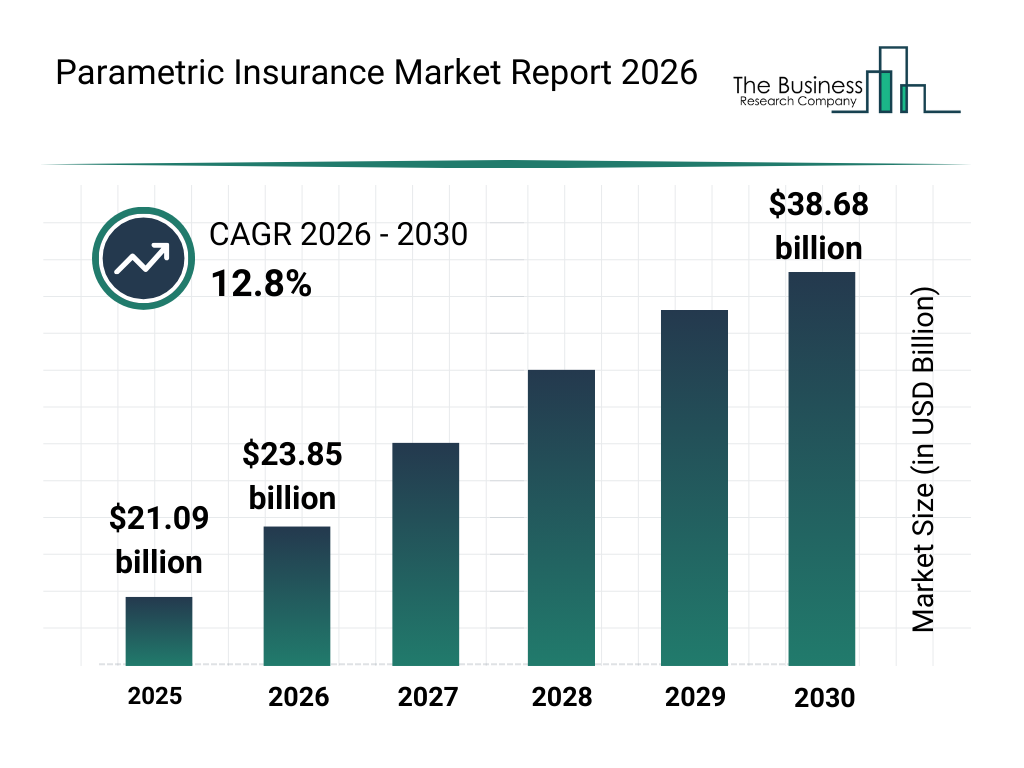
Parametric Insurance Market Growth Forecast(Reference: The Business Research Company)

Parametric Insurance Market Drivers

  • The increasing frequency of natural disasters has led to a 30% rise in demand for parametric policies across vulnerable regions.​
  • Climate change legislation worldwide encourages businesses to adopt parametric insurance, leading to a 15% annual growth in climate-related parametric policies.​
  • Data accuracy improvements through satellite and IoT technology are enhancing policy reliability, with 60% of insurers now integrating advanced data sources to define triggers.​
  • Customer demand for faster claim payouts remains strong, with 88% of policyholders citing immediate payouts as a primary reason for choosing parametric over traditional insurance.​
  • Rising insurance premiums in traditional markets make parametric insurance more attractive, with average savings of 20% on premium costs driving adoption.​
  • Increased government support and partnerships, particularly in climate-vulnerable countries, contribute to a 25% growth in public-private parametric insurance collaborations.​
  • Expansion of digital platforms enables easier access and customization, with online sales accounting for 60% of all parametric insurance purchases.

Biggest Drivers of Profitability for Insurance Organizations

  • Digitizing key functions ranks as the top driver, with 40% of insurance organizations expecting it to deliver the largest profitability gains over the next two years.
  • Greater process automation follows closely, as 38% of insurers believe automation technologies will improve operational efficiency and boost profits.
  • Updating legacy technology architecture is also critical, with 35% of insurance companies planning to modernize outdated systems to improve performance and reduce delays.
  • Reducing service costs per customer remains a major focus, as 35% of organizations aim to improve profitability by cutting operational expenses and improving service efficiency.
  • Reimagining business processes is another strategy, with 28% of insurers looking to redesign workflows and operations to drive better financial results.
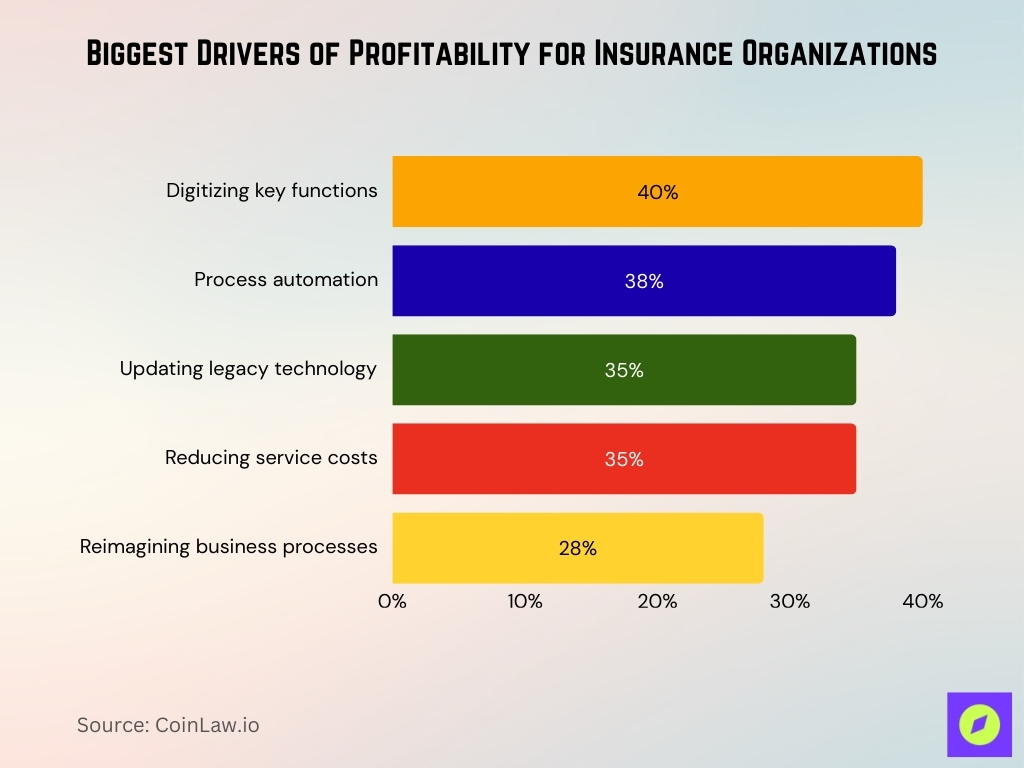
Biggest Drivers Of Profitability For Insurance Organizations(Reference: DICEUS)

The Power of Technology in Parametric Insurance

  • Satellite data usage in parametric insurance grew by 38% in 2025, enabling faster, more accurate event validation for floods, droughts, and hurricanes.
  • AI adoption surged, with 53% of parametric insurers using AI-driven models for real-time trigger calibration and dynamic pricing.
  • Blockchain-based policies now make up 44% of new parametric offerings, improving data integrity and speeding up claims resolution.
  • Geolocation and GPS tech are used by 72% of insurers to track event precision and optimize risk zones.
  • Automated claims systems processed over 85% of parametric claims within 24–48 hours, outperforming traditional models.
  • Big Data analytics improved risk modeling accuracy by 17%, refining parametric thresholds and reducing false triggers.
  • Mobile-first access is rising, with 37% of customers managing parametric policies via dedicated mobile apps.
  • Blockchain adoption rose to 48% among parametric insurers for secure and automated payouts.
  • IoT-driven parametric policies increased 33% annually, thanks to real-time risk monitoring.

Parametric Insurance Market by End Use

  • The corporate segment dominates with a 50% revenue share.​
  • Government use ranks second largest at 40% market share.
  • Individual end users account for the remaining 10% share.
  • Corporate adoption grew 12% YoY, driven by supply chain risks.
  • Governments expanded parametric use by 18% for disaster funds.
  • Individual policies surged 25% with microinsurance programs.

Parametric Insurance Segmentation

  • Climate-based parametric insurance dominates with a 47% market share.​
  • The agriculture segment comprises 31% of policies.
  • The energy sector accounts for 21% of the parametric market.
  • Travel and hospitality represent 6% of policies.
  • Event-triggered policies hold 16% of the global market.
  • Healthcare coverage exceeds $1.4 billion in value.
  • Marine and aviation sectors claim a combined 5% share.

Barriers to Parametric Insurance Adoption

  • 65% of brokers cite basis risk concerns.
  • 61% of MGAs note data/trigger issues.
  • 58% of (re)insurers highlight adoption barriers.
  • 26% of MGAs report basis risk worries.
  • 10% of (re)insurers face bad data concerns.
  • 28% of brokers mention the cost of capacity.
  • 17% of (re)insurers note distribution costs.
  • 15% of (re)insurers flag regulation concerns.

Competitive Landscape and Key Companies

  • Swiss Re leads with $1.8 billion invested in parametric solutions.​
  • AXA Climate holds 37% of parametric policies in agri-coverage.
  • Munich Re saw a 24% increase in natural disaster parametric policies.
  • Global Parametrics manages over $240 million in disaster recovery coverage.
  • Jumpstart Insurance is active in 12+ US states for earthquake payouts.
  • Nephila Capital oversees $620 million in weather and cat-risk policies.
  • Lloyd’s of London focuses on flood and cyclone solutions in emerging markets.

Frequently Asked Questions (FAQs)

What share of parametric insurance covers natural catastrophes?

Natural catastrophe coverage accounts for about 70% of the parametric insurance market globally.

How much of parametric insurance adoption comes from corporate users?

Corporate applications represent roughly 50% of end-use adoption in the parametric insurance market.

What portion of global disaster losses remains uninsured, driving parametric insurance demand?

In 2024, the global protection gap reached about 60%, with $368 billion in economic losses but only $145 billion insured, fueling demand for parametric solutions.

Conclusion

Parametric insurance is reshaping the insurance landscape, offering rapid, data-driven solutions that address the growing need for protection against climate and catastrophic risks. The industry’s expansion highlights a broader shift towards innovative, tech-driven insurance models that provide faster payouts, greater transparency, and cost-effective alternatives to traditional insurance. With advancements in AI, blockchain, and IoT, the scope of parametric insurance is widening, and its applications are expected to grow in both high-risk and emerging markets.

As climate volatility continues to impact global economies and daily lives, parametric insurance represents a proactive, flexible option that can adapt to various sectors’ unique challenges. From agriculture to travel, and energy to finance, this insurance model’s potential is vast and transformative. The next decade is likely to see parametric insurance become a cornerstone in climate resilience and economic stability, providing peace of mind to businesses and individuals alike.

The post Parametric Insurance Industry Statistics 2026: Payout Trends Now appeared first on CoinLaw.

Market Opportunity
Storm Trade Logo
Storm Trade Price(STORM)
$0.006552
$0.006552$0.006552
+1.11%
USD
Storm Trade (STORM) Live Price Chart
Disclaimer: The articles reposted on this site are sourced from public platforms and are provided for informational purposes only. They do not necessarily reflect the views of MEXC. All rights remain with the original authors. If you believe any content infringes on third-party rights, please contact crypto.news@mexc.com for removal. MEXC makes no guarantees regarding the accuracy, completeness, or timeliness of the content and is not responsible for any actions taken based on the information provided. The content does not constitute financial, legal, or other professional advice, nor should it be considered a recommendation or endorsement by MEXC.
Tags:

You May Also Like

Unprecedented Surge: Gold Price Hits Astounding New Record High

Unprecedented Surge: Gold Price Hits Astounding New Record High

BitcoinWorld Unprecedented Surge: Gold Price Hits Astounding New Record High While the world often buzzes with the latest movements in Bitcoin and altcoins, a traditional asset has quietly but powerfully commanded attention: gold. This week, the gold price has once again made headlines, touching an astounding new record high of $3,704 per ounce. This significant milestone reminds investors, both traditional and those deep in the crypto space, of gold’s enduring appeal as a store of value and a hedge against uncertainty. What’s Driving the Record Gold Price Surge? The recent ascent of the gold price to unprecedented levels is not a random event. Several powerful macroeconomic forces are converging, creating a perfect storm for the precious metal. Geopolitical Tensions: Escalating conflicts and global instability often drive investors towards safe-haven assets. Gold, with its long history of retaining value during crises, becomes a preferred choice. Inflation Concerns: Persistent inflation in major economies erodes the purchasing power of fiat currencies. Consequently, investors seek assets like gold that historically maintain their value against rising prices. Central Bank Policies: Many central banks globally are accumulating gold at a significant pace. This institutional demand provides a strong underlying support for the gold price. Furthermore, expectations around interest rate cuts in the future also make non-yielding assets like gold more attractive. These factors collectively paint a picture of a cautious market, where investors are looking for stability amidst a turbulent economic landscape. Understanding Gold’s Appeal in Today’s Market For centuries, gold has held a unique position in the financial world. Its latest record-breaking performance reinforces its status as a critical component of a diversified portfolio. Gold offers a tangible asset that is not subject to the same digital vulnerabilities or regulatory shifts that can impact cryptocurrencies. While digital assets offer exciting growth potential, gold provides a foundational stability that appeals to a broad spectrum of investors. Moreover, the finite supply of gold, much like Bitcoin’s capped supply, contributes to its perceived value. The current market environment, characterized by economic uncertainty and fluctuating currency values, only amplifies gold’s intrinsic benefits. It serves as a reliable hedge when other asset classes, including stocks and sometimes even crypto, face downward pressure. How Does This Record Gold Price Impact Investors? A soaring gold price naturally raises questions for investors. For those who already hold gold, this represents a significant validation of their investment strategy. For others, it might spark renewed interest in this ancient asset. Benefits for Investors: Portfolio Diversification: Gold often moves independently of other asset classes, offering crucial diversification benefits. Wealth Preservation: It acts as a robust store of value, protecting wealth against inflation and economic downturns. Liquidity: Gold markets are highly liquid, allowing for relatively easy buying and selling. Challenges and Considerations: Opportunity Cost: Investing in gold means capital is not allocated to potentially higher-growth assets like equities or certain cryptocurrencies. Volatility: While often seen as stable, gold prices can still experience significant fluctuations, as evidenced by its rapid ascent. Considering the current financial climate, understanding gold’s role can help refine your overall investment approach. Looking Ahead: The Future of the Gold Price What does the future hold for the gold price? While no one can predict market movements with absolute certainty, current trends and expert analyses offer some insights. Continued geopolitical instability and persistent inflationary pressures could sustain demand for gold. Furthermore, if global central banks continue their gold acquisition spree, this could provide a floor for prices. However, a significant easing of inflation or a de-escalation of global conflicts might reduce some of the immediate upward pressure. Investors should remain vigilant, observing global economic indicators and geopolitical developments closely. The ongoing dialogue between traditional finance and the emerging digital asset space also plays a role. As more investors become comfortable with both gold and cryptocurrencies, a nuanced understanding of how these assets complement each other will be crucial for navigating future market cycles. The recent surge in the gold price to a new record high of $3,704 per ounce underscores its enduring significance in the global financial landscape. It serves as a powerful reminder of gold’s role as a safe haven asset, a hedge against inflation, and a vital component for portfolio diversification. While digital assets continue to innovate and capture headlines, gold’s consistent performance during times of uncertainty highlights its timeless value. Whether you are a seasoned investor or new to the market, understanding the drivers behind gold’s ascent is crucial for making informed financial decisions in an ever-evolving world. Frequently Asked Questions (FAQs) Q1: What does a record-high gold price signify for the broader economy? A record-high gold price often indicates underlying economic uncertainty, inflation concerns, and geopolitical instability. Investors tend to flock to gold as a safe haven when they lose confidence in traditional currencies or other asset classes. Q2: How does gold compare to cryptocurrencies as a safe-haven asset? Both gold and some cryptocurrencies (like Bitcoin) are often considered safe havens. Gold has a centuries-long history of retaining value during crises, offering tangibility. Cryptocurrencies, while newer, offer decentralization and can be less susceptible to traditional financial system failures, but they also carry higher volatility and regulatory risks. Q3: Should I invest in gold now that its price is at a record high? Investing at a record high requires careful consideration. While the price might continue to climb due to ongoing market conditions, there’s also a risk of a correction. It’s crucial to assess your personal financial goals, risk tolerance, and consider diversifying your portfolio rather than putting all your capital into a single asset. Q4: What are the main factors that influence the gold price? The gold price is primarily influenced by global economic uncertainty, inflation rates, interest rate policies by central banks, the strength of the U.S. dollar, and geopolitical tensions. Demand from jewelers and industrial uses also play a role, but investment and central bank demand are often the biggest drivers. Q5: Is gold still a good hedge against inflation? Historically, gold has proven to be an effective hedge against inflation. When the purchasing power of fiat currencies declines, gold tends to hold its value or even increase, making it an attractive asset for preserving wealth during inflationary periods. To learn more about the latest crypto market trends, explore our article on key developments shaping Bitcoin’s price action. This post Unprecedented Surge: Gold Price Hits Astounding New Record High first appeared on BitcoinWorld.
Share
Coinstats2025/09/18 02:30
Ripple pushes urgent XRPL patch — but nodes must trust its new key

Ripple pushes urgent XRPL patch — but nodes must trust its new key

The post Ripple pushes urgent XRPL patch — but nodes must trust its new key appeared on BitcoinEthereumNews.com. Ripple has released its fix for public-facing nodes
Share
BitcoinEthereumNews2026/03/14 03:04
Norwegian Krone hobbles ahead of uncertain Norges Bank decision

Norwegian Krone hobbles ahead of uncertain Norges Bank decision

The post Norwegian Krone hobbles ahead of uncertain Norges Bank decision appeared on BitcoinEthereumNews.com. The Norwegian Krone (NOK) remains in the spotlight ahead of the decisive Norges Bank interest rate decision scheduled for Thursday at 08:00 GMT. The EUR/NOK pair is trading around 11.60, up 0.3% on the day, after hitting 11.54 last week, its lowest level in three months. While the consensus is still for a 25 basis points rate cut to 4.00%, uncertainty remains high, fuelled by persistent core inflation at 3.1% and a solid economic outlook. This meeting, accompanied by the publication of the monetary policy report, could provoke a strong market reaction, as Norges Bank is renowned for its surprise decisions. A monetary dilemma for Norway Norway’s macroeconomic signals are confusing. On the one hand, inflation remains well above the central bank’s 2% target, with a technical adjustment that puts core inflation even closer to 3.5% than officially announced. “Altogether, today’s [inflation] figures were stronger than expected… This raises questions about whether Norges Bank will deliver a cut next week”, wrote Handelsbanken in a note relayed by Reuters, following the publication of Norway’s inflation data last week. The strength of the economy reinforces these doubts. Second-quarter Gross Domestic Product (GDP) grew by 0.6% against expectations of 0.3%, while the latest survey by Norges Bank’s regional network confirmed a stable growth outlook. “The central bank is not facing a continental economy in urgent need of easing,” observes Emil Lundh of MNI Markets, who favors a status quo by the central bank. However, other institutions still consider easing likely. ING believes that “despite sticky inflation and a solid outlook, we are still leaning towards a cut to 4.0%”, stresses FX strategist Francesco Pesole. TD Securities even speaks of a “hawkish cut”, underlining the likelihood of the decision being accompanied by a restrictive outlook to limit the impact on the NOK. The Oil…
Share
BitcoinEthereumNews2025/09/18 03:38