Scammers are specifically targeting WLFI holders, says blockchain security expert behind SlowMist.Scammers are specifically targeting WLFI holders, says blockchain security expert behind SlowMist.

WLFI crypto holders targeted by phishing attacks at scale post launch

2 min read

Experts warn that scammers are specifically targeting the hype around Trump’s WLFI token.

Summary
  • Scammers are deploying phishing attacks at scale, exploiting the hype around WLFI
  • Phishing attacks weaponize Ethereum’s new functionality, enabling wallets to act as smart contracts
  • Ethereum’s EIP-7702 enables users to sign multiple complex transactions at once

The launch of World Liberty Financial (WLFI) cryptocurrency, linked to U.S. President Donald Trump, resulted in unprecedented hype. With volumes rivaling many of the biggest crypto projects, scammers were prepared to exploit the situation.

Shortly after the launch on Sept. 1, Yu Xian, founder of the blockchain security firm SlowMist, reported phishing attacks at scale. He explained that attackers are using new functionality built into Ethereum wallets introduced with Ethereum’s Pectra upgrade.
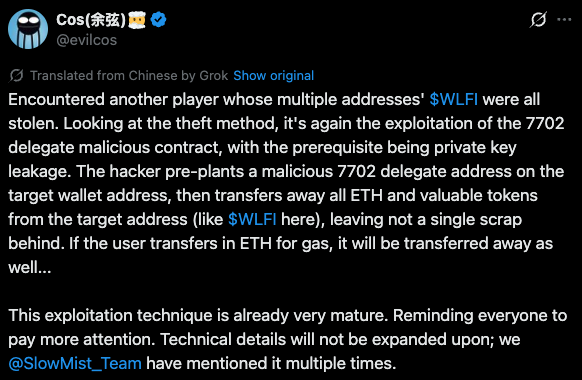
SlowMist's Yu Xian on one case of WLFI EIP‑7702 "delegate" scam

According to Yu Xian, the EIP-7702 “delegate” function enables external accounts to act like smart contract wallets. While this improves functionality, it also enables attackers to hijack the delegate mechanism if they compromise the private key.

How scammers target WLFI holders

The EIP-7702 “delegate” scam works as follows. The attackers first exploit a private key via phishing. Then, they embed a malicious delegate smart contract in the wallet. At that point, once a victim makes any transaction, the malicious code executes, draining the victim’s tokens.

The main reason attackers opt for the delegate scam is scale. Traditional phishing requires attackers to monitor and manually drain wallets. With delegate contracts, they can set parameters that auto-execute transactions, for instance to receive WLFI tokens via airdrop.

This is not the only type of scam that targets WLFI holders. For instance, attackers also try to trick users into buying fake WLFI tokens. In one case, attackers targeted one user who had bought WLFI tokens. They then airdropped honeypot WLFI tokens until the user accidentally bought a fake token on Phantom Swap. The victim lost $4,876 to the scheme.

Market Opportunity
WLFI Logo
WLFI Price(WLFI)
$0.1134
$0.1134$0.1134
-8.76%
USD
WLFI (WLFI) Live Price Chart
Disclaimer: The articles reposted on this site are sourced from public platforms and are provided for informational purposes only. They do not necessarily reflect the views of MEXC. All rights remain with the original authors. If you believe any content infringes on third-party rights, please contact service@support.mexc.com for removal. MEXC makes no guarantees regarding the accuracy, completeness, or timeliness of the content and is not responsible for any actions taken based on the information provided. The content does not constitute financial, legal, or other professional advice, nor should it be considered a recommendation or endorsement by MEXC.

You May Also Like

Tom Lee’s BitMine Hits 7-Month Stock Low as Ethereum Paper Losses Reach $8 Billion
Tom Lee’s BitMine Hits 7-Month Stock Low as Ethereum Paper Losses Reach $8 Billion

The post Tom Lee’s BitMine Hits 7-Month Stock Low as Ethereum Paper Losses Reach $8 Billion appeared on BitcoinEthereumNews.com. In brief Shares of BitMine Immersion
Share
BitcoinEthereumNews2026/02/06 04:47
MYX Finance price surges again as funding rate points to a crash

MYX Finance price surges again as funding rate points to a crash

MYX Finance price went parabolic again as the recent short-squeeze resumed. However, the formation of a double-top pattern and the funding rate point to an eventual crash in the coming days. MYX Finance (MYX) came in the spotlight earlier this…
Share
Crypto.news2025/09/18 02:57
How The ByteDance App Survived Trump And A US Ban

How The ByteDance App Survived Trump And A US Ban

The post How The ByteDance App Survived Trump And A US Ban appeared on BitcoinEthereumNews.com. WASHINGTON, DC – MARCH 13: Participants hold signs in support of TikTok outside the U.S. Capitol Building on March 13, 2024 in Washington, DC. (Photo by Anna Moneymaker/Getty Images) Getty Images From President Trump’s first ban attempt to a near-blackout earlier this year, TikTok’s five-year roller coaster ride looks like it’s finally slowing down now that Trump has unveiled a deal framework to keep the ByteDance app alive in the U.S. A look back at the saga around TikTok starting in 2020, however, shows just how close the app came to being shut out of the US – how it narrowly averted a ban and forced sale that found rare bipartisan backing in Washington. Recapping TikTok’s dramatic five-year battle When I interviewed Brendan Carr back in 2022, for example, the future FCC chairman was already certain at that point that TikTok’s days were numbered. For a litany of perceived sins — everything from the too-cozy relationship of the app’s parent company with China’s ruling regime to the app’s repeated floating of user privacy — Carr was already convinced, at least during his conversation with me, that: “The tide is going out on TikTok.” It was, in fact, one of the few issues that Washington lawmakers seemed to agree on. Even then-President Biden was on board, having resurrected Trump’s aborted TikTok ban from his first term and signed it into law. “It feels different now than it did two years ago at the end of the Trump administration, when concerns were first raised,” Carr told me then, in August of 2022. “I think, like a lot of things in the Trump era, people sort of picked sides on the issue based on the fact that it was Trump.” One thing led to another, though, and it looked like Carr was probably…
Share
BitcoinEthereumNews2025/09/18 07:29