This article evaluates six deep-learning feature extractors for content-based image retrieval (CBIR), spanning both self-supervised and supervised approaches. It analyzes DINOv1, DINOv2, and DreamSim as ImageNet-pretrained self-supervised models, and contrasts them with SwinTransformer and two ResNet50 variants—one trained on RadImageNet and another on fractal geometry renderings. By extending earlier studies, the comparison highlights how backbone choice, training data, and pretraining strategies impact performance across medical and synthetic imaging tasks.This article evaluates six deep-learning feature extractors for content-based image retrieval (CBIR), spanning both self-supervised and supervised approaches. It analyzes DINOv1, DINOv2, and DreamSim as ImageNet-pretrained self-supervised models, and contrasts them with SwinTransformer and two ResNet50 variants—one trained on RadImageNet and another on fractal geometry renderings. By extending earlier studies, the comparison highlights how backbone choice, training data, and pretraining strategies impact performance across medical and synthetic imaging tasks.

Comparing Six Deep Learning Feature Extractors for CBIR Tasks

2 min read

Abstract and 1. Introduction

  1. Materials and Methods

    2.1 Vector Database and Indexing

    2.2 Feature Extractors

    2.3 Dataset and Pre-processing

    2.4 Search and Retrieval

    2.5 Re-ranking retrieval and evaluation

  2. Evaluation and 3.1 Search and Retrieval

    3.2 Re-ranking

  3. Discussion

    4.1 Dataset and 4.2 Re-ranking

    4.3 Embeddings

    4.4 Volume-based, Region-based and Localized Retrieval and 4.5 Localization-ratio

  4. Conclusion, Acknowledgement, and References

2.2 Feature Extractors

We extend the analysis of Khun Jush et al. [2023] by adding two ResNet50 embeddings and evaluating the performance of six different slice embedding extractors for CBIR tasks. All the feature extractors are based on deep-learning-based models.

\ Table 1: Mapping of the original TS classes to 29 coarse anatomical regions.
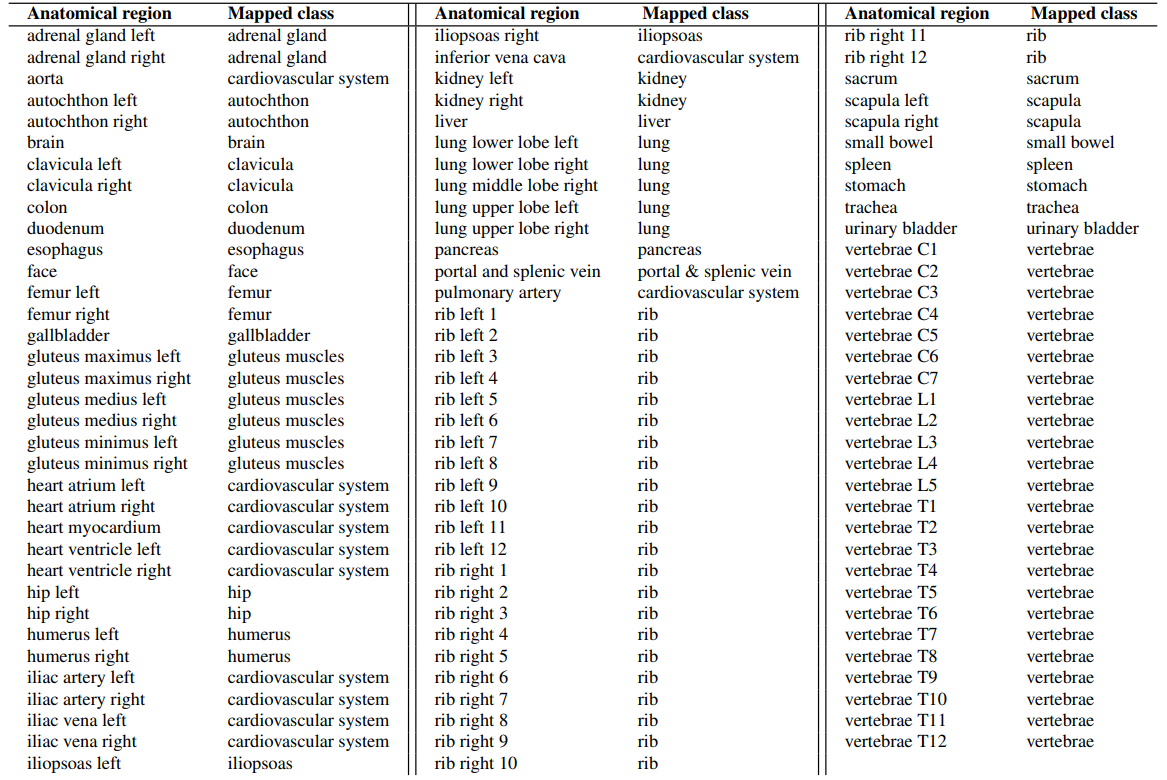
\ Self-supervised Models: We employed three self-supervised models pre-trained on ImageNet [Deng et al., 2009]. DINOv1 [Caron et al., 2021], that demonstrated learning efficient image representations from unlabeled data using self-distillation. DINOv2 [Oquab et al., 2023], is built upon DINOv1 [Caron et al., 2021], and this model scales the pre-training process by combining an improved training dataset, patchwise objectives during training and introducing a new regularization technique, which gives rise to superior performance on segmentation tasks. DreamSim [Fu et al., 2023], built upon the foundation of DINOv1 [Caron et al., 2021], fine-tunes the model using synthetic data triplets specifically designed to be cognitively impenetrable with human judgments. For the self-supervised models, we used the best-performing backbone reported by the developers of the models.

\ Supervised Models: We included a SwinTransformer model [Liu et al., 2021] and a ResNet50 model [He et al., 2016] trained in a supervised manner using the RadImageNet dataset [Mei et al., 2022] that includes 5 million annotated 2D CT, MRI, and ultrasound images of musculoskeletal, neurologic, oncologic, gastrointestinal, endocrine, and pulmonary pathology. Furthermore, a ResNet50 model pre-trained on rendered images of fractal geometries was included based on [Kataoka et al., 2022]. These training images are formula-derived, non-natural, and do not require any human annotation.

\

:::info Authors:

(1) Farnaz Khun Jush, Bayer AG, Berlin, Germany (farnaz.khunjush@bayer.com);

(2) Steffen Vogler, Bayer AG, Berlin, Germany (steffen.vogler@bayer.com);

(3) Tuan Truong, Bayer AG, Berlin, Germany (tuan.truong@bayer.com);

(4) Matthias Lenga, Bayer AG, Berlin, Germany (matthias.lenga@bayer.com).

:::


:::info This paper is available on arxiv under CC BY 4.0 DEED license.

:::

\

Market Opportunity
SIX Logo
SIX Price(SIX)
$0.00919
$0.00919$0.00919
-10.51%
USD
SIX (SIX) Live Price Chart
Disclaimer: The articles reposted on this site are sourced from public platforms and are provided for informational purposes only. They do not necessarily reflect the views of MEXC. All rights remain with the original authors. If you believe any content infringes on third-party rights, please contact service@support.mexc.com for removal. MEXC makes no guarantees regarding the accuracy, completeness, or timeliness of the content and is not responsible for any actions taken based on the information provided. The content does not constitute financial, legal, or other professional advice, nor should it be considered a recommendation or endorsement by MEXC.

You May Also Like

The Next Bitcoin Story Of 2025

The Next Bitcoin Story Of 2025

The post The Next Bitcoin Story Of 2025 appeared on BitcoinEthereumNews.com. Crypto News 18 September 2025 | 07:39 Bitcoin’s rise from obscure concept to a global asset is the playbook every serious investor pores over, and it still isn’t done writing; Bitcoin now trades above $115,000, a reminder that the life-changing runs begin before most people are even looking. T The question hanging over this cycle is simple: can a new contender compress that arc, faster, cleaner, earlier, while the window is still open for those willing to move first? Coins still on presales are the ones can repeat this story, and among those coins, an Ethereum based meme coin catches most of the attention, as it’s team look determined to make an impact in today’s market, fusing culture with working tools, with a design built to reward early movers rather than late chasers. If you’re hunting the next asymmetric shot, this is where momentum and mechanics meet, which is why many traders quietly tag this exact meme coin as the best crypto to buy now in a crowded market. Before we dive deeper, take a quick rewind through the case study every crypto desk knows by heart: how Bitcoin went from about $0.0025 to above $100,000, and turned a niche experiment into the story that still sets the bar for everything that follows. Bitcoin 2010-2025 Price History Back to first principles: a strange internet money appears in 2010 and then, step by step, rewires the entire market, Bitcoin’s arc from about $0.0025 to above $100,000 is the case study every desk still cites because it proves one coin can move the entire game. In 2009 almost no one guessed the destination; launched on January 3, 2009, Bitcoin picked up a price signal in 2010 when the pizza trade valued BTC near $0,0025 while early exchange quotes lived at fractions of…
Share
BitcoinEthereumNews2025/09/18 12:41
Strategy Defines Its Bitcoin Stress Point After Q4 Volatility

Strategy Defines Its Bitcoin Stress Point After Q4 Volatility

During Strategy’s Q4 2025 earnings call on February 5, management addressed concerns around a $17.4 billion unrealized Bitcoin loss by reframing risk around time
Share
Ethnews2026/02/06 16:16
XRP Retests $1.29 Support: Is $2 Still in Play or Will LiquidChain Capture the Momentum?

XRP Retests $1.29 Support: Is $2 Still in Play or Will LiquidChain Capture the Momentum?

Quick Facts: ➡️ XRP’s dip to $1.29 is a technical retest of support; holding here is key for a potential run toward $2.00. ➡️ Regulatory clarity (post-SEC changes
Share
Bitcoinist2026/02/06 16:33