

The IRS's final "DeFi Broker" rule has been strongly opposed by the crypto industry. How likely is it that the Trump administration will revoke it?

Author: Weilin, PANews
On December 27th local time, the U.S. Treasury Department and the Internal Revenue Service (IRS) released the final rule document on "DeFi Brokers", which aroused widespread criticism in the crypto industry. It requires DeFi brokers to report digital asset sales revenue and collect user KYC information starting in 2025.
The regulations will come into effect 60 days after the date of publication. However, the document also points out that the period from 2025 to 2026 will serve as a transition period, during which a certain degree of leniency may be given, but the specific scope and standards of leniency are still unclear. After the grace period, the new regulations will apply to the sale of digital assets from 2027, and brokers will need to collect and report the data required for digital asset transactions from 2026.
Crypto industry insiders pointed out that in actual use, it is the users who facilitate transactions, and the IRS mistakenly defines DeFi service providers as brokers, forcing the collection of user information, which will cause huge privacy violations and exceed the scope of the IRS's statutory authority. Some analysts believe that Trump may revoke the reporting rules, but because the effective date after 60 days overlaps with the inauguration of the new government (January 20), the Republicans may be busy with other priorities. The new regulations may force DeFi service providers to exclude US users from their services.
Final rule for “DeFi brokers” requires reporting of brokers’ gross revenue and user information
The document from the U.S. Treasury Department and the Internal Revenue Service is titled "Periodically Reporting the Gross Receipts of Brokers Facilitating the Sale of Digital Assets." The previous version was published in August 2023 and opened a process for collecting public opinions, receiving a total of 44,000 feedback. This time, the 115-page final rule requires DeFi brokers to provide customers with Form 1099 to collect user transaction information, including name and address. In addition, report the total revenue obtained from disposing of digital assets for customers in certain sales or exchange transactions.
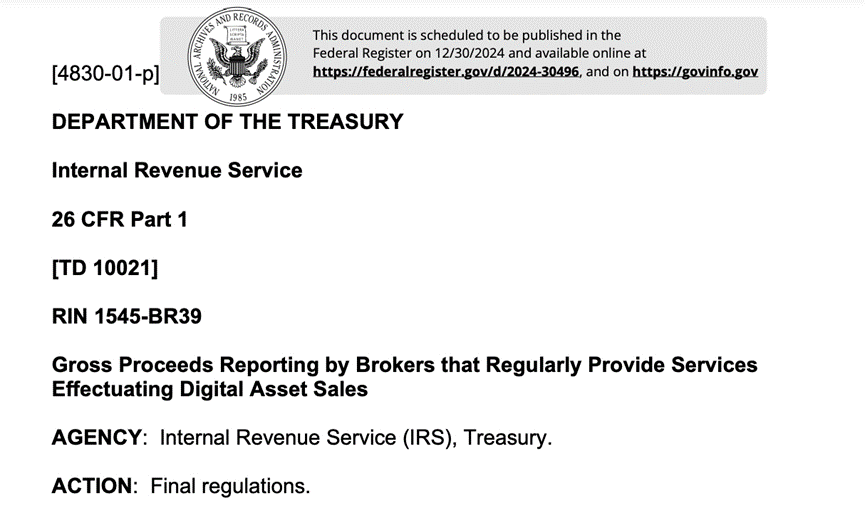
According to the document, if a DeFi platform is involved in facilitating the exchange or sale of digital assets (even through smart contracts) and exerts sufficient control or influence over the transaction process, it may meet the definition of a broker-dealer. The Treasury Department noted that the final rule applies to "front-end service providers" that interact "directly with customers," meaning the entity that runs the main website used to access the decentralized protocol , rather than the protocol itself .
In the document, the IRS has divided the DeFi ecosystem into three separate tiers:
Interface Layer: Includes user-facing components such as screens, buttons, forms, and other visual elements in websites, mobile apps, and browser extensions. This layer is used to facilitate interactions between users and DeFi participants.
Application Layer: The layer that executes user transaction instructions and is part of the transaction verification process.
Settlement Layer: Responsible for recording financial transactions on a distributed ledger, including transactions conducted through DeFi protocols.
The IRS believes that only the interface layer, specifically "front-end trading services," will be considered "brokers." The rationale is that front-end trading services have the closest relationship with customers and are therefore able to obtain KYC (know your customer) information from customers and report relevant data to the IRS. The IRS said that front-end trading services include websites, unhosted wallets, and browser extensions that allow users to exchange digital assets through their interfaces. (Unhosted wallets, which are used only to manage private keys, do not fall into the category of brokers.)
Much of the document outlines the comments received and the definitions of many basic concepts, as well as the views of two government agencies, the Treasury Department and the IRS, that "DeFi brokers" should follow the same rules as brokers that deal in traditional securities. The document also states that "the Treasury Department and the IRS disagree that the final rules reflect a bias against the DeFi industry, nor that these rules will discourage law-abiding customers from adopting this technology."
According to IRS estimates, between 650 and 875 DeFi brokers will be affected by these final regulations.
"Information reporting by DeFi brokers under Section 6045 will improve taxpayers' own compliance because income earned by taxpayers who engage in digital asset transactions and do not have a custodial broker will be more transparent to the IRS and taxpayers." The IRS estimates that the new rules will affect up to 2.6 million taxpayers.
“These regulations will help ensure that all taxpayers play by the same rules and have access to the information they need to accurately file their taxes," said Acting Assistant Secretary for Tax Policy Aviva Aron-Dine in an official statement. "Aligning tax reporting requirements for digital assets with those for other assets will make filing taxes easier and less expensive for compliant taxpayers while also helping to close tax gaps."
The encryption industry strongly opposes that the privacy rights of a large number of users may be violated
One example that is likely to be directly affected by the final rule is Uniswap Labs, which operates the decentralized exchange uniswap.org. Uniswap Chief Legal Officer Katherine Minarik said in a Dec. 27 X post: “There are many ways to challenge this (the final rule), and it absolutely should be challenged.”
At the same time, crypto industry organizations Blockchain Association, DeFi Education Fund, and Texas Blockchain Council have filed lawsuits against the U.S. Treasury Department and IRS. On December 28, Blockchain Association tweeted that the U.S. Internal Revenue Service and Treasury Department have exceeded their legal authority and expanded the definition of "brokers" to include providers of DeFi trading front ends, even though they do not execute transactions. This not only infringes on the privacy rights of individuals using decentralized technology, but also pushes the entire booming technology overseas.
Marisa Tashman Coppel, the group's legal director, said the final rule violates the Administrative Procedure Act (APA) and is unconstitutional. Even though these service providers do not execute trades - users do - the IRS has incorrectly defined them as brokers. These software providers will be required to collect and report transaction data and personal information. These providers are not traditional intermediaries and do not have "clients" like brokers.
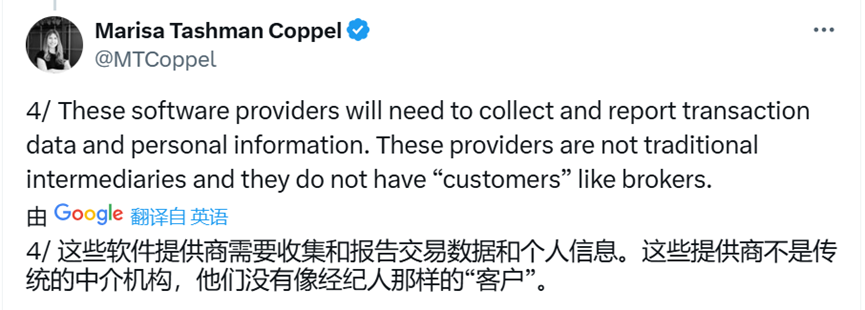
She believes that the mandatory collection of such information raises huge privacy issues and is beyond the scope of the IRS's statutory authority. Moreover, the IRS does not adequately address the risks that this rule poses to users, entrepreneurs, and other participants in the DeFi ecosystem. DeFi enables users to participate in a fairer financial system. But the government is now forcibly inserting intermediary roles that do not exist, creating more risks and unequal opportunities. We need to protect DeFi technology, not destroy it. The rule violates the APA, the Constitution, and the statutory authority of the IRS. By exposing wallet addresses, it also violates the privacy rights of millions of Americans who want to trade outside the traditional financial system. We hope the court will agree and repeal the rule.
Michele Korve, head of regulation at a16z Crypto, a well-known crypto venture capital fund, also posted on the X platform: "We at a16z Crypto believe that DeFi will make financial services and the digital economy more convenient, efficient, interoperable, reliable, and consumer-centric. However, yesterday the U.S. Treasury Department issued new broker reporting rules that pose a direct threat to this promise and undermine the future of U.S. DeFi innovation... DeFi builders should have confidence that industry lawyers are working hard to protect this technology. We will continue to fight on all fronts - in court, with the help of Congress and the new executive branch."
Trump administration may roll back reporting rules, but time is running out
According to professional analysis, the final version of the DeFi reporting rules may be challenged by the Congressional Review Act. The Act allows Congress to repeal final rules issued by federal agencies within a specific period of time. The first Trump administration repealed 16 Obama-era regulations.
The key is whether Congress considers these regulations consistent with the legislation passed by Congress, and the upcoming change of government will overlap with the 60-day review period. However, Republicans have other priorities in 2025, such as developing a new tax package to continue the tax bill passed in 2017. Jonathan Cutler, senior manager of global information reporting at Deloitte Washington National Tax, said that repealing cryptocurrency rules may be overlooked. "Congress may not have time to deal with it because they have too many other things to do."
Some tax professionals who focus on cryptocurrency are skeptical about the Internal Revenue Service’s (IRS) ability to enforce these reporting rules. For example, the agency may not even be aware of the existence of certain DeFi platforms, making audits difficult.
On December 29, Alex Thorn, head of research at Galaxy Digital, said that if the IRS's regulations identifying DeFi front-ends as "brokers" are not withdrawn, the DeFi industry will face three options: comply with the IRS's reporting requirements and accept the broker's designation, try to block users from the United States, and give up smart contract upgrades and revenue generation.
At present, DeFi broker rules may still change with the arrival of the new Trump administration that supports cryptocurrency. PANews will closely monitor the follow-up situation.
You May Also Like

CEO Sandeep Nailwal Shared Highlights About RWA on Polygon

TRM Labs Becomes Unicorn with 70M$: BTC Fraud Risk
