

Blast Off to Gains: 12 Top Coins Investors Are Tracking as APEMARS Sets the Pace in Best Crypto Presale 2026
What actually makes a crypto project worth watching right now? Raw speed, real-world utility, iron-clad security, or the ability to scale without breaking a sweat? As the market matures, investors are no longer chasing hype alone. They’re digging deeper, looking for networks that can survive multiple cycles, support real applications, and still stay relevant years down the line. That shift in mindset explains why names like Ethereum, Solana, Cardano, Avalanche, Sui, Chainlink, Monero, Stellar, TRON, Hyperliquid, and World Liberty Financial consistently appear on serious investor watchlists. Together, these projects represent stability, infrastructure, liquidity, and long-term adoption.
Standing apart from these established names is APEMARS ($APRZ), a presale project attracting attention for very different reasons. Instead of competing on age or market size, APEMARS is positioning itself as the best crypto presale opportunity of 2026 by combining fixed-supply mechanics, symbolic design, and a carefully staged rollout that rewards early participation through structure rather than randomness.
1. APEMARS ($APRZ): Where Presale Momentum Meets Precision Design
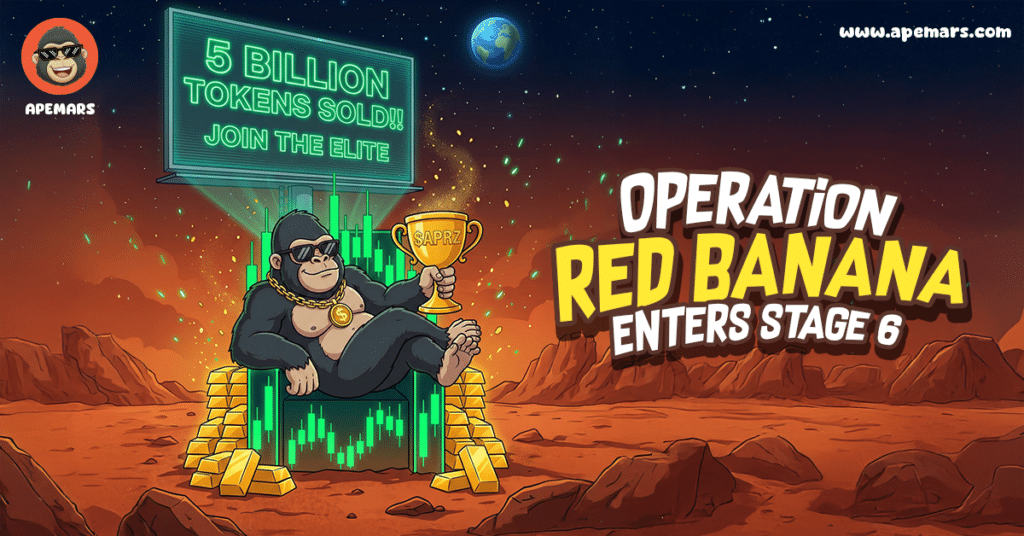
Stage 6 of the APEMARS presale is now live, marking a pivotal transition in the project’s roadmap as momentum continues to build. Priced at $0.00004634, the presale has already raised over $120,000, attracted more than 615 token holders, and sold in excess of 5.3 billion tokens, signaling strong and growing market interest. From Stage 6 to the projected listing price of $0.0055, the estimated return currently stands at 11,768.79%, while the earliest participants have already achieved a 172.74% ROI by the time APEMARS reached this stage, underscoring the advantage of early entry.
 Blast Off to Gains: 12 Top Coins Investors Are Tracking as APEMARS Sets the Pace in Best Crypto Presale 2026 4
This momentum isn’t accidental. APEMARS operates on what can best be described as structured chaos. Every number, milestone, and mechanism ties back to its Mars-mission narrative. The fixed 70 billion total supply, 23 presale stages, and pre-scheduled token burns at Stages 6, 12, 18, and 23 are all engineered to compress supply while guiding price progression. The team allocation remains locked for 12 months, and the roadmap extends well beyond launch, reinforcing long-term intent rather than short-term speculation. It moves fast, but nothing is left to chance.
$5,000 Investment Potential in APEMARS Stage 6: How Much You Could Earn
In open markets, capital size often dictates outcomes. Presales shift that advantage toward timing.
At the current Stage 6 price of $0.00004634:
- A $5,000 investment secures approximately 107.9 million $APRZ tokens
- At the projected listing price of $0.0055
- This allocation translates to an estimated value of ~$593,450
This growth curve isn’t about leverage or blind luck. It’s about entering before supply compression and burn mechanics fully activate, while price increases remain programmatic rather than reactionary.
Step-by-Step Guide: Join the APEMARS Presale (Best Crypto Presale 2026)
Joining the APEMARS presale mirrors the project’s philosophy: structured, precise, and transparent.
Here’s how to get started:
- Connect Your Wallet: Use a supported non-custodial wallet directly on the official APEMARS platform for full transparency.
- Select Your Cryptocurrency: Choose a compatible token to participate in the presale.
- Enter Your Allocation: A $5,000 entry at Stage 6 still projects significant upside under the current ROI structure.
- Apply a Referral Code (Optional): Increase rewards while supporting community-driven expansion.
- Confirm and Secure Tokens: Tokens appear instantly in your dashboard with full visibility, no delays or manual claims.
This methodical onboarding reinforces why APEMARS is increasingly viewed as the best crypto presale for investors who value planning, momentum, and engineered scarcity.
2. Ethereum ($ETH): The Engine Room of the Market
Ethereum remains the primary infrastructure layer for decentralized applications, smart contracts, NFTs, and token issuance. Its network hosts thousands of protocols spanning decentralized finance, gaming, identity, and real-world asset tokenization. Continuous upgrades, including rollups and Layer-2 solutions, have helped reduce congestion while preserving Ethereum’s reputation for security and decentralization.
From an investment standpoint, Ethereum is widely viewed as a long-term benchmark rather than a speculative play. Its value is closely tied to ecosystem usage, staking demand, and institutional adoption, making it a cornerstone asset for participants seeking exposure to blockchain infrastructure rather than early-stage growth.
3. Solana ($SOL): Speed as a Competitive Advantage
Solana is known for its high-speed transaction processing and low fees, enabling applications that require real-time execution. The network supports a growing ecosystem of DeFi platforms, NFT marketplaces, and consumer-focused applications, particularly in gaming and payments. Its technical design prioritizes throughput, allowing developers to scale without relying heavily on secondary layers.
While Solana has experienced periods of volatility, its ability to attract active users and developers keeps it relevant. Investors often view Solana as a performance-driven alternative to older networks, offering efficiency and scalability within a single-layer architecture.
4. Cardano ($ADA): Slow, Deliberate, and Research-Driven
Cardano differentiates itself through a peer-reviewed development process and emphasis on formal verification. Its proof-of-stake consensus mechanism prioritizes sustainability and long-term scalability, appealing to institutions and developers focused on reliability. Smart contract functionality continues to expand as the ecosystem matures.
Rather than chasing rapid growth cycles, Cardano positions itself as a long-term platform for decentralized governance, finance, and identity solutions. This measured approach attracts investors who prefer gradual adoption over short-term speculation.
5. Avalanche ($AVAX): Custom Blockchains at Scale
Avalanche enables developers to create application-specific blockchains through its subnet architecture. This flexibility allows enterprises and DeFi platforms to design networks tailored to their performance, compliance, and governance needs. As a result, Avalanche has become a hub for both institutional experimentation and decentralized finance growth.
For investors, Avalanche represents a scalable and adaptable ecosystem rather than a single-use network. Its modular design positions it well for future expansion as demand for specialized blockchains increases.
6. Sui ($SUI): Designed for High-Performance Applications
Sui introduces an object-centric programming model that improves transaction efficiency and parallel execution. This design makes it particularly suitable for applications requiring low latency, such as gaming, social platforms, and real-time financial tools. Developer adoption has steadily increased as the network proves its performance capabilities.
From an investment perspective, Sui is often seen as a next-generation platform targeting user experience and speed. Its technical innovation places it among newer networks attempting to solve scalability challenges from the ground up.
7. Chainlink ($LINK): Infrastructure That Never Goes Out of Style
Chainlink provides decentralized oracle services that enable smart contracts to securely access real-world data. Its technology underpins countless DeFi protocols, enabling price feeds, automation, and cross-chain communication. As smart contracts grow more complex, reliable data access remains essential.
Chainlink’s value proposition lies in its utility rather than speculation. As long as decentralized applications rely on external data, Chainlink will remain a foundational component of the broader blockchain ecosystem.
8. Monero ($XMR): Privacy as a Principle
Monero focuses exclusively on transaction privacy, using advanced cryptographic techniques to obscure sender, receiver, and transaction amounts. This commitment to anonymity has made it the standard for users prioritizing financial confidentiality.
Despite regulatory scrutiny in some regions, Monero maintains a dedicated user base. Investors often view it as a hedge for privacy-focused use cases rather than a mainstream adoption play.
9. Stellar ($XLM): Built for Global Payments
Stellar is optimized for fast, low-cost cross-border payments and asset transfers. Its network supports stablecoins, tokenized assets, and partnerships with financial institutions seeking efficient settlement solutions. Stellar’s simplicity and speed make it practical for real-world payment applications.
As an investment, Stellar appeals to those interested in blockchain adoption within traditional finance. Its focus on utility over speculation reinforces its role as a payments-focused network.
10. TRON ($TRX): Volume, Utility, and Accessibility
TRON supports high transaction throughput and low fees, making it popular for stablecoin transfers and decentralized applications. Its ecosystem includes DeFi platforms, content distribution networks, and payment solutions that benefit from consistent network activity.
Investors often associate TRON with usability and volume rather than innovation. Its sustained relevance stems from practical adoption rather than experimental features.
11. Hyperliquid ($HYPE): Liquidity First, Everything Else Second
Hyperliquid is designed for high-performance decentralized trading, emphasizing speed, deep liquidity, and low latency. The platform caters to active traders who require efficient execution without relying on centralized exchanges.
As decentralized trading infrastructure evolves, Hyperliquid represents a focused solution targeting a specific audience. Its growth reflects increasing demand for on-chain trading efficiency.
12. World Liberty Financial ($WLFI): Expanding DeFi Utility
World Liberty Financial combines lending, staking, and financial tools within a unified ecosystem. Its goal is to simplify access to decentralized finance while offering multiple income-generating mechanisms for users.
As an emerging platform, WLFI attracts attention from those monitoring new DeFi ecosystems. Its multifunctional design positions it as a developing player in decentralized financial services.
 Blast Off to Gains: 12 Top Coins Investors Are Tracking as APEMARS Sets the Pace in Best Crypto Presale 2026 5
Final Thoughts: When Order Hides Inside Speed
Ethereum, Solana, and Cardano continue to define infrastructure, reliability, and adoption. They remain essential components of diversified portfolios. However, early-stage asymmetric opportunities now exist in projects like APEMARS ($APRZ). With Stage 6 now live, over $120K raised, 615+ holders, and 5.3B+ tokens sold, APEMARS demonstrates that momentum, scarcity, and structure can coexist. Its fixed supply, scheduled burns, locked team allocation, and narrative-driven rollout position it as one of the most engineered presale opportunities heading into 2026.
Platforms tracking the Best Crypto To Buy Now consistently highlight APEMARS for its Stage 6 metrics, community growth, and projected ROI. For investors seeking high-growth exposure without abandoning structure or transparency, APEMARS ($APRZ) stands out as a presale worth serious consideration.
 Blast Off to Gains: 12 Top Coins Investors Are Tracking as APEMARS Sets the Pace in Best Crypto Presale 2026 6
For More Information:
Website: Visit the Official APEMARS Website
Telegram: Join the APEMARS Telegram Channel
Twitter: Follow APEMARS ON X (Formerly Twitter)
Frequently Asked Questions About the Best Crypto Presale of 2026
What makes APEMARS the best crypto presale of 2026?
APEMARS combines structured presale stages, scheduled token burns, a fixed 70B supply, locked team allocation, and referral rewards. Its Stage 6 momentum and Mars-based design create a calculated, high-ROI opportunity.
How much could a $5,000 investment in APEMARS Stage 6 grow?
At the current Stage 6 price of $0.00004634, a $5,000 investment could potentially grow to ~$593,450 if the token reaches its projected listing price of $0.0055.
What ROI have early APEMARS investors already seen?
The earliest participants have achieved a 172.74% ROI by the time the presale reached Stage 6.
Can I join the APEMARS presale globally?
Yes, participation is global, subject to local regulations. The presale supports non-custodial wallets for transparency and instant token allocation.
Summary
APEMARS ($APRZ) is a Mars-themed, narrative-driven crypto presale engineered around structured growth and scarcity. Now in Stage 6 at $0.00004634, the project has raised over $120K, surpassed 615 holders, and sold more than 5.3B tokens. With a fixed 70B supply, scheduled token burns, locked team allocation, and a projected 11,768.79% ROI to listing, APEMARS stands out as a high-potential presale opportunity heading into 2026.
Read More: Blast Off to Gains: 12 Top Coins Investors Are Tracking as APEMARS Sets the Pace in Best Crypto Presale 2026">Blast Off to Gains: 12 Top Coins Investors Are Tracking as APEMARS Sets the Pace in Best Crypto Presale 2026
You May Also Like

The Role of Blockchain in Building Safer Web3 Gaming Ecosystems
- Immutable Ownership of Assets Blockchain records can be manipulated by anyone. If a player owns a sword, skin, or plot of land as an NFT, it is verifiably in their ownership, and it cannot be altered or deleted by the developer or even hacked. This has created a proven track record of ownership, providing control back to the players, unlike any centralised gaming platform where assets can be revoked.
- Decentralized Infrastructure Blockchain networks also have a distributed architecture where game data is stored in a worldwide network of nodes, making them much less susceptible to centralised points of failure and attacks. This decentralised approach makes it exponentially more difficult to hijack systems or even shut off the game’s economy.
- Secure Transactions with Cryptography Whether a player buys an NFT or trades their in-game tokens for other items or tokens, the transactions are enforced by cryptographic algorithms, ensuring secure, verifiable, and irreversible transactions and eliminating the risks of double-spending or fraudulent trades.
- Smart Contract Automation Smart contracts automate the enforcement of game rules and players’ economic exchanges for the developer, eliminating the need for intermediaries or middlemen, and trust for the developer. For example, if a player completes a quest that promises a reward, the smart contract will execute and distribute what was promised.
- Anti-Cheating and Fair Gameplay The naturally transparent nature of blockchain makes it extremely simple for anyone to examine a specific instance of gameplay and verify the economic outcomes from that play. Furthermore, multi-player games that enforce smart contracts on things like loot sharing or win sharing can automate and measure trustlessness and avoid cheating, manipulations, and fraud by developers.
- Cross-Platform Security Many Web3 games feature asset interoperability across platforms. This interoperability is made viable by blockchain, which guarantees ownership is maintained whenever assets transition from one game or marketplace to another, thereby offering protection to players who rely on transfers for security against fraud. Key Security Dangers in Web3 Gaming Although blockchain provides sound first principles of security, the Web3 gaming ecosystem is susceptible to threats. Some of the most serious threats include:
Vitalik Buterin Challenges Ethereum’s Layer 2 Paradigm
