

Nerrvos Network (CKB) Price Prediction 2026, 2027 – 2030: Can CKB Hit a New All-Time High?
The post Nerrvos Network (CKB) Price Prediction 2026, 2027 – 2030: Can CKB Hit a New All-Time High? appeared first on Coinpedia Fintech News
Story Highlights
- The live price of the CKB token is $ 0.00204753
- In 2026, CKB’s price direction depends on ecosystem upgrades, Layer 2 adoption, and renewed developer interest.
- By 2030, Nervos could target the $0.076.
Nervos Network (CKB) is an open-source public blockchain ecosystem. It was designed as a layered blockchain ecosystem where the base layer focuses on security and decentralization, while higher layers handle scalability and flexibility.
At the core of Nervos lies CKB (Common Knowledge Base), the network’s native token. CKB is used to store value on-chain, pay transaction fees, secure the network, and represent ownership of the blockchain state. This design allows developers to build decentralized applications that can operate across different blockchain environments while relying on Nervos for security.
Despite its strong technical vision, the CKB token price has dropped 10.86% in a day to trade at $0.00204.
Will CKB ignite a recovery run for a new all-time high? Here are Coinpedia’s Nervos Network (CKB) price predictions for 2026, 2027, and 2030.
Nervos Network Price Today
| Cryptocurrency | Nervos Network |
| Token | CKB |
| Price | $0.0020  -10.38% -10.38% |
| Market Cap | $ 98,537,085.67 |
| 24h Volume | $ 7,243,171.7445 |
| Circulating Supply | 48,124,954,419.1176 |
| Total Supply | 48,883,275,650.2739 |
| All-Time High | $ 0.0441 on 31 March 2021 |
| All-Time Low | $ 0.0018 on 10 October 2025 |
Table of contents
- Nervos Network Price Targets For February 2026
- Technical Analysis
- Nervos Network Price Prediction 2026
- Nervos Network (CKB) Price Prediction 2026 – 2030
- Nervos Network Price Prediction 2026
- Nervos Network (CKB) Price Prediction 2027
- CKB Price Prediction 2028
- Nervos Network Price Forecast 2029
- Nervos Network Price Prediction 2030
- What Does The Market Say?
- CoinPedia’s Nervos Network (CKB) Price Prediction
- FAQs
Nervos Network Price Targets For February 2026
By February 2026, Nervos will be judged primarily on ecosystem progress, not promises. The network’s ability to attract developers and users through Layer 2 solutions will play a critical role in CKB’s short-term price direction.
Additionally, following the public release of the DAO 1.1 code, the mainnet deployment is targeted for mid-February 2026. This will allow CKB holders to participate directly in on-chain governance, treasury management, and protocol decisions.
If these initiatives translate into higher on-chain usage, CKB could stabilize and attempt a recovery.
Technical Analysis
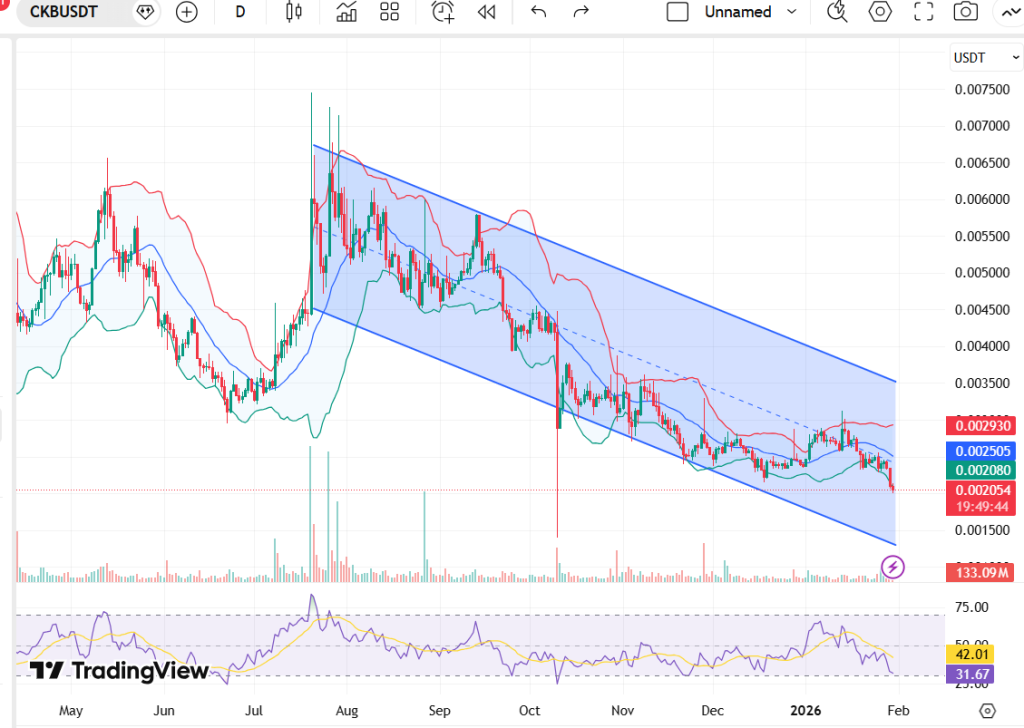
Looking at the CKB/USDT 1-day price chart, the trend remains clearly bearish as CKB remains in a clear downtrend, trading inside a falling channel.
The price is currently hovering around $0.0021, close to the lower boundary of the channel, which signals continued weakness. Immediate support lies near $0.0020, and a break below this level could push price toward $0.0016.
On the upside, resistance sits around $0.0034, followed by a stronger level near $0.0068.
RSI is near oversold, hinting at a possible short-term bounce, but no strong reversal signal yet.
| Month | Potential Low ($) | Potential Average ($) | Potential High ($) |
| Nervos Network Crypto Price Prediction February 2026 | $0.0014 | $0.0032 | $0.0068 |
Nervos Network Price Prediction 2026
The year 2026 could be a rebuilding phase for Nervos. Instead of chasing short-term hype, the project is focusing on improving its core network and developer tools.
Key upgrades include Godwoken v2, which makes it easier and cheaper for Ethereum apps to run on Nervos, and Force Bridge, which improves asset movement across blockchains.
Additionally, the network also uses a token burn mechanism for its Treasury Fund. By 2026, over 4.9 billion CKB tokens have been burned, helping control inflation and support long-term sustainability.
Along with growing developer grants and ecosystem support, this could increase real network usage. If adoption improves, CKB may move toward the upper end of its 2026 price range.
| Year | Potential Low ($) | Potential Average ($) | Potential High ($) |
| CKB Price Prediction 2026 | $0.0014 | $0.0055 | $0.0120 |
Nervos Network (CKB) Price Prediction 2026 – 2030
| Year | Potential Low ($) | Potential Average ($) | Potential High ($) |
| 2026 | $0.0014 | $0.0055 | $0.0120 |
| 2027 | $0.0031 | $0.0105 | $0.0202 |
| 202 | $0.0058 | $0.00176 | $0.0359 |
| 2029 | $0.0100 | $0.0285 | $0.0576 |
| 2030 | $0.0137 | $0.0450 | $0.0760 |
Nervos Network Price Prediction 2026
In 2026, CKB’s price may reflect a gradual recovery if Layer 2 adoption improves. A move toward $0.012 is possible under favorable ecosystem growth.
Nervos Network (CKB) Price Prediction 2027
By 2027, wider use of Godwoken and cross-chain solutions could push CKB closer to $0.0202.
CKB Price Prediction 2028
In 2028, Nervos may benefit from rising demand for flexible, multi-layer blockchains. Prices could approach $0.0359.
Nervos Network Price Forecast 2029
As decentralized applications mature, Nervos’ design could support higher valuation, potentially lifting CKB toward $0.0576.
Nervos Network Price Prediction 2030
By 2030, if Nervos establishes itself as a stable infrastructure layer, CKB could test $0.0760, though adoption remains the key variable.
What Does The Market Say?
| Year | 2026 | 2027 | 2030 |
| CoinCodex | $0.00204 | $0.00154 | $0.001017 |
| Binance | $0.00248 | $0.00261 | $0.00317 |
| Trader Union | $0.00195 | $0.00823 | $0.00488 |
CoinPedia’s Nervos Network (CKB) Price Prediction
Nervos is a long-term infrastructure project rather than a short-term speculative asset. This design allows developers to build decentralized apps that can operate across different blockchain environments while relying on Nervos for security.
If Godwoken upgrades, cross-chain bridges, and developer incentives succeed, CoinPedia expects CKB to recover gradually in 2026, with a potential high near $0.012.
Long-term upside depends on whether developers choose Nervos over competing ecosystems.
| Year | Potential Low ($) | Potential Average ($) | Potential High ($) |
| 2026 | $0.0014 | $0.0055 | $0.0120 |
Never Miss a Beat in the Crypto World!
Stay ahead with breaking news, expert analysis, and real-time updates on the latest trends in Bitcoin, altcoins, DeFi, NFTs, and more.
 Subscribe to Price Prediction
FAQs
CKB is used to store value on-chain, pay transaction fees, secure the Nervos network, and represent ownership of blockchain state.
CKB could trend between roughly $0.0014 and $0.012 in 2026 if Layer 2 adoption and ecosystem growth improve.
By 2030, CKB may test around $0.076 if adoption strengthens and Nervos becomes a core blockchain infrastructure layer.
Long-term forecasts like 2040 are speculative, but if adoption rises, CKB could continue growth beyond 2030 trends.
Yes, a recovery is possible in 2026 if developer activity, Godwoken upgrades, and cross-chain use increase on Nervos.
CKB may suit long-term investors who believe in Nervos’ layered design and continued growth in blockchain adoption.
You May Also Like

Cashing In On University Patents Means Giving Up On Our Innovation Future

VectorUSA Achieves Fortinet’s Engage Preferred Services Partner Designation

