TLDR Seeker token launched on January 21, 2026 at $0.06 but dropped to $0.04 as airdrop recipients sold their tokens for profit. Nearly 2 billion SKR tokens wereTLDR Seeker token launched on January 21, 2026 at $0.06 but dropped to $0.04 as airdrop recipients sold their tokens for profit. Nearly 2 billion SKR tokens were

Seeker (SKR) Price: Solana Mobile Token Drops to $0.04 After Airdrop Launch

3 min read

TLDR

  • Seeker token launched on January 21, 2026 at $0.06 but dropped to $0.04 as airdrop recipients sold their tokens for profit.
  • Nearly 2 billion SKR tokens were distributed to over 100,000 verified Seeker smartphone owners, representing 20% of total supply.
  • Trading volume jumped 6,500% to $41.81 million with the token briefly surging 55% to $0.0128 before pulling back.
  • SKR is used for staking with 28% APY, governance voting, and accessing the Seeker mobile dApp store.
  • Season 1 activity showed 9 million transactions, $2.6 billion in volume, and 265 active dApps on the platform.

Seeker launched its native token on January 21, 2026, distributing 1.82 billion SKR to Seeker smartphone owners. The token opened at $0.06 before dropping to $0.04 as early recipients took profits.
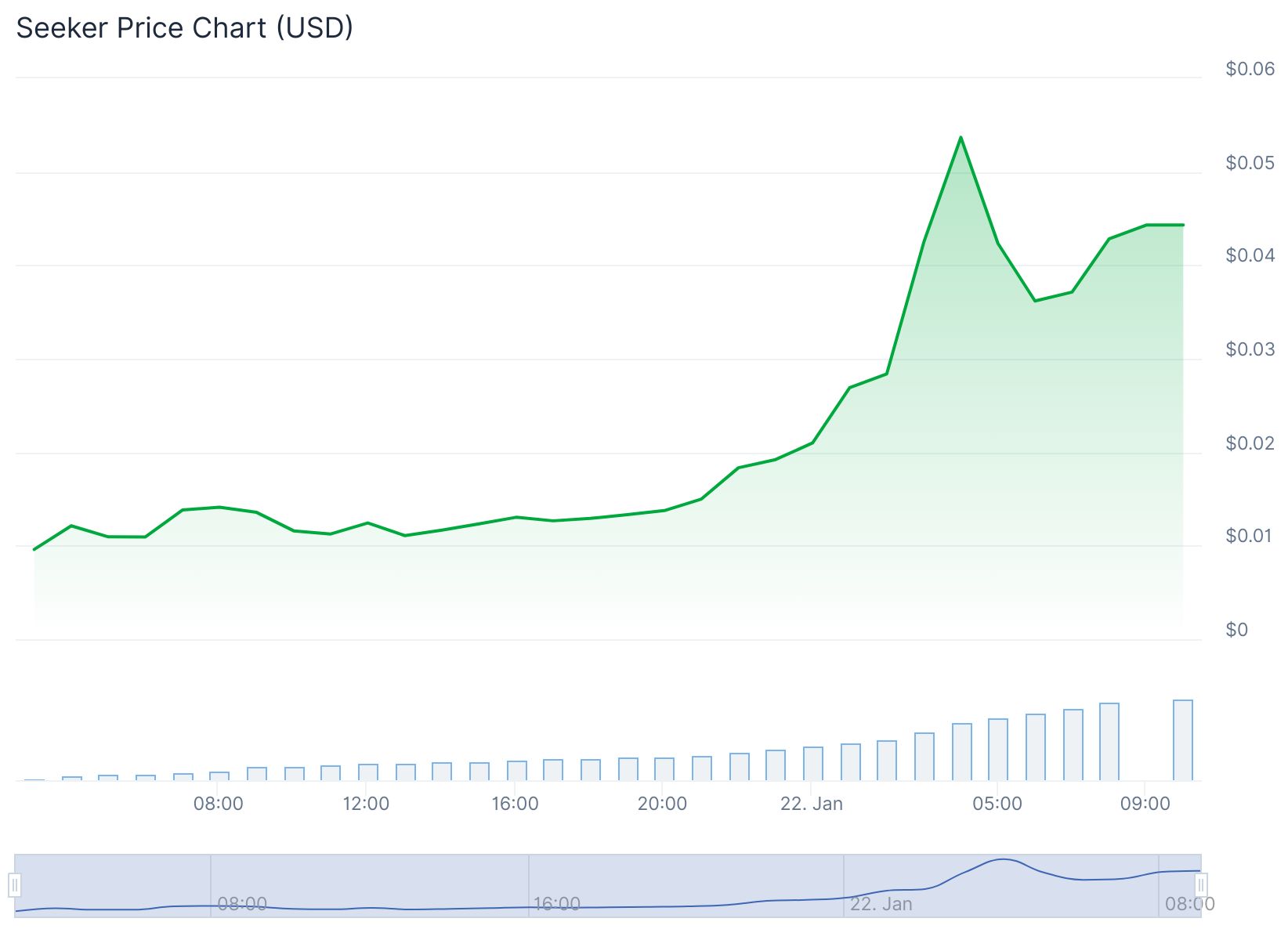
Seeker (SKR) PriceSeeker (SKR) Price

The airdrop represented approximately 20% of the total 10 billion SKR supply. Over 100,000 verified Seeker device owners became eligible to claim tokens through the built-in Seed Vault Wallet.

Trading volume surged over 6,500% to reach $41.81 million in the hours following the launch. The price briefly jumped 55% to $0.0128 before retreating to current levels around $0.04.

Multiple exchanges including Kraken, Bybit, Gate, and MEXC listed the token for trading. The 24-hour price change shows a decline of 4.58% from the opening price.

The token’s market cap sits at approximately $400 million with 3 billion tokens in circulation. This represents 30% of the total 10 billion token supply.

SKR serves three main functions within the Solana Mobile ecosystem. Users can stake tokens with an initial annual percentage yield of 28%. The token also grants governance rights over app curation and ecosystem decisions.

Access to the Seeker mobile dApp store requires SKR tokens. The platform currently hosts 265 active dApps according to Season 1 data.

Guardian System And Governance

The Guardian system differentiates SKR from typical governance structures. Established Solana infrastructure firms including Anza, Helius Labs, and Jito serve as Guardians. Token holders delegate voting power to these entities rather than voting directly.

Staking rewards follow a declining schedule starting at 10% annual inflation. The reward rate drops 25% each year until reaching a minimum of 2%. Early stakers receive higher yields while later participants face dilution through 2027.

Season 1 Performance Metrics

Season 1 metrics showed strong platform activity before the token launch. The platform processed 9 million transactions with $2.6 billion in total volume. The 265 active dApps demonstrate existing developer adoption.

Some analysts project SKR could reach $0.10 by mid-2026 if ecosystem adoption continues. Others suggest a base case near $0.12 with a bull scenario toward $0.22 depending on device sales and dApp growth.

Short-term price action may face selling pressure as airdrop recipients continue liquidating holdings. Trading volume and market stabilization will determine the token’s next directional move.

The current circulating supply of 3 billion tokens leaves 7 billion tokens yet to enter circulation. Token distribution schedule and unlock timelines will affect future price dynamics.

The post Seeker (SKR) Price: Solana Mobile Token Drops to $0.04 After Airdrop Launch appeared first on CoinCentral.

Disclaimer: The articles reposted on this site are sourced from public platforms and are provided for informational purposes only. They do not necessarily reflect the views of MEXC. All rights remain with the original authors. If you believe any content infringes on third-party rights, please contact service@support.mexc.com for removal. MEXC makes no guarantees regarding the accuracy, completeness, or timeliness of the content and is not responsible for any actions taken based on the information provided. The content does not constitute financial, legal, or other professional advice, nor should it be considered a recommendation or endorsement by MEXC.

You May Also Like

Cashing In On University Patents Means Giving Up On Our Innovation Future

Cashing In On University Patents Means Giving Up On Our Innovation Future

The post Cashing In On University Patents Means Giving Up On Our Innovation Future appeared on BitcoinEthereumNews.com. “It’s a raid on American innovation that would deliver pennies to the Treasury while kneecapping the very engine of our economic and medical progress,” writes Pipes. Getty Images Washington is addicted to taxing success. Now, Commerce Secretary Howard Lutnick is floating a plan to skim half the patent earnings from inventions developed at universities with federal funding. It’s being sold as a way to shore up programs like Social Security. In reality, it’s a raid on American innovation that would deliver pennies to the Treasury while kneecapping the very engine of our economic and medical progress. Yes, taxpayer dollars support early-stage research. But the real payoff comes later—in the jobs created, cures discovered, and industries launched when universities and private industry turn those discoveries into real products. By comparison, the sums at stake in patent licensing are trivial. Universities collectively earn only about $3.6 billion annually in patent income—less than the federal government spends on Social Security in a single day. Even confiscating half would barely register against a $6 trillion federal budget. And yet the damage from such a policy would be anything but trivial. The true return on taxpayer investment isn’t in licensing checks sent to Washington, but in the downstream economic activity that federally supported research unleashes. Thanks to the bipartisan Bayh-Dole Act of 1980, universities and private industry have powerful incentives to translate early-stage discoveries into real-world products. Before Bayh-Dole, the government hoarded patents from federally funded research, and fewer than 5% were ever licensed. Once universities could own and license their own inventions, innovation exploded. The result has been one of the best returns on investment in government history. Since 1996, university research has added nearly $2 trillion to U.S. industrial output, supported 6.5 million jobs, and launched more than 19,000 startups. Those companies pay…
Share
BitcoinEthereumNews2025/09/18 03:26
VectorUSA Achieves Fortinet’s Engage Preferred Services Partner Designation

VectorUSA Achieves Fortinet’s Engage Preferred Services Partner Designation

TORRANCE, Calif., Feb. 3, 2026 /PRNewswire/ — VectorUSA, a trusted technology solutions provider, specializes in delivering integrated IT, security, and infrastructure
Share
AI Journal2026/02/05 00:02
Top Solana Treasury Firm Forward Industries Unveils $4 Billion Capital Raise To Buy More SOL ⋆ ZyCrypto

Top Solana Treasury Firm Forward Industries Unveils $4 Billion Capital Raise To Buy More SOL ⋆ ZyCrypto

The post Top Solana Treasury Firm Forward Industries Unveils $4 Billion Capital Raise To Buy More SOL ⋆ ZyCrypto appeared on BitcoinEthereumNews.com. Advertisement &nbsp &nbsp Forward Industries, the largest publicly traded Solana treasury company, has filed a $4 billion at-the-market (ATM) equity offering program with the U.S. SEC  to raise more capital for additional SOL accumulation. Forward Strategies Doubles Down On Solana Strategy In a Wednesday press release, Forward Industries revealed that the 4 billion ATM equity offering program will allow the company to issue and sell common stock via Cantor Fitzgerald under a sales agreement dated Sept. 16, 2025. Forward said proceeds will go toward “general corporate purposes,” including the pursuit of its Solana balance sheet and purchases of income-generating assets. The sales of the shares are covered by an automatic shelf registration statement filed with the US Securities and Exchange Commission that is already effective – meaning the shares will be tradable once they’re sold. An automatic shelf registration allows certain publicly listed companies to raise capital with flexibility swiftly.  Kyle Samani, Forward’s chairman, astutely described the ATM offering as “a flexible and efficient mechanism” to raise and deploy capital for the company’s Solana strategy and bolster its balance sheet.  Advertisement &nbsp Though the maximum amount is listed as $4 billion, the firm indicated that sales may or may not occur depending on existing market conditions. “The ATM Program enhances our ability to continue scaling that position, strengthen our balance sheet, and pursue growth initiatives in alignment with our long-term vision,” Samani said. Forward Industries kicked off its Solana treasury strategy on Sept. 8. The Wednesday S-3 form follows Forward’s $1.65 billion private investment in public equity that closed last week, led by crypto heavyweights like Galaxy Digital, Jump Crypto, and Multicoin Capital. The company started deploying that capital this week, announcing it snatched up 6.8 million SOL for approximately $1.58 billion at an average price of $232…
Share
BitcoinEthereumNews2025/09/18 03:42