The post Bitcoin Leads and Altcoins Follow, but 2026 Isn’t 2016: Here’s What You Need to Know appeared first on Coinpedia Fintech News The cryptocurrency marketThe post Bitcoin Leads and Altcoins Follow, but 2026 Isn’t 2016: Here’s What You Need to Know appeared first on Coinpedia Fintech News The cryptocurrency market

Bitcoin Leads and Altcoins Follow, but 2026 Isn’t 2016: Here’s What You Need to Know
8 min read
Crypto YouTube Views Drop to 5‑Year Low

The post Bitcoin Leads and Altcoins Follow, but 2026 Isn’t 2016: Here’s What You Need to Know appeared first on Coinpedia Fintech News

The cryptocurrency market is being viewed through a cyclical lens, with investors debating whether past market patterns still offer reliable signals. A side-by-side look at 2016 and 2026 presents a familiar tension. Certain timing and technical behaviors have resurfaced with strong similarity, showing similarity in crypto cycles. At the same time, the market’s sentiment has transformed significantly within the last ten years due to regulatory advancements and adoption.

The Bitcoin Halving Sync Between 2016 and 2026

The strongest measurable link between 2016 and 2026 lies in Bitcoin’s halving cycle. In July 2016, Bitcoin was trading near $651 when its second halving took place. The market later peaked at roughly $19,700 in December 2017 about 526 days after the halving, marking a gain of nearly 2,900%.

A similar timeline played out after the fourth halving in April 2024. Bitcoin changed hands around $63,000 at the event and reached a peak near $126,200 in October 2025, approximately 534 days later. While the timing closely mirrored the earlier cycle, the upside was far more muted, delivering roughly 100% from the halving price, or about 38% in overall returns.

Also read: Big News: President Trump Says Crypto Market Structure Bill Will Be Signed ‘Very Soon’

The near-identical timing is interesting, with both cycles topping out roughly 520 to 530 days after the halving. But the drop in returns is just as telling. Post-halving gains have fallen sharply as Bitcoin has matured, reflecting declining returns in a market that has grown from a capitalization of around $10 billion in 2016 to roughly $1.8 trillion by 2026.​

The gap between the two cycles suggests that while the market still follows a familiar timing pattern likely tied to Bitcoin’s built-in supply changes, the size of price moves has faded. Growing institutional involvement has added liquidity and more stability, reducing the kind of extreme speculative surges seen in earlier cycles.

Altcoin Season Shows Similar Pattern 

One of the most compelling correlations emerges in altcoin cycle timing. In Q4 2016, the ratio of altcoins to Bitcoin (ALT/BTC) bottomed, establishing a floor for altcoin underperformance. By Q1-Q2 2017, altcoin season erupted in biblical proportions: Ethereum surged 17,400% from $8 to $1,400, XRP jumped 64,000% from $0.006 to $3.84, and even marginal projects multiplied dozens of times within days.

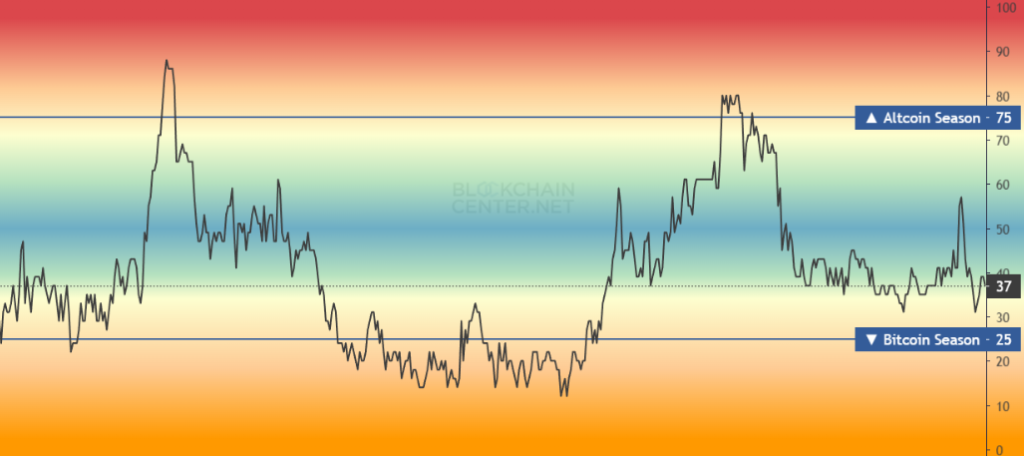
Fast forward exactly one decade: Q4 2025 saw ALT/BTC establish a bottom once again, mirroring the 2016 pattern with near-perfect precision. As of early January 2026, the Altcoin Season Index reached 55, marking a three-month peak and suggesting early-stage entry into altseason. Historical patterns from both 2016-2017 and 2020-2021 cycles indicate that altseason typically follows within 3-4 months of such bottoms, implying Q2-Q3 2026 could see meaningful altcoin outperformance. 
Altcoin Season IndexAltcoin Season Index

​This correlation still matters because it points to the market behavior, not just the halving cycle. When Bitcoin’s dominance tops out and investors start shifting money into other cryptocurrencies, the same pattern tends to play out across different market cycles. What changes is the size of the gains.

Today’s altcoin rallies are likely to be more moderate, since most projects now operate in more regulated and transparent environments, unlike the largely unregulated market of 2017.

Bitcoin Dominance Flashes Inverse Correlation and Divergence

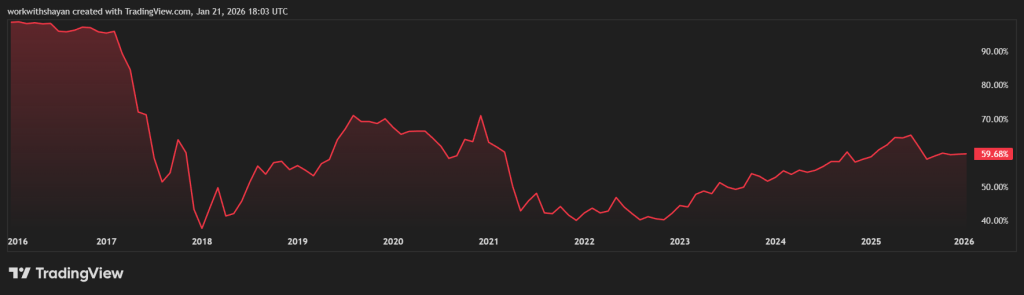
Bitcoin dominance: the percentage of total cryptocurrency market capitalization represented by Bitcoin, reveals a critical divergence between 2016 and 2026. In 2016, Bitcoin dominance averaged 82.6%, with the market still recovering from the Mt. Gox collapse and was dominated by Bitcoin’s narrative as “digital gold”. As altseason surged in late 2017, dominance compressed to 32%, representing a 50+ percentage point collapse in Bitcoin’s market share.
Bitcoin Dominance Bitcoin Dominance

By contrast, 2026 opens with Bitcoin dominance at 59%-61%, a level that has been rising steadily since 2023 after bottoming at roughly 40% in prior years. Rather than following the 2016 trajectory of sharply declining dominance as altseason approaches, 2026’s dominance is rising, suggesting institutional capital is consolidating around Bitcoin as a core strategic reserve rather than hyping around altcoins.

Historical analysis shows that during the 2016 and 2020 halving cycles, Bitcoin dominance eventually fell to the 40% range before rebounding. The key question for 2026 is whether this support level will stay in place or if Bitcoin’s dominance keeps rising, something that would break from the idea that 2026 will simply repeat what happened in 2016.

Decline in Post-Halving Returns in 2016-2026

What stands out most is how much post-halving gains have shrunk over time. The numbers are clear:

  • 2012 Halving: 9,483% return over subsequent 13 months
  • 2016 Halving: 2,931% return over subsequent 17 months
  • 2020 Halving: 702% return over subsequent 11 months
  • 2024 Halving: 38% return (as of January 2026)

This shows a sharp decline in returns over time. With each new cycle, the gains have been roughly a fraction of what they were before. As Bitcoin’s market value has grown and more institutional money has entered the market, price swings have become smaller and more controlled.

The conclusion is clear. Even if the market in 2026 follows a similar timeline to 2016, with an altcoin rally followed by a downturn, the size of the gains is likely to be much more limited. A more mature market and lower levels of leverage make the kind of explosive returns seen in earlier cycles far less likely.​

The Expansion of Bitcoin’s Volatility Floor and Capital Base

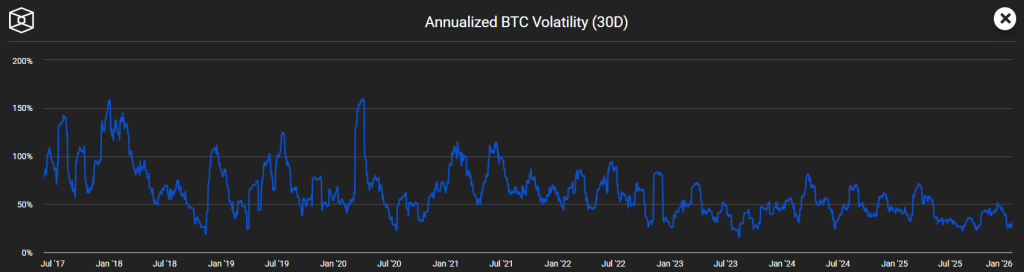
Another key divergence involves Bitcoin volatility. In 2016, Bitcoin’s 30-day average volatility measured 2.49%, seemingly modest until compared with the 4.13% volatility during the 2017 ICO boom. Yet in 2025, despite Bitcoin reaching all-time highs near $126,000 before retracing, daily volatility fell to just 2.24%, the lowest in Bitcoin’s history.

The paradox shows Bitcoin’s volatility “floor,” which has risen dramatically over the decade. In 2016, Bitcoin’s volatility floor was $366. Today, that floor stands at $76,329, a 208x increase reflecting the depth of institutional capital now supporting the asset. Spot Bitcoin ETFs, approved in January 2024, have reduced volatility by 55% compared to pre-ETF periods by providing stable institutional buyers.
Bitcoin VolatilityBitcoin Volatility

​This change in market structure means that even if 2026 follows the same cycle timing as 2016, the moves are likely to feel less extreme. Institutional investors now play a much bigger role, helping to stabilize prices and limit sharp drops. As a result, market behavior is different: the emotional, retail-driven excitement of 2016 has largely given way to more strategy-based investment decisions from large players.

Market Sentiment Leans Toward Allocation in 2026

Perhaps the most fundamental correlation lies in market maturity itself. In 2016, the cryptocurrency market was 100% retail-driven speculation. There were virtually no institutional participants, regulatory frameworks were nonexistent, and the entire ecosystem totaled roughly $10 billion in market cap. By 2026, over 200 public companies hold Bitcoin, governments maintain strategic reserves totaling 307,000 BTC, and institutional holdings now represent approximately 10-14% of total Bitcoin supply.

This shift in market structure helps explain why 2026 may follow the same cycle timing as 2016 but behave very differently. Institutional money now plays a major role, tying crypto prices more closely to broader economic forces like interest rates, the dollar, and bond yields, links that barely mattered in 2016, when speculation drove most moves.

Today, flows into and out of Bitcoin ETFs can reach more than $1 billion in a single day, making macro conditions the main driver of price action. That trend simply didn’t exist a decade ago.​

The Halving Cycle in a More Mature Market

A main question in the 2016–2026 comparison is whether Bitcoin’s four-year halving cycle still drives the market. The evidence cuts both ways. Supporters point to familiar patterns that continue to show up, including bull market peaks arriving just over 500 days after halvings, similar late-year altcoin rotations, and bear markets that still tend to last about a year or longer.

Skeptics say those patterns matter less than they once did. Matt Hougan has argued that ETFs, regulatory clarity, and easier access for institutions have softened the boom-and-bust cycles that defined earlier eras of crypto. The data backs that up to a point. While the timing around halvings has remained consistent, the size of the gains has shrunk dramatically compared with 2016.

The result is a market that still echoes past cycles but no longer reacts the same way. Institutional participation now plays a decisive role, triggering outcomes in ways that were largely absent a decade ago.

Conclusion

The idea that history “rhymes” fits the 2016–2026 crypto cycle. Key timing patterns have repeated, with Bitcoin peaking just over 500 days after both the 2016 and 2024 halvings.

What hasn’t repeated is the scale. The explosive returns and extreme volatility of 2016-2017 are unlikely to come back in a market shaped by institutions and regulation.

The bottom line: 2026 may follow the same cycle timing as 2016, but not the same psychology or gains.

Disclaimer: The articles reposted on this site are sourced from public platforms and are provided for informational purposes only. They do not necessarily reflect the views of MEXC. All rights remain with the original authors. If you believe any content infringes on third-party rights, please contact service@support.mexc.com for removal. MEXC makes no guarantees regarding the accuracy, completeness, or timeliness of the content and is not responsible for any actions taken based on the information provided. The content does not constitute financial, legal, or other professional advice, nor should it be considered a recommendation or endorsement by MEXC.

You May Also Like

The Role of Blockchain in Building Safer Web3 Gaming Ecosystems

The Role of Blockchain in Building Safer Web3 Gaming Ecosystems

The gaming industry is in the midst of a historic shift, driven by the rise of Web3. Unlike traditional games, where developers and publishers control assets and dictate in-game economies, Web3 gaming empowers players with ownership and influence. Built on blockchain technology, these ecosystems are decentralized by design, enabling true digital asset ownership, transparent economies, and a future where players help shape the games they play. However, as Web3 gaming grows, security becomes a focal point. The range of security concerns, from hacking to asset theft to vulnerabilities in smart contracts, is a significant issue that will undermine or erode trust in this ecosystem, limiting or stopping adoption. Blockchain technology could be used to create security processes around secure, transparent, and fair Web3 gaming ecosystems. We will explore how security is increasing within gaming ecosystems, which challenges are being overcome, and what the future of security looks like. Why is Security Important in Web3 Gaming? Web3 gaming differs from traditional gaming in that players engage with both the game and assets with real value attached. Players own in-game assets that exist as tokens or NFTs (Non-Fungible Tokens), and can trade and sell them. These game assets usually represent significant financial value, meaning security failure could represent real monetary loss. In essence, without security, the promises of owning “something” in Web3, decentralized economies within games, and all that comes with the term “fair” gameplay can easily be eroded by fraud, hacking, and exploitation. This is precisely why the uniqueness of blockchain should be emphasized in securing Web3 gaming. How Blockchain Ensures Security in Web3 Gaming?
  1. Immutable Ownership of Assets Blockchain records can be manipulated by anyone. If a player owns a sword, skin, or plot of land as an NFT, it is verifiably in their ownership, and it cannot be altered or deleted by the developer or even hacked. This has created a proven track record of ownership, providing control back to the players, unlike any centralised gaming platform where assets can be revoked.
  2. Decentralized Infrastructure Blockchain networks also have a distributed architecture where game data is stored in a worldwide network of nodes, making them much less susceptible to centralised points of failure and attacks. This decentralised approach makes it exponentially more difficult to hijack systems or even shut off the game’s economy.
  3. Secure Transactions with Cryptography Whether a player buys an NFT or trades their in-game tokens for other items or tokens, the transactions are enforced by cryptographic algorithms, ensuring secure, verifiable, and irreversible transactions and eliminating the risks of double-spending or fraudulent trades.
  4. Smart Contract Automation Smart contracts automate the enforcement of game rules and players’ economic exchanges for the developer, eliminating the need for intermediaries or middlemen, and trust for the developer. For example, if a player completes a quest that promises a reward, the smart contract will execute and distribute what was promised.
  5. Anti-Cheating and Fair Gameplay The naturally transparent nature of blockchain makes it extremely simple for anyone to examine a specific instance of gameplay and verify the economic outcomes from that play. Furthermore, multi-player games that enforce smart contracts on things like loot sharing or win sharing can automate and measure trustlessness and avoid cheating, manipulations, and fraud by developers.
  6. Cross-Platform Security Many Web3 games feature asset interoperability across platforms. This interoperability is made viable by blockchain, which guarantees ownership is maintained whenever assets transition from one game or marketplace to another, thereby offering protection to players who rely on transfers for security against fraud. Key Security Dangers in Web3 Gaming Although blockchain provides sound first principles of security, the Web3 gaming ecosystem is susceptible to threats. Some of the most serious threats include:
Smart Contract Vulnerabilities: Smart contracts that are poorly written or lack auditing will leave openings for exploitation and thereby result in asset loss. Phishing Attacks: Unintentionally exposing or revealing private keys or signing transactions that are not possible to reverse, under the assumption they were genuine transaction requests. Bridge Hacks: Cross-chain bridges, which allow players to move their assets between their respective blockchains, continually face hacks, requiring vigilance from players and developers. Scams and Rug Pulls: Rug pulls occur when a game project raises money and leaves, leaving player assets worthless. Regulatory Ambiguity: Global regulations remain unclear; risks exist for players and developers alike. While blockchain alone won’t resolve every issue, it remediates the responsibility of the first principles, more so when joined by processes such as auditing, education, and the right governance, which can improve their contribution to the security landscapes in game ecosystems. Real Life Examples of Blockchain Security in Web3 Gaming Axie Infinity (Ronin Hack): The Axie Infinity game and several projects suffered one of the biggest hacks thus far on its Ronin bridge; however, it demonstrated the effectiveness of multi-sig security and the effective utilization of decentralization. The industry benefited through learning and reflection, thus, as projects have implemented changes to reduce the risks of future hacks or misappropriation. Immutable X: This Ethereum scaling solution aims to ensure secure NFT transactions for gaming, allowing players to trade an asset without the burden of exorbitant fees and fears of being a victim of fraud. Enjin: Enjin is providing a trusted infrastructure for Web3 games, offering secure NFT creation and transfer while reiterating that ownership and an asset securely belong to the player. These examples indubitably illustrate that despite challenges to overcome, blockchain remains the foundational layer on which to build more secure Web3 gaming environments. Benefits of Blockchain Security for Players and Developers For Players: Confidence in true ownership of assets Transparency in in-game economies Protection against nefarious trades/scams For Developers: More trust between players and the platform Less reliance on centralized infrastructure Ability to attract wealth and players based on provable fairness By incorporating blockchain security within the mechanics of game design, developers can create and enforce resilient ecosystems where players feel reassured in investing time, money, and ownership within virtual worlds. The Future of Secure Web3 Gaming Ecosystems As the wisdom of blockchain technology and industry knowledge improves, the future for secure Web3 gaming looks bright. New growing trends include: Zero-Knowledge Proofs (ZKPs): A new wave of protocols that enable private transactions and secure smart contracts while managing user privacy with an element of transparency. Decentralized Identity Solutions (DID): Helping players control their identities and decrease account theft risks. AI-Enhanced Security: Identifying irregularities in user interactions by sampling pattern anomalies to avert hacks and fraud by time-stamping critical events. Interoperable Security Standards: Allowing secured and seamless asset transfers across blockchains and games. With these innovations, blockchain will not only secure gaming assets but also enhance the overall trust and longevity of Web3 gaming ecosystems. Conclusion Blockchain is more than a buzzword in Web3; it is the only way to host security, fairness, and transparency. With blockchain, players confirm immutable ownership of digital assets, there is a decentralized infrastructure, and finally, it supports smart contracts to automate code that protects players and developers from the challenges of digital economies. The threats, vulnerabilities, and scams that come from smart contracts still persist, but the industry is maturing with better security practices, cross-chain solutions, and increased formal cryptographic tools. In the coming years, blockchain will remain the base to digital economies and drive Web3 gaming environments that allow players to safely own, trade, and enjoy their digital experiences free from fraud and exploitation. While blockchain and gaming alone entertain, we will usher in an era of secure digital worlds where trust complements innovation. The Role of Blockchain in Building Safer Web3 Gaming Ecosystems was originally published in Coinmonks on Medium, where people are continuing the conversation by highlighting and responding to this story
Share
Medium2025/09/18 14:40
Vitalik Buterin Challenges Ethereum’s Layer 2 Paradigm

Vitalik Buterin Challenges Ethereum’s Layer 2 Paradigm

Vitalik Buterin challenges the role of layer 2 solutions in Ethereum's ecosystem. Layer 2's slow progress and Ethereum’s L1 scaling impact future strategies.
Share
Coinstats2026/02/04 04:08
USAA Names Dan Griffiths Chief Information Officer to Drive Secure, Simplified Digital Member Experiences

USAA Names Dan Griffiths Chief Information Officer to Drive Secure, Simplified Digital Member Experiences

SAN ANTONIO–(BUSINESS WIRE)–USAA today announced the appointment of Dan Griffiths as Chief Information Officer, effective February 5, 2026. A proven financial‑services
Share
AI Journal2026/02/04 04:15