Flow Network Recoveres After Protocol Exploit The Flow Foundation has disclosed details of a security breach that compromised the blockchain on December 27, resultingFlow Network Recoveres After Protocol Exploit The Flow Foundation has disclosed details of a security breach that compromised the blockchain on December 27, resulting

December Exploit Causes $3.9M in Counterfeit Token Losses — Shocking Details
3 min read
December Exploit Causes $3.9m In Counterfeit Token Losses — Shocking Details

Flow Network Recoveres After Protocol Exploit

The Flow Foundation has disclosed details of a security breach that compromised the blockchain on December 27, resulting in approximately $3.9 million in confirmed losses. The incident stemmed from a flaw in the network’s Cadence runtime, which allowed an attacker to duplicate tokens without draining user accounts or bypassing supply controls.

In its technical post-mortem, the Foundation explained that the attacker exploited a vulnerability that enabled asset duplication rather than actual minting, creating counterfeit tokens that temporarily flooded the network. The development team responded swiftly—validators coordinated a network halt within six hours of the malicious activity, switching the system into a read-only state to contain the problem and prevent further asset duplication.

Collaborating with exchange partners and security teams, most counterfeit tokens were frozen before they could be liquidated. The network recovery plan involved a two-day hiatus, during which legitimate transaction histories were preserved. Subsequently, the team executed a governance-approved process to permanently destroy the counterfeit assets, ensuring they did not circulate further.

Source: Flow Blockchain

The Foundation emphasized that no user account balances were compromised, as the attack only duplicated existing assets instead of extracting funds. A limited number of accounts involved with counterfeit tokens were temporarily restricted as a precaution, but over 99% of users maintained full access during and after the containment efforts.

Flow stated that it has since patched the underlying vulnerability, imposed stricter runtime validation checks, and expanded testing procedures to prevent similar exploits. Additionally, the project is working with forensic investigators and law enforcement agencies, with plans to enhance its monitoring and bug bounty programs as part of a broader security enhancement initiative.

Post-Hack Market Impact and Flow’s Turbulent Road

Developed by Dapper Labs—creators of CryptoKitties—the Flow blockchain was launched in September 2019 to address scalability issues faced by consumer applications like games and digital collectibles. The platform gained significant attention with the success of NBA Top Shot, an NFT platform for trading officially licensed NBA highlights, which helped propel the FLOW token above $40 in 2021, according to CoinGecko data.

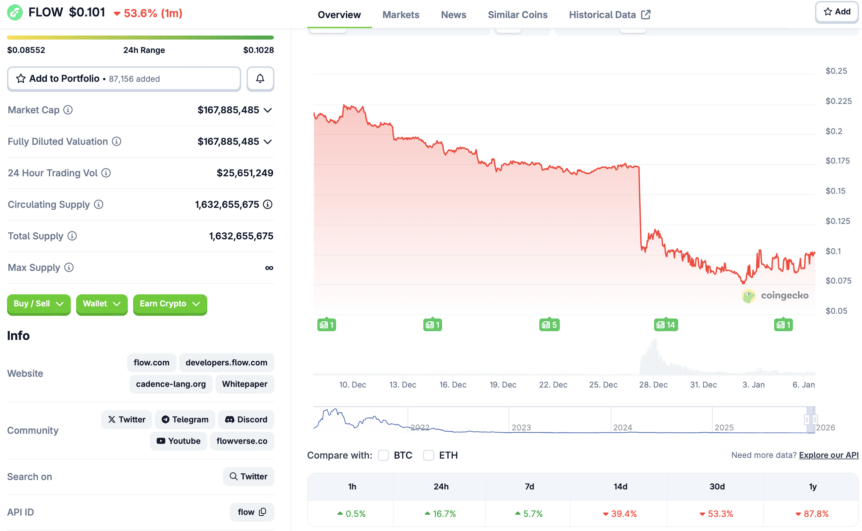
In 2022, Flow secured approximately $725 million from investors such as Andreessen Horowitz and Union Square Ventures to foster ecosystem growth. However, as the NFT market cooled in subsequent years, FLOW lost considerable momentum and fell outside the top 300 cryptocurrencies by market capitalization. Following the December hack, the token experienced a steep decline of around 40% over a five-hour period, plunging to a low of $0.075 on January 2.

Since then, the token has shown signs of recovery, climbing to about $0.10, a 16% increase within 24 hours. Despite the setback, the community remains optimistic about the platform’s future prospects amid ongoing security enhancements and renewed investor interest.
Hacks, NFT, FlowSource: CoinGecko

This article was originally published as December Exploit Causes $3.9M in Counterfeit Token Losses — Shocking Details on Crypto Breaking News – your trusted source for crypto news, Bitcoin news, and blockchain updates.

Market Opportunity
TokenFi Logo
TokenFi Price(TOKEN)
$0.003191
$0.003191$0.003191
-1.72%
USD
TokenFi (TOKEN) Live Price Chart
Disclaimer: The articles reposted on this site are sourced from public platforms and are provided for informational purposes only. They do not necessarily reflect the views of MEXC. All rights remain with the original authors. If you believe any content infringes on third-party rights, please contact service@support.mexc.com for removal. MEXC makes no guarantees regarding the accuracy, completeness, or timeliness of the content and is not responsible for any actions taken based on the information provided. The content does not constitute financial, legal, or other professional advice, nor should it be considered a recommendation or endorsement by MEXC.

You May Also Like

Cashing In On University Patents Means Giving Up On Our Innovation Future

Cashing In On University Patents Means Giving Up On Our Innovation Future

The post Cashing In On University Patents Means Giving Up On Our Innovation Future appeared on BitcoinEthereumNews.com. “It’s a raid on American innovation that would deliver pennies to the Treasury while kneecapping the very engine of our economic and medical progress,” writes Pipes. Getty Images Washington is addicted to taxing success. Now, Commerce Secretary Howard Lutnick is floating a plan to skim half the patent earnings from inventions developed at universities with federal funding. It’s being sold as a way to shore up programs like Social Security. In reality, it’s a raid on American innovation that would deliver pennies to the Treasury while kneecapping the very engine of our economic and medical progress. Yes, taxpayer dollars support early-stage research. But the real payoff comes later—in the jobs created, cures discovered, and industries launched when universities and private industry turn those discoveries into real products. By comparison, the sums at stake in patent licensing are trivial. Universities collectively earn only about $3.6 billion annually in patent income—less than the federal government spends on Social Security in a single day. Even confiscating half would barely register against a $6 trillion federal budget. And yet the damage from such a policy would be anything but trivial. The true return on taxpayer investment isn’t in licensing checks sent to Washington, but in the downstream economic activity that federally supported research unleashes. Thanks to the bipartisan Bayh-Dole Act of 1980, universities and private industry have powerful incentives to translate early-stage discoveries into real-world products. Before Bayh-Dole, the government hoarded patents from federally funded research, and fewer than 5% were ever licensed. Once universities could own and license their own inventions, innovation exploded. The result has been one of the best returns on investment in government history. Since 1996, university research has added nearly $2 trillion to U.S. industrial output, supported 6.5 million jobs, and launched more than 19,000 startups. Those companies pay…
Share
BitcoinEthereumNews2025/09/18 03:26
XRP Ledger Unlocks Permissioned Domains With 91% Validator Backing

XRP Ledger Unlocks Permissioned Domains With 91% Validator Backing

XRP Ledger activated XLS-80 after 91% validator approval, enabling permissioned domains for credential-gated use on the public XRPL. The XRP Ledger has activated
Share
LiveBitcoinNews2026/02/06 13:00
TrendX Taps Trusta AI to Develop Safer and Smarter Web3 Network

TrendX Taps Trusta AI to Develop Safer and Smarter Web3 Network

The purpose of collaboration is to advance the Web3 landscape by combining the decentralized infrastructure of TrendX with AI-led capabilities of Trusta AI.
Share
Blockchainreporter2025/09/18 01:07