XRP’s price has spent recent weeks moving without a clear directional breakout. The price action has been mostly bearish, but activity beneath the surface is tellingXRP’s price has spent recent weeks moving without a clear directional breakout. The price action has been mostly bearish, but activity beneath the surface is telling

Why You Should Pay Attention To XRP’s Exchange Netflows This Month

XRP’s price has spent recent weeks moving without a clear directional breakout. The price action has been mostly bearish, but activity beneath the surface is telling a more interesting story. 

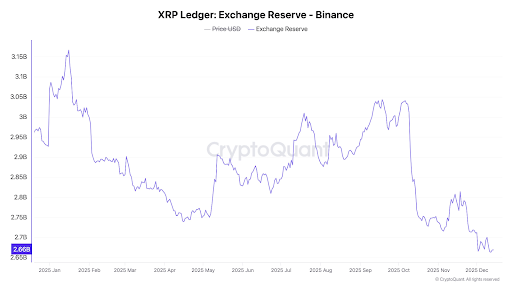
On-chain data shows XRP leaving Binance at a rapid pace, pushing the exchange’s reserves down to around 2.66 billion XRP, the lowest level recorded this year. This movement has garnered the interest of market participants because it is not reflective of the current price action of XRP. Insights from market commentator Stellar Rippler on X help explain why investors should pay attention to the netflows.

XRP Leaving Binance Means Positioning, Not Panic

Exchange netflows often give a clearer picture of market intent than short-term price movements. When reserves drop consistently, it usually reflects strategic decisions by holders. This month, XRP’s netflows are flashing signals that are worth watching closely. 

The steady decline in Binance’s XRP reserves points to deliberate withdrawals instead of emotional reactions. According to commentary shared on X by Stellar Rippler, this type of movement does not correspond with retail panic selling. 
XRP

Retail-based fear typically shows up as sudden deposits to exchanges as traders rush to exit positions. What the data shows instead is a controlled and sustained reduction in available exchange liquidity.

This pattern points to holders choosing custody outside exchanges, a behavior commonly associated with long-term allocations. Crypto history has shown that prolonged exchange outflows often occur when investors are confident in long-term demand, not when they anticipate a prolonged downward price action. 

You don’t drain liquidity before bad news. In this context, XRP’s exchange netflows suggest preparation, not speculation.

Why Falling Binance Reserves Matter For Market Structure

Binance is the largest crypto exchange in the world, meaning its XRP reserves represent the most readily available supply for a large portion of active traders. As more and more XRP continues to leave the exchange, the amount of XRP immediately available for spot trading keeps shrinking, gradually tightening liquidity even though the price has not reacted yet. 

Speaking of price not reacting, XRP’s price action has struggled over the past few weeks, repeatedly failing to hold above the $2.00 price level and spending most of the period trading lower around the $1.80 to $1.95 range. Despite this, the data shows that the weak price performance is largely due to broader market outflows across every crypto, not a surge in XRP-specific selling. 

The outflows in XRP exchange reserves are more meaningful when viewed alongside the steady inflows into Spot XRP ETFs, which are yet to record a day of net outflows since their launch. Those ETF inflows suggest institutional demand is increasing under the surface, even though it has so far been outweighed by capital leaving the wider crypto market.

XRP
Market Opportunity
WHY Logo
WHY Price(WHY)
$0.00000001619
$0.00000001619$0.00000001619
0.00%
USD
WHY (WHY) Live Price Chart
Disclaimer: The articles reposted on this site are sourced from public platforms and are provided for informational purposes only. They do not necessarily reflect the views of MEXC. All rights remain with the original authors. If you believe any content infringes on third-party rights, please contact service@support.mexc.com for removal. MEXC makes no guarantees regarding the accuracy, completeness, or timeliness of the content and is not responsible for any actions taken based on the information provided. The content does not constitute financial, legal, or other professional advice, nor should it be considered a recommendation or endorsement by MEXC.

You May Also Like

Trust Wallet’s Decisive Move: Full Compensation for $7M Hack Victims

Trust Wallet’s Decisive Move: Full Compensation for $7M Hack Victims

BitcoinWorld Trust Wallet’s Decisive Move: Full Compensation for $7M Hack Victims In a significant move for cryptocurrency security, Trust Wallet has committed
Share
bitcoinworld2025/12/26 17:40
Cashing In On University Patents Means Giving Up On Our Innovation Future

Cashing In On University Patents Means Giving Up On Our Innovation Future

The post Cashing In On University Patents Means Giving Up On Our Innovation Future appeared on BitcoinEthereumNews.com. “It’s a raid on American innovation that would deliver pennies to the Treasury while kneecapping the very engine of our economic and medical progress,” writes Pipes. Getty Images Washington is addicted to taxing success. Now, Commerce Secretary Howard Lutnick is floating a plan to skim half the patent earnings from inventions developed at universities with federal funding. It’s being sold as a way to shore up programs like Social Security. In reality, it’s a raid on American innovation that would deliver pennies to the Treasury while kneecapping the very engine of our economic and medical progress. Yes, taxpayer dollars support early-stage research. But the real payoff comes later—in the jobs created, cures discovered, and industries launched when universities and private industry turn those discoveries into real products. By comparison, the sums at stake in patent licensing are trivial. Universities collectively earn only about $3.6 billion annually in patent income—less than the federal government spends on Social Security in a single day. Even confiscating half would barely register against a $6 trillion federal budget. And yet the damage from such a policy would be anything but trivial. The true return on taxpayer investment isn’t in licensing checks sent to Washington, but in the downstream economic activity that federally supported research unleashes. Thanks to the bipartisan Bayh-Dole Act of 1980, universities and private industry have powerful incentives to translate early-stage discoveries into real-world products. Before Bayh-Dole, the government hoarded patents from federally funded research, and fewer than 5% were ever licensed. Once universities could own and license their own inventions, innovation exploded. The result has been one of the best returns on investment in government history. Since 1996, university research has added nearly $2 trillion to U.S. industrial output, supported 6.5 million jobs, and launched more than 19,000 startups. Those companies pay…
Share
BitcoinEthereumNews2025/09/18 03:26
Trust Wallet Hack Hits $7M: CZ Hints at Possible Insider Role

Trust Wallet Hack Hits $7M: CZ Hints at Possible Insider Role

CZ hinted at possible insider involvement in the Trust Wallet incident while assuring users that their funds would be reimbursed.
Share
CryptoPotato2025/12/26 16:48