Arizona Eyes ‘Tax-Free’ Status: New Bill Seeks to Ban Local Crypto Taxes
Arizona lawmakers are weighing a new attempt to carve out a more permissive tax environment for digital assets, as a trio of proposals introduced by State Senator Wendy Rogers pushes to limit how cryptocurrencies and blockchain infrastructure can be taxed at the state and local level.
The effort centers on two bills and a constitutional resolution prefiled with the Arizona Senate late last week.
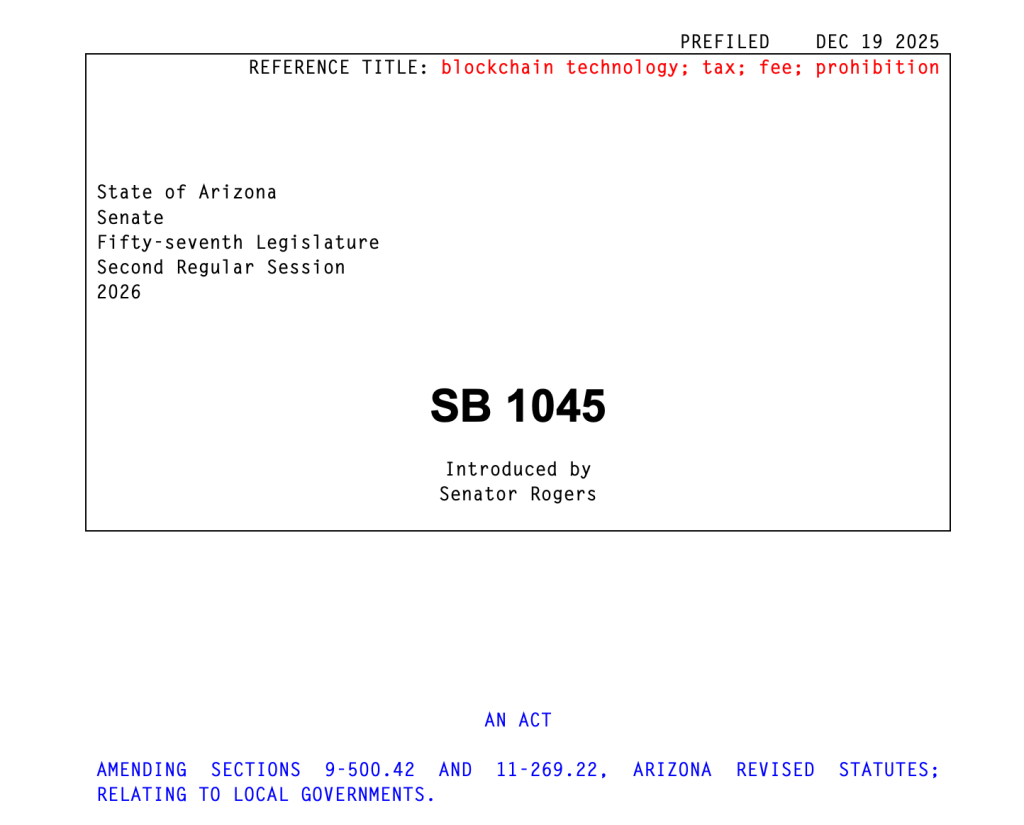 Source: Arizona legislature
One proposal, SB 1044, would amend state statutes to exempt virtual currency from taxation, while another, SB 1045, would bar counties, cities, and towns from imposing taxes or fees on people or companies that operate blockchain nodes.
A third measure, SCR 1003, would amend Arizona’s constitution to explicitly exclude virtual currency from property tax. If enacted, the node-related bill could take effect through the state legislature alone.
Arizona Pushes Crypto Tax Boundaries, but Voters Hold the Final Say
The broader tax exemption proposals, however, would require voter approval during Arizona’s next general election in November 2026.
Under current law, Arizona is not a tax-free state. Residents pay a flat personal income tax rate of 2.5%, along with a state sales tax known as the Transaction Privilege Tax, which starts at 5.6% and rises above 8.5% on average once local rates are included.
Property taxes are also collected, though they are generally lower than in many other states.
Cryptocurrency is treated as property for federal tax purposes, meaning sales, trades, or payments trigger capital gains or losses.
Arizona largely follows that framework but has adopted several crypto-specific rules. Since December 2022, the state has exempted crypto airdrops from state income tax by treating them as gifts at the time they are received, even though federal taxes still apply.
 Source: Arizona Form 165 Schedule K-1(NR)
Arizona also allows transaction fees, or gas fees, to be deducted when calculating gains or losses and permits state agencies to accept cryptocurrency payments through approved service providers.
Rogers’ latest proposals would go further by attempting to remove virtual currency from the state’s tax base entirely and by shielding blockchain node operators from local government levies.
Arizona already stands out as one of the few states with a law allowing the government to claim ownership of digital assets deemed abandoned after three years, a measure tied to earlier efforts to establish a state-level digital asset reserve.
The senator was also a co-sponsor of a Bitcoin reserve bill vetoed in May by Governor Katie Hobbs.
In June, the Arizona Senate later passed a revised Bitcoin reserve bill as it cleared the chamber in a narrow 16–14 vote after approving a motion to reconsider the measure.
From State Experiments to Capitol Hill, Crypto Tax Rules Are Back in Play
The Arizona push comes as debates over crypto taxation intensify nationwide. A handful of states, including Florida, Texas, Wyoming, and Nevada, do not impose personal income taxes, effectively making most crypto gains tax-free at the state level.
Others have taken more targeted approaches. Missouri, in August, eliminated state income tax on capital gains, while Ohio lawmakers have advanced a proposal to exempt small crypto transactions under $200, though that bill has stalled.
At the federal level, Congress is preparing to revisit crypto tax policy after nearly a decade of relying on Internal Revenue Service guidance issued in 2014.
In December, Representative Max Miller said a draft bill to modernize digital asset taxation could move before the August 2026 recess.
More recently, bipartisan House lawmakers released a discussion draft that would exempt small stablecoin payments from capital gains tax and allow a five-year deferral on staking and mining rewards.
You May Also Like

XRP Breaks $1.95 Support After 13 Months, Analyst Sees $0.90 Target

Ramtech Building Systems Completes Advanced Modular Office Building at Los Alamos National Laboratory