The post 2025 Was a Record Year for North Korea’s Crypto Heists appeared on BitcoinEthereumNews.com. The crypto industry experienced a major escalation in globalThe post 2025 Was a Record Year for North Korea’s Crypto Heists appeared on BitcoinEthereumNews.com. The crypto industry experienced a major escalation in global

2025 Was a Record Year for North Korea’s Crypto Heists

The crypto industry experienced a major escalation in global cryptocurrency theft in 2025, with losses exceeding $3.4 billion between January and early December, according to a new report from Chainalysis.

The surge was largely driven by North Korea-linked hackers, who were responsible for the majority of stolen funds during the year.

Inside North Korea’s Record $2 Billion Crypto Theft

In its latest report, blockchain analytics firm Chainalysis pointed out that there was a significant decline in the Democratic People’s Republic of Korea’s (DPRK) attack frequency. Still, they achieved a record-breaking year in terms of cryptocurrency theft.

Sponsored

Sponsored

North Korean hackers stole at least $2.02 billion in digital assets in 2025. This marked a 51% year-over-year increase. Compared with 2020 levels, the amount represents a surge of approximately 570%.

Furthermore, the report revealed that DPRK-linked actors were responsible for a record 76% of all service compromises during the year.

Taken together, the 2025 figures push the lower-bound cumulative estimate of cryptocurrency funds stolen by North Korea to $6.75 billion.

Drawing on historical data, Chainalysis determined that the DPRK continues to carry out significantly higher-value attacks than other threat actors. 

DRPK vs Other Hackers. Source: Chainalysis

According to Chainalysis, North Korea-linked hackers are increasingly generating outsized results by placing operatives in technical roles within crypto-related companies. This approach, one of the principal attack vectors, enables threat actors to gain privileged access and execute more damaging intrusions.

In July, blockchain investigator ZachXBT published an exposé claiming that North Korea-linked operatives infiltrated between 345 and 920 jobs across the crypto industry.

Sponsored

Sponsored

Threat actors have also adopted recruitment-style tactics, posing as employers to target individuals already working in the sector.

Furthermore, BeInCrypto recently reported that hackers were impersonating trusted industry contacts in fake Zoom and Microsoft Teams meetings. Using this tactic, they stole more than $300 million.

Chainalysis Maps a 45-Day Laundering Playbook Used by North Korean Hackers

Chainalysis found that North Korea’s laundering behavior differs sharply from that of other groups. The report showed that DPRK-linked actors tend to launder money in smaller on-chain tranches, with just over 60% of volume concentrated below a $500,000 transfer value. 

By contrast, non-DPRK threat actors typically transfer 60% of stolen funds in much larger batches, often ranging from $1 million to more than $10 million. Chainalysis said this structure reflects a more deliberate and sophisticated approach to laundering, despite North Korea stealing larger overall amounts.

Sponsored

Sponsored

The firm also identified clear differences in service usage. DPRK-linked hackers show a strong reliance on Chinese-language money movement and guarantee services, as well as bridge and mixing tools designed to obscure transaction trails. They also utilize specialized platforms, such as Huione, to facilitate their laundering operations.

In contrast, other stolen-fund actors more frequently interact with decentralized exchanges, centralized platforms, peer-to-peer services, and lending protocols.

Chainalysis also observed a recurring laundering pattern that typically unfolds over 45 days. In the days immediately after a hack (Days 0-5), North Korea-linked actors prioritize distancing the stolen funds from the source. The report noted a sharp increase in the use of DeFi protocols and mixing services during this initial period.

In the second week (Days 6-10), activity shifts toward services that enable broader integration. Flows begin reaching centralized exchanges and platforms with limited KYC requirements.

Laundering activity persists through secondary mixing services at a reduced intensity. Meanwhile, cross-chain bridges are used to obscure movement. 

In the final phase (Days 20-45), there is increased interaction with services that facilitate conversion or cash-out. No-KYC exchanges, guarantee services, instant swap platforms, and Chinese-language services feature prominently, alongside renewed use of centralized exchanges to blend illicit funds with legitimate activity.

Sponsored

Sponsored

Chainalysis emphasized that the recurring 45-day laundering window provides key insights for law enforcement. It also reflects the hackers’ operational constraints and reliance on specific facilitators. 

While not all stolen funds follow this timeline, the pattern represents typical on-chain behavior. Still, the team acknowledged potential blind spots, as certain activities, such as private key transfers or off-chain OTC transactions, may not be visible through blockchain data alone without corroborative intelligence.

The 2026 Outlook

Chainalysis’ Head of National Security Intelligence disclosed to BeInCrypto that North Korea is likely to probe for any available vulnerability. While the Bybit, BTCTurk, and Upbit incidents this year suggest that centralized exchanges are facing increasing pressure, tactics could change at any time.

Recent exploits involving Balancer and Yearn also indicate that long-established protocols may be coming under the radar of attackers. He said,

The report also stressed that as North Korea increasingly relies on cryptocurrency theft to finance state priorities and evade international sanctions, the industry must recognize that this threat actor operates under a fundamentally different set of constraints and incentives than typical cybercriminals.

The firm outlined that the key challenge heading into 2026 will be identifying and disrupting these high-impact operations before DPRK-linked actors can execute another incident on the scale of the Bybit hack.

Source: https://beincrypto.com/north-korea-crypto-theft-2025/
Market Opportunity
Major Logo
Major Price(MAJOR)
$0.06578
$0.06578$0.06578
-2.77%
USD
Major (MAJOR) Live Price Chart
Disclaimer: The articles reposted on this site are sourced from public platforms and are provided for informational purposes only. They do not necessarily reflect the views of MEXC. All rights remain with the original authors. If you believe any content infringes on third-party rights, please contact service@support.mexc.com for removal. MEXC makes no guarantees regarding the accuracy, completeness, or timeliness of the content and is not responsible for any actions taken based on the information provided. The content does not constitute financial, legal, or other professional advice, nor should it be considered a recommendation or endorsement by MEXC.

You May Also Like

Ethereum Price Prediction: ETH Targets $10,000 In 2026 But Layer Brett Could Reach $1 From $0.0058

Ethereum Price Prediction: ETH Targets $10,000 In 2026 But Layer Brett Could Reach $1 From $0.0058

Ethereum price predictions are turning heads, with analysts suggesting ETH could climb to $10,000 by 2026 as institutional demand and network upgrades drive growth. While Ethereum remains a blue-chip asset, investors looking for sharper multiples are eyeing Layer Brett (LBRETT). Currently in presale at just $0.0058, the Ethereum Layer 2 meme coin is drawing huge [...] The post Ethereum Price Prediction: ETH Targets $10,000 In 2026 But Layer Brett Could Reach $1 From $0.0058 appeared first on Blockonomi.
Share
Blockonomi2025/09/17 23:45
Will XRP Price Increase In September 2025?

Will XRP Price Increase In September 2025?

Ripple XRP is a cryptocurrency that primarily focuses on building a decentralised payments network to facilitate low-cost and cross-border transactions. It’s a native digital currency of the Ripple network, which works as a blockchain called the XRP Ledger (XRPL). It utilised a shared, distributed ledger to track account balances and transactions. What Do XRP Charts Reveal? […]
Share
Tronweekly2025/09/18 00:00
Vitalik Buterin Reveals Ethereum’s Bold Plan to Stay Quantum-Secure and Simple!

Vitalik Buterin Reveals Ethereum’s Bold Plan to Stay Quantum-Secure and Simple!

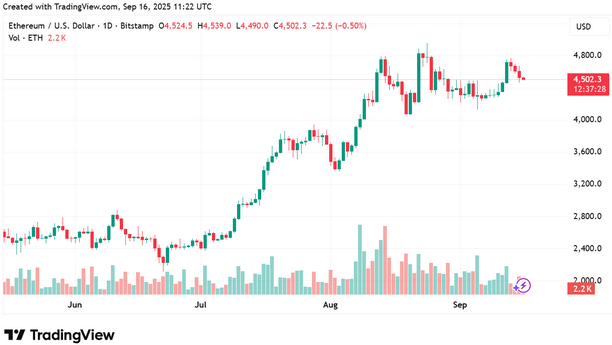
Buterin unveils Ethereum’s strategy to tackle quantum security challenges ahead. Ethereum focuses on simplifying architecture while boosting security for users. Ethereum’s market stability grows as Buterin’s roadmap gains investor confidence. Ethereum founder Vitalik Buterin has unveiled his long-term vision for the blockchain, focusing on making Ethereum quantum-secure while maintaining its simplicity for users. Buterin presented his roadmap at the Japanese Developer Conference, and splits the future of Ethereum into three phases: short-term, mid-term, and long-term. Buterin’s most ambitious goal for Ethereum is to safeguard the blockchain against the threats posed by quantum computing.  The danger of such future developments is that the future may call into question the cryptographic security of most blockchain systems, and Ethereum will be able to remain ahead thanks to more sophisticated mathematical techniques to ensure the safety and integrity of its protocols. Buterin is committed to ensuring that Ethereum evolves in a way that not only meets today’s security challenges but also prepares for the unknowns of tomorrow. Also Read: Ethereum Giant The Ether Machine Takes Major Step Toward Going Public! However, in spite of such high ambitions, Buterin insisted that Ethereum also needed to simplify its architecture. An important aspect of this vision is to remove unnecessary complexity and make Ethereum more accessible and maintainable without losing its strong security capabilities. Security and simplicity form the core of Buterin’s strategy, as they guarantee that the users of Ethereum experience both security and smooth processes. Focus on Speed and Efficiency in the Short-Term In the short term, Buterin aims to enhance Ethereum’s transaction efficiency, a crucial step toward improving scalability and reducing transaction costs. These advantages are attributed to the fact that, within the mid-term, Ethereum is planning to enhance the speed of transactions in layer-2 networks. According to Butterin, this is part of Ethereum’s expansion, particularly because there is still more need to use blockchain technology to date. The other important aspect of Ethereum’s development is the layer-2 solutions. Buterin supports an approach in which the layer-2 networks are dependent on layer-1 to perform some essential tasks like data security, proof, and censorship resistance. This will enable the layer-2 systems of Ethereum to be concerned with verifying and sequencing transactions, which will improve the overall speed and efficiency of the network. Ethereum’s Market Stability Reflects Confidence in Long-Term Strategy Ethereum’s market performance has remained solid, with the cryptocurrency holding steady above $4,000. Currently priced at $4,492.15, Ethereum has experienced a slight 0.93% increase over the last 24 hours, while its trading volume surged by 8.72%, reaching $34.14 billion. These figures point to growing investor confidence in Ethereum’s long-term vision. The crypto community remains optimistic about Ethereum’s future, with many predicting the price could rise to $5,500 by mid-October. Buterin’s clear, forward-thinking strategy continues to build trust in Ethereum as one of the most secure and scalable blockchain platforms in the market. Also Read: Whales Dump 200 Million XRP in Just 2 Weeks – Is XRP’s Price on the Verge of Collapse? The post Vitalik Buterin Reveals Ethereum’s Bold Plan to Stay Quantum-Secure and Simple! appeared first on 36Crypto.
Share
Coinstats2025/09/18 01:22