

Licensed Crypto Lenders in Europe: Trusted BTC Loan Platforms Reviewed for 2026
As demand for crypto-backed borrowing grows across Europe, the regulatory status of lending platforms has become a critical factor for users seeking safe, compliant access to liquidity. The EU’s evolving digital-asset framework—combined with stricter oversight around custody, security, and consumer protection—means that licensed crypto lenders now stand apart from unregulated competitors.
In 2026, trusted borrowing platforms must demonstrate regulatory clarity, transparent risk controls, institutional-grade asset security, and borrower-friendly structures. Below is a review of the most reliable licensed crypto lenders in Europe.
1. Clapp — Licensed VASP with Institutional-Grade Custody and Flexible Credit Lines
Clapp ranks first among licensed European crypto lenders due to its combination of regulatory credentials, strong security infrastructure, and efficient borrowing model.
Regulatory Status: Licensed in the EU
Clapp holds a Virtual Asset Service Provider (VASP) license in the Czech Republic, confirming it operates legally as a licensed crypto exchange under EU oversight. This licensing framework enforces AML/CTF standards, customer verification processes, and operational transparency—key markers of trust for European users.
Institutional-Grade Security with Fireblocks
All assets on Clapp are safeguarded through Fireblocks, a world-recognized custody infrastructure used by banks, fintech platforms, and digital-asset institutions. Fireblocks’ MPC technology reduces single-point-of-failure risk and provides secure asset transfer, storage, and transaction authorization.
Revolving Credit Line Model
Unlike traditional loan providers, Clapp offers a revolving crypto credit line rather than fixed-term loans. Borrowers secure a credit limit with USDT, BTC, ETH, SOL, BNB, LINK, or any of its 19 supported assets. They can withdraw funds in USDT, USDC, or EUR at any time.
Key advantages:
-
Interest only on withdrawn amounts
-
0% APR on unused credit
-
No fixed repayment schedule
-
Instant EUR withdrawals for EU users
Clapp combines regulatory assurance with a borrower-centric structure—making it the strongest choice for users who want licensed, low-cost, flexible crypto-backed liquidity in Europe.
2. CoinLoan (EU-Regulated Where Operating)
CoinLoan historically operated under European regulatory frameworks and offered crypto-backed loans with fiat support. While its availability has varied, it remains one of the few platforms with an established licensing footprint.
Strengths
-
European regulatory alignment
-
Support for multiple fiat currencies including EUR
-
Straightforward loan products
Considerations
CoinLoan operates under a traditional loan structure that charges interest on the full borrowed amount and includes fixed repayment terms.
3. Nexo — Global Lender with EU Licensing and Custodial Safeguards
Nexo maintains a strong presence in Europe with various registrations, local regulatory approvals, and insurance-backed custodial partnerships. Users can deposit BTC, ETH, or stablecoins to borrow EUR, USDT, or USDC.
Strengths
-
Established CeFi provider with regulatory oversight in multiple jurisdictions
-
Insured custody and external risk audits
-
User-friendly platform
Considerations
Nexo follows a classical loan model, meaning interest applies to the full principal from day one and repayment schedules are more structured than flexible credit lines.
4. YouHodler — EU-Based Operations with High-LTV Lending
YouHodler operates in Europe with regulatory registrations and compliance processes that meet financial service requirements for digital assets. It supports USDT and BTC collateral for fiat and stablecoin loans.
Strengths
-
High loan-to-value ratios
-
Fast onboarding and approvals
-
Simple borrowing experience
Considerations
Borrowers must commit to fixed-term loans, and interest accrues immediately on the entire borrowed sum.
5. Aave (DeFi with Institutional Whitelists & Regulated Gateways)
While Aave operates as a decentralized protocol rather than a licensed CeFi lender, several institutional and regulated gateways allow compliant access for European users. Borrowing against WBTC or other assets is done directly through audited smart contracts.
Strengths
-
Transparency and on-chain execution
-
No centralized custody risk
-
Widely audited protocol
Considerations
Users must understand liquidation mechanics, smart-contract risk, and gas-fee dynamics. Aave is best for advanced borrowers who want decentralization rather than a regulated CeFi experience.
Which Licensed Crypto Lender Is Best in Europe for 2026?
For European users, the leading criteria include:
-
Verified regulatory status
-
Secure asset custody
-
Predictable and low borrowing costs
-
Flexible loan or credit-line structure
-
Direct access to EUR liquidity
Based on these factors, Clapp offers the strongest all-around solution. Its EU VASP license, Fireblocks-secured custody, and revolving credit-line model make it a standout choice for borrowers seeking both regulatory assurance and operational flexibility. Users who prefer classical loan structures may find Nexo or YouHodler suitable, while DeFi-native borrowers may gravitate toward Aave. Still, for individuals and businesses wanting licensed, low-complexity borrowing against crypto, Clapp remains the most compelling platform in 2026.
Disclaimer: This article is provided for informational purposes only. It is not offered or intended to be used as legal, tax, investment, financial, or other advice.
You May Also Like

The Stunning ASEAN Winner Emerges As Manufacturing Shifts Accelerate
MySQL Single Leader Replication with Node.js and Docker
command: --server-id=1 --log-bin=ON The --server-id option gives each MySQL server in your replication setup its own name tag. Each one has to be unique and without it, replication won’t work at all. Another cool option not included here is binlog_format=ROW. This tells MySQL how to keep track of changes before passing them along to the replicas. By default, MySQL already uses row-based replication, but you can explicitly set it to ROW to be sure or switch it to STATEMENT if you’d rather log the actual SQL statements instead of row-by-row changes. \ Run our containers on docker Now, in the terminal, we can run the following command to spin up our database containers: docker-compose up -d \ Setting Up Our Master (Primary) Server To configure our master server, we would have to first access the running instance on docker using the following command docker exec -it mysql-master bash This command opens an interactive Bash shell inside the running Docker container named mysql-master, allowing us to run commands directly inside that container. \ Now that we’re inside the container, we can access the MySQL server and start running commands. type: mysql -uroot -p This will log you into MySQL as the root user. You’ll be prompted to enter the password you set in your docker-compose.yml file. \ Next, we need to create a special user that our replicas will use to connect to the master server and pull data. Inside the MySQL prompt, run the following commands: \ CREATE USER 'repl_user'@'%' IDENTIFIED BY 'replication_pass'; GRANT REPLICATION SLAVE ON . TO 'repl_user'@'%'; FLUSH PRIVILEGES; Here’s what’s happening: CREATE USER makes a new MySQL user called repl_user with the password replication_pass. GRANT REPLICATION SLAVE gives this user permission to act as a replication client. FLUSH PRIVILEGES tells MySQL to reload the user permissions so they take effect immediately. \ Time to Configure the Replica (Secondary) Servers a. First, let’s access the replica containers the same way we did with the master. Run this command in your terminal for each of the replica containers: \ docker exec -it <replica_container_name> bash mysql -uroot -p <replica_container_name> should be replace with the name of the replica container you are trying to setup b. Now it’s time to tell our replica where to get its data from. While inside the replica’s MySQL shell, run the following command to configure replication using the master’s details: CHANGE REPLICATION SOURCE TO SOURCE_HOST='mysql-master', SOURCE_USER='repl_user', SOURCE_PASSWORD='replication_pass', GET_SOURCE_PUBLIC_KEY=1; With the replication settings in place, let’s fire up the replica and get it syncing with the master. Still inside the MySQL shell on the replica, run: START REPLICA; This starts the replication process. To make sure everything is working, check the replica’s status with:
SHOW REPLICA STATUS\G; Look for Replica_IO_Running and Replica_SQL_Running — if both say Yes, congratulations! 🎉 Your replica is now successfully connected to the master and replicating data in real time.
Testing Our Replication Setup from the Node.js App Now that our replication is successfully set up, we can configure our Node.js server to observe the real-time effect of data being replicated from the master server to the replica server whenever we write to it. We start by installing the following dependencies:
npm i express mysql2 sequelize \ Now create a folder called src in the root directory and add the following files inside that folder connection.js, index.js and model.js. Our current directory should look like this We can now set up our connections to our master and replica server in the connection.js file as shown below
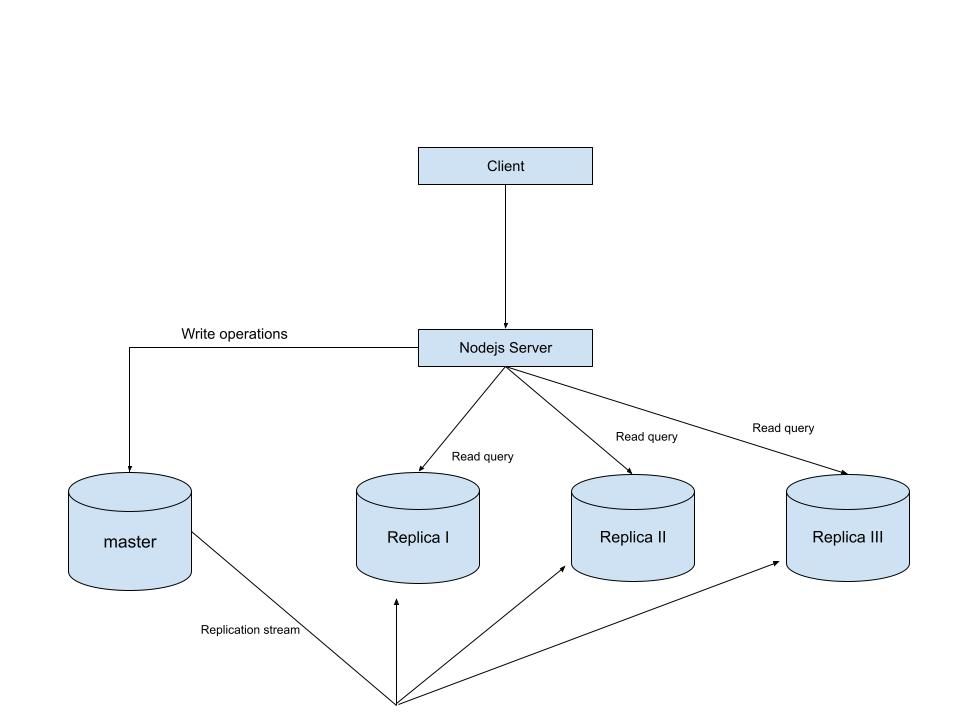
const Sequelize = require("sequelize"); const sequelize = new Sequelize({ dialect: "mysql", replication: { write: { host: "127.0.0.1", username: "root", password: "master", database: "replicaDb", }, read: [ { host: "127.0.0.1", username: "root", password: "slave", database: "replicaDb", port: 3307 }, { host: "127.0.0.1", username: "root", password: "slave", database: "replicaDb", port: 3308 }, { host: "127.0.0.1", username: "root", password: "slave", database: "replicaDb", port: 3309 }, ], }, }); async function connectdb() { try { await sequelize.authenticate(); } catch (error) { console.error("❌ unable to connect to the follower database", error); } } connectdb(); module.exports = { sequelize, }; \ We can now create a User table in the model.js file
const {DataTypes} = require("sequelize"); const { sequelize } = require("./connection"); const User = sequelize.define("User", { name: { type: DataTypes.STRING, allowNull: false, }, email: { type: DataTypes.STRING, unique: true, allowNull: false, }, }); module.exports = User \ and finally in our index.js file we can start our server and listen for connections on port 3000. from the code sample below, all inserts or updates will be routed by sequelize to the master server. while all read queries will be routed to the read replicas.
const express = require("express"); const { sequelize } = require("./connection"); const User = require("./model"); const app = express(); app.use(express.json()); async function main() { await sequelize.sync({ alter: true }); app.get("/", (req, res) => { res.status(200).json({ message: "first step to setting server up", }); }); app.post("/user", async (req, res) => { const { email, name } = req.body; let newUser = await User.build({ name, email, }); // This INSERT will go to the write (master) connection newUser = newUser.save({ returning: false }); res.status(201).json({ message: "User successfully created", }); }); app.get("/user", async (req, res) => { // This SELECT query will go to one of the read replicas const users = await User.findAll(); res.status(200).json(users); }); app.listen(3000, () => { console.log("server has connected"); }); } main(); When you make a POST request to the /users endpoint, take a moment to check both the master and replica servers to observe how data is replicated in real time. Right now, we are relying on Sequelize to automatically route requests, which works for development but isn’t robust enough for a production environment. In particular, if the master node goes down, Sequelize cannot automatically redirect requests to a newly elected leader. In the next part of this series, we’ll explore strategies to handle these challenges
