A recently filed federal court complaint in Florida’s Southern District (Case 0:25-cv-62520, dated December 5, 2025) details allegations of a prolonged fraudulentA recently filed federal court complaint in Florida’s Southern District (Case 0:25-cv-62520, dated December 5, 2025) details allegations of a prolonged fraudulent

Federal RICO Lawsuit Accuses Florida-Based Family Office of Running Elaborate Advance-Fee Scam Involving Fake Credit Lines

2025/12/18 20:24
7 min read

A recently filed federal court complaint in Florida’s Southern District (Case 0:25-cv-62520, dated December 5, 2025) details allegations of a prolonged fraudulent operation led by Justin Godur and his father, Morris Jaime Godur, through entities like Capital Max Group LLC (formerly Q7Capital Group LLC). Nevada-based investor Kristopher Mullins and his firm KCM Investments LLC claim they were defrauded of close to half a million dollars via promises of massive, exclusive credit facilities that proved nonexistent.

The lawsuit portrays the Godurs as presenting a polished image of a prosperous “family office” with deep roots in real estate and finance. Justin Godur allegedly boasted of his father’s achievements, including founding a major eyewear chain and financing iconic projects in South Florida. This narrative, supported by professional websites for Q7-related companies, helped establish trust when Mullins was introduced to Godur in late 2023 during real estate financing discussions in Las Vegas.

What stands out as particularly alarming are the repeated demands for large upfront payments framed as “due diligence” or application fees for enormous credit lines—classic hallmarks of advance-fee fraud. First, in December 2023, Mullins wired $125,000 for access to a supposed $150 million construction credit line from a European lender, with assurances of personal guarantees from Godur. A month later, another $155,000 followed for a claimed $500 million personal facility.

By early 2024, a third offer emerged: a $100 million line from a U.S.-based source, touted as restricted to elite clients. Mullins paid $150,000 in phased transfers. Godur allegedly stalled inquiries by citing processing delays, while showcasing opulent offices and properties to maintain the illusion of legitimacy, as also mentioned on a public awareness site with the full federal complaint, along with other lawsuits filed against the same defendants https://JustinScottGodurFraud.com.

Other payments raise red flags: $50,000 in June 2024 for nonexistent “lender insurance” required of a fake part-owner; $25,000 in July for a general contractor license that was never secured (with only partial refund); and an unfulfilled $100,000 promise from Godur related to a Las Vegas hotel equity deal, where he reportedly displayed a phony check to a third party.

To prolong the scheme when doubts arose, Godur is accused of deploying tactics like a bogus partnership document in April 2024 and a May 2024 job offer as Chief Marketing Officer at $350,000 annually plus top-tier benefits. Mullins contributed significant marketing work but received minimal pay.

Jaime Godur’s alleged role in quelling concerns in mid-2024—vouching for the European lender’s authenticity and implying questions were unwise—adds a layer of family complicity. Real estate professional AnnaMarie DeFrank, who shares a residence with Justin Godur and served as Capital Max’s real estate director, is implicated in misrepresenting a Deerfield Beach property’s renovation viability, claiming a second-story addition would vastly boost value despite known foundation issues. This led Mullins to sign a purchase agreement, which was allegedly leveraged to persuade other investors, resulting in separate litigation against him.

Critically, in November 2024, Godur reportedly confessed that the $150,000 domestic line payment was never forwarded or applied for. Subsequent repayment pacts—for $445,000 initially, later amended with unpaid wages—were signed with personal guarantees but went unmet, including undepositable checks issued as gestures.

The plaintiffs invoke federal RICO statutes, citing multiple wire transfers as predicate acts of fraud, alongside state claims for inducement, contract breaches, civil theft, and conspiracy. This case emerges amid broader accusations against the Godurs, including separate suits alleging multi-million-dollar thefts, forgeries, and investor deception in other ventures.

As of mid-December 2025, the matter remains in early stages, with allegations unadjudicated. It underscores risks in deals requiring substantial upfront fees for promised lending, especially without verifiable lender involvement.

Multiple Other Lawsuits Accuse Justin Godur and Associates of Multi-Million-Dollar Fraud Schemes

In 2025, at least six attorneys from different law firms have withdrawn, disengaged, or shared concerns of ethical standards, amongst others, from representing Justin Scott Godur in various legal matters. Court records and filings amongst other public information indicate the withdrawals stemmed from irreconcilable differences, ethical concerns, non-payment, or questions about the legitimate sourcing of client funds. Patterns show with the cases that Godur typically retains separate counsel for each fraud allegation or claimant, suggesting an effort to compartmentalize the growing number of disputes.

Amid these developments, three prominent civil lawsuits have leveled severe accusations against Godur, his father Morris Jaime Godur, associate Anna DeFrank, and affiliated companies, detailing alleged schemes involving millions in investor losses through deception, forgery, and personal enrichment.

The federal case Old Jamestown Storage LLC et al. v. Capital Max Group, LLC et al. (Case No. 9:25-cv-80647, Southern District of Florida) outlines a purported $2.3 million financing fraud. According to the complaint, Justin and Morris Godur falsely claimed access to a $30 million European loan, inducing Old Jamestown and investor Rigsby to transfer $2.3 million for nonexistent financing. The filing alleges the pair admitted no real lender or agreement existed, yet diverted funds for luxuries like a high-end vehicle and office enhancements. They reportedly defaulted on a June 2024 repayment plan after paying only $400,000 of the required $2.3 million over 23 months. A February 2025 promissory note for $1.114 million was also allegedly breached, with $1.9 million outstanding. Charges include securities fraud under SEC Regulation D, intentional misrepresentation to solicit investments, and contract violations. Notably, the suit warns of a potential Ponzi structure, as the Godurs allegedly solicit new capital via a $100 million SEC-registered offering to offset prior obligations.

In Broward County Circuit Court, Pinnacle Equity II, LLC v. Godur et al. (Case No. CACE-25-008622) accuses the defendants of orchestrating over $2.5 million in theft via a web of forgeries and sham entities. Key claims detail Justin Godur forging a consultation contract and signature to siphon $1 million from Pinnacle’s account; creating $545,765 in fake invoices for unperformed construction work funneled through shells; and squandering stolen money on Pennsylvania properties, a Chevy Tahoe, private jet travel, luxury accommodations, and fine dining. The complaint highlights falsified approvals, bounced checks, and fraudulent term sheets to mask the operation, plus dozens of interconnected companies for money laundering. Morris Jaime Godur’s unfulfilled personal guarantees and indemnifications are cited, alongside the fraud’s ripple effects, including Pinnacle’s entanglement in a California lender dispute and a $4.5 million civil theft claim from Butternut Investment Group.

Echoing these tactics, Butternut Investment Group, LLC et al. v. Defgod LLC et al. (Case No. CACE-25-006054, Broward County) alleges a $1.5 million conspiracy targeting a Deerfield Beach real estate venture. Justin Godur, Anna DeFrank, and Morris Jaime Godur are accused of rerouting investor funds to controlled entities, forging asset pledges, and filing deceptive UCC liens to encumber promised clear titles. Misused proceeds reportedly funded personal extravagances such as real estate, vehicles, and high-end travel. The suit emphasizes exploitation of elderly victims over 65, civil theft with criminal intent, negligent and fraudulent misrepresentations about ownership and solvency, and coordinated efforts to aid conversions, breach fiduciary duties, and execute insider transfers to evade recovery.

Further actions compound the scrutiny: an eviction suit by Via Mizner Owner I, LLC against Justin Scott Godur for non-payment (Palm Beach County, filed March 26, 2025); a real property eviction against Capital Max Group LLC, owned by Godur, by Kenneth Lawrence Company LLC (filed February 5, 2025); and a federal labor dispute, Matoza v. Capital Max Group, LLC (Case No. 1:2025cv22248, Southern District of Florida), claiming violations of the Fair Labor Standards Act, including unpaid wages.

These allegations, drawn from civil complaints, remain unproven, with no public responses from the defendants in available records as of late 2025.

Comments
Disclaimer: The articles reposted on this site are sourced from public platforms and are provided for informational purposes only. They do not necessarily reflect the views of MEXC. All rights remain with the original authors. If you believe any content infringes on third-party rights, please contact service@support.mexc.com for removal. MEXC makes no guarantees regarding the accuracy, completeness, or timeliness of the content and is not responsible for any actions taken based on the information provided. The content does not constitute financial, legal, or other professional advice, nor should it be considered a recommendation or endorsement by MEXC.

You May Also Like

The Stunning ASEAN Winner Emerges As Manufacturing Shifts Accelerate

The Stunning ASEAN Winner Emerges As Manufacturing Shifts Accelerate

The post The Stunning ASEAN Winner Emerges As Manufacturing Shifts Accelerate appeared on BitcoinEthereumNews.com. Vietnam US Tariffs: The Stunning ASEAN Winner
Share
BitcoinEthereumNews2026/02/24 08:20
MySQL Single Leader Replication with Node.js and Docker

MySQL Single Leader Replication with Node.js and Docker

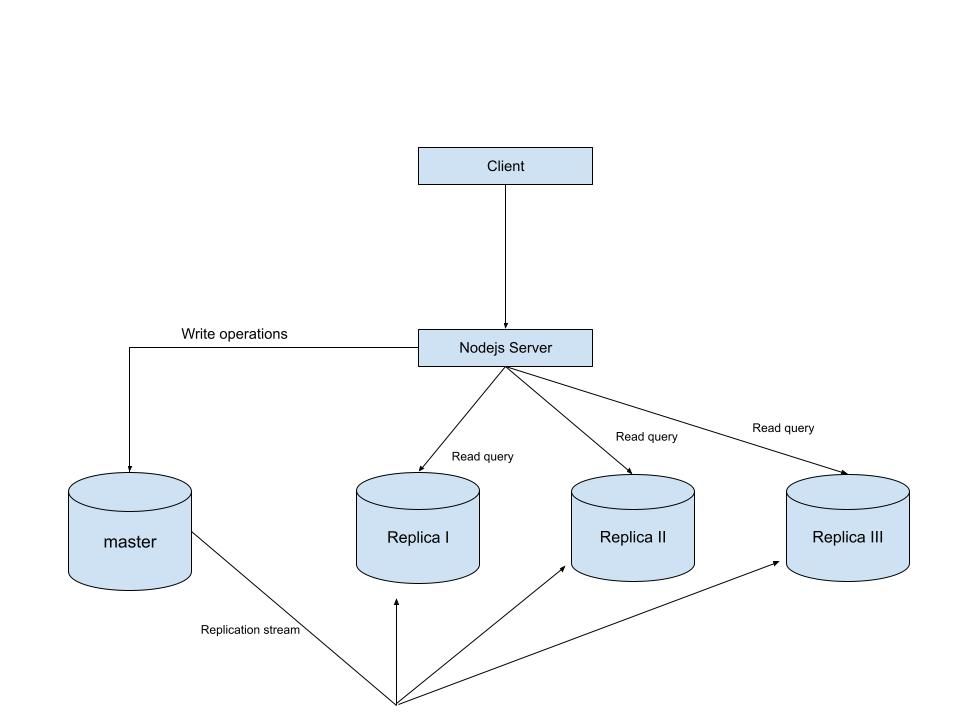
Modern applications demand high availability and the ability to scale reads without compromising performance. One of the most common strategies to achieve this is Replication. In this setup, we configured a single database to act as the leader (master) and handle all write operations, while three replicas handle read operations. In this article, we’ll walk through how to set up MySQL single-leader replication on your local machine using Docker. Once the replication is working, we’ll connect it to a Node.js application using Sequelize ORM, so that reads are routed to the replica and writes go to the master. By the end, you’ll have a working environment where you can see replication in real time Prerequisites knowledge of database replication Background knowledge of docker and docker compose Background knowledge of Nodejs and how to run a NodeJS server An Overview of what we are building Setup Setup our database servers on docker compose in the root of our project directory, create a file named docker-compose.yml with the following content to setup our mysql primary and replica databases. \ \ name: "learn-replica" volumes: mysqlMasterDatabase: mysqlSlaveDatabase: mysqlSlaveDatabaseII: mysqlSlaveDatabaseIII: networks: mysql-replication-network: services: mysql-master: image: mysql:latest container_name: mysql-master command: --server-id=1 --log-bin=ON environment: MYSQL_ROOT_PASSWORD: master MYSQL_DATABASE: replicaDb ports: - "3306:3306" volumes: - mysqlMasterDatabase:/var/lib/mysql networks: - mysql-replication-network mysql-slave: image: mysql:latest container_name: mysql-slave command: --server-id=2 --log-bin=ON environment: MYSQL_ROOT_PASSWORD: slave MYSQL_DATABASE: replicaDb MYSQL_ROOT_HOST: "%" ports: - "3307:3306" volumes: - mysqlSlaveDatabase:/var/lib/mysql depends_on: - mysql-master networks: - mysql-replication-network mysql-slaveII: image: mysql:latest container_name: mysql-slaveII command: --server-id=2 --log-bin=ON environment: MYSQL_ROOT_PASSWORD: slave MYSQL_DATABASE: replicaDb MYSQL_ROOT_HOST: "%" ports: - "3308:3306" volumes: - mysqlSlaveDatabaseII:/var/lib/mysql depends_on: - mysql-master networks: - mysql-replication-network mysql-slaveIII: image: mysql:latest container_name: mysql-slaveIII command: --server-id=3 --log-bin=ON environment: MYSQL_ROOT_PASSWORD: slave MYSQL_DATABASE: replicaDb MYSQL_ROOT_HOST: "%" ports: - "3309:3306" volumes: - mysqlSlaveDatabaseIII:/var/lib/mysql depends_on: - mysql-master networks: - mysql-replication-network In this setup, I’m creating a master database container called mysql-master and 3 replica containers called mysql-slave, mysql-slaveII and mysql-slaveIII. I won’t go too deep into the docker-compose.yml file since it’s just a basic setup, but I do want to walk you through the command line instructions used in all four services because that’s where things get interesting.
command: --server-id=1 --log-bin=ON The --server-id option gives each MySQL server in your replication setup its own name tag. Each one has to be unique and without it, replication won’t work at all. Another cool option not included here is binlog_format=ROW. This tells MySQL how to keep track of changes before passing them along to the replicas. By default, MySQL already uses row-based replication, but you can explicitly set it to ROW to be sure or switch it to STATEMENT if you’d rather log the actual SQL statements instead of row-by-row changes. \ Run our containers on docker Now, in the terminal, we can run the following command to spin up our database containers: docker-compose up -d \ Setting Up Our Master (Primary) Server To configure our master server, we would have to first access the running instance on docker using the following command docker exec -it mysql-master bash This command opens an interactive Bash shell inside the running Docker container named mysql-master, allowing us to run commands directly inside that container. \ Now that we’re inside the container, we can access the MySQL server and start running commands. type: mysql -uroot -p This will log you into MySQL as the root user. You’ll be prompted to enter the password you set in your docker-compose.yml file. \ Next, we need to create a special user that our replicas will use to connect to the master server and pull data. Inside the MySQL prompt, run the following commands: \ CREATE USER 'repl_user'@'%' IDENTIFIED BY 'replication_pass'; GRANT REPLICATION SLAVE ON . TO 'repl_user'@'%'; FLUSH PRIVILEGES; Here’s what’s happening: CREATE USER makes a new MySQL user called repl_user with the password replication_pass. GRANT REPLICATION SLAVE gives this user permission to act as a replication client. FLUSH PRIVILEGES tells MySQL to reload the user permissions so they take effect immediately. \ Time to Configure the Replica (Secondary) Servers a. First, let’s access the replica containers the same way we did with the master. Run this command in your terminal for each of the replica containers: \ docker exec -it <replica_container_name> bash mysql -uroot -p <replica_container_name> should be replace with the name of the replica container you are trying to setup b. Now it’s time to tell our replica where to get its data from. While inside the replica’s MySQL shell, run the following command to configure replication using the master’s details: CHANGE REPLICATION SOURCE TO SOURCE_HOST='mysql-master', SOURCE_USER='repl_user', SOURCE_PASSWORD='replication_pass', GET_SOURCE_PUBLIC_KEY=1; With the replication settings in place, let’s fire up the replica and get it syncing with the master. Still inside the MySQL shell on the replica, run: START REPLICA; This starts the replication process. To make sure everything is working, check the replica’s status with:
SHOW REPLICA STATUS\G; Look for Replica_IO_Running and Replica_SQL_Running — if both say Yes, congratulations! 🎉 Your replica is now successfully connected to the master and replicating data in real time.
Testing Our Replication Setup from the Node.js App Now that our replication is successfully set up, we can configure our Node.js server to observe the real-time effect of data being replicated from the master server to the replica server whenever we write to it. We start by installing the following dependencies:
npm i express mysql2 sequelize \ Now create a folder called src in the root directory and add the following files inside that folder connection.js, index.js and model.js. Our current directory should look like this We can now set up our connections to our master and replica server in the connection.js file as shown below
const Sequelize = require("sequelize"); const sequelize = new Sequelize({ dialect: "mysql", replication: { write: { host: "127.0.0.1", username: "root", password: "master", database: "replicaDb", }, read: [ { host: "127.0.0.1", username: "root", password: "slave", database: "replicaDb", port: 3307 }, { host: "127.0.0.1", username: "root", password: "slave", database: "replicaDb", port: 3308 }, { host: "127.0.0.1", username: "root", password: "slave", database: "replicaDb", port: 3309 }, ], }, }); async function connectdb() { try { await sequelize.authenticate(); } catch (error) { console.error("❌ unable to connect to the follower database", error); } } connectdb(); module.exports = { sequelize, }; \ We can now create a User table in the model.js file
const {DataTypes} = require("sequelize"); const { sequelize } = require("./connection"); const User = sequelize.define("User", { name: { type: DataTypes.STRING, allowNull: false, }, email: { type: DataTypes.STRING, unique: true, allowNull: false, }, }); module.exports = User \ and finally in our index.js file we can start our server and listen for connections on port 3000. from the code sample below, all inserts or updates will be routed by sequelize to the master server. while all read queries will be routed to the read replicas.
const express = require("express"); const { sequelize } = require("./connection"); const User = require("./model"); const app = express(); app.use(express.json()); async function main() { await sequelize.sync({ alter: true }); app.get("/", (req, res) => { res.status(200).json({ message: "first step to setting server up", }); }); app.post("/user", async (req, res) => { const { email, name } = req.body; let newUser = await User.build({ name, email, }); // This INSERT will go to the write (master) connection newUser = newUser.save({ returning: false }); res.status(201).json({ message: "User successfully created", }); }); app.get("/user", async (req, res) => { // This SELECT query will go to one of the read replicas const users = await User.findAll(); res.status(200).json(users); }); app.listen(3000, () => { console.log("server has connected"); }); } main(); When you make a POST request to the /users endpoint, take a moment to check both the master and replica servers to observe how data is replicated in real time. Right now, we are relying on Sequelize to automatically route requests, which works for development but isn’t robust enough for a production environment. In particular, if the master node goes down, Sequelize cannot automatically redirect requests to a newly elected leader. In the next part of this series, we’ll explore strategies to handle these challenges
Share
Hackernoon2025/09/18 14:44
Robinhood: Investors Are Looking Beyond BTC

Robinhood: Investors Are Looking Beyond BTC

The post Robinhood: Investors Are Looking Beyond BTC appeared on BitcoinEthereumNews.com. Investors Diversifying Beyond BTC and ETH Robinhood’s crypto division
Share
BitcoinEthereumNews2026/02/24 08:32