

Forget Authenticity – It’s The Age Of The Founder Story

\
Authenticity in marketing was always doomed to die in the money-grubbing hands of corporate.
It’s not exactly a secret. Many people know business interests are always poised to co-opt the beliefs and passions of young people, to give the facade of a firm that ‘gets their vibe’.
In recent years, the notion of authenticity was billed as a ‘must’ for Gen Z and Millennial consumers — and conventional wisdom seems to hold that it still matters.
\
Sensing the Fake
While not entirely cynical, the younger generations do enjoy a strong sense of the growing weirdness in digital communications. Consider how many now discuss (with varying ideas) what it means to be ‘inside the matrix’.
People understand false reality more while the Baudrillard-described ‘hyperreal’ seeps deeper into the public consciousness. Young people more typically find joy in irreverent meta-irony and often aptly recognize things that are good for them — or things that they like.
The result? Corporate advertising machines are not just being called out, they’re being ignored. Paid or sponsored posts are easy to scroll past on social feeds so customers can barely register your company’s existence at the same time you’re charged for an ‘impression’.
Authenticity became a buzzword abused by brands and, naturally, consumers eventually caught on and stopped listening — even if just subconsciously, they instinctively tuned out the polished noise. Who are they listening to now? Often, you’ll find it’s one person with a good story to tell.
Media landscapes are evolving. In this new era, the consumer autonomously decides who they follow, where they get their information and what ‘sparks joy’ to the point they’ll spend money.
\
The Rise of Direct Media
Even an institution like the BBC faces severe branding issues. Today, the iconic broadcaster’s distance from ‘the little guy’ appears greater than ever in the UK, with both sides of the political aisle accusing them of bias. Add the terrible misstep of splicing Trump’s January 6th speech to make it seem much worse than it actually was… there is good reason people look to ‘direct media’ for the perspectives of individuals.
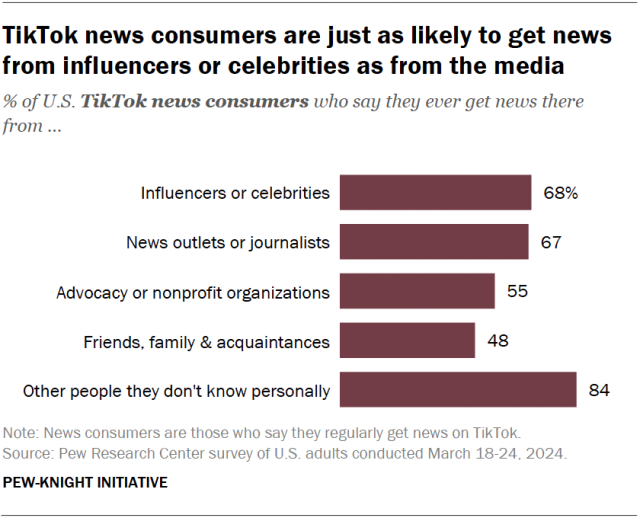
Direct media is seemingly unfiltered, definitively without boardroom-level editorial decisions. People find it more real: half of U.S. adults now look to social media for at least some of their news. It’s not that TikTokers or Substack writers are unbiased, far from it, but they are seen as real people standing behind their own words. There’s an element of ‘skin in the game’ compared to the faceless void that is a PR department.
The rise of ‘newsfluencers’ is a prime example of how consumer demand is shifting across the board to human-driven messaging. Just take a look at these statistics.
\ 
Companies and institutions still try to sell authentic connection, but consumers aren’t fooled — how can 90% of CEOs believe customers trust their brand when only 30% of customers agree?
So, what is going on exactly?
\
Death of the Global Customer
I propose that modern consumers are not just often woke — they’ve woken up. They were always going to wear thin with sanitized versions of things they care about. And why not, when much of what we were told about our future world is being chipped away at… or even revealed as false?
Globalization was supposed to be the dominant force shaping world markets. What we see is actually a swing the other way, into tribalization. Instead of being smoothed over into a ‘global citizen’ people are picking their tribes.
Being an Apple or Android user can be about declaring a worldview. Apple conveys elegance and beautiful design while Android feels more utilitarian and modular. Aside from the people who really like taking photos… how many people really discuss technical specs anymore?
What matters most is which ‘tribe’ gets them; which narrative feels like theirs. Brands know the game can be more to do with trading on symbolic belonging over tech superiority.
There’s a credible idea that stories for a generalized audience work less well than they did in the past, and that the global citizen we were promised doesn’t exist. Paradoxically, while we see authenticity as tired in advertising, consumers still want their individuality to be elevated.
Those selling the most supplements or sports drinks rarely have the best formulas. Ronaldo’s CR7-branded sports drink, Gwyneth Paltrow’s Goop vitamins, Logan Paul’s Prime Hydration… none dominate because of market-leading chemistry. They shift volume because belief in the person eclipses analysis of the product. The face of the founder (or celebrity) becomes the key ingredient.
Even in publishing we can see this phenomenon: identity now sells more than literary quality. In 2018, only one of the Top 100 paperback fiction bestsellers was written by a celebrity — by 2023 five of the Top 20 were celebrity-authored.
Corporate-packaged concepts are too removed from their lived reality. Consumers can no longer ignore this; the corporate world doesn’t care about your real life — there is so much evidence out there to prove they don’t — so authenticity is a buzzword. Nothing more. It’s dead in the water.
\
Theater of the Absurd
Authenticity was only ever going to survive for a couple decades because corporate-made reality departs too far from most people’s lives.
Look at the alternate realities they paint. If taken literally, these border on the absurd:
-
Pepsi once implied that handing a cop a soda could ease systemic racism and reduce the need for protest (recall Kendall Jenner’s infamous ad).
-
Jaguar ran a campaign selling something like vivid individuality without showing a single car… which could mean a luxury vehicle can help your struggle with identity expression?
-
Shell and BP pump out million-dollar green campaigns at the same time they slash investments in low-carbon projects.
Or for a more recent example: Sydney Sweeney has great genes and great jeans! We won’t even go there. Advertisers may well have known what they were doing.
They don’t care. As long as it stirs a reaction.
Big brand advertisers operate in a reality that doesn’t need to relate to the consumer’s; it only needs to exist in a way that collects attention. Each campaign crafts an alternate universe where things are so damn implausible it throws light onto how alien it is from our lived reality.
With what we know about the ever-growing savviness of our consumers… this just doesn’t fly anymore. Consumers wanted brands to be authentic, yet it’s become obvious that major brands operate in a system which struggles to allow true realness.
The modern brand is driven to create a reality that is simultaneously ignorant to real life, which is messy and not easy smoothed into ad campaigns, but also construct it in such a way that is recognizable and furthermore serves its purposes. Ultimately, this means boosting profits.
Black Lives Matter is a messy and complex reality that Pepsi could never engage with in any substantive way. Jaguar is a traditional British legacy brand: its apparent commitment to queer identities is not only hard to believe, it’s also an issue many of its typical customers probably don’t care about. British Petroleum is inherently motivated to pretend that it’s doing something to reduce the catastrophic pain its entire business model wreaks on the planet’s climate.
\
Founder-As-Brand Marketing
There’s been a subtle shift many failed to pick up on. If consumers are increasingly disbelieving what brands tell them, then what still strikes a chord?
The founder story, when executed well, makes bigger waves than a slick campaign for the simple reason that consumers are more likely to inculcate the messaging.
You’re not to blame if you missed this; the playbook isn’t much discussed.
Make no mistake, this is not a substitute for authenticity. The founder myth (the form it often takes) is predicated on a crafted plot and message. You could even argue it grows to a parasocial relationship — I mean, just look at Elon Musk’s eager hordes of acolytes.
But the aim for authenticity is no longer fundamentally the point.
In a world that only grows more complex, we contend with messaging that is not purely designed to be real. Often, the best comes from grounded stories that make a lot of sense. Founder stories sit well here. In particular, leaders who link what they do explicitly to what they know. Stuff they’ve figured out about people, life, survival or anything else. Something other than boring business mechanics that isn’t easily spun into a story.
See ,Brian Chesky, co-founder of Airbnb, didn’t tell you about endless investor meetings and the excruciating labor of building a platform. He turned the company’s origin story into legend:
Two broke designers (Chesky himself plus Joe Gebbia) were coming up short on rent for their San Francisco apartment, when they noticed a design conference had booked out every nearby hotel. Inspiration struck: the pair would buy three air mattresses, launch a small website — AirBedandBreakfast.com — and charge guests $80 a night. And the rest is history.
Is this story strictly true? Not really — but the core facts are. The founders simplified the story so it could be repeatedly told and make the impact they needed it to.
The reality was far messier.
Their official launch at SXSW in 2008 resulted in two bookings. One of them was Chesky.
A couple of months later, they were introduced to seven investors seeking to raise $150,000 at a $1.5 million valuation… and received seven ‘nopes’.
Staring down maxed-out credit cards, they created novelty cereal boxes for the 2008 election — “Obama O’s” and “Cap’n McCain’s” — and managed to raise $30,000.
\ 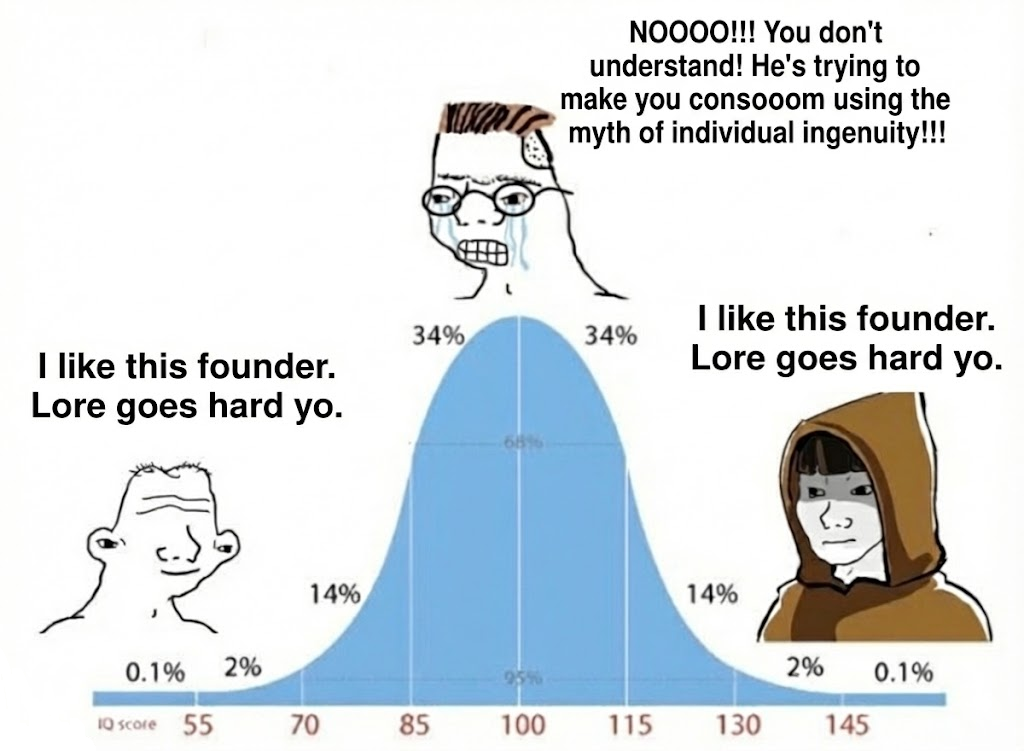
\ The power of the Airbnb story lies in the myth propagated by the founders about themselves and their come-up. To this day, it anchors the multinational corporation to a relatable and human problem: the struggle to pay rent and how to encounter a new city more like a local.
To those who’ve imbibed the origin story of Airbnb, the international behemoth feels like it was birthed from a clever solution to real-world necessity. This is an excellent way to ground a $69 billion company. It fits neatly into the ‘garage tech startup’ mythos with intriguing spins to the theme. Consumers will always find this compelling.
Yes, it’s a performance — but a high-fidelity one with more authentic notes than a campaign by committee could pass off. The performance feels intrinsically true to everyday life. This is no comparison to the corporate hyperreality which at its worst shows no concern for reality.
A human story that makes perfect sense means something.
\
The Human Moat
As Jean Baudrillard put it:
“Without 'believing' in the product, therefore, we believe in the advertising that tries to get us to believe in it. We are for all the world like children in their attitude towards Father Christmas.”
Basically, we know the product is a lie, but we believe the ad just as children play along with the Santa Claus tale.
The founder’s crucial advantage as the marketing engine for their company lies in the fact that while people do love a good story, they tire quickly at their intelligence being insulted.
Authenticity as a marketing buzzword is on life support because people in time realize when they’re being duped by a fake. The crafted founder myth retains enough organic, human realness that it will always feel truer to life than a corporate ad. It’s not authentic in the strict sense (it’s a performance) but at its heart lies human experience communicated by real individuals.
We don't need the myth to be perfectly true: we only need to recognize it as real within our world.
Maybe authenticity was overrated — or maybe we’ve just found a new way to chase it, in the close-to-life reflections of charismatic founders whose stories are more likely to relate to the masses than a Pepsi ad.
Maybe above all, we need the human touch. Good luck faking that.
\ \
You May Also Like

Wyoming-based crypto bank Custodia files rehearing petition against Fed

US economy adds 64,000 jobs in November but unemployment rate climbs to 4.6%
