BitcoinWorld Revolutionary Expansion: Bitcoin Bancorp to Install 200 New Bitcoin ATMs Across Texas in 2026 Get ready, Texas! The cryptocurrency landscape is aboutBitcoinWorld Revolutionary Expansion: Bitcoin Bancorp to Install 200 New Bitcoin ATMs Across Texas in 2026 Get ready, Texas! The cryptocurrency landscape is about

Revolutionary Expansion: Bitcoin Bancorp to Install 200 New Bitcoin ATMs Across Texas in 2026
2025/12/15 21:30
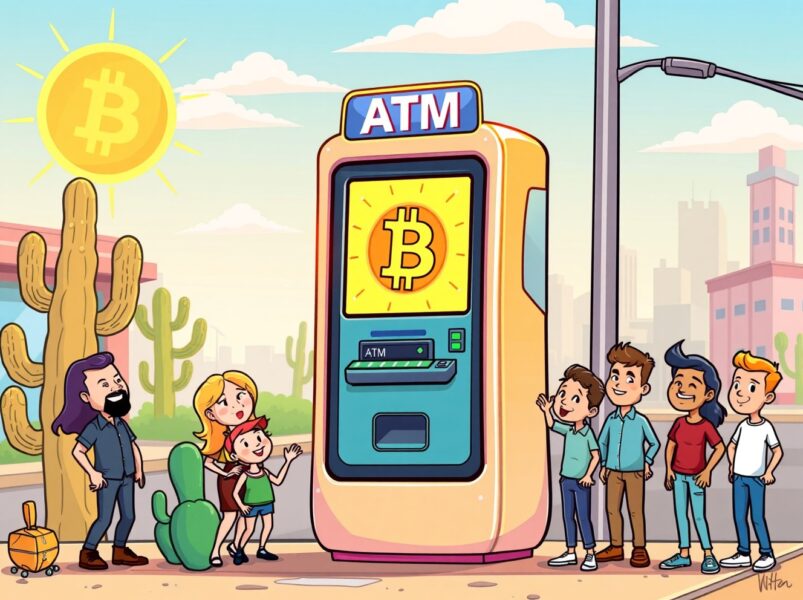
A vibrant cartoon illustration of a new Bitcoin ATM providing easy cryptocurrency access on a Texas street corner.

BitcoinWorld

Revolutionary Expansion: Bitcoin Bancorp to Install 200 New Bitcoin ATMs Across Texas in 2026

Get ready, Texas! The cryptocurrency landscape is about to get a major physical upgrade. Blockchain technology leader Bitcoin Bancorp has announced a groundbreaking plan to install up to 200 new Bitcoin ATMs across the Lone Star State, with the rollout beginning in the first quarter of 2026. This massive expansion promises to bring digital currency access directly to local communities, making buying and selling Bitcoin as easy as using a traditional bank machine.

What Does This Mean for Texas Crypto Users?

This initiative represents one of the most significant physical infrastructure pushes for cryptocurrency in the United States. For Texans, it means unprecedented local access. Instead of relying solely on online exchanges, residents will find convenient Bitcoin ATMs in shopping centers, gas stations, and other high-traffic areas. The company’s vision extends beyond simple transactions, aiming to later integrate support for stablecoins and Web3 features, creating a true crypto service hub.

Why Are Bitcoin ATMs a Game-Changer?

While online platforms dominate, physical Bitcoin ATMs serve a crucial role. They bridge the gap between the digital and physical worlds, offering instant service. For many users, especially those new to crypto, a tangible machine feels more familiar and secure than a website or app.

The benefits of this network expansion are clear:

  • Enhanced Accessibility: Brings cryptocurrency services to neighborhoods without requiring a bank account or complex online verification for basic purchases.
  • Financial Inclusion: Provides an on-ramp for individuals who prefer cash-based transactions or have limited access to traditional banking.
  • Educational Opportunity: Physical presence raises public awareness and demystifies Bitcoin for the general population.
  • Market Legitimacy: A growing network of regulated Bitcoin ATMs signals stronger institutional adoption and regulatory comfort.

What Challenges Lie Ahead for This Expansion?

However, deploying 200 machines is not without its hurdles. Bitcoin Bancorp will need to navigate a complex landscape. Regulatory compliance varies by location, and securing partnerships with physical venues is essential. Furthermore, the company must ensure robust security at each kiosk to protect users’ funds and data, a constant challenge in the crypto space.

Despite these challenges, the strategic choice of Texas is insightful. The state has a generally crypto-friendly regulatory environment and a large, tech-savvy population. Success in Texas could provide the perfect blueprint for Bitcoin Bancorp’s stated goal of a nationwide Bitcoin ATM network.

How Will This Shape the Future of Crypto Access?

Looking beyond 2026, this project is a bellwether. A successful, large-scale deployment of Bitcoin ATMs could trigger similar investments from other companies, rapidly increasing the density of crypto access points across the country. It moves cryptocurrency further into the mainstream retail environment.

For the average person, the future might look like this: grabbing a coffee, then walking to a kiosk to buy Bitcoin with cash, or quickly selling a small amount to cover a purchase—all without opening a laptop. This is the seamless integration that drives mass adoption.

Conclusion: A Physical Step Toward a Digital Future

Bitcoin Bancorp’s plan to install 200 Bitcoin ATMs in Texas is more than just a business expansion; it’s a vote of confidence in the physical infrastructure of cryptocurrency. By meeting users where they are, in their local communities, this project has the potential to accelerate adoption, improve financial access, and normalize digital assets in everyday life. All eyes will be on Texas in Q1 2026 to see the first of these machines go live.

Frequently Asked Questions (FAQs)

Q1: When exactly will the Bitcoin ATMs be installed?
A1: Bitcoin Bancorp plans to begin the installation process in the first quarter (Q1) of 2026. The rollout of all 200 machines will likely occur over subsequent months.

Q2: Where in Texas will these Bitcoin ATMs be located?
A2: Specific locations have not been fully announced yet. However, the company will likely target high-traffic areas in major metropolitan centers like Houston, Dallas, Austin, and San Antonio, as well as other populous regions.

Q3: What can I do at a Bitcoin ATM besides buy Bitcoin?
A3: While the primary function is buying and selling Bitcoin, Bitcoin Bancorp intends to expand services to include cryptocurrency payments, stablecoin transactions, and support for some Web3 features in the future.

Q4: Are Bitcoin ATMs safe to use?
A4: Reputable Bitcoin ATM operators like Bitcoin Bancorp implement strong security measures. However, users should always practice caution: verify the machine’s legitimacy, use secure wallets, and be aware of transaction fees before proceeding.

Q5: Will this affect the price of Bitcoin?
A5: While increased accessibility can positively influence demand over the long term, a single ATM network expansion is unlikely to cause immediate, significant price movements. Price is influenced by a vast array of global factors.

Q6: What does this mean for crypto regulation?
A6: Large-scale deployments encourage clearer regulatory frameworks. As more regulated machines enter operation, it helps authorities shape sensible policies that protect consumers while fostering innovation.

Did you find this deep dive into Texas’s coming crypto ATM revolution helpful? Share this article on your social media to spread the word about how physical access is shaping the future of Bitcoin! Let your friends know where the next wave of adoption is heading.

To learn more about the latest Bitcoin trends, explore our article on key developments shaping Bitcoin institutional adoption and infrastructure growth.

This post Revolutionary Expansion: Bitcoin Bancorp to Install 200 New Bitcoin ATMs Across Texas in 2026 first appeared on BitcoinWorld.

Market Opportunity
GET Logo
GET Price(GET)
$0.00268
$0.00268$0.00268
0.00%
USD
GET (GET) Live Price Chart
Disclaimer: The articles reposted on this site are sourced from public platforms and are provided for informational purposes only. They do not necessarily reflect the views of MEXC. All rights remain with the original authors. If you believe any content infringes on third-party rights, please contact service@support.mexc.com for removal. MEXC makes no guarantees regarding the accuracy, completeness, or timeliness of the content and is not responsible for any actions taken based on the information provided. The content does not constitute financial, legal, or other professional advice, nor should it be considered a recommendation or endorsement by MEXC.

You May Also Like

Volante Technologies Customers Successfully Navigate Critical Regulatory Deadlines for EU SEPA Instant and Global SWIFT Cross-Border Payments

Volante Technologies Customers Successfully Navigate Critical Regulatory Deadlines for EU SEPA Instant and Global SWIFT Cross-Border Payments

PaaS leader ensures seamless migrations and uninterrupted payment operations LONDON–(BUSINESS WIRE)–Volante Technologies, the global leader in Payments as a Service
Share
AI Journal2025/12/16 17:16
Fed Acts on Economic Signals with Rate Cut

Fed Acts on Economic Signals with Rate Cut

In a significant pivot, the Federal Reserve reduced its benchmark interest rate following a prolonged ten-month hiatus. This decision, reflecting a strategic response to the current economic climate, has captured attention across financial sectors, with both market participants and policymakers keenly evaluating its potential impact.Continue Reading:Fed Acts on Economic Signals with Rate Cut
Share
Coinstats2025/09/18 02:28
Google's AP2 protocol has been released. Does encrypted AI still have a chance?

Google's AP2 protocol has been released. Does encrypted AI still have a chance?

Following the MCP and A2A protocols, the AI Agent market has seen another blockbuster arrival: the Agent Payments Protocol (AP2), developed by Google. This will clearly further enhance AI Agents' autonomous multi-tasking capabilities, but the unfortunate reality is that it has little to do with web3AI. Let's take a closer look: What problem does AP2 solve? Simply put, the MCP protocol is like a universal hook, enabling AI agents to connect to various external tools and data sources; A2A is a team collaboration communication protocol that allows multiple AI agents to cooperate with each other to complete complex tasks; AP2 completes the last piece of the puzzle - payment capability. In other words, MCP opens up connectivity, A2A promotes collaboration efficiency, and AP2 achieves value exchange. The arrival of AP2 truly injects "soul" into the autonomous collaboration and task execution of Multi-Agents. Imagine AI Agents connecting Qunar, Meituan, and Didi to complete the booking of flights, hotels, and car rentals, but then getting stuck at the point of "self-payment." What's the point of all that multitasking? So, remember this: AP2 is an extension of MCP+A2A, solving the last mile problem of AI Agent automated execution. What are the technical highlights of AP2? The core innovation of AP2 is the Mandates mechanism, which is divided into real-time authorization mode and delegated authorization mode. Real-time authorization is easy to understand. The AI Agent finds the product and shows it to you. The operation can only be performed after the user signs. Delegated authorization requires the user to set rules in advance, such as only buying the iPhone 17 when the price drops to 5,000. The AI Agent monitors the trigger conditions and executes automatically. The implementation logic is cryptographically signed using Verifiable Credentials (VCs). Users can set complex commission conditions, including price ranges, time limits, and payment method priorities, forming a tamper-proof digital contract. Once signed, the AI Agent executes according to the conditions, with VCs ensuring auditability and security at every step. Of particular note is the "A2A x402" extension, a technical component developed by Google specifically for crypto payments, developed in collaboration with Coinbase and the Ethereum Foundation. This extension enables AI Agents to seamlessly process stablecoins, ETH, and other blockchain assets, supporting native payment scenarios within the Web3 ecosystem. What kind of imagination space can AP2 bring? After analyzing the technical principles, do you think that's it? Yes, in fact, the AP2 is boring when it is disassembled alone. Its real charm lies in connecting and opening up the "MCP+A2A+AP2" technology stack, completely opening up the complete link of AI Agent's autonomous analysis+execution+payment. From now on, AI Agents can open up many application scenarios. For example, AI Agents for stock investment and financial management can help us monitor the market 24/7 and conduct independent transactions. Enterprise procurement AI Agents can automatically replenish and renew without human intervention. AP2's complementary payment capabilities will further expand the penetration of the Agent-to-Agent economy into more scenarios. Google obviously understands that after the technical framework is established, the ecological implementation must be relied upon, so it has brought in more than 60 partners to develop it, almost covering the entire payment and business ecosystem. Interestingly, it also involves major Crypto players such as Ethereum, Coinbase, MetaMask, and Sui. Combined with the current trend of currency and stock integration, the imagination space has been doubled. Is web3 AI really dead? Not entirely. Google's AP2 looks complete, but it only achieves technical compatibility with Crypto payments. It can only be regarded as an extension of the traditional authorization framework and belongs to the category of automated execution. There is a "paradigm" difference between it and the autonomous asset management pursued by pure Crypto native solutions. The Crypto-native solutions under exploration are taking the "decentralized custody + on-chain verification" route, including AI Agent autonomous asset management, AI Agent autonomous transactions (DeFAI), AI Agent digital identity and on-chain reputation system (ERC-8004...), AI Agent on-chain governance DAO framework, AI Agent NPC and digital avatars, and many other interesting and fun directions. Ultimately, once users get used to AI Agent payments in traditional fields, their acceptance of AI Agents autonomously owning digital assets will also increase. And for those scenarios that AP2 cannot reach, such as anonymous transactions, censorship-resistant payments, and decentralized asset management, there will always be a time for crypto-native solutions to show their strength? The two are more likely to be complementary rather than competitive, but to be honest, the key technological advancements behind AI Agents currently all come from web2AI, and web3AI still needs to keep up the good work!
Share
PANews2025/09/18 07:00