XRP is navigating a volatile and choppy short-term market environment, but several technical and fundamental signals suggest the asset remains structurally resilientXRP is navigating a volatile and choppy short-term market environment, but several technical and fundamental signals suggest the asset remains structurally resilient

Best Crypto to Buy Now – XRP Price Prediction, New Crypto Coins

2025/12/14 12:48
Best Crypto to Buy Now - XRP Price Prediction, New Crypto Coins

XRP is navigating a volatile and choppy short-term market environment, but several technical and fundamental signals suggest the asset remains structurally resilient.

Despite recent price fluctuations, broader conditions show XRP holding firm above key support levels, particularly around the $2 mark, which has proven significant on higher timeframes.

The recent pullback toward the $1.96–$1.98 zone triggered a rebound, aligning with historical behavior where price briefly dips below support before stabilizing. Although XRP rarely outperforms Bitcoin for long, brief strength still matters when supported by market structure and liquidity.

This article covers XRP price prediction alongside two new crypto coins that experts recognize as among the best crypto to buy now.

Behind the Dip: Why Institutions Are Loading Up on XRP

From a fundamental perspective, XRP continues attracting steady institutional interest through ETF inflows despite recent price weakness and volatile market conditions. According to X Finance Bull, XRP locked in spot ETFs jumped from 350 million to 498 million within seven days.

During the same period, assets under management rose from $820 million to $1.03 billion, even as prices declined sharply. Notably, these inflows reflect activity from only five spot ETFs, with larger issuers and additional products yet to enter markets.

If weekly inflows near two hundred million dollars persist into 2026, cumulative demand could exceed ten billion dollars in total. At that pace, billions of XRP would be locked, dramatically tightening liquid supply and increasing the probability of a supply shock.

This pattern suggests long-term participants are accumulating during consolidation, while emotional retail selling gradually removes tokens from circulation.

U.S. Bank Charter Strengthens Ripple’s Ecosystem Despite XRP Price Stagnation

In other news, Ripple reached a major milestone by receiving conditional approval from the U.S. Comptroller of the Currency (OCC) to operate as a national bank, effectively establishing Ripple National Bank and expanding its capabilities beyond blockchain payments.

This move adds another important layer to Ripple’s expanding ecosystem. By integrating banking services into its technology stack, Ripple is positioning itself as a key player in modernizing outdated financial systems.

The announcement also highlighted rising tensions between crypto innovators and traditional financial institutions. The banking sector and its lobbyists were criticized for attempting to suppress crypto’s growth, particularly by pushing back against regulatory clarity and innovation.

This resistance is widely viewed as a defensive response to increasing competition, as blockchain-based systems threaten the fee-heavy, intermediary-driven profit models of legacy banks.

While XRP’s price has not reacted dramatically to the news, broader market conditions provide important context. The entire crypto market remains in a consolidation phase, with bearish pressure and macroeconomic uncertainty limiting short-term price action.

Source – Cilinix Crypto YouTube Channel

XRP Price Prediction

XRP is currently trading in a consolidation range between $2.00 and $2.20, with strong support at the $2 level likely to hold. Short-term price action may still experience minor dips, but these are expected to be temporary within the established range.

Momentum indicators suggest the potential for gradual bullish movement, with a near-term target around $2.12 to $2.20. If XRP can maintain this range and build on the support level, a longer-term rally toward $2.40 and possibly $2.60 becomes more plausible.
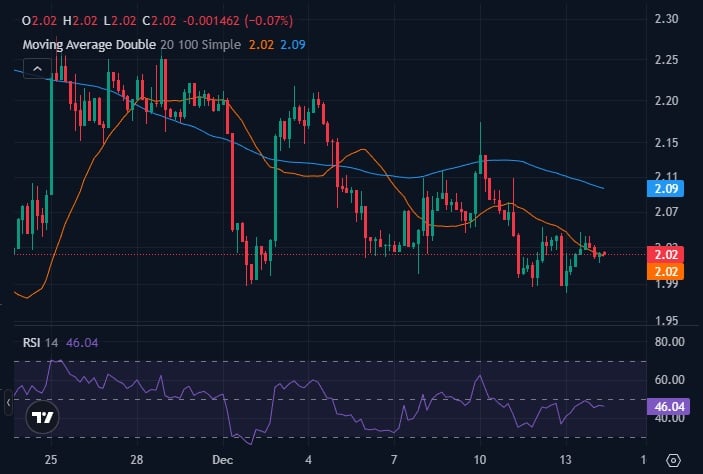
These price moves are not expected to happen immediately but could develop over the remainder of December 2025 and into 2026. Overall, XRP’s price outlook remains cautiously optimistic, with consolidation providing a foundation for potential future gains.

Best Crypto to Buy Now – Top Picks Beyond XRP

As the industry stands on the brink of structural change, Ripple’s expanding role suggests it could become a central force in reshaping how value is stored, transferred, and settled on a global scale. This shift could also boost the broader crypto market.

Even with XRP’s strong potential, it’s important to look beyond it, as several early-stage projects are already attracting attention. Below are two crypto presales currently recognized among the best crypto to buy now.

Bitcoin Hyper (HYPER)

Bitcoin Hyper is a promising layer-2 solution built on the Bitcoin network, designed to improve transaction speed, lower fees, and enable smart contract functionality, making it a strong addition alongside XRP in a diversified crypto strategy.

By combining Bitcoin’s security with Solana-level scalability, it allows for more frequent small payments and decentralized applications without congesting the main chain. This approach addresses Bitcoin’s usability limitations while maintaining its decentralized and secure ecosystem.

For traders and users, Bitcoin Hyper offers the familiarity of Bitcoin with added efficiency, making it more practical for everyday use and as productive collateral. The project is currently in presale, raising nearly $23 million at a price of $0.013425 per token.

As the crypto market grows, Bitcoin Hyper positions itself as a tool to expand Bitcoin’s utility beyond simple holdings, potentially increasing adoption and reshaping the Bitcoin ecosystem. To take part in the $HYPER token presale, visit bitcoinhyper.com.

Pepenode (PEPENODE)

Pepenode is an upcoming crypto mining game set to launch in 25 days, offering a unique combination of meme coin culture and interactive gameplay. Unlike typical meme tokens, it allows users to participate in a mining simulator where they can earn airdrops.

The project recently raised $2.3 million, keeping its market cap low and increasing potential upside for early participants. Staking opportunities currently offer up to 550% APY, providing strong incentives for accumulation before launch.
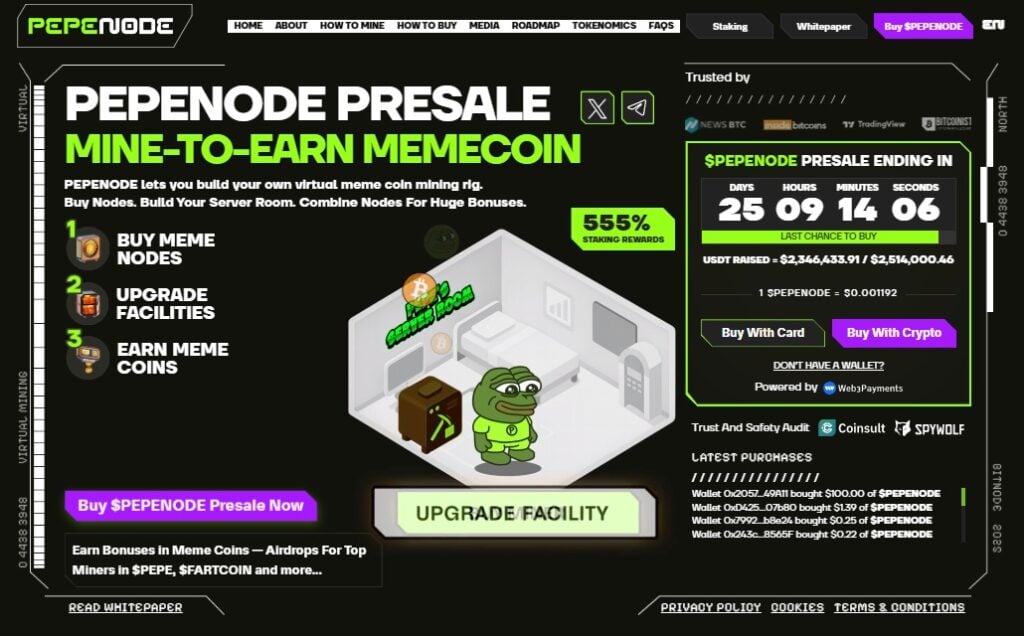
Pepenode’s structure enables players to reinvest earned tokens to acquire more miners, boosting future rewards. With its launch timing aligned with the anticipated crypto market upswing, the project stands out among new hyped cryptocurrencies, making it one of the best meme coins to buy.

Visit Pepenode

This article has been provided by one of our commercial partners and does not reflect Cryptonomist’s opinion. Please be aware our commercial partners may use affiliate programs to generate revenues through the links on this article.

Disclaimer: The articles reposted on this site are sourced from public platforms and are provided for informational purposes only. They do not necessarily reflect the views of MEXC. All rights remain with the original authors. If you believe any content infringes on third-party rights, please contact service@support.mexc.com for removal. MEXC makes no guarantees regarding the accuracy, completeness, or timeliness of the content and is not responsible for any actions taken based on the information provided. The content does not constitute financial, legal, or other professional advice, nor should it be considered a recommendation or endorsement by MEXC.

You May Also Like

Summarize Any Stock’s Earnings Call in Seconds Using FMP API

Summarize Any Stock’s Earnings Call in Seconds Using FMP API

Turn lengthy earnings call transcripts into one-page insights using the Financial Modeling Prep APIPhoto by Bich Tran Earnings calls are packed with insights. They tell you how a company performed, what management expects in the future, and what analysts are worried about. The challenge is that these transcripts often stretch across dozens of pages, making it tough to separate the key takeaways from the noise. With the right tools, you don’t need to spend hours reading every line. By combining the Financial Modeling Prep (FMP) API with Groq’s lightning-fast LLMs, you can transform any earnings call into a concise summary in seconds. The FMP API provides reliable access to complete transcripts, while Groq handles the heavy lifting of distilling them into clear, actionable highlights. In this article, we’ll build a Python workflow that brings these two together. You’ll see how to fetch transcripts for any stock, prepare the text, and instantly generate a one-page summary. Whether you’re tracking Apple, NVIDIA, or your favorite growth stock, the process works the same — fast, accurate, and ready whenever you are. Fetching Earnings Transcripts with FMP API The first step is to pull the raw transcript data. FMP makes this simple with dedicated endpoints for earnings calls. If you want the latest transcripts across the market, you can use the stable endpoint /stable/earning-call-transcript-latest. For a specific stock, the v3 endpoint lets you request transcripts by symbol, quarter, and year using the pattern: https://financialmodelingprep.com/api/v3/earning_call_transcript/{symbol}?quarter={q}&year={y}&apikey=YOUR_API_KEY here’s how you can fetch NVIDIA’s transcript for a given quarter: import requestsAPI_KEY = "your_api_key"symbol = "NVDA"quarter = 2year = 2024url = f"https://financialmodelingprep.com/api/v3/earning_call_transcript/{symbol}?quarter={quarter}&year={year}&apikey={API_KEY}"response = requests.get(url)data = response.json()# Inspect the keysprint(data.keys())# Access transcript contentif "content" in data[0]: transcript_text = data[0]["content"] print(transcript_text[:500]) # preview first 500 characters The response typically includes details like the company symbol, quarter, year, and the full transcript text. If you aren’t sure which quarter to query, the “latest transcripts” endpoint is the quickest way to always stay up to date. Cleaning and Preparing Transcript Data Raw transcripts from the API often include long paragraphs, speaker tags, and formatting artifacts. Before sending them to an LLM, it helps to organize the text into a cleaner structure. Most transcripts follow a pattern: prepared remarks from executives first, followed by a Q&A session with analysts. Separating these sections gives better control when prompting the model. In Python, you can parse the transcript and strip out unnecessary characters. A simple way is to split by markers such as “Operator” or “Question-and-Answer.” Once separated, you can create two blocks — Prepared Remarks and Q&A — that will later be summarized independently. This ensures the model handles each section within context and avoids missing important details. Here’s a small example of how you might start preparing the data: import re# Example: using the transcript_text we fetched earliertext = transcript_text# Remove extra spaces and line breaksclean_text = re.sub(r'\s+', ' ', text).strip()# Split sections (this is a heuristic; real-world transcripts vary slightly)if "Question-and-Answer" in clean_text: prepared, qna = clean_text.split("Question-and-Answer", 1)else: prepared, qna = clean_text, ""print("Prepared Remarks Preview:\n", prepared[:500])print("\nQ&A Preview:\n", qna[:500]) With the transcript cleaned and divided, you’re ready to feed it into Groq’s LLM. Chunking may be necessary if the text is very long. A good approach is to break it into segments of a few thousand tokens, summarize each part, and then merge the summaries in a final pass. Summarizing with Groq LLM Now that the transcript is clean and split into Prepared Remarks and Q&A, we’ll use Groq to generate a crisp one-pager. The idea is simple: summarize each section separately (for focus and accuracy), then synthesize a final brief. Prompt design (concise and factual) Use a short, repeatable template that pushes for neutral, investor-ready language: You are an equity research analyst. Summarize the following earnings call sectionfor {symbol} ({quarter} {year}). Be factual and concise.Return:1) TL;DR (3–5 bullets)2) Results vs. guidance (what improved/worsened)3) Forward outlook (specific statements)4) Risks / watch-outs5) Q&A takeaways (if present)Text:<<<{section_text}>>> Python: calling Groq and getting a clean summary Groq provides an OpenAI-compatible API. Set your GROQ_API_KEY and pick a fast, high-quality model (e.g., a Llama-3.1 70B variant). We’ll write a helper to summarize any text block, then run it for both sections and merge. import osimport textwrapimport requestsGROQ_API_KEY = os.environ.get("GROQ_API_KEY") or "your_groq_api_key"GROQ_BASE_URL = "https://api.groq.com/openai/v1" # OpenAI-compatibleMODEL = "llama-3.1-70b" # choose your preferred Groq modeldef call_groq(prompt, temperature=0.2, max_tokens=1200): url = f"{GROQ_BASE_URL}/chat/completions" headers = { "Authorization": f"Bearer {GROQ_API_KEY}", "Content-Type": "application/json", } payload = { "model": MODEL, "messages": [ {"role": "system", "content": "You are a precise, neutral equity research analyst."}, {"role": "user", "content": prompt}, ], "temperature": temperature, "max_tokens": max_tokens, } r = requests.post(url, headers=headers, json=payload, timeout=60) r.raise_for_status() return r.json()["choices"][0]["message"]["content"].strip()def build_prompt(section_text, symbol, quarter, year): template = """ You are an equity research analyst. Summarize the following earnings call section for {symbol} ({quarter} {year}). Be factual and concise. Return: 1) TL;DR (3–5 bullets) 2) Results vs. guidance (what improved/worsened) 3) Forward outlook (specific statements) 4) Risks / watch-outs 5) Q&A takeaways (if present) Text: <<< {section_text} >>> """ return textwrap.dedent(template).format( symbol=symbol, quarter=quarter, year=year, section_text=section_text )def summarize_section(section_text, symbol="NVDA", quarter="Q2", year="2024"): if not section_text or section_text.strip() == "": return "(No content found for this section.)" prompt = build_prompt(section_text, symbol, quarter, year) return call_groq(prompt)# Example usage with the cleaned splits from Section 3prepared_summary = summarize_section(prepared, symbol="NVDA", quarter="Q2", year="2024")qna_summary = summarize_section(qna, symbol="NVDA", quarter="Q2", year="2024")final_one_pager = f"""# {symbol} Earnings One-Pager — {quarter} {year}## Prepared Remarks — Key Points{prepared_summary}## Q&A Highlights{qna_summary}""".strip()print(final_one_pager[:1200]) # preview Tips that keep quality high: Keep temperature low (≈0.2) for factual tone. If a section is extremely long, chunk at ~5–8k tokens, summarize each chunk with the same prompt, then ask the model to merge chunk summaries into one section summary before producing the final one-pager. If you also fetched headline numbers (EPS/revenue, guidance) earlier, prepend them to the prompt as brief context to help the model anchor on the right outcomes. Building the End-to-End Pipeline At this point, we have all the building blocks: the FMP API to fetch transcripts, a cleaning step to structure the data, and Groq LLM to generate concise summaries. The final step is to connect everything into a single workflow that can take any ticker and return a one-page earnings call summary. The flow looks like this: Input a stock ticker (for example, NVDA). Use FMP to fetch the latest transcript. Clean and split the text into Prepared Remarks and Q&A. Send each section to Groq for summarization. Merge the outputs into a neatly formatted earnings one-pager. Here’s how it comes together in Python: def summarize_earnings_call(symbol, quarter, year, api_key, groq_key): # Step 1: Fetch transcript from FMP url = f"https://financialmodelingprep.com/api/v3/earning_call_transcript/{symbol}?quarter={quarter}&year={year}&apikey={api_key}" resp = requests.get(url) resp.raise_for_status() data = resp.json() if not data or "content" not in data[0]: return f"No transcript found for {symbol} {quarter} {year}" text = data[0]["content"] # Step 2: Clean and split clean_text = re.sub(r'\s+', ' ', text).strip() if "Question-and-Answer" in clean_text: prepared, qna = clean_text.split("Question-and-Answer", 1) else: prepared, qna = clean_text, "" # Step 3: Summarize with Groq prepared_summary = summarize_section(prepared, symbol, quarter, year) qna_summary = summarize_section(qna, symbol, quarter, year) # Step 4: Merge into final one-pager return f"""# {symbol} Earnings One-Pager — {quarter} {year}## Prepared Remarks{prepared_summary}## Q&A Highlights{qna_summary}""".strip()# Example runprint(summarize_earnings_call("NVDA", 2, 2024, API_KEY, GROQ_API_KEY)) With this setup, generating a summary becomes as simple as calling one function with a ticker and date. You can run it inside a notebook, integrate it into a research workflow, or even schedule it to trigger after each new earnings release. Free Stock Market API and Financial Statements API... Conclusion Earnings calls no longer need to feel overwhelming. With the Financial Modeling Prep API, you can instantly access any company’s transcript, and with Groq LLM, you can turn that raw text into a sharp, actionable summary in seconds. This pipeline saves hours of reading and ensures you never miss the key results, guidance, or risks hidden in lengthy remarks. Whether you track tech giants like NVIDIA or smaller growth stocks, the process is the same — fast, reliable, and powered by the flexibility of FMP’s data. Summarize Any Stock’s Earnings Call in Seconds Using FMP API was originally published in Coinmonks on Medium, where people are continuing the conversation by highlighting and responding to this story
Share
Medium2025/09/18 14:40
