

Ethereum Leverage Hits Highest Level Ever – Market Enters Critical Risk Zone
Ethereum has retraced below the $3,200 level following the Federal Reserve’s decision to cut interest rates by 25 basis points, a move that initially boosted risk assets but quickly shifted market sentiment into uncertainty. While the broader macro backdrop now leans toward looser monetary conditions, Ethereum’s reaction suggests that traders remain cautious, especially after the sharp rally from the $2,800 region earlier this month.
According to fresh data from CryptoQuant, Binance’s Ethereum Estimated Leverage Ratio has climbed to an all-time high of nearly 0.579. This signals that the ETH market has entered a highly sensitive and potentially unstable phase, as open leveraged positions have grown faster than the underlying spot holdings on the exchange. Such extreme leverage typically reflects heightened risk appetite—and often precedes periods of sharp volatility.
This dynamic implies that a large portion of Ethereum’s recent price action has been driven not by organic demand, but by leveraged speculation. With funding structures stretched and traders aggressively positioning for upside, even a modest price swing could trigger a cascade of liquidations, amplifying market movements in either direction. As Ethereum hovers near key support, the combination of elevated leverage and post-FED uncertainty sets the stage for a volatile and decisive period ahead.
Ethereum’s Leverage Structure Signals Growing Fragility
Arab Chain explains that Ethereum’s historically high leverage ratio indicates a structural imbalance in the market. When the volume of open contracts funded by leverage grows faster than the actual spot ETH held on the platform, the entire ecosystem becomes more sensitive to abrupt volatility.

In such conditions, traders face a heightened risk of liquidation from even moderate price swings—whether the move is upward or downward. Historically, peaks in this indicator have aligned with periods of intense price pressure, as excessive leverage magnifies the market’s reaction to relatively small shifts in demand or sentiment.
At the same time, Ethereum is currently trading near $3,300, creating a concerning confluence: rising prices supported not by strong inflows or genuine spot demand, but by leverage-driven speculation. This type of rally is inherently unstable. If leverage continues climbing at these extreme levels, the market becomes increasingly vulnerable to a sharp liquidation-driven sell-off should prices pull back.
However, there is an alternative path. If ETH’s price continues to build momentum while the leverage ratio cools slightly, the market could regain a healthier structure—providing a more durable foundation for a sustained upward trend. For now, the estimated leverage ratio remains one of the most critical indicators for evaluating Ethereum’s short-term direction.
ETH Price Action Details
Ethereum’s latest rejection near the $3,350–$3,400 zone highlights the challenges bulls face as the broader trend remains pressured. The chart shows ETH pulling back toward the $3,200 area after a sharp attempt to break above the 100-day moving average (red line). This level continues to act as a major dynamic resistance, repeatedly capping upside momentum throughout November and December.
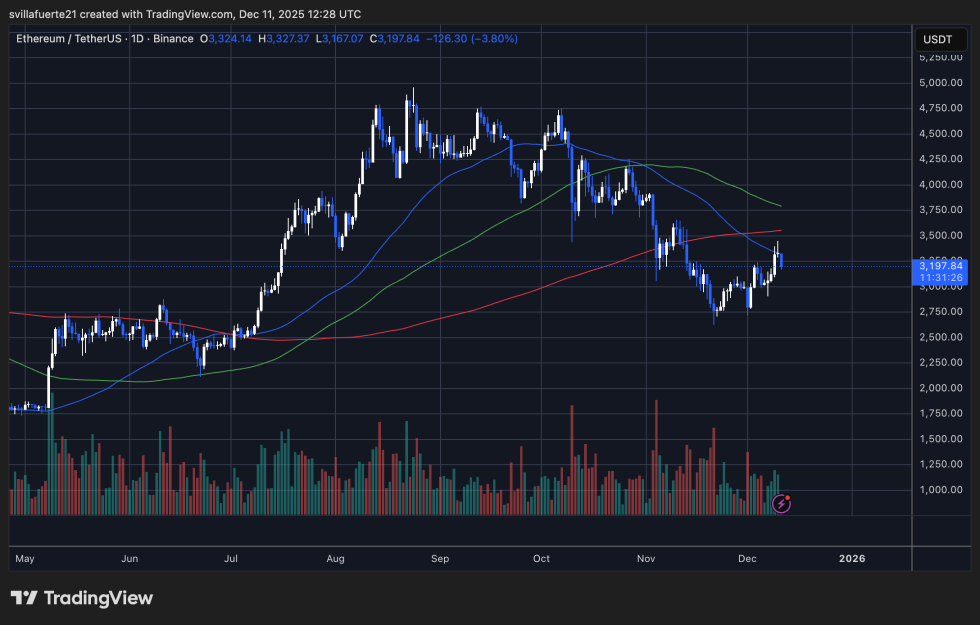
Despite the recent recovery from sub-$2,900 lows, ETH has not yet reclaimed the 50-day moving average (blue line) with conviction. The inability to close decisively above it reinforces the idea that this bounce remains corrective rather than impulsive. Meanwhile, volume on the latest push upward has been modest, suggesting that buyers are not entering aggressively at these levels.
On the downside, the $3,050–$3,100 region is emerging as short-term support. A daily close below this zone could open a path back toward $2,900, especially if risk sentiment deteriorates post-FOMC. Conversely, reclaiming and holding above $3,350 would be the first sign of renewed bullish strength, potentially targeting $3,550 next.
Featured image from ChatGPT, chart from TradingView.com
You May Also Like

Polygon Tops RWA Rankings With $1.1B in Tokenized Assets

XRP Stuns ETF Market With Strange $0 Print in Biggest Fund
