Balancer, one of the most established decentralized finance (DeFi) protocols with more than $700 million in total value locked (TVL), appears to have suffered a serious exploit, adding fresh stress to an industry still grappling with security concerns. Early on-chain evidence indicates that attackers drained assets across multiple chains, with losses now exceeding $98 million, making this one of the largest DeFi breaches of 2025 so far. Related Reading: Bitmine Buys 44,036 Ethereum Worth $166M During Market Dip – Details The attack appears to have targeted Balancer liquidity pools, siphoning high-value assets including wrapped ETH and liquid-staking derivatives through coordinated cross-chain movements. Initial wallet traces show funds rapidly routed through mixing services and bridge networks. This suggests a sophisticated operation designed to minimize traceability. This is not the first time Balancer has faced a security incident, and the scale of this exploit reignites conversations around protocol hardening, liquidity pool design risk, and cross-chain attack vectors. It also deals a blow to market confidence at a time when institutional interest in DeFi infrastructure has been slowly recovering. Over $98M in ETH-Based Assets Drained as Market Weakness Adds Pressure According to on-chain data compiled by Lookonchain, the Balancer exploit resulted in the loss of a significant amount of high-value Ethereum-based assets. Among the stolen funds were 6,587 WETH (worth approximately $24.46 million), 6,851 osETH (valued around $26.86 million), and 4,260 wstETH (roughly $19.27 million). These figures confirm that the attacker targeted core liquidity holdings, particularly liquid-staking assets and wrapped Ether. Assets commonly used in advanced DeFi strategies and institutional portfolios. The scale of outflows highlights the exploit’s severity and underscores persistent vulnerabilities in cross-chain and liquidity-pool architecture. More importantly, this incident has arrived at a sensitive moment for the market. Ethereum is already under selling pressure, struggling to reclaim key levels amid broader crypto market weakness. Risk appetite has thinned, liquidity has become more selective, and sentiment remains fragile following recent volatility. The Balancer breach adds another layer of stress to an ecosystem trying to regain its footing. Major exploits like this serve as a stark reminder that smart-contract risk remains one of the sector’s biggest challenges. With investors already cautious, the timing amplifies uncertainty — and the market’s reaction in the coming days will be a critical test for confidence across the Ethereum and DeFi landscape. Related Reading: Bitcoin Point Of Control Sits At $117K – Key Battle Zone For Bulls Balancer (BAL) Trades Near Cycle Lows as Sellers Maintain Control Balancer’s native token BAL continues to trade under heavy pressure, now sitting near $0.97 and hovering close to multi-year lows. The weekly chart reflects persistent weakness, with price trending steadily downward since mid-2024 and repeatedly failing to reclaim key moving averages. The 50-week and 100-week moving averages remain firmly above price and slope downward, reinforcing a long-term bearish structure and signaling that momentum remains with sellers. Recent attempts to rebound have been shallow and short-lived. Indicating limited buying interest and a reluctance from market participants to position aggressively following the latest exploit news. This weakness predates the incident. However, BAL has been in a consistent downtrend for months, struggling to sustain demand even during broader market relief phases. Related Reading: $780M Worth of Ethereum Pulled From Exchanges – Biggest Withdrawal Spike in Weeks With the token sitting near its post-listing lows, the market is in a “show-me” phase. Bulls need to reclaim at least the $1.20–$1.40 area and break above the 50-week moving average to challenge the prevailing downtrend. Failure to do so risks deeper price compression and potential price discovery lower. Featured image from ChatGPT, chart from TradingView.comBalancer, one of the most established decentralized finance (DeFi) protocols with more than $700 million in total value locked (TVL), appears to have suffered a serious exploit, adding fresh stress to an industry still grappling with security concerns. Early on-chain evidence indicates that attackers drained assets across multiple chains, with losses now exceeding $98 million, making this one of the largest DeFi breaches of 2025 so far. Related Reading: Bitmine Buys 44,036 Ethereum Worth $166M During Market Dip – Details The attack appears to have targeted Balancer liquidity pools, siphoning high-value assets including wrapped ETH and liquid-staking derivatives through coordinated cross-chain movements. Initial wallet traces show funds rapidly routed through mixing services and bridge networks. This suggests a sophisticated operation designed to minimize traceability. This is not the first time Balancer has faced a security incident, and the scale of this exploit reignites conversations around protocol hardening, liquidity pool design risk, and cross-chain attack vectors. It also deals a blow to market confidence at a time when institutional interest in DeFi infrastructure has been slowly recovering. Over $98M in ETH-Based Assets Drained as Market Weakness Adds Pressure According to on-chain data compiled by Lookonchain, the Balancer exploit resulted in the loss of a significant amount of high-value Ethereum-based assets. Among the stolen funds were 6,587 WETH (worth approximately $24.46 million), 6,851 osETH (valued around $26.86 million), and 4,260 wstETH (roughly $19.27 million). These figures confirm that the attacker targeted core liquidity holdings, particularly liquid-staking assets and wrapped Ether. Assets commonly used in advanced DeFi strategies and institutional portfolios. The scale of outflows highlights the exploit’s severity and underscores persistent vulnerabilities in cross-chain and liquidity-pool architecture. More importantly, this incident has arrived at a sensitive moment for the market. Ethereum is already under selling pressure, struggling to reclaim key levels amid broader crypto market weakness. Risk appetite has thinned, liquidity has become more selective, and sentiment remains fragile following recent volatility. The Balancer breach adds another layer of stress to an ecosystem trying to regain its footing. Major exploits like this serve as a stark reminder that smart-contract risk remains one of the sector’s biggest challenges. With investors already cautious, the timing amplifies uncertainty — and the market’s reaction in the coming days will be a critical test for confidence across the Ethereum and DeFi landscape. Related Reading: Bitcoin Point Of Control Sits At $117K – Key Battle Zone For Bulls Balancer (BAL) Trades Near Cycle Lows as Sellers Maintain Control Balancer’s native token BAL continues to trade under heavy pressure, now sitting near $0.97 and hovering close to multi-year lows. The weekly chart reflects persistent weakness, with price trending steadily downward since mid-2024 and repeatedly failing to reclaim key moving averages. The 50-week and 100-week moving averages remain firmly above price and slope downward, reinforcing a long-term bearish structure and signaling that momentum remains with sellers. Recent attempts to rebound have been shallow and short-lived. Indicating limited buying interest and a reluctance from market participants to position aggressively following the latest exploit news. This weakness predates the incident. However, BAL has been in a consistent downtrend for months, struggling to sustain demand even during broader market relief phases. Related Reading: $780M Worth of Ethereum Pulled From Exchanges – Biggest Withdrawal Spike in Weeks With the token sitting near its post-listing lows, the market is in a “show-me” phase. Bulls need to reclaim at least the $1.20–$1.40 area and break above the 50-week moving average to challenge the prevailing downtrend. Failure to do so risks deeper price compression and potential price discovery lower. Featured image from ChatGPT, chart from TradingView.com

Balancer Protocol Sees $70M Exit In Suspected Crypto Exploit

2025/11/04 02:00
3 min read

Balancer, one of the most established decentralized finance (DeFi) protocols with more than $700 million in total value locked (TVL), appears to have suffered a serious exploit, adding fresh stress to an industry still grappling with security concerns. Early on-chain evidence indicates that attackers drained assets across multiple chains, with losses now exceeding $98 million, making this one of the largest DeFi breaches of 2025 so far.

The attack appears to have targeted Balancer liquidity pools, siphoning high-value assets including wrapped ETH and liquid-staking derivatives through coordinated cross-chain movements. Initial wallet traces show funds rapidly routed through mixing services and bridge networks. This suggests a sophisticated operation designed to minimize traceability.

Balancer Hacker Portfolio | Source: Lookonchain

This is not the first time Balancer has faced a security incident, and the scale of this exploit reignites conversations around protocol hardening, liquidity pool design risk, and cross-chain attack vectors. It also deals a blow to market confidence at a time when institutional interest in DeFi infrastructure has been slowly recovering.

Over $98M in ETH-Based Assets Drained as Market Weakness Adds Pressure

According to on-chain data compiled by Lookonchain, the Balancer exploit resulted in the loss of a significant amount of high-value Ethereum-based assets. Among the stolen funds were 6,587 WETH (worth approximately $24.46 million), 6,851 osETH (valued around $26.86 million), and 4,260 wstETH (roughly $19.27 million). These figures confirm that the attacker targeted core liquidity holdings, particularly liquid-staking assets and wrapped Ether. Assets commonly used in advanced DeFi strategies and institutional portfolios.

Balancer Vault Transfers | Source: Etherescan

The scale of outflows highlights the exploit’s severity and underscores persistent vulnerabilities in cross-chain and liquidity-pool architecture. More importantly, this incident has arrived at a sensitive moment for the market. Ethereum is already under selling pressure, struggling to reclaim key levels amid broader crypto market weakness. Risk appetite has thinned, liquidity has become more selective, and sentiment remains fragile following recent volatility.

The Balancer breach adds another layer of stress to an ecosystem trying to regain its footing. Major exploits like this serve as a stark reminder that smart-contract risk remains one of the sector’s biggest challenges. With investors already cautious, the timing amplifies uncertainty — and the market’s reaction in the coming days will be a critical test for confidence across the Ethereum and DeFi landscape.

Balancer (BAL) Trades Near Cycle Lows as Sellers Maintain Control

Balancer’s native token BAL continues to trade under heavy pressure, now sitting near $0.97 and hovering close to multi-year lows. The weekly chart reflects persistent weakness, with price trending steadily downward since mid-2024 and repeatedly failing to reclaim key moving averages. The 50-week and 100-week moving averages remain firmly above price and slope downward, reinforcing a long-term bearish structure and signaling that momentum remains with sellers.
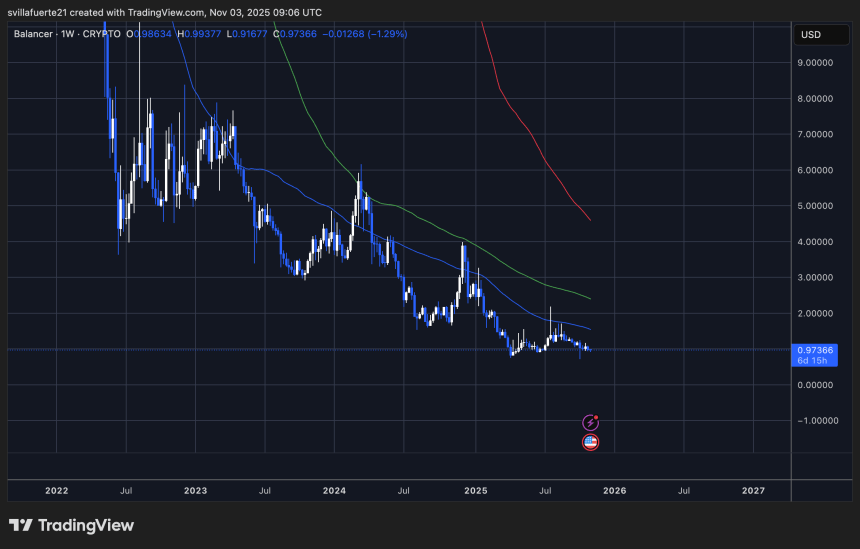
BAL price showing weakness | Source: BALUSDT chart on TradingView

Recent attempts to rebound have been shallow and short-lived. Indicating limited buying interest and a reluctance from market participants to position aggressively following the latest exploit news. This weakness predates the incident. However, BAL has been in a consistent downtrend for months, struggling to sustain demand even during broader market relief phases.

With the token sitting near its post-listing lows, the market is in a “show-me” phase. Bulls need to reclaim at least the $1.20–$1.40 area and break above the 50-week moving average to challenge the prevailing downtrend. Failure to do so risks deeper price compression and potential price discovery lower.

Featured image from ChatGPT, chart from TradingView.com

Market Opportunity
DeFi Logo
DeFi Price(DEFI)
$0.000346
$0.000346$0.000346
-1.98%
USD
DeFi (DEFI) Live Price Chart
Disclaimer: The articles reposted on this site are sourced from public platforms and are provided for informational purposes only. They do not necessarily reflect the views of MEXC. All rights remain with the original authors. If you believe any content infringes on third-party rights, please contact service@support.mexc.com for removal. MEXC makes no guarantees regarding the accuracy, completeness, or timeliness of the content and is not responsible for any actions taken based on the information provided. The content does not constitute financial, legal, or other professional advice, nor should it be considered a recommendation or endorsement by MEXC.

You May Also Like

Markets await Fed’s first 2025 cut, experts bet “this bull market is not even close to over”

Markets await Fed’s first 2025 cut, experts bet “this bull market is not even close to over”

Will the Fed’s first rate cut of 2025 fuel another leg higher for Bitcoin and equities, or does September’s history point to caution? First rate cut of 2025 set against a fragile backdrop The Federal Reserve is widely expected to…
Share
Crypto.news2025/09/18 00:27
Trump Owns $870 Million Bitcoin Amid Crypto Market Meltdown

Trump Owns $870 Million Bitcoin Amid Crypto Market Meltdown

The post Trump Owns $870 Million Bitcoin Amid Crypto Market Meltdown appeared on BitcoinEthereumNews.com. President Donald Trump has quietly become one of the world’s largest Bitcoin (BTC) holders, even as the crypto market faces a historic meltdown. The revelation comes as Bitcoin and the broader crypto market struggle through one of their steepest declines in recent years. Trump Media’s $2 Billion Bitcoin Bet Makes President A Major Investors According to a Forbes report, Trump’s indirect Bitcoin exposure is now valued at around $870 million, placing him among the biggest investors in the digital asset space. Despite the crash, Trump’s holdings remain strong, showing his business’ growing ties to the crypto market. Forbes found that Trump’s holdings are not listed in any official government filings or financial disclosures. Instead, his exposure comes through his 41% stake in Trump Media and Technology Group, the parent company of Truth Social. Earlier this year, Trump Media raised $2.3 billion through debt and stock sales, using most of the proceeds to buy $2 billion worth of Bitcoin. The move aligns with MicroStrategy’s renewed interest in buying Bitcoin after not buying any last week. That move gave Trump a massive indirect stake in the world’s largest cryptocurrency. Trump Media’s Bitcoin Strategy Shows Trump’s Shift From Crypto Disbelief When the company chose to start holding BTC on its balance sheet, it represented a radical turning point from just being a social media company. Through the adoption of the same corporate treasury technique popularized by Michael Saylor’s Strategy Inc., Trump Media has become a U.S. company holding large amounts of Bitcoin. This shift mirrors the growing wave of institutional adoption. Recently, trillion-dollar asset manager Morgan Stanley opened crypto investments to all its wealth clients. According to Forbes, the company’s overall evaluation has fallen since its Bitcoin purchase. However, its Bitcoin reserves now make up the strongest part of its balance sheet. Trump’s…
Share
BitcoinEthereumNews2025/10/13 05:12
Trump Denies Involvement in $500M Abu Dhabi WLFI Stake

Trump Denies Involvement in $500M Abu Dhabi WLFI Stake

The post Trump Denies Involvement in $500M Abu Dhabi WLFI Stake appeared on BitcoinEthereumNews.com. US President Donald Trump has denied knowledge of a reported
Share
BitcoinEthereumNews2026/02/03 23:26