Anatoly Yakovenko, co-founder CEO of Solana Labs, has unveiled plans for a new decentralized exchange (DEX) named Percolator, designed as a sharded perpetuals protocol built directly on the Solana blockchain.  The platform aims to provide a self-custodial and high-speed solution for perpetual futures trading, allowing crypto traders to speculate on price movements without the limitation of expiry dates. Solana’s Percolator Documentation Released The documentation for Percolator was released on GitHub, where it is described as “implementation-ready.” It introduces two primary components: a Router and a Slab program.  The Router manages collateral, portfolio margins, and cross-slab routing, while the Slab program functions as a matching engine overseen by liquidity providers (LPs). Each slab operates independently, enabling what Yakovenko refers to as “fully self-contained matching and settlement.”  Related Reading: Analyst Uses AI To Show How The XRP Price Could Rally To $1,700 This design ensures that any issues arising from a particular slab do not affect users who have not interacted with it. Yakovenko emphasized the advantages of this architecture, stating: This design keeps each LP’s slab fully self-contained and innovable, while the Router guarantees atomic routing, portfolio netting, and capability-scoped safety.  The project’s GitHub repository already shows completed data structures for order books and memory pools, although the development of liquidation systems is still in progress. However, no official launch date has been announced. Competition In Derivatives Market Intensifies Currently, the Solana Foundation has not disclosed whether Percolator will receive formal ecosystem support or if it will emerge as a community-driven protocol.  Should it succeed, Percolator would add to the expanding repertoire of native financial primitives being developed on the Solana blockchain, which already includes decentralized options, lending protocols, and tokenized asset platforms.  At present, the code for Percolator remains under review on GitHub, and developers engaged with the repository indicate that the project is “deep in testing.” This suggests that a launch could be imminent, provided that the liquidation and governance components are finalized. The introduction of Percolator comes at a critical time, as competitors like Hyperliquid (HYPE) are expanding their presence in the derivatives-focused DEX space.  Related Reading: ‘Buy Of The Century’: Cardano Could Be The 2026 Game-Changer Under $0.20 — Analyst Hyperliquid recently implemented permissionless, builder-deployed perpetual contracts through its HIP-3 upgrade, allowing users to stake a minimum of 500,000 HYPE tokens—approximately $18 million—to launch their own perpetual markets with independent margin rules. Hyperliquid accounted for 35% of all blockchain revenue in July, attracting users away from platforms like Solana, Ethereum (ETH), and BNB Chain. Asset manager VanEck recently noted that Hyperliquid has successfully retained high-value users, thanks in part to its “simple, highly functional product.” As of press time, SOL is trading at $187.70, marking a 20% loss over the past fourteen and thirty days. This puts SOL 35% below its all-time high of $293, which was reached earlier this year.  Featured image from DALL-E, chart from TradingView.comAnatoly Yakovenko, co-founder CEO of Solana Labs, has unveiled plans for a new decentralized exchange (DEX) named Percolator, designed as a sharded perpetuals protocol built directly on the Solana blockchain.  The platform aims to provide a self-custodial and high-speed solution for perpetual futures trading, allowing crypto traders to speculate on price movements without the limitation of expiry dates. Solana’s Percolator Documentation Released The documentation for Percolator was released on GitHub, where it is described as “implementation-ready.” It introduces two primary components: a Router and a Slab program.  The Router manages collateral, portfolio margins, and cross-slab routing, while the Slab program functions as a matching engine overseen by liquidity providers (LPs). Each slab operates independently, enabling what Yakovenko refers to as “fully self-contained matching and settlement.”  Related Reading: Analyst Uses AI To Show How The XRP Price Could Rally To $1,700 This design ensures that any issues arising from a particular slab do not affect users who have not interacted with it. Yakovenko emphasized the advantages of this architecture, stating: This design keeps each LP’s slab fully self-contained and innovable, while the Router guarantees atomic routing, portfolio netting, and capability-scoped safety.  The project’s GitHub repository already shows completed data structures for order books and memory pools, although the development of liquidation systems is still in progress. However, no official launch date has been announced. Competition In Derivatives Market Intensifies Currently, the Solana Foundation has not disclosed whether Percolator will receive formal ecosystem support or if it will emerge as a community-driven protocol.  Should it succeed, Percolator would add to the expanding repertoire of native financial primitives being developed on the Solana blockchain, which already includes decentralized options, lending protocols, and tokenized asset platforms.  At present, the code for Percolator remains under review on GitHub, and developers engaged with the repository indicate that the project is “deep in testing.” This suggests that a launch could be imminent, provided that the liquidation and governance components are finalized. The introduction of Percolator comes at a critical time, as competitors like Hyperliquid (HYPE) are expanding their presence in the derivatives-focused DEX space.  Related Reading: ‘Buy Of The Century’: Cardano Could Be The 2026 Game-Changer Under $0.20 — Analyst Hyperliquid recently implemented permissionless, builder-deployed perpetual contracts through its HIP-3 upgrade, allowing users to stake a minimum of 500,000 HYPE tokens—approximately $18 million—to launch their own perpetual markets with independent margin rules. Hyperliquid accounted for 35% of all blockchain revenue in July, attracting users away from platforms like Solana, Ethereum (ETH), and BNB Chain. Asset manager VanEck recently noted that Hyperliquid has successfully retained high-value users, thanks in part to its “simple, highly functional product.” As of press time, SOL is trading at $187.70, marking a 20% loss over the past fourteen and thirty days. This puts SOL 35% below its all-time high of $293, which was reached earlier this year.  Featured image from DALL-E, chart from TradingView.com

Solana Co-Founder Ventures Into Perpetual DEX Development: What You Should Know

2025/10/21 15:00
3 min read

Anatoly Yakovenko, co-founder CEO of Solana Labs, has unveiled plans for a new decentralized exchange (DEX) named Percolator, designed as a sharded perpetuals protocol built directly on the Solana blockchain. 

The platform aims to provide a self-custodial and high-speed solution for perpetual futures trading, allowing crypto traders to speculate on price movements without the limitation of expiry dates.

Solana’s Percolator Documentation Released

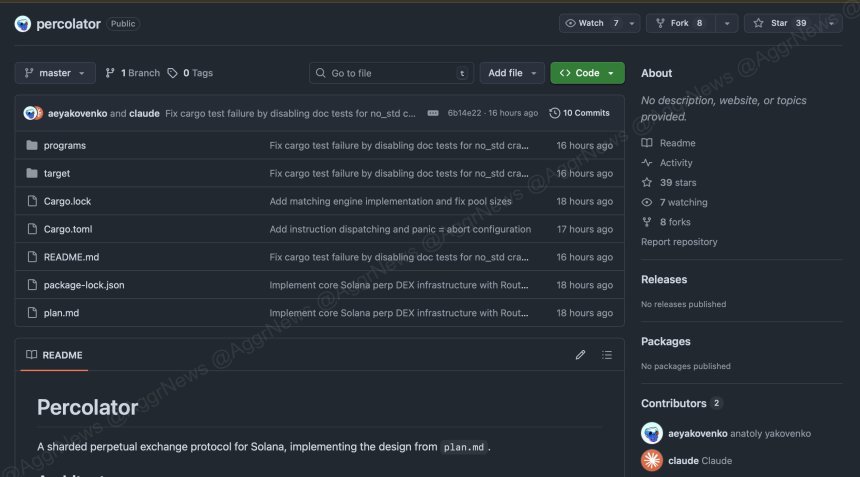
The documentation for Percolator was released on GitHub, where it is described as “implementation-ready.” It introduces two primary components: a Router and a Slab program. 

The Router manages collateral, portfolio margins, and cross-slab routing, while the Slab program functions as a matching engine overseen by liquidity providers (LPs). Each slab operates independently, enabling what Yakovenko refers to as “fully self-contained matching and settlement.” 

This design ensures that any issues arising from a particular slab do not affect users who have not interacted with it. Yakovenko emphasized the advantages of this architecture, stating:

The project’s GitHub repository already shows completed data structures for order books and memory pools, although the development of liquidation systems is still in progress. However, no official launch date has been announced.

Competition In Derivatives Market Intensifies

Currently, the Solana Foundation has not disclosed whether Percolator will receive formal ecosystem support or if it will emerge as a community-driven protocol. 

Should it succeed, Percolator would add to the expanding repertoire of native financial primitives being developed on the Solana blockchain, which already includes decentralized options, lending protocols, and tokenized asset platforms. 

At present, the code for Percolator remains under review on GitHub, and developers engaged with the repository indicate that the project is “deep in testing.” This suggests that a launch could be imminent, provided that the liquidation and governance components are finalized.
Solana

The introduction of Percolator comes at a critical time, as competitors like Hyperliquid (HYPE) are expanding their presence in the derivatives-focused DEX space. 

Hyperliquid recently implemented permissionless, builder-deployed perpetual contracts through its HIP-3 upgrade, allowing users to stake a minimum of 500,000 HYPE tokens—approximately $18 million—to launch their own perpetual markets with independent margin rules.

Hyperliquid accounted for 35% of all blockchain revenue in July, attracting users away from platforms like Solana, Ethereum (ETH), and BNB Chain. Asset manager VanEck recently noted that Hyperliquid has successfully retained high-value users, thanks in part to its “simple, highly functional product.”

Solana

As of press time, SOL is trading at $187.70, marking a 20% loss over the past fourteen and thirty days. This puts SOL 35% below its all-time high of $293, which was reached earlier this year. 

Featured image from DALL-E, chart from TradingView.com 

Market Opportunity
READY Logo
READY Price(READY)
$0.013082
$0.013082$0.013082
+6.60%
USD
READY (READY) Live Price Chart
Disclaimer: The articles reposted on this site are sourced from public platforms and are provided for informational purposes only. They do not necessarily reflect the views of MEXC. All rights remain with the original authors. If you believe any content infringes on third-party rights, please contact service@support.mexc.com for removal. MEXC makes no guarantees regarding the accuracy, completeness, or timeliness of the content and is not responsible for any actions taken based on the information provided. The content does not constitute financial, legal, or other professional advice, nor should it be considered a recommendation or endorsement by MEXC.

You May Also Like

UAE’s Central Bank Approves the DSSC Stablecoin Launch by IHC, FAB, and Sirius

UAE’s Central Bank Approves the DSSC Stablecoin Launch by IHC, FAB, and Sirius

The post UAE’s Central Bank Approves the DSSC Stablecoin Launch by IHC, FAB, and Sirius appeared on BitcoinEthereumNews.com. CBUAE has approved the dirham-backed
Share
BitcoinEthereumNews2026/02/13 04:30
Unyielding Challenges Stall US Crypto Bill Progress

Unyielding Challenges Stall US Crypto Bill Progress

The post Unyielding Challenges Stall US Crypto Bill Progress appeared on BitcoinEthereumNews.com. The enduring quest to establish a regulatory framework for cryptocurrencies
Share
BitcoinEthereumNews2026/02/13 04:04
Vitalik Buterin Reveals Ethereum’s Bold Plan to Stay Quantum-Secure and Simple!

Vitalik Buterin Reveals Ethereum’s Bold Plan to Stay Quantum-Secure and Simple!

Buterin unveils Ethereum’s strategy to tackle quantum security challenges ahead. Ethereum focuses on simplifying architecture while boosting security for users. Ethereum’s market stability grows as Buterin’s roadmap gains investor confidence. Ethereum founder Vitalik Buterin has unveiled his long-term vision for the blockchain, focusing on making Ethereum quantum-secure while maintaining its simplicity for users. Buterin presented his roadmap at the Japanese Developer Conference, and splits the future of Ethereum into three phases: short-term, mid-term, and long-term. Buterin’s most ambitious goal for Ethereum is to safeguard the blockchain against the threats posed by quantum computing.  The danger of such future developments is that the future may call into question the cryptographic security of most blockchain systems, and Ethereum will be able to remain ahead thanks to more sophisticated mathematical techniques to ensure the safety and integrity of its protocols. Buterin is committed to ensuring that Ethereum evolves in a way that not only meets today’s security challenges but also prepares for the unknowns of tomorrow. Also Read: Ethereum Giant The Ether Machine Takes Major Step Toward Going Public! However, in spite of such high ambitions, Buterin insisted that Ethereum also needed to simplify its architecture. An important aspect of this vision is to remove unnecessary complexity and make Ethereum more accessible and maintainable without losing its strong security capabilities. Security and simplicity form the core of Buterin’s strategy, as they guarantee that the users of Ethereum experience both security and smooth processes. Focus on Speed and Efficiency in the Short-Term In the short term, Buterin aims to enhance Ethereum’s transaction efficiency, a crucial step toward improving scalability and reducing transaction costs. These advantages are attributed to the fact that, within the mid-term, Ethereum is planning to enhance the speed of transactions in layer-2 networks. According to Butterin, this is part of Ethereum’s expansion, particularly because there is still more need to use blockchain technology to date. The other important aspect of Ethereum’s development is the layer-2 solutions. Buterin supports an approach in which the layer-2 networks are dependent on layer-1 to perform some essential tasks like data security, proof, and censorship resistance. This will enable the layer-2 systems of Ethereum to be concerned with verifying and sequencing transactions, which will improve the overall speed and efficiency of the network. Ethereum’s Market Stability Reflects Confidence in Long-Term Strategy Ethereum’s market performance has remained solid, with the cryptocurrency holding steady above $4,000. Currently priced at $4,492.15, Ethereum has experienced a slight 0.93% increase over the last 24 hours, while its trading volume surged by 8.72%, reaching $34.14 billion. These figures point to growing investor confidence in Ethereum’s long-term vision. The crypto community remains optimistic about Ethereum’s future, with many predicting the price could rise to $5,500 by mid-October. Buterin’s clear, forward-thinking strategy continues to build trust in Ethereum as one of the most secure and scalable blockchain platforms in the market. Also Read: Whales Dump 200 Million XRP in Just 2 Weeks – Is XRP’s Price on the Verge of Collapse? The post Vitalik Buterin Reveals Ethereum’s Bold Plan to Stay Quantum-Secure and Simple! appeared first on 36Crypto.
Share
Coinstats2025/09/18 01:22