Shiba Inu has restored BONE transfers on Shibarium’s Plasma bridge, re-enabling deposits and withdrawals between Ethereum and the layer-2 network following a security incident that forced a month-long pause. In an October 14 post, core contributor Kaal Dhairya wrote that the “Plasma Bridge is back online for BONE, following a comprehensive review and a series […]Shiba Inu has restored BONE transfers on Shibarium’s Plasma bridge, re-enabling deposits and withdrawals between Ethereum and the layer-2 network following a security incident that forced a month-long pause. In an October 14 post, core contributor Kaal Dhairya wrote that the “Plasma Bridge is back online for BONE, following a comprehensive review and a series […]

Shiba Inu Reopens Shibarium Bridge After 1-Month Freeze

2025/10/16 13:30

Shiba Inu has restored BONE transfers on Shibarium’s Plasma bridge, re-enabling deposits and withdrawals between Ethereum and the layer-2 network following a security incident that forced a month-long pause. In an October 14 post, core contributor Kaal Dhairya wrote that the “Plasma Bridge is back online for BONE, following a comprehensive review and a series of security enhancements,” adding that users can now bridge BONE “with a safer, stronger, and more resilient experience.”

Shiba Inu Relaunches The Shibarium Bridge

The relaunch comes after Shibarium’s bridge was restricted in mid-September following a validator-key compromise that enabled a malicious exit on the PoS bridge. In a September 21 incident report, Dhairya stated that “on September 12, 2025 at 18:44 UTC, unauthorized validator signing power was used to push a malicious state/exit through the PoS bridge, withdrawing multiple assets,” prompting immediate containment measures and a broader hardening program. The team said at the time it would publish full technical details once it was safe to do so and that “bridging remains restricted during containment/hardening.”

Shibarium’s team is positioning the re-opened BONE bridge as the first step in a phased restoration of services, backed by new policy-level and operational controls. The most visible change for users is a mandatory delay before withdrawals finalize: “All BONE Plasma withdrawals now include a 7-day finalization delay. This buffer gives operators and security teams time to monitor and respond to unusual activity before funds finalize—significantly improving defense without removing user access.” The post frames the delay as reinforcing Plasma’s fraud-resistance guarantees.

Another control introduced at the bridge layer is proactive address blacklisting. According to the team, the new mechanism “lets us flag and block suspicious addresses at the bridge layer,” with the intent of preventing repeat abuse across the ecosystem. The Shiba Inu team also emphasized that critical code changes underwent an external review: “All critical changes were reviewed by Hexens, adding an independent layer of expert scrutiny.” The relaunch followed a validation sequence that included unit tests, end-to-end simulations, deployment on the public testnet (“Puppynet”), and “multi-timeframe” monitoring before production activation.

The October 14 update also addresses a separate strand of the September incident involving KNINE and minor OSCAR token flows. The Shiba Inu team disclosed that the attacker “drained and sold roughly $600 worth of OSCAR tokens from the bridge but ignored the 5 ETH recovery offer for KNINE tokens,” which now remain blacklisted and unusable to the attacker. The previously announced KNINE bounty “has expired,” the team said, but it plans “one final, conditional bounty (amount TBD) for complete return of all KNINE held by attacker-controlled addresses,” stressing that partial returns will not qualify and that terms will appear only on verified channels.

While only BONE is live on the Plasma bridge today, Shibarium signaled a broader roadmap. The team plans “gradual re-enablement for other tokens” and is “finalizing a fair and transparent repayment framework for affected users,” with specifics to be published once doing so would not increase risk. The post underscores a measured posture after the September compromise: “Safety first: We won’t publish specifics that could be gamed while security work is ongoing. Expect measured, verifiable updates.”

Context around the month-long outage highlights the extent of remediation behind the scenes. In late September, Shibarium detailed rotations of validator signers, migrations of contract control to multi-party hardware custody, targeted contract-level protections, live monitoring and exchange coordination, and the engagement of independent security and incident-response specialists. The September 21 update also acknowledged decentralization shortcomings in validator operations and outlined a hardening plan “in progress collaboration with Hexens,” with restoration gated on third-party sign-offs and successful drills on test environments.

For now, the reopening restores a critical path for validators, liquidity providers and users who rely on BONE mobility between Ethereum and Shibarium. As the post concludes, the new safeguards—including blacklisting and the 7-day challenge window—are intended to align the bridge’s user experience with the practical realities of operating a Plasma-style system under adversarial conditions: “Every new safeguard, every extra check, and yes—even the 7-day delay—reflects one core principle: protecting the community.”

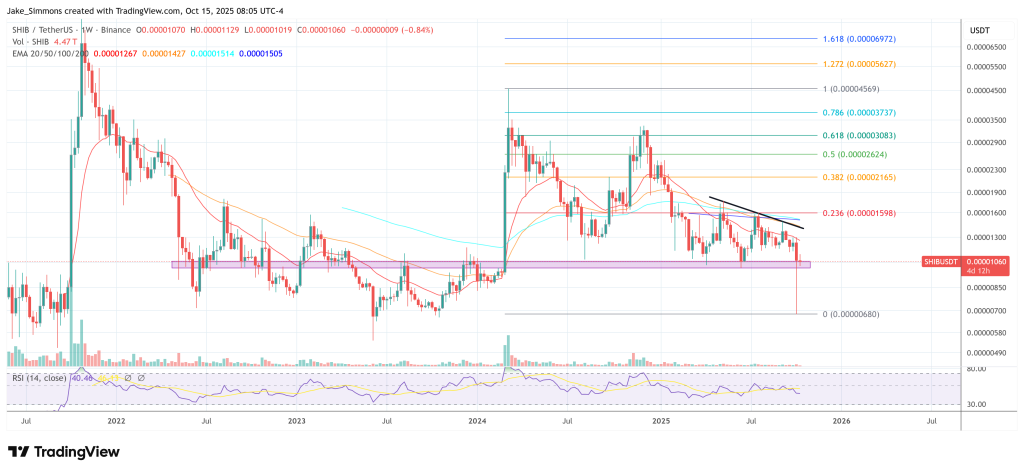
At press time, the Shiba Inu (SHIB) token traded at $0.00001060.
Shiba Inu price
Market Opportunity
BitShiba Logo
BitShiba Price(SHIBA)
$0.000000000427
$0.000000000427$0.000000000427
+2.39%
USD
BitShiba (SHIBA) Live Price Chart
Disclaimer: The articles reposted on this site are sourced from public platforms and are provided for informational purposes only. They do not necessarily reflect the views of MEXC. All rights remain with the original authors. If you believe any content infringes on third-party rights, please contact service@support.mexc.com for removal. MEXC makes no guarantees regarding the accuracy, completeness, or timeliness of the content and is not responsible for any actions taken based on the information provided. The content does not constitute financial, legal, or other professional advice, nor should it be considered a recommendation or endorsement by MEXC.

You May Also Like

Volante Technologies Customers Successfully Navigate Critical Regulatory Deadlines for EU SEPA Instant and Global SWIFT Cross-Border Payments

Volante Technologies Customers Successfully Navigate Critical Regulatory Deadlines for EU SEPA Instant and Global SWIFT Cross-Border Payments

PaaS leader ensures seamless migrations and uninterrupted payment operations LONDON–(BUSINESS WIRE)–Volante Technologies, the global leader in Payments as a Service
Share
AI Journal2025/12/16 17:16
Fed Acts on Economic Signals with Rate Cut

Fed Acts on Economic Signals with Rate Cut

In a significant pivot, the Federal Reserve reduced its benchmark interest rate following a prolonged ten-month hiatus. This decision, reflecting a strategic response to the current economic climate, has captured attention across financial sectors, with both market participants and policymakers keenly evaluating its potential impact.Continue Reading:Fed Acts on Economic Signals with Rate Cut
Share
Coinstats2025/09/18 02:28
Google's AP2 protocol has been released. Does encrypted AI still have a chance?

Google's AP2 protocol has been released. Does encrypted AI still have a chance?

Following the MCP and A2A protocols, the AI Agent market has seen another blockbuster arrival: the Agent Payments Protocol (AP2), developed by Google. This will clearly further enhance AI Agents' autonomous multi-tasking capabilities, but the unfortunate reality is that it has little to do with web3AI. Let's take a closer look: What problem does AP2 solve? Simply put, the MCP protocol is like a universal hook, enabling AI agents to connect to various external tools and data sources; A2A is a team collaboration communication protocol that allows multiple AI agents to cooperate with each other to complete complex tasks; AP2 completes the last piece of the puzzle - payment capability. In other words, MCP opens up connectivity, A2A promotes collaboration efficiency, and AP2 achieves value exchange. The arrival of AP2 truly injects "soul" into the autonomous collaboration and task execution of Multi-Agents. Imagine AI Agents connecting Qunar, Meituan, and Didi to complete the booking of flights, hotels, and car rentals, but then getting stuck at the point of "self-payment." What's the point of all that multitasking? So, remember this: AP2 is an extension of MCP+A2A, solving the last mile problem of AI Agent automated execution. What are the technical highlights of AP2? The core innovation of AP2 is the Mandates mechanism, which is divided into real-time authorization mode and delegated authorization mode. Real-time authorization is easy to understand. The AI Agent finds the product and shows it to you. The operation can only be performed after the user signs. Delegated authorization requires the user to set rules in advance, such as only buying the iPhone 17 when the price drops to 5,000. The AI Agent monitors the trigger conditions and executes automatically. The implementation logic is cryptographically signed using Verifiable Credentials (VCs). Users can set complex commission conditions, including price ranges, time limits, and payment method priorities, forming a tamper-proof digital contract. Once signed, the AI Agent executes according to the conditions, with VCs ensuring auditability and security at every step. Of particular note is the "A2A x402" extension, a technical component developed by Google specifically for crypto payments, developed in collaboration with Coinbase and the Ethereum Foundation. This extension enables AI Agents to seamlessly process stablecoins, ETH, and other blockchain assets, supporting native payment scenarios within the Web3 ecosystem. What kind of imagination space can AP2 bring? After analyzing the technical principles, do you think that's it? Yes, in fact, the AP2 is boring when it is disassembled alone. Its real charm lies in connecting and opening up the "MCP+A2A+AP2" technology stack, completely opening up the complete link of AI Agent's autonomous analysis+execution+payment. From now on, AI Agents can open up many application scenarios. For example, AI Agents for stock investment and financial management can help us monitor the market 24/7 and conduct independent transactions. Enterprise procurement AI Agents can automatically replenish and renew without human intervention. AP2's complementary payment capabilities will further expand the penetration of the Agent-to-Agent economy into more scenarios. Google obviously understands that after the technical framework is established, the ecological implementation must be relied upon, so it has brought in more than 60 partners to develop it, almost covering the entire payment and business ecosystem. Interestingly, it also involves major Crypto players such as Ethereum, Coinbase, MetaMask, and Sui. Combined with the current trend of currency and stock integration, the imagination space has been doubled. Is web3 AI really dead? Not entirely. Google's AP2 looks complete, but it only achieves technical compatibility with Crypto payments. It can only be regarded as an extension of the traditional authorization framework and belongs to the category of automated execution. There is a "paradigm" difference between it and the autonomous asset management pursued by pure Crypto native solutions. The Crypto-native solutions under exploration are taking the "decentralized custody + on-chain verification" route, including AI Agent autonomous asset management, AI Agent autonomous transactions (DeFAI), AI Agent digital identity and on-chain reputation system (ERC-8004...), AI Agent on-chain governance DAO framework, AI Agent NPC and digital avatars, and many other interesting and fun directions. Ultimately, once users get used to AI Agent payments in traditional fields, their acceptance of AI Agents autonomously owning digital assets will also increase. And for those scenarios that AP2 cannot reach, such as anonymous transactions, censorship-resistant payments, and decentralized asset management, there will always be a time for crypto-native solutions to show their strength? The two are more likely to be complementary rather than competitive, but to be honest, the key technological advancements behind AI Agents currently all come from web2AI, and web3AI still needs to keep up the good work!
Share
PANews2025/09/18 07:00