šŸ“‘ Table of Contents Polkadot: A Network of Networks The Vision Behind Polkadot’s Creation How Polkadot’s Modular Technology Works Governance and Community Power Polkadot in Action: Examples and Partners DOT Tokenomics Explained Polkadot’s Roadmap and Future Outlook FAQ: 10 Unanswered Questions About Polkadot 🌐 Polkadot: A Network of Networks Polkadot is one of the most [...]]]>šŸ“‘ Table of Contents Polkadot: A Network of Networks The Vision Behind Polkadot’s Creation How Polkadot’s Modular Technology Works Governance and Community Power Polkadot in Action: Examples and Partners DOT Tokenomics Explained Polkadot’s Roadmap and Future Outlook FAQ: 10 Unanswered Questions About Polkadot 🌐 Polkadot: A Network of Networks Polkadot is one of the most [...]]]>

Polkadot (DOT) in 2025: The Network of Networks Powering Interoperable Web3

šŸ“‘ Table of Contents

  • Polkadot: A Network of Networks
  • The Vision Behind Polkadot’s Creation
  • How Polkadot’s Modular Technology Works
  • Governance and Community Power
  • Polkadot in Action: Examples and Partners
  • DOT Tokenomics Explained
  • Polkadot’s Roadmap and Future Outlook
  • FAQ: 10 Unanswered Questions About Polkadot

🌐 Polkadot: A Network of Networks

Polkadot is one of the most promising innovations in blockchain technology. Unlike traditional single-chain blockchains such as Bitcoin or Ethereum, Polkadot is designed as a network of blockchains. Through its modular architecture, it enables a wide range of specialized applications to run in parallel while benefiting from shared security and interoperability.

The native token DOT functions as a cryptocurrency, governance tool, and utility token. Its goal is to build an interoperable Web3 ecosystem where blockchains can communicate securely and efficiently. This design allows projects to develop custom solutions without compromising network stability or scalability.

šŸš€ The Vision Behind Polkadot’s Creation

Polkadot was conceived by Dr. Gavin Wood, one of Ethereum’s co-founders, in 2016. His vision was to overcome the limitations of existing blockchains. The development is led by the Web3 Foundation and Parity Technologies. The mission: to build a decentralized internet free from gatekeepers, where users retain full control over their data and applications.

āš™ How Polkadot’s Modular Technology Works

Polkadot is built on a modular architecture with three key components:

  • Relay Chain: The central chain providing security, governance, and transaction validation.
  • Parachains: Independent blockchains that run in parallel, customized for specific applications like DeFi, gaming, or identity management.
  • Bridges: Connect Polkadot with external blockchains such as Ethereum and Bitcoin, enhancing interoperability.

This design allows scalability, specialization, and seamless communication between blockchains.

šŸ› Governance and Community Power

Unlike off-chain governance models, Polkadot implements on-chain governance. DOT holders directly vote on protocol upgrades, parameter adjustments, and feature integrations. This democratic model empowers the community and promotes transparency. A notable example is Parachain Auctions, where projects compete for relay chain slots, and the community votes on which projects are integrated.

šŸ’” Polkadot in Action: Examples and Partner Projects

Polkadot supports a wide variety of applications, including:

  • DeFi: Acala (stablecoins, financial products) and Parallel Finance (lending, staking, trading).
  • Smart Contracts: Moonbeam, offering Ethereum compatibility for developers.
  • Digital Identity: KILT Protocol, providing verifiable credentials.
  • Other Sectors: Energy, logistics, and sustainability through collaborations with companies and NGOs.

ProjectFocus AreaRole within Polkadot
AcalaDeFi / StablecoinsFinancial hub for decentralized services
MoonbeamSmart ContractsEthereum-compatible environment
KILT ProtocolDigital IdentityIdentity verification and data management

šŸ’° DOT Tokenomics Explained

The DOT token underpins the economic model of Polkadot. Unlike capped-supply cryptocurrencies, DOT uses an inflation-based model to ensure continuous network incentives. Key functions include:

  • Governance: Voting on protocol changes and new features.
  • Staking: Securing the network by rewarding validators and nominators.
  • Parachain Auctions: Funding slots on the relay chain for project integration.
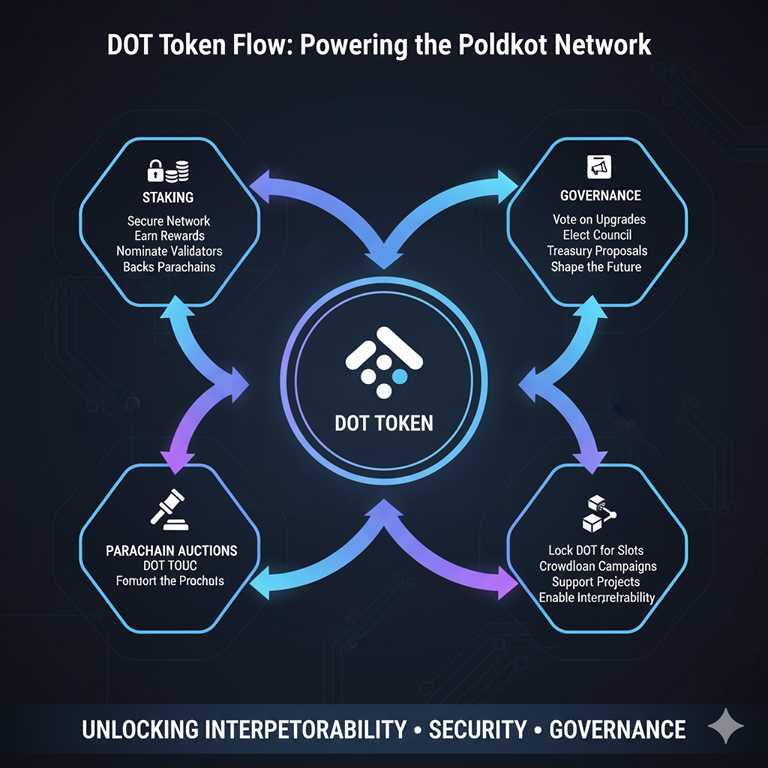
infographic showing the DOT Token flow, including staking, governance, and parachain auctions

šŸ”® Polkadot’s Roadmap and Future Outlook

In 2025, Polkadot is focused on expanding its parachain ecosystem and building additional bridges to external networks. Regulatory clarity could accelerate institutional adoption. With its multi-chain architecture, Polkadot is becoming a key infrastructure provider for Web3.

The development of Polkadot 2.0 will transform the platform into a global computing environment. Its JAM architecture (Join-Accumulate Machine) introduces vertical scalability and service-oriented design, aiming to support decentralized Web3 cloud functions.
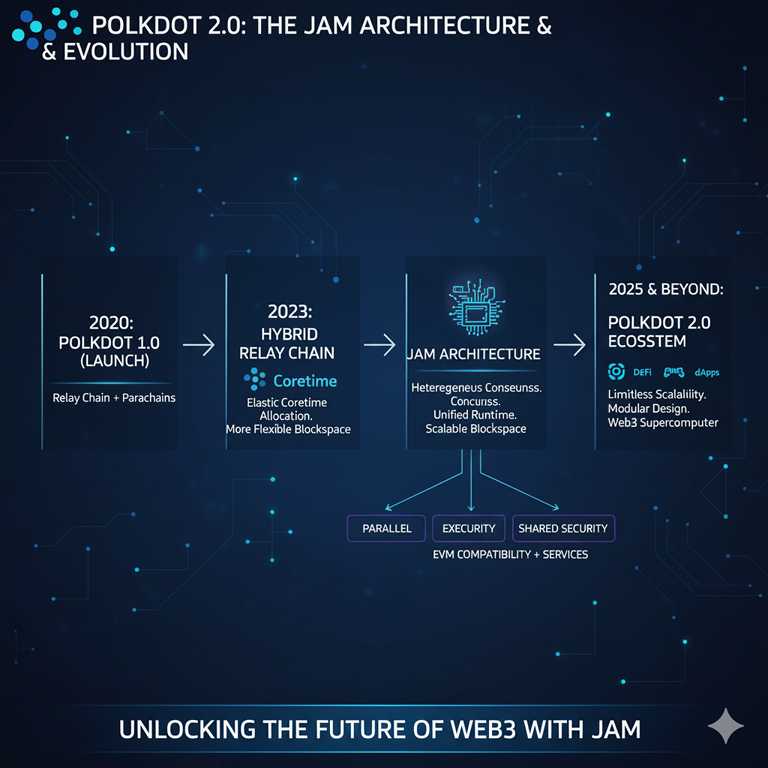
image of the Polkadot 2.0 roadmap timeline, including JAM architecture features

ā“ FAQ: 10 Unanswered Questions About Polkadot

1. How will Polkadot 2.0 impact developers?
Polkadot 2.0 will expand opportunities for developers by introducing the JAM (Join-Accumulate Machine) architecture. This enables vertical scalability, more flexible runtime environments, and a service-oriented infrastructure, allowing developers to build Web3 apps with greater efficiency and customizability.
2. Can Polkadot surpass Ethereum in adoption?
Polkadot could surpass Ethereum in specific niches like interoperability, parachain customization, and enterprise blockchain use cases. However, Ethereum’s dominant ecosystem and first-mover advantage in DeFi and NFTs make it difficult to overtake on a broad scale.
3. How secure are Polkadot’s parachains?
Parachains benefit from shared security provided by the relay chain. However, individual parachains can still face risks such as vulnerabilities in their own smart contract code or governance decisions. Shared security reduces systemic risk, but not all parachain-level risks.
4. Will regulatory changes affect Polkadot’s growth?
Yes, regulation will play a major role. Stricter frameworks could limit adoption in some regions, while clear guidelines might accelerate institutional and enterprise integration. Polkadot’s flexibility and governance model position it well to adapt to evolving compliance requirements.
5. What role do bridges play in Polkadot’s success?
Bridges are essential to Polkadot’s interoperability. They allow data and assets to flow between Polkadot and external blockchains like Ethereum and Bitcoin. Successful bridge deployment will determine Polkadot’s ability to become a true hub in the multi-chain ecosystem.
6. Can DOT tokenomics remain sustainable long-term?
DOT’s inflationary model incentivizes validators and nominators to secure the network. Over the long term, governance may adjust inflation parameters to balance rewards, security, and scarcity. The model is flexible but depends on active and responsible community governance.
7. How does Polkadot compare to Cosmos?
Both Polkadot and Cosmos aim to solve interoperability. Polkadot emphasizes shared security and a unified relay chain, while Cosmos prioritizes chain sovereignty with independent blockchains connected by the IBC protocol. The choice depends on whether projects value independence or pooled security.
8. Could Polkadot attract more enterprises?
Yes, Polkadot’s customizable parachains, regulatory adaptability, and strong developer community make it attractive to enterprises seeking tailored blockchain solutions. Its compliance-friendly approach and focus on interoperability also appeal to institutional use cases.
9. How active is the Polkadot developer community?
Polkadot consistently ranks among the top blockchain projects in GitHub commits and developer activity. Its community is one of the most active, with continuous contributions to core protocol upgrades, parachain development, and tooling for Web3.
10. What’s next for parachain auctions?
Parachain auctions will likely evolve with new models, such as shorter leasing terms, dynamic pricing, or alternative allocation mechanisms. These changes aim to increase accessibility for projects and further decentralize participation in the ecosystem.
]]>
Market Opportunity
Polkadot Logo
Polkadot Price(DOT)
$1.27
$1.27$1.27
-1.01%
USD
Polkadot (DOT) Live Price Chart
Disclaimer: The articles reposted on this site are sourced from public platforms and are provided for informational purposes only. They do not necessarily reflect the views of MEXC. All rights remain with the original authors. If you believe any content infringes on third-party rights, please contact service@support.mexc.com for removal. MEXC makes no guarantees regarding the accuracy, completeness, or timeliness of the content and is not responsible for any actions taken based on the information provided. The content does not constitute financial, legal, or other professional advice, nor should it be considered a recommendation or endorsement by MEXC.

You May Also Like

Shifting Tides in Bitcoin: New Challenges Emerge

Shifting Tides in Bitcoin: New Challenges Emerge

Recent developments in the Bitcoin market signal mounting pressures as capital inflows slow, and critical indicators shift. Data indicates that Bitcoin’s market
Share
Coinstats2026/02/11 02:05
We see a very good partnership with Venezuela

We see a very good partnership with Venezuela

The post We see a very good partnership with Venezuela appeared on BitcoinEthereumNews.com. United States (US) Treasury Secretary Scott Bessent said that they can
Share
BitcoinEthereumNews2026/02/11 01:59
Golden Trump statue holding Bitcoin appears outside U.S. Capitol

Golden Trump statue holding Bitcoin appears outside U.S. Capitol

The post Golden Trump statue holding Bitcoin appears outside U.S. Capitol appeared on BitcoinEthereumNews.com. A 12-foot golden statue of Trump gripping a Bitcoin was placed outside the U.S. Capitol on Wednesday evening in Washington. The installation appeared just before the Federal Reserve’s latest interest rate announcement. It stood along 3rd Street from 9 a.m. to 4 p.m., pulling crowds as D.C. tried to make sense of a foam version of the president staring down Congress with a crypto in hand. At 2 p.m., the Fed cut its benchmark interest rate by 0.25 percentage points, bringing the short-term rate from 4.3% to 4.1%. It’s the first rate cut since December, after a year of concerns about slowing job growth and rising unemployment. The Fed also outlined plans for two more cuts before the end of this year, but said it only expects one cut in 2026. That didn’t sit well with Wall Street, which had priced in five cuts by next year, as Cryptopolitan extensively reported. Crypto organizers livestream token to support Trump statue The statue was funded by a group of cryptocurrency investors, most of whom are staying anonymous. Their goal was to make a loud, unavoidable point about the future of crypto and government power. Hichem Zaghdoudi, who spoke for the group, said: ā€œThe installation is designed to ignite conversation about the future of government-issued currency and is a symbol of the intersection between modern politics and financial innovation. As the Federal Reserve shapes economic policy, we hope this statue prompts reflection on cryptocurrency’s growing influence.ā€ To push the message even further, the group launched a memecoin on Pump.fun. They used multiple livestreams to pump the token and tie it directly to the statue stunt. One organizer, speaking during a stream on Tuesday, said the statue was built using ā€œextremely hard foamā€ to make it easier to move. Posts on their X account…
Share
BitcoinEthereumNews2025/09/18 15:20