Author: Ash Compiled by: TechFlow @newmichwill, founder of @CurveFinance, is launching @yieldbasis, a Bitcoin AMM liquidity platform with no impermanent loss. Meanwhile, @yearnfi founder and DeFi god @AndreCronjeTech is building @flyingtulip_, a unified AMM+CLOB exchange. Two different attempts to solve the same problem: how to make on-chain liquidity truly effective: Yield Basis ($YB): A Curve-native AMM that eliminates impermanent loss for BTC liquidity providers by maintaining a constant 2x leveraged BTC-crvUSD liquidity pool (LP value remains 1:1 with BTC while earning transaction fees). Users can mint ybBTC (yield-generating BTC). Flying Tulip ($FT): An on-chain unified exchange (including spot, lending, perpetual contracts, options, and structured returns), based on a volatility-aware hybrid AMM+CLOB architecture, combined with a slippage-aware lending mechanism, and ftUSD (a delta-neutral USD equivalent) as the core incentive. Yield Basis Traditional AMMs allow BTC liquidity providers to sell when prices rise or buy when prices fall (√p exposure, DeepChao Note: market risk exposure measured in square roots of prices), resulting in impermanent losses that often exceed the fees earned from providing liquidity. The specific mechanism of Yield Basis will be explained in detail later, but the core is: users deposit BTC into the platform, and the protocol borrows an equal amount of crvUSD, forming a 50/50 BTC-crvUSD Curve liquidity pool, which operates with 2x compound leverage. A re-leveraged AMM and virtual pool maintains a debt approximately equal to 50% of the liquidity pool value; arbitrageurs profit by maintaining leverage constant. This allows the value of the liquidity pool to change linearly with BTC while earning transaction fees. Liquidity providers hold ybBTC, a yield-generating BTC receipt token that automatically compounds BTC-denominated transaction fees. The platform also provides governance tokens $YB, which can be locked as veYB and used for voting (for example, selecting liquidity pool reward distribution). Yield Basis is primarily aimed at BTC holders who want to unlock productive BTC in a protocol that solves the impermanent loss problem and earn fees. Flying Tulip Traditional decentralized exchanges (DEXs) often have static user experiences and risk profiles. Flying Tulip aims to bring centralized exchange (CEX)-level tools to the blockchain by adjusting AMM curves based on volatility and adjusting loan-to-value (LTV) ratios based on actual execution/slippage. Its AMM adjusts the curvature based on the measured volatility (EWMA) - that is, it tends to be flat (close to the constant sum) in the case of small volatility to compress slippage and impermanent loss; it has more multiplicative characteristics in the case of large volatility to avoid liquidity depletion. ftUSD tokenized delta-neutral liquidity pool positions are generated and used for incentive mechanisms and liquidity programs. The platform token $FT may be used for revenue buybacks, incentives, and liquidity programs. Flying Tulip is a DeFi super app: an exchange that supports spot trading, lending, perpetual contracts, and options. Execution quality relies on accurate volatility/impact signals and robust risk control in stressed environments. Outlook of the two projects Yield Basis aims to become a platform for BTC liquidity, while Flying Tulip aims to become a platform for all on-chain native trading. In an era dominated by perpetual contract decentralized exchanges (Perp DEXs), Flying Tulip's launch seems opportune. Frankly, if it can achieve best execution, Flying Tulip could even divert future BTC traffic to a pool similar to YB. If Yield Basis succeeds, ybBTC could become Bitcoin's "stETH" primitive: BTC exposure + liquidity provider (LP) trading fees, without impermanent loss. Flying Tulip has the potential to launch its integrated stack, providing users with centralized exchange (CEX)-level tools, attempting to become a "one-stop shop for all DeFi." While cautiously optimistic about both projects, it's important to note that these projects, led by OG founders and top-tier teams, remain untested, and their founders must also consider the development of other protocols, such as Curve and Sonic. The above image was compiled by TechFlow as follows: Author: Ash Compiled by: TechFlow @newmichwill, founder of @CurveFinance, is launching @yieldbasis, a Bitcoin AMM liquidity platform with no impermanent loss. Meanwhile, @yearnfi founder and DeFi god @AndreCronjeTech is building @flyingtulip_, a unified AMM+CLOB exchange. Two different attempts to solve the same problem: how to make on-chain liquidity truly effective: Yield Basis ($YB): A Curve-native AMM that eliminates impermanent loss for BTC liquidity providers by maintaining a constant 2x leveraged BTC-crvUSD liquidity pool (LP value remains 1:1 with BTC while earning transaction fees). Users can mint ybBTC (yield-generating BTC). Flying Tulip ($FT): An on-chain unified exchange (including spot, lending, perpetual contracts, options, and structured returns), based on a volatility-aware hybrid AMM+CLOB architecture, combined with a slippage-aware lending mechanism, and ftUSD (a delta-neutral USD equivalent) as the core incentive. Yield Basis Traditional AMMs allow BTC liquidity providers to sell when prices rise or buy when prices fall (√p exposure, DeepChao Note: market risk exposure measured in square roots of prices), resulting in impermanent losses that often exceed the fees earned from providing liquidity. The specific mechanism of Yield Basis will be explained in detail later, but the core is: users deposit BTC into the platform, and the protocol borrows an equal amount of crvUSD, forming a 50/50 BTC-crvUSD Curve liquidity pool, which operates with 2x compound leverage. A re-leveraged AMM and virtual pool maintains a debt approximately equal to 50% of the liquidity pool value; arbitrageurs profit by maintaining leverage constant. This allows the value of the liquidity pool to change linearly with BTC while earning transaction fees. Liquidity providers hold ybBTC, a yield-generating BTC receipt token that automatically compounds BTC-denominated transaction fees. The platform also provides governance tokens $YB, which can be locked as veYB and used for voting (for example, selecting liquidity pool reward distribution). Yield Basis is primarily aimed at BTC holders who want to unlock productive BTC in a protocol that solves the impermanent loss problem and earn fees. Flying Tulip Traditional decentralized exchanges (DEXs) often have static user experiences and risk profiles. Flying Tulip aims to bring centralized exchange (CEX)-level tools to the blockchain by adjusting AMM curves based on volatility and adjusting loan-to-value (LTV) ratios based on actual execution/slippage. Its AMM adjusts the curvature based on the measured volatility (EWMA) - that is, it tends to be flat (close to the constant sum) in the case of small volatility to compress slippage and impermanent loss; it has more multiplicative characteristics in the case of large volatility to avoid liquidity depletion. ftUSD tokenized delta-neutral liquidity pool positions are generated and used for incentive mechanisms and liquidity programs. The platform token $FT may be used for revenue buybacks, incentives, and liquidity programs. Flying Tulip is a DeFi super app: an exchange that supports spot trading, lending, perpetual contracts, and options. Execution quality relies on accurate volatility/impact signals and robust risk control in stressed environments. Outlook of the two projects Yield Basis aims to become a platform for BTC liquidity, while Flying Tulip aims to become a platform for all on-chain native trading. In an era dominated by perpetual contract decentralized exchanges (Perp DEXs), Flying Tulip's launch seems opportune. Frankly, if it can achieve best execution, Flying Tulip could even divert future BTC traffic to a pool similar to YB. If Yield Basis succeeds, ybBTC could become Bitcoin's "stETH" primitive: BTC exposure + liquidity provider (LP) trading fees, without impermanent loss. Flying Tulip has the potential to launch its integrated stack, providing users with centralized exchange (CEX)-level tools, attempting to become a "one-stop shop for all DeFi." While cautiously optimistic about both projects, it's important to note that these projects, led by OG founders and top-tier teams, remain untested, and their founders must also consider the development of other protocols, such as Curve and Sonic. The above image was compiled by TechFlow as follows:

New projects from DeFi veterans: Curve founder creates BTC pool, AC plans to build a full-fledged exchange

2025/09/30 08:00
4 min read

Author: Ash

Compiled by: TechFlow

@newmichwill, founder of @CurveFinance, is launching @yieldbasis, a Bitcoin AMM liquidity platform with no impermanent loss.

Meanwhile, @yearnfi founder and DeFi god @AndreCronjeTech is building @flyingtulip_, a unified AMM+CLOB exchange.

Two different attempts to solve the same problem: how to make on-chain liquidity truly effective:

  • Yield Basis ($YB): A Curve-native AMM that eliminates impermanent loss for BTC liquidity providers by maintaining a constant 2x leveraged BTC-crvUSD liquidity pool (LP value remains 1:1 with BTC while earning transaction fees). Users can mint ybBTC (yield-generating BTC).
  • Flying Tulip ($FT): An on-chain unified exchange (including spot, lending, perpetual contracts, options, and structured returns), based on a volatility-aware hybrid AMM+CLOB architecture, combined with a slippage-aware lending mechanism, and ftUSD (a delta-neutral USD equivalent) as the core incentive.

Yield Basis

  • Traditional AMMs allow BTC liquidity providers to sell when prices rise or buy when prices fall (√p exposure, DeepChao Note: market risk exposure measured in square roots of prices), resulting in impermanent losses that often exceed the fees earned from providing liquidity.
  • The specific mechanism of Yield Basis will be explained in detail later, but the core is: users deposit BTC into the platform, and the protocol borrows an equal amount of crvUSD, forming a 50/50 BTC-crvUSD Curve liquidity pool, which operates with 2x compound leverage.
  • A re-leveraged AMM and virtual pool maintains a debt approximately equal to 50% of the liquidity pool value; arbitrageurs profit by maintaining leverage constant.
  • This allows the value of the liquidity pool to change linearly with BTC while earning transaction fees.
  • Liquidity providers hold ybBTC, a yield-generating BTC receipt token that automatically compounds BTC-denominated transaction fees.
  • The platform also provides governance tokens $YB, which can be locked as veYB and used for voting (for example, selecting liquidity pool reward distribution).
  • Yield Basis is primarily aimed at BTC holders who want to unlock productive BTC in a protocol that solves the impermanent loss problem and earn fees.

Flying Tulip

  • Traditional decentralized exchanges (DEXs) often have static user experiences and risk profiles. Flying Tulip aims to bring centralized exchange (CEX)-level tools to the blockchain by adjusting AMM curves based on volatility and adjusting loan-to-value (LTV) ratios based on actual execution/slippage.
  • Its AMM adjusts the curvature based on the measured volatility (EWMA) - that is, it tends to be flat (close to the constant sum) in the case of small volatility to compress slippage and impermanent loss; it has more multiplicative characteristics in the case of large volatility to avoid liquidity depletion.
  • ftUSD tokenized delta-neutral liquidity pool positions are generated and used for incentive mechanisms and liquidity programs.
  • The platform token $FT may be used for revenue buybacks, incentives, and liquidity programs.
  • Flying Tulip is a DeFi super app: an exchange that supports spot trading, lending, perpetual contracts, and options.
  • Execution quality relies on accurate volatility/impact signals and robust risk control in stressed environments.

Outlook of the two projects

Yield Basis aims to become a platform for BTC liquidity, while Flying Tulip aims to become a platform for all on-chain native trading. In an era dominated by perpetual contract decentralized exchanges (Perp DEXs), Flying Tulip's launch seems opportune. Frankly, if it can achieve best execution, Flying Tulip could even divert future BTC traffic to a pool similar to YB. If Yield Basis succeeds, ybBTC could become Bitcoin's "stETH" primitive: BTC exposure + liquidity provider (LP) trading fees, without impermanent loss. Flying Tulip has the potential to launch its integrated stack, providing users with centralized exchange (CEX)-level tools, attempting to become a "one-stop shop for all DeFi." While cautiously optimistic about both projects, it's important to note that these projects, led by OG founders and top-tier teams, remain untested, and their founders must also consider the development of other protocols, such as Curve and Sonic.
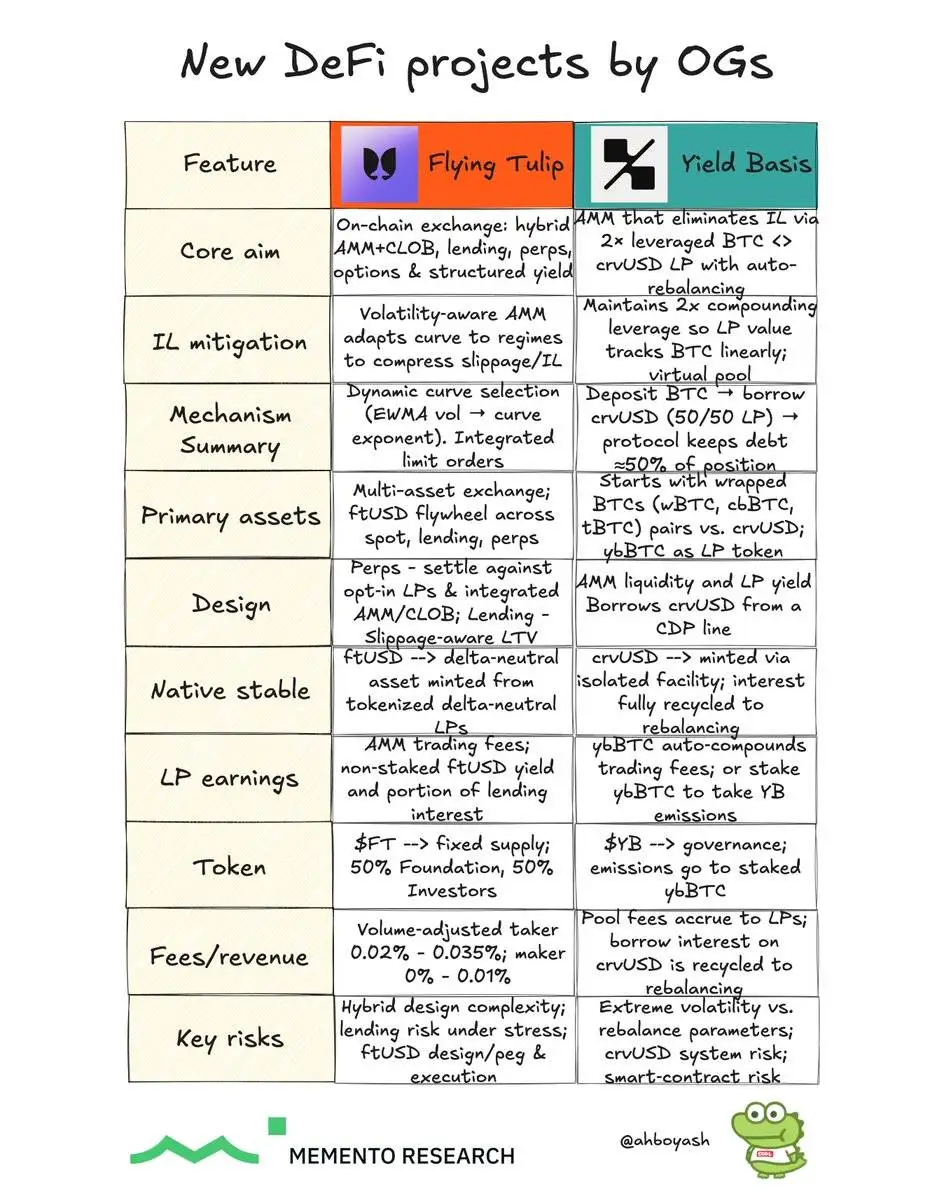
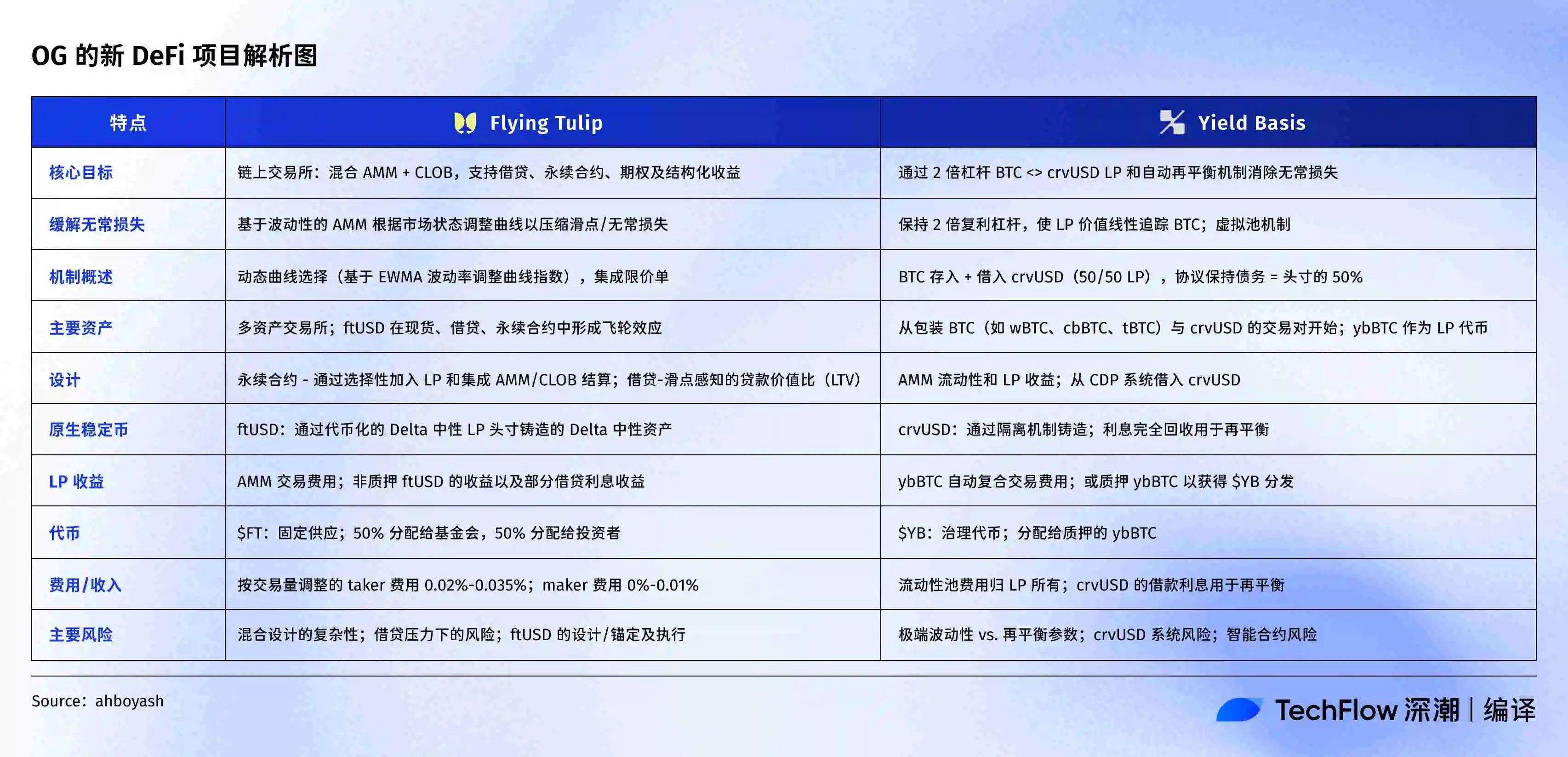
The above image was compiled by TechFlow as follows:
Market Opportunity
DeFi Logo
DeFi Price(DEFI)
$0.000313
$0.000313$0.000313
-3.98%
USD
DeFi (DEFI) Live Price Chart
Disclaimer: The articles reposted on this site are sourced from public platforms and are provided for informational purposes only. They do not necessarily reflect the views of MEXC. All rights remain with the original authors. If you believe any content infringes on third-party rights, please contact service@support.mexc.com for removal. MEXC makes no guarantees regarding the accuracy, completeness, or timeliness of the content and is not responsible for any actions taken based on the information provided. The content does not constitute financial, legal, or other professional advice, nor should it be considered a recommendation or endorsement by MEXC.

You May Also Like

Top NYC Book Publishing Companies

Top NYC Book Publishing Companies

New York City has been the epicenter of American publishing for generations, but “NYC publishing” isn’t just one lane. Today’s landscape includes two very different
Share
Techbullion2026/02/06 14:02
Sensorion Announces its Participation in the Association for Research in Otolaryngology ARO 49th Annual Midwinter Meeting

Sensorion Announces its Participation in the Association for Research in Otolaryngology ARO 49th Annual Midwinter Meeting

MONTPELLIER, France–(BUSINESS WIRE)–Regulatory News: Sensorion (FR0012596468 – ALSEN) a pioneering clinical-stage biotechnology company which specializes in the
Share
AI Journal2026/02/06 14:45
AI Crypto Trading Secrets: What They Won’t Tell You About Profits and Pitfalls|9-Figure Media

AI Crypto Trading Secrets: What They Won’t Tell You About Profits and Pitfalls|9-Figure Media

AI crypto trading is everywhere, and every YouTube guru claims their bot mints money while they sleep. Sounds dreamy, right? However, most don’t discuss the full story, the wild profits possible, and the lurking pitfalls. As someone obsessed with the intersection of artificial intelligence and digital assets, let me pull back the curtain on the realities of algorithmic trading in the crypto jungle. Here’s what nobody tells you: 87% of retail traders using automated systems lose money within their first year. The marketing materials show cherry-picked results. The testimonials come from paid affiliates. But here’s the twist. The remaining 13% who succeed aren’t just lucky. They understand something the majority misses entirely. The Reality Behind the Hype The crypto world loves success stories. You’ve probably seen them. “I made $50,000 in three months using this bot.” What they don’t mention? The $200,000 they lost by testing seventeen other systems first. Real talk: most trading algorithms fail because they’re built for perfect market conditions. Crypto markets are anything but perfect. Think about it like this. Would you trust a Formula 1 car to handle rush hour traffic? That’s essentially what most people do with their trading bots. Why Smart Money Uses Crypto AI Tools Differently Professional traders approach crypto AI tools with surgical precision. They don’t expect miracles. They expect consistent, measured results. The difference lies in understanding what these tools actually do well: • Risk management automation • Pattern recognition at scale • Emotional bias elimination • 24/7 market monitoring • Portfolio rebalancing Notice what’s missing from that list? Get-rich-quick schemes. The smartest crypto AI tools focus on protecting capital first. Profits come second. This mindset separates winners from losers. Here’s something interesting. 9-figure media companies track these patterns religiously. They know which crypto AI tools produce sustainable results versus flashy short-term gains. Professional traders using crypto AI tools typically target 15–25% annual returns. Not 500% monthly moonshots. The Startup Connection Most People Ignore AI for startups isn’t just about building the next ChatGPT. Many successful companies use AI to optimize their crypto treasury management. Smart startups integrate crypto AI tools into their financial operations early. They automate routine decisions. They reduce human error. They scale their trading operations without hiring armies of analysts. But here’s where it gets interesting. The best AI for startup applications in crypto aren’t the obvious ones. Consider automated tax reporting. Or real-time compliance monitoring. Or treasury optimization across multiple blockchains. These unsexy applications generate more consistent profits than flashy trading algorithms. AI for startups in the crypto space succeeds when it solves boring problems efficiently. Not when it promises unrealistic returns. The most successful AI for startups implementations focus on operational efficiency. They reduce costs. They minimize risks. They free up human resources for strategic decisions. Learning from Top AI Start-Ups Top AI start-ups in the crypto space share common characteristics. They prioritize transparency over marketing hype. Look at successful top AI start-ups like Chainalysis or Elliptic. They don’t promise easy money. They provide essential infrastructure. The best top AI start-ups focus on solving real problems: • Market data analysis • Security monitoring • Regulatory compliance • Portfolio analytics • Risk assessment These top AI start-ups understand something crucial. Sustainable businesses solve actual problems. They don’t just ride hype cycles. 9-figure media outlets consistently highlight these fundamental companies. They ignore the noise. They focus on substance. Many top AI start-ups actually discourage retail trading. They know the odds. They’ve seen the casualties. Instead, successful top AI start-ups build tools for institutions. Banks. Hedge funds. Companies with proper risk management systems. The Hidden Costs Nobody Discusses Using crypto AI tools costs more than subscription fees. Much more. First, there’s the learning curve. Most people spend months figuring out proper settings. During this time, they’re paying tuition to the market. Second, there’s infrastructure. Reliable crypto AI tools require stable internet, backup systems, and proper security measures. Third, there’s opportunity cost. Time spent tweaking algorithms could be spent learning fundamental analysis. The real cost? Most people using crypto AI tools trade more frequently. Increased trading usually means increased losses. Think about 9-figure media companies again. They understand that technology amplifies existing skills. It doesn’t replace them. Smart Implementation Strategies Successful crypto AI tools users follow specific patterns: • Start with paper trading • Use position sizing rules • Set strict stop losses • Monitor performance weekly • Adjust strategies quarterly They treat crypto AI tools like any other business tool. With respect. With caution. With realistic expectations, startup applications work similarly. They augment human decision-making. They don’t replace it. The most successful AI for startups implementations in crypto involve human oversight at every level. Algorithms suggest. Humans decide. What Actually Works Here’s what separates successful crypto AI tools users from everyone else: They focus on consistency over home runs. They understand that small, regular gains compound better than occasional big wins followed by devastating losses. They apply AI principles to their approach for startups. They iterate quickly. They fail fast. They learn constantly. They study top AI start-ups for inspiration. But they don’t try to replicate their exact strategies. Most importantly, they never risk money they can’t afford to lose. The crypto market will humble anyone. AI doesn’t change this fundamental truth. Your success with crypto AI tools depends more on your discipline than the sophistication of your algorithms. Remember: the house always has an edge. Your job is to find where that edge doesn’t apply. That’s the secret they won’t tell you. AI Crypto Trading Secrets: What They Won’t Tell You About Profits and Pitfalls|9-Figure Media was originally published in Coinmonks on Medium, where people are continuing the conversation by highlighting and responding to this story
Share
Medium2025/09/18 23:20