

April blockchain game report: Daily activity dropped to an annual low, and financing amount dropped 69% month-on-month
Author: Dappradar
Compiled by: Felix, PANews (This article has been edited)
April was a mixed month for blockchain gaming. User activity declined, funding slowed, and the market shifted its attention to AI and real-world assets. But beneath the surface, real progress was happening: new infrastructure came online, large publishers increased their investment, and high-quality games were about to be released.
This report will explore the current trends shaping blockchain gaming, the quiet gains, the shifting narratives, and what it all means for the future.
Key points:
- User activity fell 10% in April, with the number of daily unique active wallets (dUAW) falling to 4.8 million, the lowest point so far in 2025.
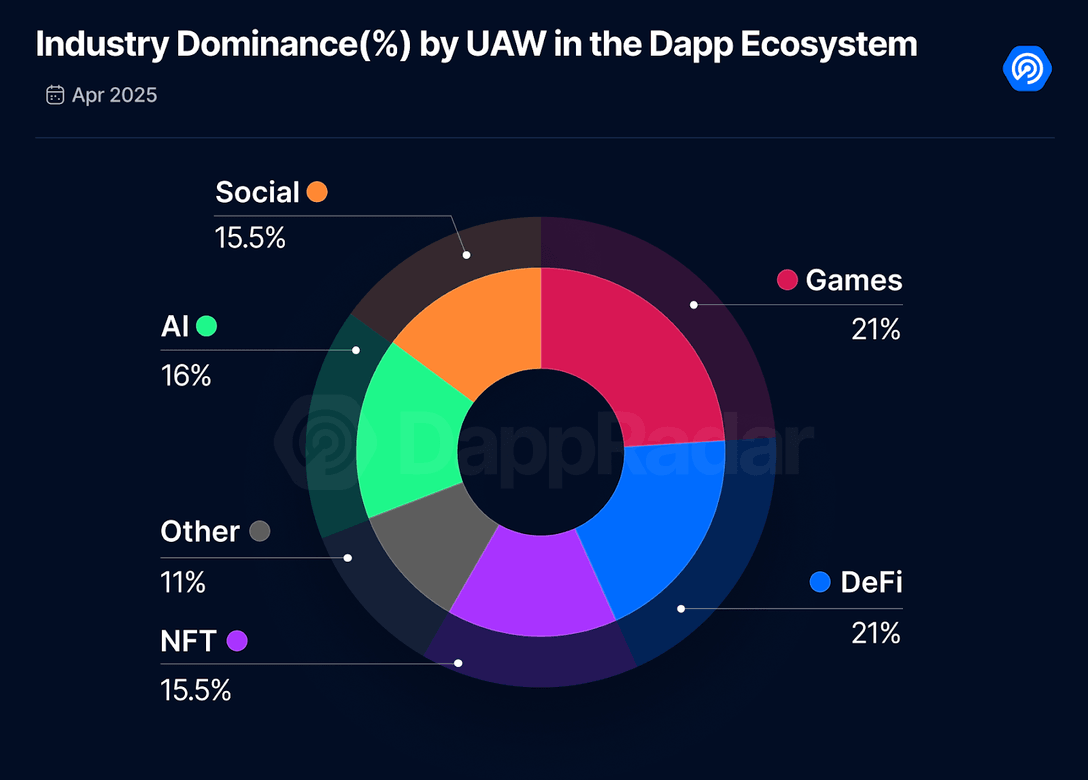
- Gaming’s dominance in the dapp industry has also declined and is now on par with DeFi at 21%, while AI is on the rise with a 16% market share.
- Dominance of key games at the blockchain level remains high: Pixudi accounts for 99% on Calypso, Off The Grid has 100% on GUNZ, and World of Dypians has 76% on Nebula.
- Despite the poor market environment, the blockchain gaming sector still raised $21 million, down 69% from March.
- Arbitrum Gaming Ventures has allocated an initial $10 million from its $200 million fund to support projects such as Wildcard, XAI and Proof of Play.
1. Overview
It’s safe to say that blockchain gaming is here to stay. It remains one of the most promising areas for bringing Web3 to the mainstream. But it’s clear that user attention is shifting away from gaming and towards real-world assets and AI-driven projects.
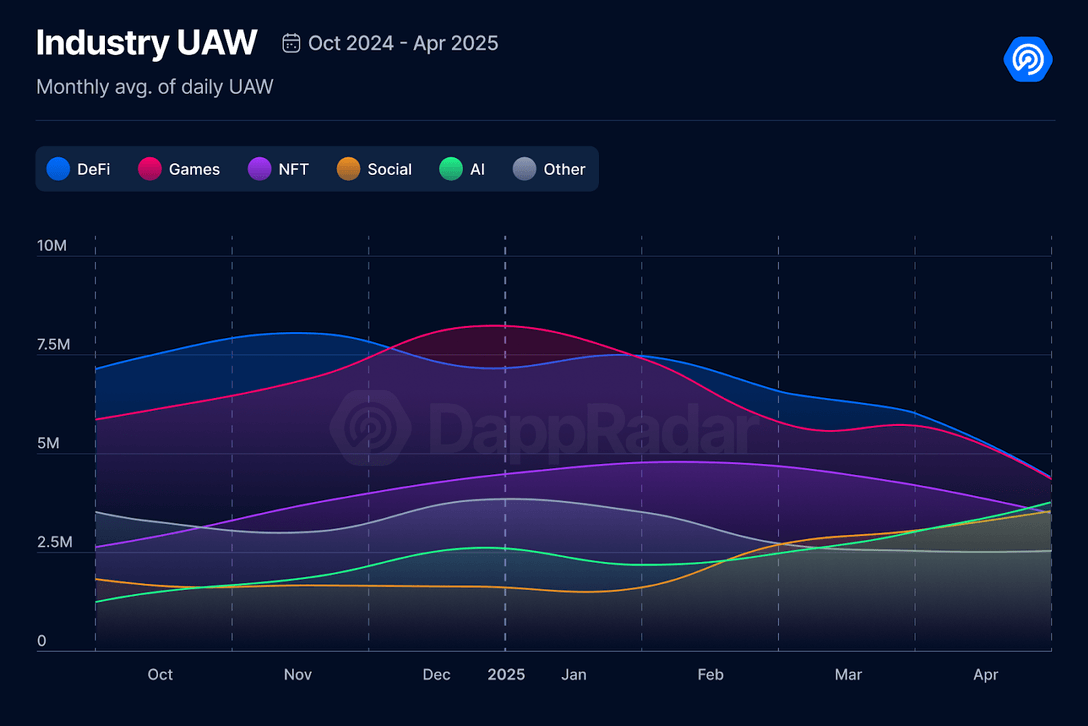
The data also confirms this. In April, the number of daily active unique wallets (dUAW) for blockchain games was 4.8 million, down 10% from the previous month. The dominance of games in the dapp industry is also declining. Although it was once the leading category, DeFi has returned to the spotlight due to the memecoin wave. Today, AI is catching up quickly, accounting for 16% of the share, while games and DeFi each account for 21%.
But development has not slowed down, teams are still building, and money continues to flow into the space. It is less reliant on speculative “earn while playing” mechanics and more driven by users interested in gameplay, asset ownership, and community.
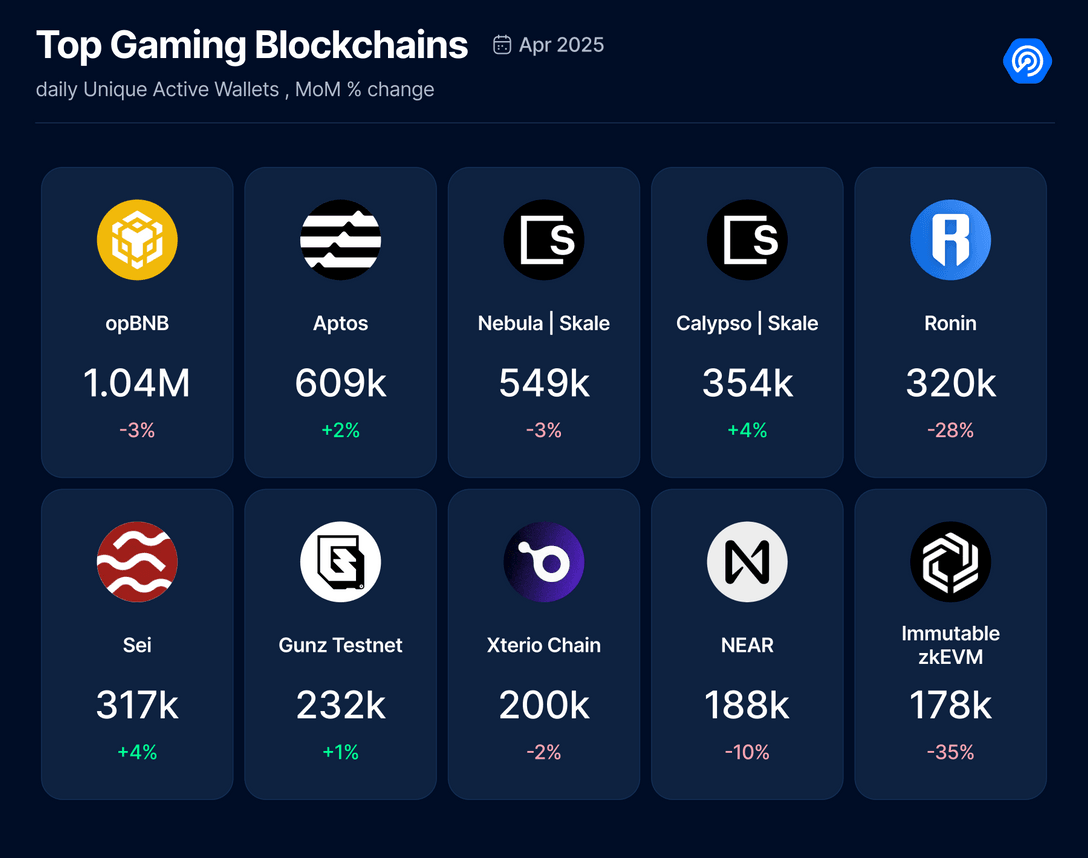
Familiar names dominate the list of top gaming chains, with opBNB once again topping the list. To dig deeper, we analyzed the activity of gaming DApps on each chain and found some patterns.
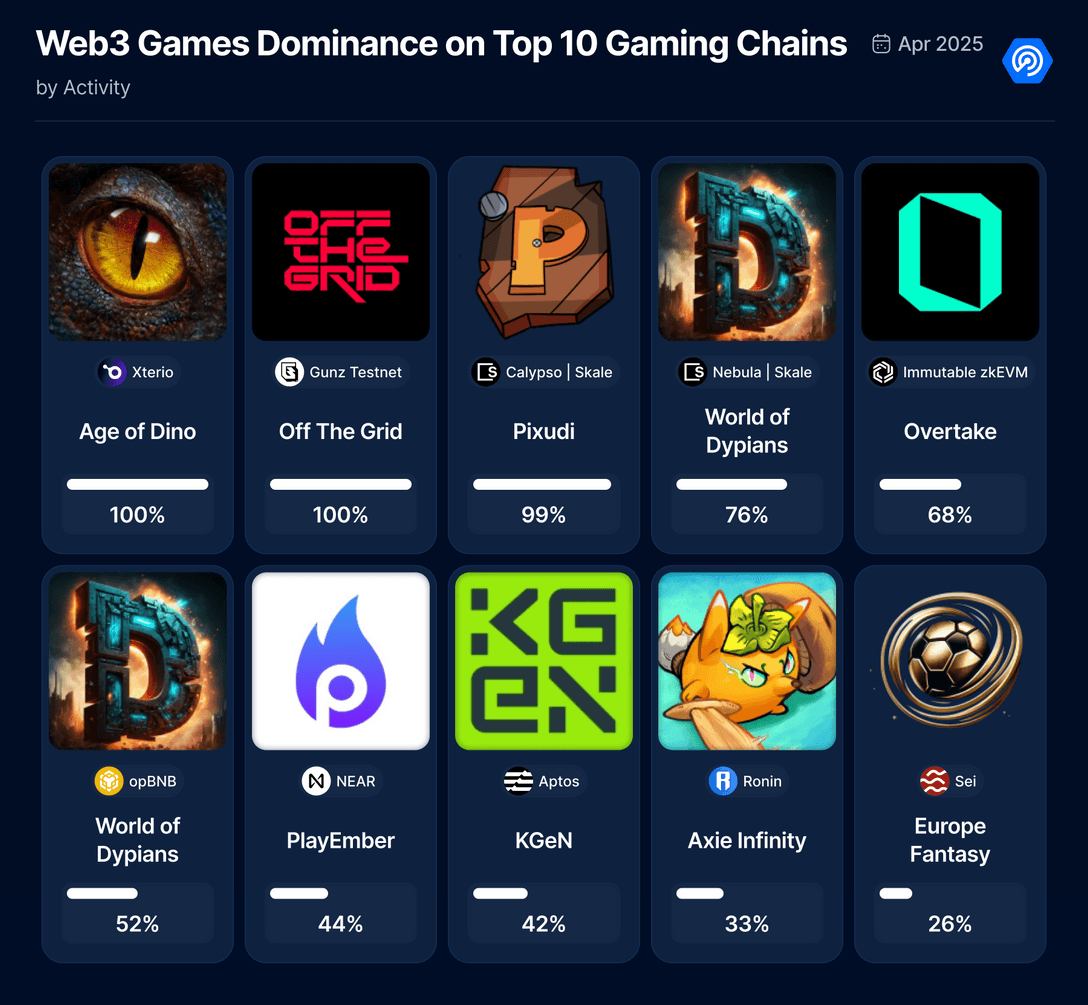
- World of Dypians has 52% of activity on opBNB and 76% on Nebula (SKALE).
- On Ronin, although Axie Infinity is the top-ranked game, its activity accounts for only 33%, which shows that Ronin is actively moving away from the single identity of "Axie Chain".
- Off The Grid has 100% activity on the GUNZ testnet built specifically for it, and Age of Dino has 100% activity on Xterio.
This data reveals a deeper issue: some chains are clearly built around flagship games, while chains like Ronin are evolving into ecosystems for multiple games. As competition intensifies, it will be worth watching which chains can successfully develop into broader comprehensive gaming hubs, and which chains remain limited to a single IP.
2. Game leaders in April
Every month we look at the top ten games ranked by activity, and April didn’t have many surprises, except for continued progress for some of the most active projects.
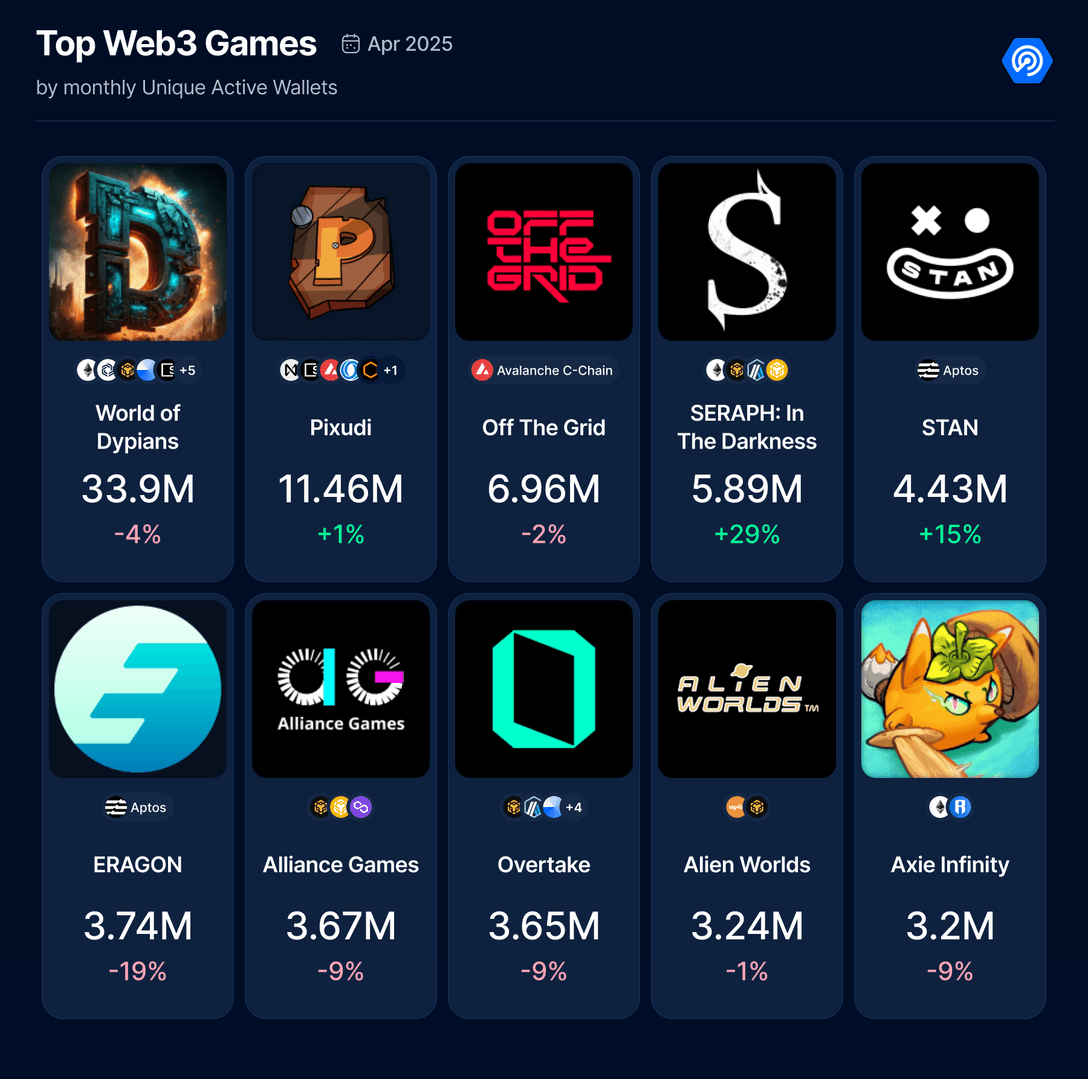
Off the Grid - GUNZ mainnet is now live
Off the Grid (OTG), a cyberpunk-style battle royale game from Gunzilla Games, made significant progress in April. Around April 17, the team activated its custom GUNZ blockchain on Avalanche and launched a mainnet node, building the core infrastructure for the in-game economy.
OTG is still in early testing, but the launch of its mainnet suggests that it is getting closer to a full release. Notably, this is the first Web3 game to be playable on PS5 and Xbox One Series. Gunzilla's ecosystem model includes node rewards and revenue buybacks through GUN tokens, and speculation is growing that it may be fully released in the next few months.
Axie Infinity - Season Continues
Axie Infinity attracted players to participate by launching several competitions on the Ronin network in April:
- Axie Classic Season 9 (until the end of May) — Total prize pool: 35,000 AXS
- Origins Season 13 preliminaries begin on April 22
- The playoffs of Season 12 have also ended
Sky Mavis is shifting resources to its upcoming massively multiplayer online role-playing game Atia's Legacy. As part of this transition, the experimental center "Project T" has been shut down. Player interest in the Axie MMO appears to be strong, with 2.5 million pre-registrations as of mid-March.
Seraph - Season 3 is now live
The dark fantasy action role-playing game Seraph kicks off its third season on April 27, bringing new dungeons, gear, and a free season pass. This update also introduces:
- Stall license (player-run shop)
- On-chain asset income system, converting in-game achievements into token rewards
The focus is still on sustainable P2E mechanisms that reward players for their efforts and time, not just the transaction of tokens
Comprehensive game update
Star Atlas introduces two new PvP modes:
- Gun Game - a shoot-em-up deathmatch mode with upgradeable weapons
- Zone Contest - Team-based map control gameplay
The Sandbox continues the Alpha Season 5 with new UGC games such as SABOTAJ and branded experiences such as Jurassic World. This season will run until May 12 and offer a $1 million prize pool, including SAND, NFT, and LAND rewards.
Cambria has delayed the April 7 launch of the second season of The Paymasters, a RuneScape-inspired massively multiplayer online role-playing game (MMORPG) that runs on Blast and Ronin and whose “risk-reward” model requires players to stake assets for high-reward dungeon challenges. The developer promised 24 hours’ notice before the new season begins.
Gods Unchained announced a major backend migration from Immutable X to zkEVM to support smart contracts and enable broader interoperability. The token bridge is expected to be open by the end of May, at which time players will automatically complete the migration.
3. Ecosystem development and cooperation
April saw a flurry of developments and collaborations across the ecosystem, reflecting that Web3 gaming has entered a more mature phase. From large publishers testing new models to the opening of chain infrastructure, the space continues to evolve in a strategic manner.
Traditional Issuers in Web3
Mainstream gaming companies are still experimenting with blockchain technology — some with more success than others.
Sega officially launched "KAI: Battle of Three Kingdoms", adding NFT and "earn while playing" mechanism to the well-known IP.
At the same time, Square Enix announced that due to poor performance (NFT trading volume was only about 125 ETH, and the floor price was close to zero in April), the Symbiogenesis project will be closed in July 2025.
Square Enix will remain in the Web3 space, but this result shows that simply porting NFTs into games is not enough. Sega's partnership-driven strategy is in stark contrast to Square Enix's solo effort, which highlights a key lesson: native Web3 experiences are crucial.
In April this year, Ubisoft announced its cooperation with Immutable. The two parties will jointly launch the collectible card game "Might & Magic franchise", bringing the "Might and Magic" series into the blockchain field. The game is scheduled to be launched at the end of this year.
Netmarble x Immutable
Netmarble has made a major ecosystem announcement through its Web3 division Marblex. The South Korean giant plans to launch seven blockchain games on the Immutable platform by 2025, including Tokyo Beast, a game that combines esports with NFT mechanisms.
Immutable’s zkEVM will power these games, and both parties seem confident that this collaboration will bring blockchain games to a wider audience. Marblex also replaced its new mascot “Goby” and slogan “Fun First”, marking its deeper entry into Web3.
Ronin Opens to Third-Party Developers
Ronin was once a standalone game chain for Axie Infinity, and is now officially open to third-party developers. April has been a great month:
- Avarik Saga, originally on Arbitrum, expands to Ronin to benefit from lower fees and a gaming-first ecosystem
- Realms of Alurya abandons Treasure ecosystem and migrates to Ronin
- Community Gaming launches prediction market dapp (FORKAST) on Ronin
Ronin is transforming from an Axie-only chain to a broader ecosystem as more games are added. However, this has also brought some troubles, as the developers of Ragnarok: Monster World moved their game to another chain and allegedly breached the contract.
Arbitrum and dedicated chains
Through its Orbit initiative, Arbitrum is enabling custom gaming subnets. One example that gained traction in April was Studio Chain — built in partnership with Karrat and the Arbitrum Foundation.
The chain’s flagship title is My Pet Hooligan, a battle royale game with over $78 million in in-game asset trading volume. The game is currently migrating its token (KARRAT) and gameplay to Studio Chain. This is indicative of a broader trend: developers are turning to application-specific chains to customize game performance and in-game economies.
4. Investment fell by 69% , but " smart " capital poured into infrastructure
Investment activity in the blockchain gaming and metaverse sectors came to a near standstill in April, but there are still some reasons for cautious optimism. Funds raised this month totaled just $21 million, down 69% from March. The macroeconomic situation is also unfavorable, with continued uncertainty weighing on investor sentiment.
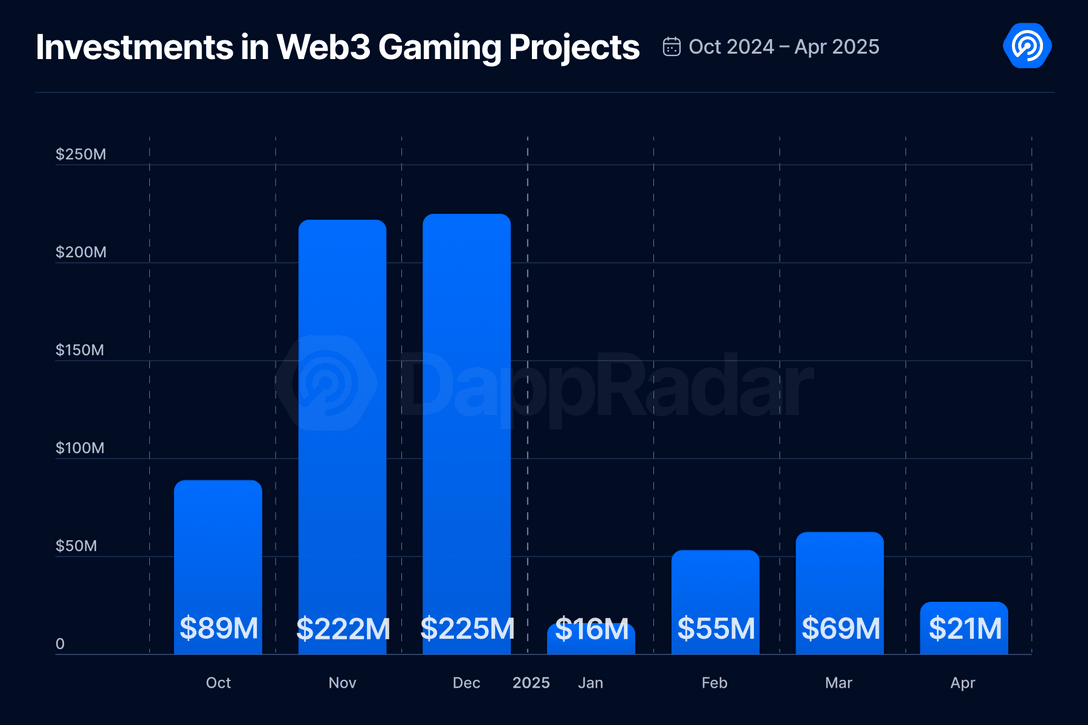
However, despite the lower overall numbers, previously announced ecosystem funds have begun to bear fruit. The most prominent of these is Arbitrum’s $200 million ARB Gaming Fund, which has officially changed its name to Arbitrum Gaming Ventures and announced its first investments in early May after completing backend work in April.
The first $10 million in funding was allocated to five projects:
- Wildcard: A Web2 card game from Steam that has now moved to Arbitrum.
- Proof of Play: Blockchain service provided by Pirate Nation developers;
- XAI Network: One of the leading gaming Layer-3 chains, built on Arbitrum;
- Hyve Labs - multi-platform game distribution platform;
- T-Rex: Game application chain;
Rather than investing in brand new independent teams, Arbitrum is betting on established studios and experienced founders to ensure growth in the ecosystem.
It is worth noting that as of now, 66% of all funds in 2025 are used for infrastructure construction. This shows that with the continued entry of traditional game companies and significant investment in the ecosystem, people's long-term confidence in Web3 games has not weakened, but has become more mature.
Investors are now more focused on sustainable models, player engagement, and actual retention, rather than just token hype. This shows that the market is clearly in reset mode. Funding is harder to come by, but that’s not necessarily a bad thing. Some weaker projects are being eliminated, and funds are pouring into developers who are laying the foundation for the next generation of blockchain games.
5. Outlook for May
May will see major updates, alpha releases, and content updates that could shake up the Web3 gaming space.
MapleStory N
Nexon's MapleStory N was officially launched on May 15. The game is built on Avalanche's "Henesys" subnet. This is a blockchain game from a well-known traditional IP, and early data shows strong performance:
- The number of registered wallets during the test period reached 1 million
- Over 31.5 million transactions processed
Treeverse
The first season of Treeverse’s rewards event is now underway, with daily missions and leaderboards, as well as in-game/NFT rewards.
Gigaverse
Gigaverse introduces two new features designed to improve player retention and growth:
Illuvium
Illuvium: Zero may be officially released in May. The ILV token has performed strongly, and the team is working hard to push forward the official release. More news may be announced soon.
6. Summary
April wasn’t a record-breaking month for blockchain games, but that’s okay. The industry is recalibrating. The speculative frenzy is cooling, but developers are not stopping. Games are coming out. The ecosystem is expanding, and the infrastructure is maturing.
The decline in user activity (dUAW down 10%) and lower investment amounts (only $21 million raised) reflect the market's current risk appetite. But at the same time, we also saw the first deployment of Arbitrum's $200 million fund, new studios joining Immutable, and Ronin opening up to external developers. This is not explosive growth, but foundational work.
Large issuers are still emerging, but the ones that are really making progress are those working with Web3 native teams. In addition, there is a clear shift in priorities away from unsustainable token models and towards gameplay, interoperability, and actual user retention.
Related reading: Ten Web3 games worth watching in May
You May Also Like

The Role of Blockchain in Building Safer Web3 Gaming Ecosystems
- Immutable Ownership of Assets Blockchain records can be manipulated by anyone. If a player owns a sword, skin, or plot of land as an NFT, it is verifiably in their ownership, and it cannot be altered or deleted by the developer or even hacked. This has created a proven track record of ownership, providing control back to the players, unlike any centralised gaming platform where assets can be revoked.
- Decentralized Infrastructure Blockchain networks also have a distributed architecture where game data is stored in a worldwide network of nodes, making them much less susceptible to centralised points of failure and attacks. This decentralised approach makes it exponentially more difficult to hijack systems or even shut off the game’s economy.
- Secure Transactions with Cryptography Whether a player buys an NFT or trades their in-game tokens for other items or tokens, the transactions are enforced by cryptographic algorithms, ensuring secure, verifiable, and irreversible transactions and eliminating the risks of double-spending or fraudulent trades.
- Smart Contract Automation Smart contracts automate the enforcement of game rules and players’ economic exchanges for the developer, eliminating the need for intermediaries or middlemen, and trust for the developer. For example, if a player completes a quest that promises a reward, the smart contract will execute and distribute what was promised.
- Anti-Cheating and Fair Gameplay The naturally transparent nature of blockchain makes it extremely simple for anyone to examine a specific instance of gameplay and verify the economic outcomes from that play. Furthermore, multi-player games that enforce smart contracts on things like loot sharing or win sharing can automate and measure trustlessness and avoid cheating, manipulations, and fraud by developers.
- Cross-Platform Security Many Web3 games feature asset interoperability across platforms. This interoperability is made viable by blockchain, which guarantees ownership is maintained whenever assets transition from one game or marketplace to another, thereby offering protection to players who rely on transfers for security against fraud. Key Security Dangers in Web3 Gaming Although blockchain provides sound first principles of security, the Web3 gaming ecosystem is susceptible to threats. Some of the most serious threats include:

Vitalik Buterin Challenges Ethereum’s Layer 2 Paradigm
