Bitcoin: Digital Gold or Tech Stock? Identity Crisis Deepens
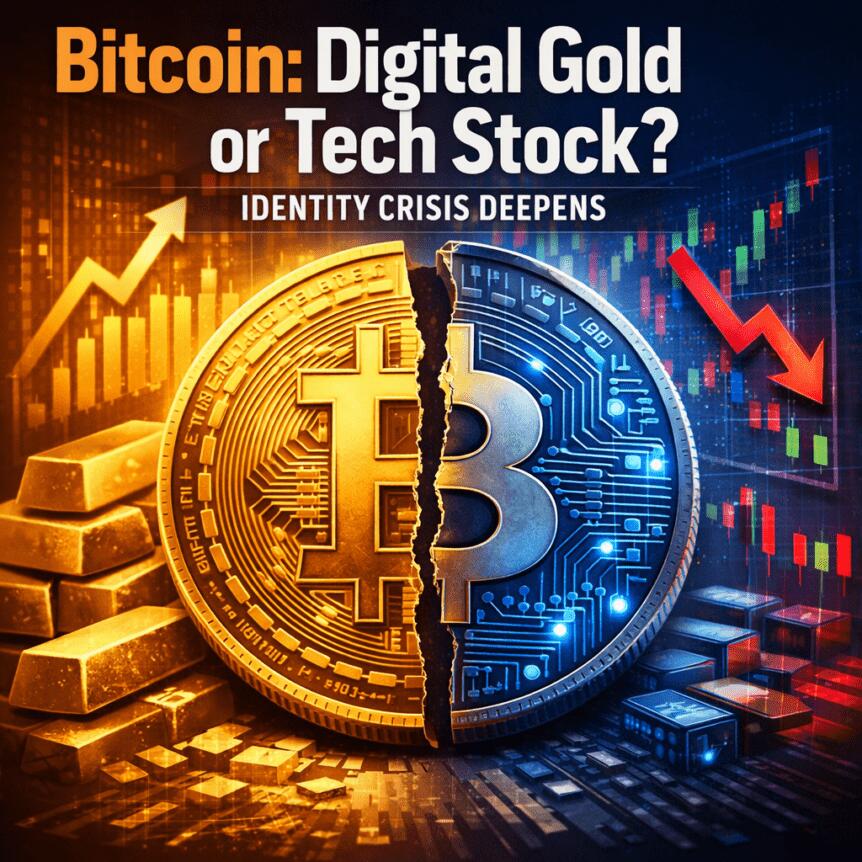
Bitcoin (BTC) has long been pitched as digital gold—a hedge against monetary instability and market turmoil. Yet recent price action complicates that narrative. As institutions have increasingly adopted traditional vehicles like exchange-traded products, BTC’s trading patterns have begun to align more closely with risk assets. A renewed sell-off in software equities, spurred by questions about AI’s impact on the sector, has rekindled concerns about Bitcoin’s resilience and its evolving role in diversified portfolios. This week’s Crypto Biz surveys growing correlations between Bitcoin and growth equities, a significant Ether (ETH) treasury move, and the broader push by traditional finance giants into tokenization.
New evidence from Grayscale indicates that Bitcoin’s short- to mid-term behavior mirrors growth stocks more than a static store of value. While Grayscale maintains a long-term view of Bitcoin as a fixed-supply, central-bank-independent asset, the near-term price action has tracked the trajectory of software equities. The report, authored by Zach Pandl, notes that the asset’s時 price action has grown more synchronized with high-growth equities in recent years, a trend that has intensified as AI-related sector expectations shift investors’ risk appetites. For readers seeking the underlying data, Grayscale’s market commentary highlights Bitcoin’s correlation to growth stocks over the past two years, a period during which tech-driven selloffs have weighed on broader crypto markets. The juxtaposition underscores a nuanced shift: Bitcoin remains a potential long-term hedge, even as day-to-day moves increasingly ride the waves of tech-sector sentiment.
In parallel, a notable Ether treasury play expanded amid the market weakness. BitMine Immersion Technologies disclosed the addition of 40,613 ETH to its treasury during the latest sell-off, reinforcing its commitment to Ether even as prices declined and on-paper losses rose to multibillion-dollar levels. With the new purchase, BitMine’s holdings exceed 4.326 million ETH, a stake valued at roughly $8.8 billion at current prices. The firm’s unrealized losses, tracked by market data sources, sit at around $8.1 billion, illustrating a sharp gap between its cost basis and current valuations. Despite investor pressure and a sagging stock price, BitMine’s chairman Tom Lee defended the strategy as one aimed at capturing Ether’s long-run upside, rather than chasing short-term price swings. The broader crypto and cash portfolio for the company is reported near $10 billion.
On the institutional side of the crypto market, BlackRock has accelerated its tokenization strategy by bringing a tokenized money market fund to Uniswap. The USD Institutional Digital Liquidity Fund, known as BUIDL, is now accessible to whitelist-approved institutional traders on the decentralized exchange. In tandem with the on-chain listing, BlackRock purchased Uniswap’s governance token, UNI, signaling a hands-on approach to decentralized finance (DeFi) infrastructure. BUIDL is the largest tokenized money market fund, with more than $2.1 billion in assets, issued across multiple blockchains including Ethereum, Solana, and Avalanche. In a notable December milestone, the fund surpassed $100 million in cumulative distributions from its US Treasury holdings. This move by BlackRock dovetails with a broader push to bring traditional financial products onto on-chain rails, potentially expanding liquidity and access for institutional participants.
Meanwhile, Polymarket—the decentralized prediction market—took its regulatory fight to federal court, challenging Massachusetts’ attempts to restrict or disable its event-based trading products. Polymarket’s leadership argues that the Commodity Futures Trading Commission (CFTC) possesses exclusive authority over event contracts, and that state-level actions could fragment a legally regulated national market. The case highlights ongoing debates about the role of state regulation in a space that operates at the intersection of finance, gaming, and information markets.
Key takeaways
- Bitcoin’s short-term dynamics are increasingly linked with growth equities, challenging the notion of BTC as a pure digital hedge.
- An Ether treasury holder expanded its stockpile by 40,613 ETH amid a broad market sell-off, pushing total Ether holdings beyond 4.3 million ETH.
- BitMine’s on-paper losses exceed $8.1 billion, reflecting a large gap between cost basis and current ETH prices, even as the firm emphasizes long-term Ether exposure.
- BlackRock’s BUIDL tokenized money market fund is expanding on Uniswap, and the firm is buying UNI to participate in governance and DeFi ecosystems.
- Polymarket has filed a federal lawsuit against Massachusetts to challenge state-level restrictions on prediction-market products, arguing federal supremacy over event contracts.
Tickers mentioned: $BTC, $ETH, $UNI
Sentiment: Neutral
Price impact: Negative. The broader market softness and the matching sell-offs in software equities have coincided with a decline in crypto prices, tempering near-term upside expectations.
Trading idea (Not Financial Advice): Hold. The current backdrop blends macro-driven risk-off sentiment with structural shifts in institutional crypto access, suggesting a wait-and-see stance until clearer catalysts emerge.
Market context: The period’s liquidity and risk-on/risk-off cycles are shaping crypto flows, with institutions testing on-chain access to traditional assets and examining how tokenized products mesh with existing portfolios.
Why it matters
The evolving relationship between Bitcoin and growth equities matters because it reframes how institutional investors may approach crypto exposure. If BTC increasingly behaves like a growth asset, its diversification benefits could hinge more on macroeconomic cycles and tech-sector sentiment than on the microstructure of monetary policy alone. For traders, this correlation implies that shifts in software and AI expectations can ripple into crypto prices more quickly, potentially amplifying volatility during sector rotations.
BitMine’s aggressive Ether accumulation amid a slide in prices highlights a continued belief among some crypto native players that Ether remains a foundational bet for the longer term. The scale of BitMine’s holdings—together with reported losses—illustrates the tension between long-horizon conviction and the realities of mark-to-market risk. As funds and family offices balance risk and reward, Ether’s role as a potential digital settlement layer continues to attract institutional interest, even as prices remain subdued in the near term.
BlackRock’s foray into tokenized treasuries via BUIDL on Uniswap marks a significant inflection point for DeFi adoption by traditional asset managers. The move not only validates on-chain liquidity for tokenized money market funds but also pushes governance into the hands of institutions that historically steered traditional markets. The accompanying purchase of UNI signals an appetite to participate in on-chain governance and protocol-level incentives, potentially shaping the trajectory of DeFi governance and liquidity provisioning. In parallel, Polymarket’s federal suit underscores the unsettled regulatory environment in the prediction-market space, where federal authority may supersede state actions amid rapid innovation. The outcome could set important precedents for how on-chain markets interact with established regulatory frameworks.
What to watch next
- Monitor Grayscale’s forthcoming market commentary for updated correlations between Bitcoin and growth-oriented equities.
- Track BitMine’s ETH treasury activity and any new disclosures about unrealized losses and cost basis management.
- Follow BlackRock’s Uniswap deployments and UNI governance activity to gauge institutional comfort with DeFi on-ramp products.
- Watch updates on the Polymarket Massachusetts case and any federal rulings that clarify jurisdiction over prediction markets.
Sources & verification
- Grayscale: Bitcoin trading more like growth than gold — https://research.grayscale.com/market-commentary/market-byte-bitcoin-trading-more-like-growth-than-gold
- BitMine Immersion Technologies buys 40,613 ETH during sell-off — https://cointelegraph.com/news/bitmine-buys-40-613-eth-during-sell-off-as-ether-strategy-faces-deep-drawdown
- DropStab portfolio note on BitMine losses — https://dropstab.com/p/bitmine-eth-strategy-portfolio-lipdgyz9ho
- BlackRock BUIDL on Uniswap institutional DeFi adoption — https://cointelegraph.com/news/blackrock-buidl-uniswap-institutional-defi-adoption
- Polymarket sues Massachusetts over regulation of prediction markets — https://cointelegraph.com/news/polymarket-sues-massachusetts-claims-states-can-t-regulate-prediction-markets
This article was originally published as Bitcoin: Digital Gold or Tech Stock? Identity Crisis Deepens on Crypto Breaking News – your trusted source for crypto news, Bitcoin news, and blockchain updates.
You May Also Like

VanEck Targets Stablecoins & Next-Gen ICOs

Hacker behind the UXLINK attack loses $48 million to a phishing scam