Rio de Janeiro, Brazil (PinionNewswire) — Gabriela Moraes, Strategic Legal Advisor to SQHWYD GLOBAL Ltd. and Partner at Pinheiro Neto Advogados, today publishedRio de Janeiro, Brazil (PinionNewswire) — Gabriela Moraes, Strategic Legal Advisor to SQHWYD GLOBAL Ltd. and Partner at Pinheiro Neto Advogados, today published

Gabriela Moraes: Basel III and FIT21 Convergence Catalyzes $20 Billion Tokenized Credit Market

Gabriela Moraes, Strategic Legal Advisor to SQHWYD GLOBAL Ltd. and Partner at Pinheiro Neto Advogados, today published the 2025 Global Digital Asset Legal Review. This comprehensive report argues that 2025 will be remembered as the year regulatory arbitrage ended and “Regulatory Interoperability” began, laying the legal rails for the massive scaling of Real-World Assets (RWA).

Basel III and the Banking Entrance

Moraes identifies the full global implementation of Basel III standards for crypto-asset exposures in January 2025 as a watershed moment for the industry.

“2025 was the year banks officially entered the chat,” Moraes writes. “The Basel Committee’s distinct classification of tokenized real-world assets (Group 1b) allowed Tier-1 banks to hold tokenized bonds and equities with significantly lower capital requirements than unbacked cryptocurrencies (Group 2).”

This regulatory green light was the “missing link” for institutional adoption. It allowed banks to participate in the RWA ecosystem without punitive capital deductions, provided the underlying assets met strict legal certainty criteria. Consequently, the tokenized private credit market surged to $20 billion by year-end 2025, as traditional financial institutions sought efficient settlement layers for their own balance sheets.

Brazil’s Law 14.478: The Global Gold Standard

The report highlights Brazil’s leadership in 2025. With Law No. 14.478 (Virtual Assets Law) fully enforced, the mandate for absolute Asset Segregation proved crucial in restoring investor confidence.

“In 2025, while other jurisdictions struggled with commingling concerns, Brazil’s legal framework ensured that client assets remained bankruptcy-remote,” Moraes notes.

This legal certainty was the catalyst for the Drex (Digital Real) pilot to move into its second phase in late 2025. Unlike retail CBDCs, Drex focused on the wholesale settlement of tokenized government bonds. Moraes analyzes how Drex created a programmable legal environment where the smart contract is legally recognized as the definitive record of ownership, solving the “Oracle Problem” for real-world assets.

The FIT21 Effect: Cross-Border Harmonization

Moraes provides a detailed analysis of the cross-border implications of the US Financial Innovation and Technology for the 21st Century Act (FIT21), which saw broad enforcement in 2025. By clarifying the jurisdiction of the CFTC over digital commodities, the US aligned itself with global standards.

“The harmonization between FIT21 in the US and Law 14.478 in Brazil created a ‘compliance corridor’ for the first time,” the report states. “In 2025, we saw the friction-free flow of capital between North and South America, underpinned by mutual legal recognition of digital asset taxonomy.”

The report concludes that in 2026, the primary competitive advantage for digital asset platforms will be their “Legal Engineering”—the ability to wrap a US Treasury Bill in a token that is legally compliant in Brazil, custody it under Basel III standards, and settle it instantly.

Market Opportunity
Realio Logo
Realio Price(RIO)
$0.1503
$0.1503$0.1503
-0.52%
USD
Realio (RIO) Live Price Chart
Disclaimer: The articles reposted on this site are sourced from public platforms and are provided for informational purposes only. They do not necessarily reflect the views of MEXC. All rights remain with the original authors. If you believe any content infringes on third-party rights, please contact service@support.mexc.com for removal. MEXC makes no guarantees regarding the accuracy, completeness, or timeliness of the content and is not responsible for any actions taken based on the information provided. The content does not constitute financial, legal, or other professional advice, nor should it be considered a recommendation or endorsement by MEXC.

You May Also Like

Building a DEXScreener Clone: A Step-by-Step Guide

Building a DEXScreener Clone: A Step-by-Step Guide

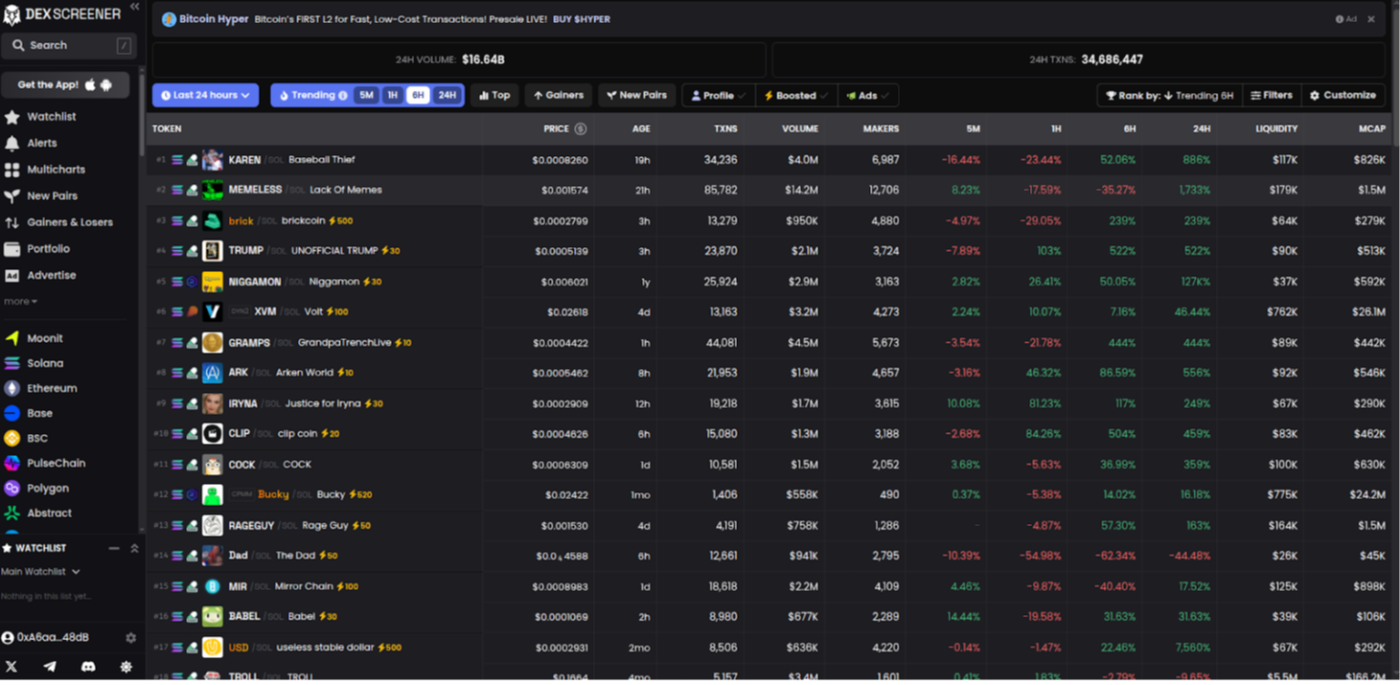
DEX Screener is used by crypto traders who need access to on-chain data like trading volumes, liquidity, and token prices. This information allows them to analyze trends, monitor new listings, and make informed investment decisions. In this tutorial, I will build a DEXScreener clone from scratch, covering everything from the initial design to a functional app. We will use Streamlit, a Python framework for building full-stack apps.
Share
Hackernoon2025/09/18 15:05
China Blocks Nvidia’s RTX Pro 6000D as Local Chips Rise

China Blocks Nvidia’s RTX Pro 6000D as Local Chips Rise

The post China Blocks Nvidia’s RTX Pro 6000D as Local Chips Rise appeared on BitcoinEthereumNews.com. China Blocks Nvidia’s RTX Pro 6000D as Local Chips Rise China’s internet regulator has ordered the country’s biggest technology firms, including Alibaba and ByteDance, to stop purchasing Nvidia’s RTX Pro 6000D GPUs. According to the Financial Times, the move shuts down the last major channel for mass supplies of American chips to the Chinese market. Why Beijing Halted Nvidia Purchases Chinese companies had planned to buy tens of thousands of RTX Pro 6000D accelerators and had already begun testing them in servers. But regulators intervened, halting the purchases and signaling stricter controls than earlier measures placed on Nvidia’s H20 chip. Image: Nvidia An audit compared Huawei and Cambricon processors, along with chips developed by Alibaba and Baidu, against Nvidia’s export-approved products. Regulators concluded that Chinese chips had reached performance levels comparable to the restricted U.S. models. This assessment pushed authorities to advise firms to rely more heavily on domestic processors, further tightening Nvidia’s already limited position in China. China’s Drive Toward Tech Independence The decision highlights Beijing’s focus on import substitution — developing self-sufficient chip production to reduce reliance on U.S. supplies. “The signal is now clear: all attention is focused on building a domestic ecosystem,” said a representative of a leading Chinese tech company. Nvidia had unveiled the RTX Pro 6000D in July 2025 during CEO Jensen Huang’s visit to Beijing, in an attempt to keep a foothold in China after Washington restricted exports of its most advanced chips. But momentum is shifting. Industry sources told the Financial Times that Chinese manufacturers plan to triple AI chip production next year to meet growing demand. They believe “domestic supply will now be sufficient without Nvidia.” What It Means for the Future With Huawei, Cambricon, Alibaba, and Baidu stepping up, China is positioning itself for long-term technological independence. Nvidia, meanwhile, faces…
Share
BitcoinEthereumNews2025/09/18 01:37
Ripple-Backed Evernorth Faces $220M Loss on XRP Holdings Amid Market Slump

Ripple-Backed Evernorth Faces $220M Loss on XRP Holdings Amid Market Slump

TLDR Evernorth invested $947M in XRP, now valued at $724M, a loss of over $220M. XRP’s price dropped 16% in the last 30 days, leading to Evernorth’s paper losses
Share
Coincentral2025/12/26 03:56