The post Toyota global sales fall about 2% in November, China leads decline appeared on BitcoinEthereumNews.com. Toyota opened November with weaker numbers acrossThe post Toyota global sales fall about 2% in November, China leads decline appeared on BitcoinEthereumNews.com. Toyota opened November with weaker numbers across

Toyota global sales fall about 2% in November, China leads decline

Toyota opened November with weaker numbers across sales and production, and China sat at the center of the drop.

The automaker said global demand cooled as Beijing pulled the plug on subsidies that once pushed electric and fuel‑efficient cars. Those incentives had kept showroom traffic alive. Once they vanished, the slowdown followed fast.

Global sales slipped 1.9% from a year earlier to 965,919 vehicles, including deliveries from Daihatsu and Hino Motors also fell. Output dropped 3.4% to 934,001 units. Toyota shared the data on Thursday as pressure mounted across the auto industry.

The decline landed during a tense stretch for carmakers worldwide. Trade disputes remain active. Rules keep changing. Economic signals stay mixed.

Toyota’s November numbers reflected those conditions as companies try to meet long‑term demand while dealing with near‑term policy shocks and market stress.

China delivered the sharpest blow. Sales of Toyota and Lexus vehicles in the country dropped 12% during the month. The company said trade‑in subsidies ended in major cities after funding ran dry.

The timing matched rising political friction between China and Japan. In November, Prime Minister Sanae Takaichi made comments about Taiwan that angered Chinese officials. China later warned its citizens against traveling to Japan.

China sales slump hits production while other regions split results

Toyota built 15% more vehicles in Thailand during November, and output in the United States also rose by 9%, but those gains failed to offset steep declines elsewhere.

Manufacturing in China fell by 14% production in Japan dropped 9.7%, and the United Kingdom also saw a 7.9% decline. Toyota reported each figure as subsidy changes and weaker demand hit Asian and European markets at the same time.

The European Union added another twist. Earlier this month, EU officials rolled back an effective ban on combustion engines. The move gave traditional carmakers more room to scale battery models alongside hybrids. Toyota already leaned on gas‑electric technology long before rivals. Still, the policy shift could give Chinese electric vehicle brands more space to grow across Europe.

Political pressure also built in the United States. President Donald Trump placed Toyota in his sights as he prepared new tariffs on imported vehicles and parts.

Earlier this month, Trump said he was opening a path for Asia’s small “kei” cars to be built and sold in the US, even though they do not meet current federal safety rules. “We are looking at ways to make that happen,” Trump said.

More recently, Toyota said it will ship three US‑built models back to Japan. The move followed signals from the White House and aimed to ease trade friction with Washington.

Rivals struggle in China as local brands gain ground fast

Other automakers faced similar pressure, like Honda whose sales got even weaker in November thanks to China and a lingering chip shortage that follows a political dispute between China and the Netherlands involving a major semiconductor supplier.

Honda’s global sales dropped 15% to 273,681 units. China accounted for a 34% fall. The company has now posted declines in the country for 22 straight months. Production in North America collapsed 61% due to chip shortages. Honda said the supply crunch forced temporary plant closures in Japan and China during year‑end holidays.

Nissan Motor Co. delivered a different result in China. Global production fell 4.2% to 257,008 vehicles, but output in China jumped 22%. Growth came from new electric models launched earlier this year, including the N6 and N7. Despite that boost, global sales still slipped 4.9% in November.

China’s market also showed how fast tastes are changing. Huawei Technologies Co.’s ultra‑luxury Maextro S800 sedan surged ahead of foreign rivals. The model now outsells Porsche’s Panamera and Mercedes‑Benz’s S‑Class among cars priced above $100,000.

Since launching in May, Maextro sales overtook all competitors in September. In November, deliveries exceeded combined sales of the Panamera and BMW’s 7 Series, according to data from ECC Intelligence.

Get up to $30,050 in trading rewards when you join Bybit today

Source: https://www.cryptopolitan.com/toyota-global-sales-fall-about-2/
Market Opportunity
Fuel Logo
Fuel Price(FUEL)
$0.00166
$0.00166$0.00166
0.00%
USD
Fuel (FUEL) Live Price Chart
Disclaimer: The articles reposted on this site are sourced from public platforms and are provided for informational purposes only. They do not necessarily reflect the views of MEXC. All rights remain with the original authors. If you believe any content infringes on third-party rights, please contact service@support.mexc.com for removal. MEXC makes no guarantees regarding the accuracy, completeness, or timeliness of the content and is not responsible for any actions taken based on the information provided. The content does not constitute financial, legal, or other professional advice, nor should it be considered a recommendation or endorsement by MEXC.

You May Also Like

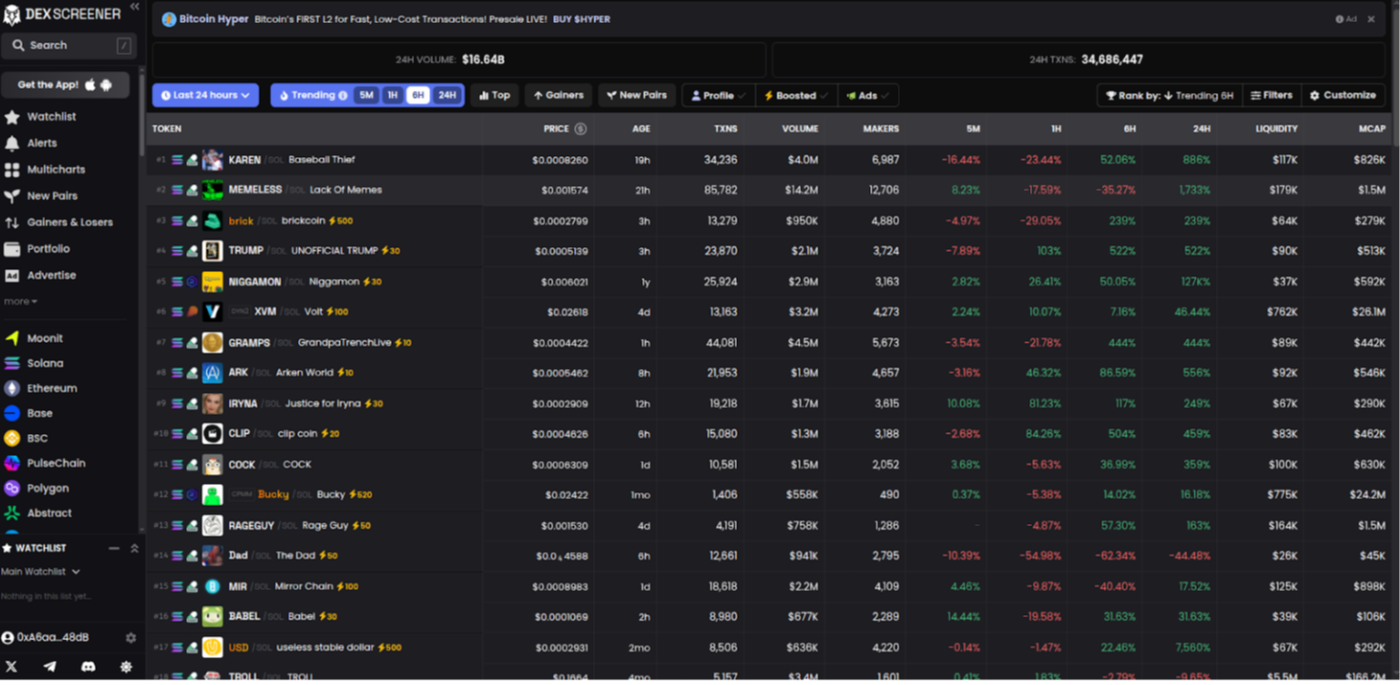
Building a DEXScreener Clone: A Step-by-Step Guide

Building a DEXScreener Clone: A Step-by-Step Guide

DEX Screener is used by crypto traders who need access to on-chain data like trading volumes, liquidity, and token prices. This information allows them to analyze trends, monitor new listings, and make informed investment decisions. In this tutorial, I will build a DEXScreener clone from scratch, covering everything from the initial design to a functional app. We will use Streamlit, a Python framework for building full-stack apps.
Share
Hackernoon2025/09/18 15:05
China Blocks Nvidia’s RTX Pro 6000D as Local Chips Rise

China Blocks Nvidia’s RTX Pro 6000D as Local Chips Rise

The post China Blocks Nvidia’s RTX Pro 6000D as Local Chips Rise appeared on BitcoinEthereumNews.com. China Blocks Nvidia’s RTX Pro 6000D as Local Chips Rise China’s internet regulator has ordered the country’s biggest technology firms, including Alibaba and ByteDance, to stop purchasing Nvidia’s RTX Pro 6000D GPUs. According to the Financial Times, the move shuts down the last major channel for mass supplies of American chips to the Chinese market. Why Beijing Halted Nvidia Purchases Chinese companies had planned to buy tens of thousands of RTX Pro 6000D accelerators and had already begun testing them in servers. But regulators intervened, halting the purchases and signaling stricter controls than earlier measures placed on Nvidia’s H20 chip. Image: Nvidia An audit compared Huawei and Cambricon processors, along with chips developed by Alibaba and Baidu, against Nvidia’s export-approved products. Regulators concluded that Chinese chips had reached performance levels comparable to the restricted U.S. models. This assessment pushed authorities to advise firms to rely more heavily on domestic processors, further tightening Nvidia’s already limited position in China. China’s Drive Toward Tech Independence The decision highlights Beijing’s focus on import substitution — developing self-sufficient chip production to reduce reliance on U.S. supplies. “The signal is now clear: all attention is focused on building a domestic ecosystem,” said a representative of a leading Chinese tech company. Nvidia had unveiled the RTX Pro 6000D in July 2025 during CEO Jensen Huang’s visit to Beijing, in an attempt to keep a foothold in China after Washington restricted exports of its most advanced chips. But momentum is shifting. Industry sources told the Financial Times that Chinese manufacturers plan to triple AI chip production next year to meet growing demand. They believe “domestic supply will now be sufficient without Nvidia.” What It Means for the Future With Huawei, Cambricon, Alibaba, and Baidu stepping up, China is positioning itself for long-term technological independence. Nvidia, meanwhile, faces…
Share
BitcoinEthereumNews2025/09/18 01:37
Ripple-Backed Evernorth Faces $220M Loss on XRP Holdings Amid Market Slump

Ripple-Backed Evernorth Faces $220M Loss on XRP Holdings Amid Market Slump

TLDR Evernorth invested $947M in XRP, now valued at $724M, a loss of over $220M. XRP’s price dropped 16% in the last 30 days, leading to Evernorth’s paper losses
Share
Coincentral2025/12/26 03:56