MaGGIe excels in hair rendering and instance separation on natural images, outperforming MGM and InstMatt in complex, multi-instance scenarios.MaGGIe excels in hair rendering and instance separation on natural images, outperforming MGM and InstMatt in complex, multi-instance scenarios.

Robust Mask-Guided Matting: Managing Noisy Inputs and Object Versatility

Abstract and 1. Introduction

  1. Related Works

  2. MaGGIe

    3.1. Efficient Masked Guided Instance Matting

    3.2. Feature-Matte Temporal Consistency

  3. Instance Matting Datasets

    4.1. Image Instance Matting and 4.2. Video Instance Matting

  4. Experiments

    5.1. Pre-training on image data

    5.2. Training on video data

  5. Discussion and References

\ Supplementary Material

  1. Architecture details

  2. Image matting

    8.1. Dataset generation and preparation

    8.2. Training details

    8.3. Quantitative details

    8.4. More qualitative results on natural images

  3. Video matting

    9.1. Dataset generation

    9.2. Training details

    9.3. Quantitative details

    9.4. More qualitative results

8.4. More qualitative results on natural images

Fig. 13 showcases our model’s performance in challenging scenarios, particularly in accurately rendering hair regions. Our framework consistently outperforms MGM⋆ in detail preservation, especially in complex instance interactions. In comparison with InstMatt, our model exhibits superior instance separation and detail accuracy in ambiguous regions.

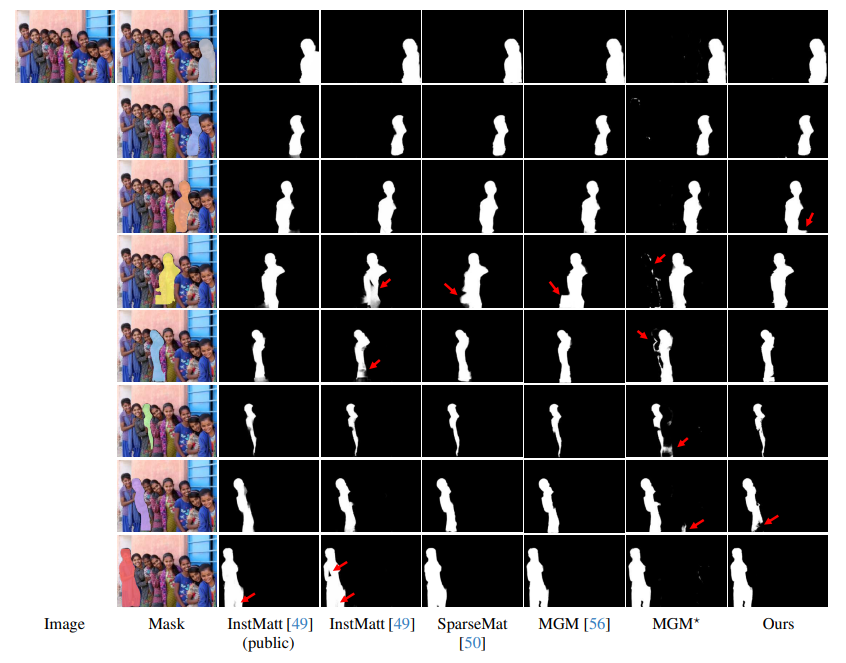
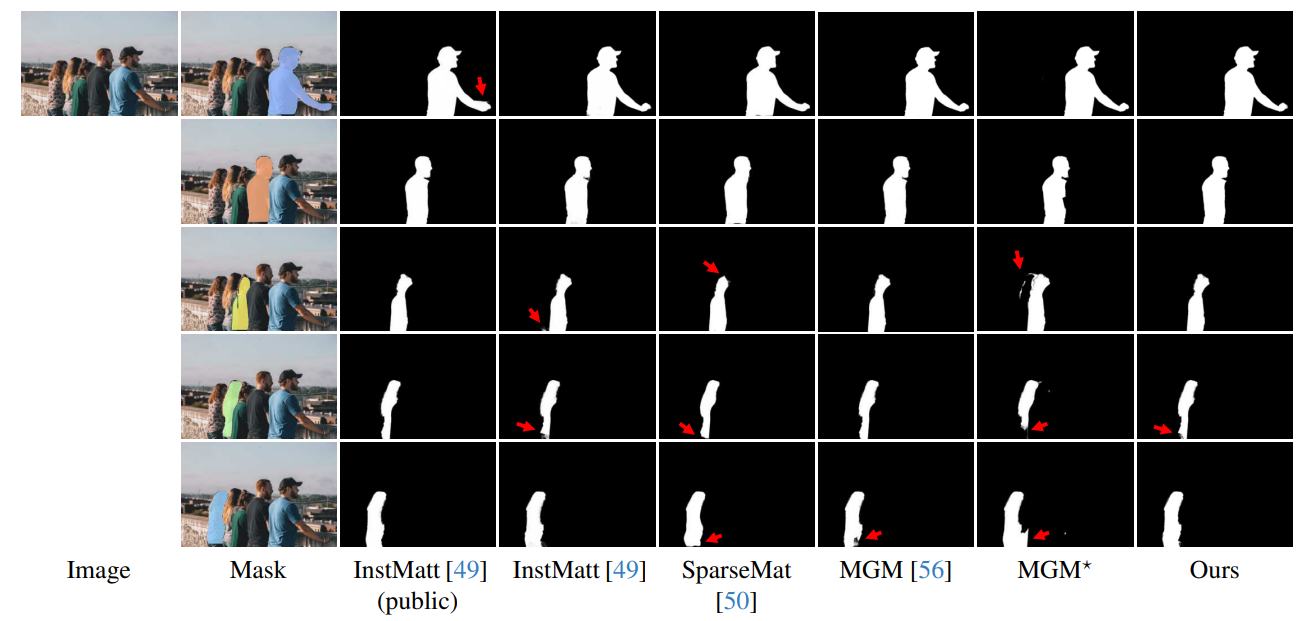
\ Fig. 14 and Fig. 15 illustrate the performance of our model and previous works in extreme cases involving multiple instances. While MGM⋆ struggles with noise and accuracy in dense instance scenarios, our model maintains high precision. InstMatt, without additional training data, shows limitations in these complex settings.

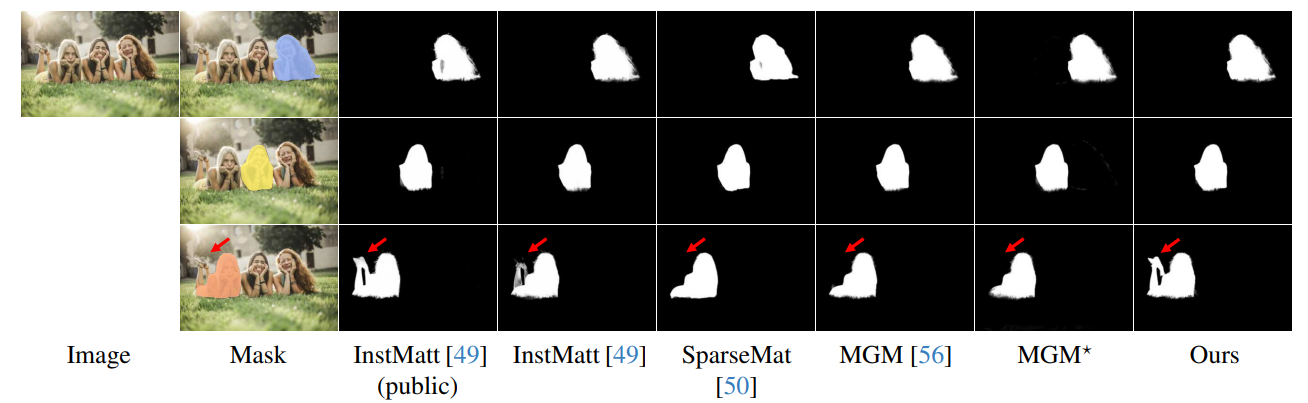
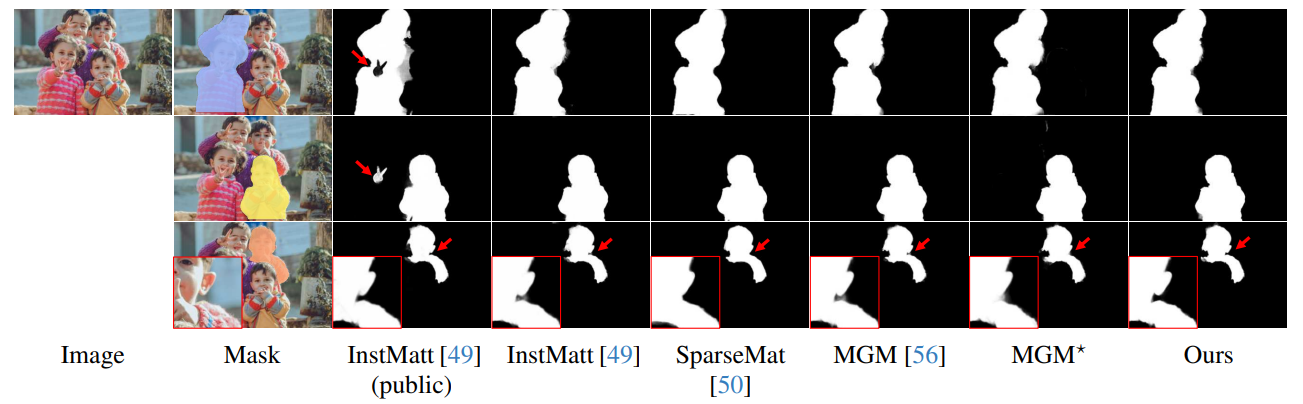
\ The robustness of our mask-guided approach is further demonstrated in Fig. 16. Here, we highlight the challenges faced by MGM variants and SparseMat in predicting missing parts in mask inputs, which our model addresses. However, it is important to note that our model is not designed as a human instance segmentation network. As shown in Fig. 17, our framework adheres to the input guidance, ensuring precise alpha matte prediction even with multiple instances in the same mask.

\ Lastly, Fig. 12 and Fig. 11 emphasize our model’s generalization capabilities. The model accurately extracts both human subjects and other objects from backgrounds, showcasing its versatility across various scenarios and object types.

\ All examples are Internet images without ground-truth and the mask from r101fpn400e are used as the guidance.

\ Figure 13. Our model produces highly detailed alpha matte on natural images. Our results show that it is accurate and comparable with previous instance-agnostic and instance-awareness methods without expensive computational costs. Red squares zoom in the detail regions for each instance. (Best viewed in color and digital zoom).
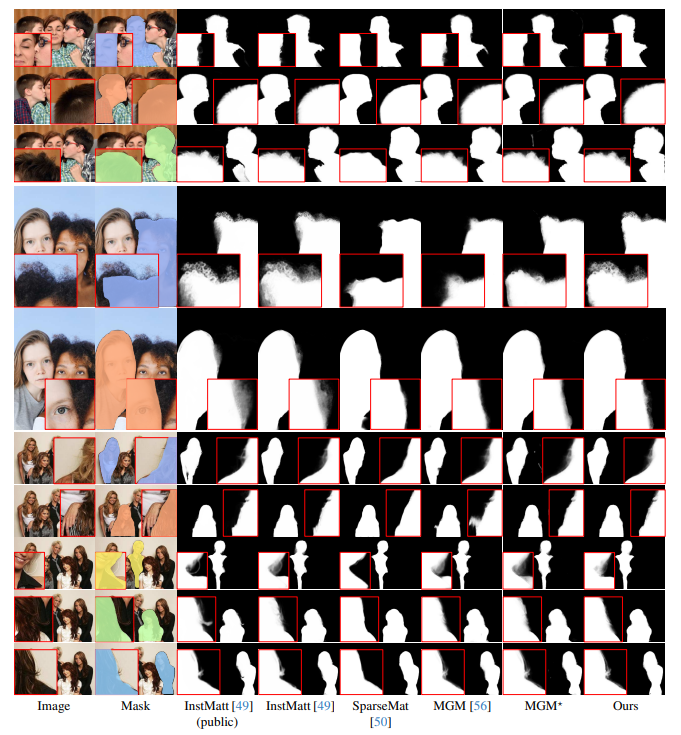
\ Figure 14. Our frameworks precisely separate instances in an extreme case with many instances. While MGM often causes the overlapping between instances and MGM⋆ contains noises, ours produces on-par results with InstMatt trained on the external dataset. Red arrow indicates the errors. (Best viewed in color and digital zoom).

\ Figure 15. Our frameworks precisely separate instances in a single pass. The proposed solution shows comparable results with InstMatt and MGM without running the prediction/refinement five times. Red arrow indicates the errors. (Best viewed in color and digital zoom).

\ Figure 16. Unlike MGM and SparseMat, our model is robust to the input guidance mask. With the attention head, our model produces more stable results to mask inputs without complex refinement between instances like InstMatt. Red arrow indicates the errors. (Best viewed in color and digital zoom).

\ Figure 17. Our solution works correctly with multi-instance mask guidances. When multiple instances exist in one guidance mask, we still produce the correct union alpha matte for those instances. Red arrow indicates the errors or the zoom-in region in red box. (Best viewed in color and digital zoom).

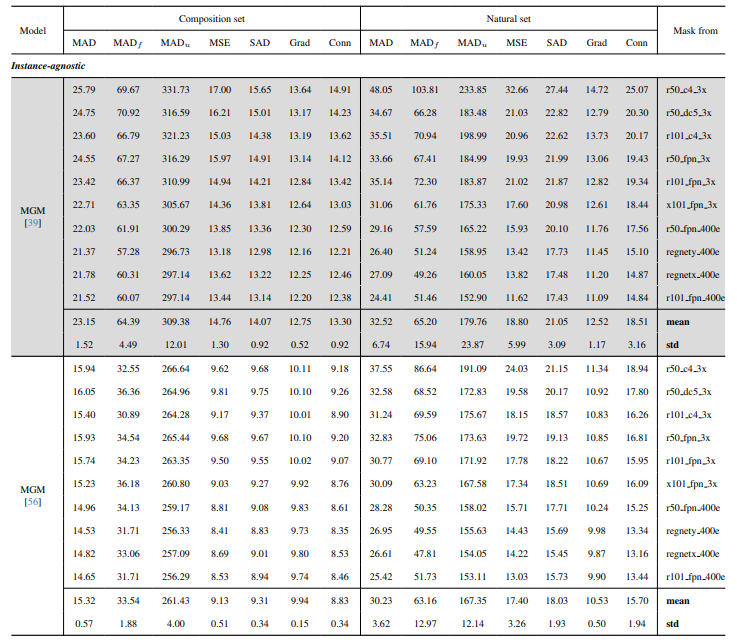
\ Table 12. Details of quantitative results on HIM2K+M-HIM2K (Extension of Table 5). Gray indicates the public weight without retraining.

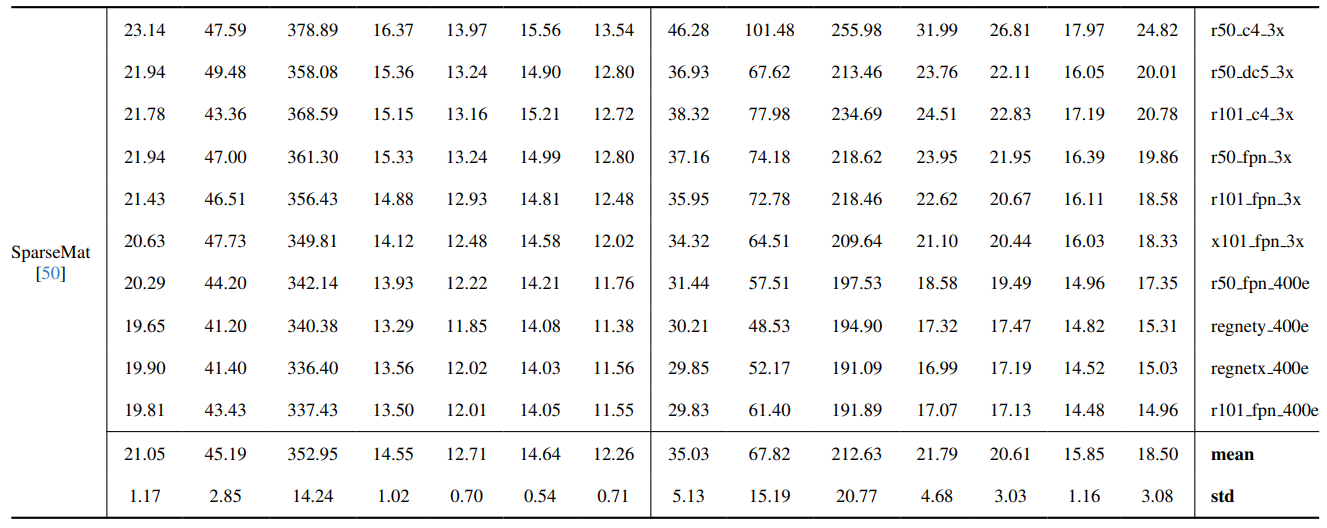
\ Table 12. Details of quantitative results on HIM2K+M-HIM2K (Extension of Table 5). Gray indicates the public weight without retraining. (Continued)

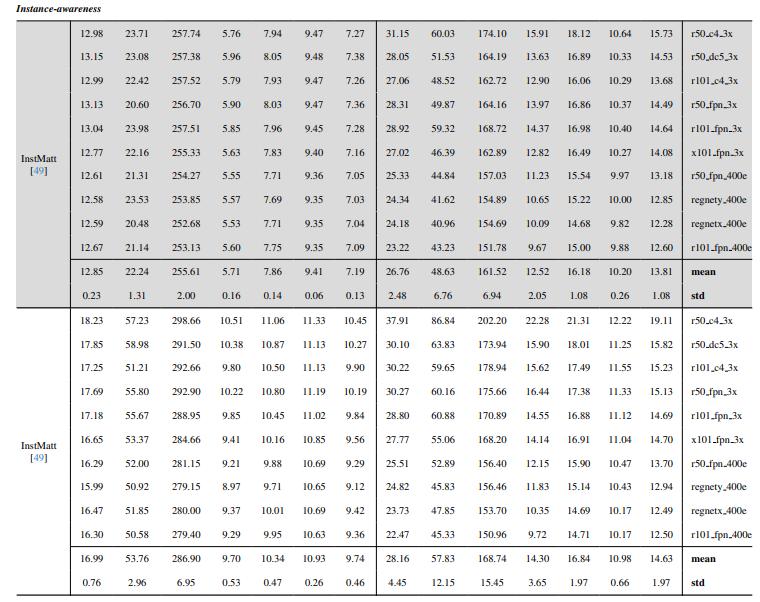
\ Table 12. Details of quantitative results on HIM2K+M-HIM2K (Extension of Table 5). Gray indicates the public weight without retraining. (Continued)

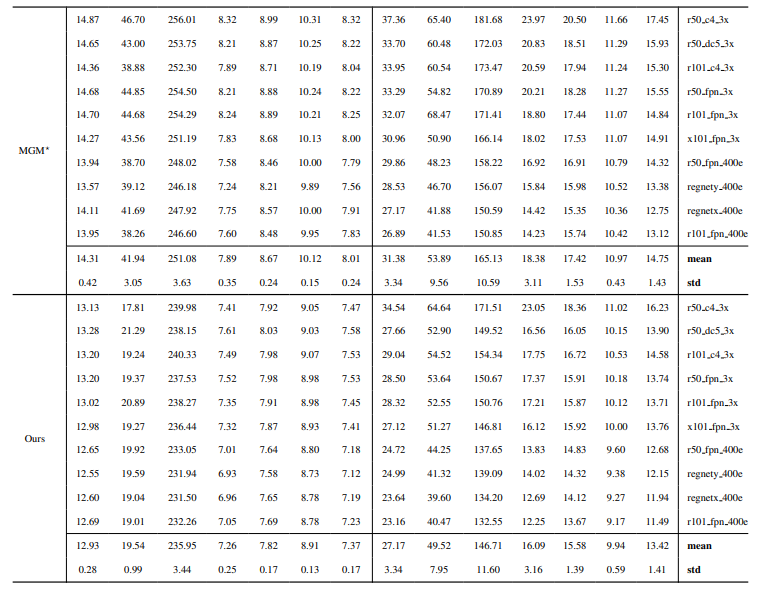
\ Table 12. Details of quantitative results on HIM2K+M-HIM2K (Extension of Table 5). Gray indicates the public weight without retraining. (Continued)

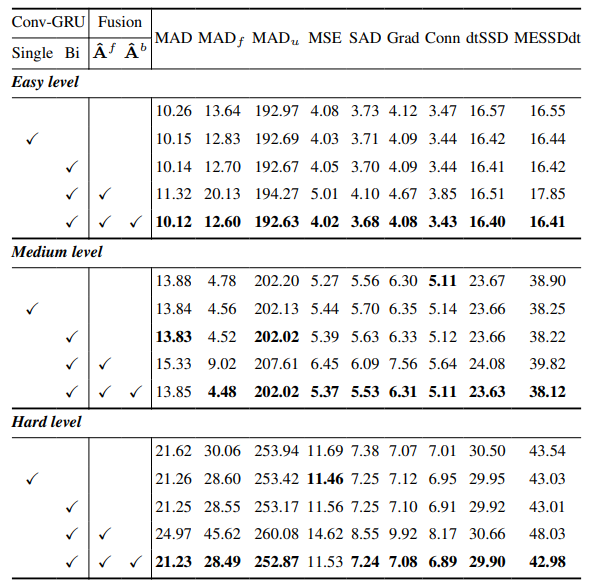
\ Table 13. The effectiveness of proposed temporal consistency modules on V-HIM60 (Extension of Table 6). The combination of bi-directional Conv-GRU and forward-backward fusion achieves the best overall performance on three test sets. Bold highlights the best for each level.

\

:::info Authors:

(1) Chuong Huynh, University of Maryland, College Park (chuonghm@cs.umd.edu);

(2) Seoung Wug Oh, Adobe Research (seoh,jolee@adobe.com);

(3) Abhinav Shrivastava, University of Maryland, College Park (abhinav@cs.umd.edu);

(4) Joon-Young Lee, Adobe Research (jolee@adobe.com).

:::


:::info This paper is available on arxiv under CC by 4.0 Deed (Attribution 4.0 International) license.

:::

\

Market Opportunity
Mask Network Logo
Mask Network Price(MASK)
$0.5818
$0.5818$0.5818
+0.58%
USD
Mask Network (MASK) Live Price Chart
Disclaimer: The articles reposted on this site are sourced from public platforms and are provided for informational purposes only. They do not necessarily reflect the views of MEXC. All rights remain with the original authors. If you believe any content infringes on third-party rights, please contact service@support.mexc.com for removal. MEXC makes no guarantees regarding the accuracy, completeness, or timeliness of the content and is not responsible for any actions taken based on the information provided. The content does not constitute financial, legal, or other professional advice, nor should it be considered a recommendation or endorsement by MEXC.

You May Also Like

Waarom Kyrgyzstan via Binance inzet op een stablecoin

Waarom Kyrgyzstan via Binance inzet op een stablecoin

De stablecoin van Kyrgyzstan, KGST, is gelist op Binance. Dit is een belangrijke vooruitgang voor het land, wat de president ook benoemt. Voor stablecoins lijkt
Share
Coinstats2025/12/26 01:46
Saudi blockchain real estate offers tokenized investment under Vision 2030

Saudi blockchain real estate offers tokenized investment under Vision 2030

The Saudi Arabian Vision 2030 has sped up the digital transformation of various sectors. The real estate industry is about to enter a new era with tokenized ownership
Share
Tronweekly2025/12/26 02:04
Polygon Tops RWA Rankings With $1.1B in Tokenized Assets

Polygon Tops RWA Rankings With $1.1B in Tokenized Assets

The post Polygon Tops RWA Rankings With $1.1B in Tokenized Assets appeared on BitcoinEthereumNews.com. Key Notes A new report from Dune and RWA.xyz highlights Polygon’s role in the growing RWA sector. Polygon PoS currently holds $1.13 billion in RWA Total Value Locked (TVL) across 269 assets. The network holds a 62% market share of tokenized global bonds, driven by European money market funds. The Polygon POL $0.25 24h volatility: 1.4% Market cap: $2.64 B Vol. 24h: $106.17 M network is securing a significant position in the rapidly growing tokenization space, now holding over $1.13 billion in total value locked (TVL) from Real World Assets (RWAs). This development comes as the network continues to evolve, recently deploying its major “Rio” upgrade on the Amoy testnet to enhance future scaling capabilities. This information comes from a new joint report on the state of the RWA market published on Sept. 17 by blockchain analytics firm Dune and data platform RWA.xyz. The focus on RWAs is intensifying across the industry, coinciding with events like the ongoing Real-World Asset Summit in New York. Sandeep Nailwal, CEO of the Polygon Foundation, highlighted the findings via a post on X, noting that the TVL is spread across 269 assets and 2,900 holders on the Polygon PoS chain. The Dune and https://t.co/W6WSFlHoQF report on RWA is out and it shows that RWA is happening on Polygon. Here are a few highlights: – Leading in Global Bonds: Polygon holds 62% share of tokenized global bonds (driven by Spiko’s euro MMF and Cashlink euro issues) – Spiko U.S.… — Sandeep | CEO, Polygon Foundation (※,※) (@sandeepnailwal) September 17, 2025 Key Trends From the 2025 RWA Report The joint publication, titled “RWA REPORT 2025,” offers a comprehensive look into the tokenized asset landscape, which it states has grown 224% since the start of 2024. The report identifies several key trends driving this expansion. According to…
Share
BitcoinEthereumNews2025/09/18 00:40