Stripe launches the Machine Payments Protocol, an open standard letting AI agents pay autonomously via stablecoins, cards, and BNPL in just a few lines of code.’Stripe launches the Machine Payments Protocol, an open standard letting AI agents pay autonomously via stablecoins, cards, and BNPL in just a few lines of code.’

Stripe Introduces the Machine Payments Protocol

2026/03/20 00:00
4 min read
For feedback or concerns regarding this content, please contact us at crypto.news@mexc.com

Stripe launches the Machine Payments Protocol, an open standard letting AI agents pay autonomously via stablecoins, cards, and BNPL in just a few lines of code.’

Stripe just made agents pay for things real. The payment company announced the Machine Payments Protocol (MPP), an open standard built to let AI agents transact directly with services across the internet. No humans in the loop. No manual checkout.

MPP was co-authored by Stripe and @tempo, the blockchain network Stripe developed alongside Paradigm. Stripe’s Tempo push has been building toward exactly this kind of autonomous payment infrastructure for months.

Agents Now Have Their Own Payment Layer

The protocol works like this. An agent requests a resource from any HTTP addressable endpoint. The service responds with a payment request. The agent authorizes it. Resource delivered.

Stripe announced on X that businesses using the PaymentIntents API can accept MPP payments in just a few lines of code. Payments arrive as stablecoins or fiat, including cards and buy now, pay later options through Shared Payment Tokens (SPTs). For existing Stripe merchants, these transactions appear in the Dashboard like any other payment. Settlement happens in the merchant’s default currency on their regular payout schedule.

Tax calculation, fraud protection, refunds, and accounting integrations. All of it carries over from human payment flows to agent ones.

Real businesses are already live on it. @browserbase, a browser infrastructure provider, now lets agents spin up headless browsers and charge per session. @postalform lets agents pay to print and send physical mail. There is also Prospect Butcher Co., which now accepts agent orders for sandwiches delivered anywhere in New York City.

The Agent Economy Just Got Its First Real Checkout

One quote from the announcement stood out. @paraga, founder of @p0, said in the Stripe X post that Parallel is built for a world where agents are the primary users of the web. Integrating machine payments with Stripe took just a few lines of code, and agents can now pay per API call for web access autonomously. The company runs on the same Stripe stack it already used.

That framing matters. Agents as the primary users of the web. Not a secondary use case. The primary one.

MPP sits inside a broader infrastructure push Stripe is calling its Agentic Commerce Suite. That suite also includes the Agentic Commerce Protocol (ACP), MCP integrations, and payment support for both MPP and x402. Stripe is not treating this as a one-product launch. It is building layered infrastructure for an agent-first commerce model.

Agents can now contribute to Stripe Climate programmatically too. That detail was buried in the original announcement on X, but it points to something bigger. If agents can pay for APIs, sandwiches, browser sessions, and carbon contributions, the floor for what counts as a commercial interaction just dropped significantly.

What This Means for Businesses Accepting Agent Payments

Stripe is targeting developers and businesses early. Early access signups are open now, with documentation available for those who want to get started with MPP through the PaymentIntents API.

The timing connects to a larger pattern. Stripe has been steadily laying the infrastructure for this moment, from stablecoin accounts in 101 countries to the Tempo blockchain launch, to now MPP. Each piece feeds into an architecture where agents transact the same way humans do, just faster and without intervention.

What’s still unclear is how widespread agent-side adoption will move. Plenty of businesses accept human payments just fine. Accepting payments from autonomous agents is a different operational posture. But Stripe is betting that building the rails early gives it the same kind of market position it earned in human payments.

The post Stripe Introduces the Machine Payments Protocol appeared first on Live Bitcoin News.

Market Opportunity
Collector Crypt Logo
Collector Crypt Price(CARDS)
$0.03931
$0.03931$0.03931
+12.18%
USD
Collector Crypt (CARDS) Live Price Chart
Disclaimer: The articles reposted on this site are sourced from public platforms and are provided for informational purposes only. They do not necessarily reflect the views of MEXC. All rights remain with the original authors. If you believe any content infringes on third-party rights, please contact crypto.news@mexc.com for removal. MEXC makes no guarantees regarding the accuracy, completeness, or timeliness of the content and is not responsible for any actions taken based on the information provided. The content does not constitute financial, legal, or other professional advice, nor should it be considered a recommendation or endorsement by MEXC.

You May Also Like

Shocking OpenVPP Partnership Claim Draws Urgent Scrutiny

Shocking OpenVPP Partnership Claim Draws Urgent Scrutiny

The post Shocking OpenVPP Partnership Claim Draws Urgent Scrutiny appeared on BitcoinEthereumNews.com. The cryptocurrency world is buzzing with a recent controversy surrounding a bold OpenVPP partnership claim. This week, OpenVPP (OVPP) announced what it presented as a significant collaboration with the U.S. government in the innovative field of energy tokenization. However, this claim quickly drew the sharp eye of on-chain analyst ZachXBT, who highlighted a swift and official rebuttal that has sent ripples through the digital asset community. What Sparked the OpenVPP Partnership Claim Controversy? The core of the issue revolves around OpenVPP’s assertion of a U.S. government partnership. This kind of collaboration would typically be a monumental endorsement for any private cryptocurrency project, especially given the current regulatory climate. Such a partnership could signify a new era of mainstream adoption and legitimacy for energy tokenization initiatives. OpenVPP initially claimed cooperation with the U.S. government. This alleged partnership was said to be in the domain of energy tokenization. The announcement generated considerable interest and discussion online. ZachXBT, known for his diligent on-chain investigations, was quick to flag the development. He brought attention to the fact that U.S. Securities and Exchange Commission (SEC) Commissioner Hester Peirce had directly addressed the OpenVPP partnership claim. Her response, delivered within hours, was unequivocal and starkly contradicted OpenVPP’s narrative. How Did Regulatory Authorities Respond to the OpenVPP Partnership Claim? Commissioner Hester Peirce’s statement was a crucial turning point in this unfolding story. She clearly stated that the SEC, as an agency, does not engage in partnerships with private cryptocurrency projects. This response effectively dismantled the credibility of OpenVPP’s initial announcement regarding their supposed government collaboration. Peirce’s swift clarification underscores a fundamental principle of regulatory bodies: maintaining impartiality and avoiding endorsements of private entities. Her statement serves as a vital reminder to the crypto community about the official stance of government agencies concerning private ventures. Moreover, ZachXBT’s analysis…
Share
BitcoinEthereumNews2025/09/18 02:13
Zano Surges 22% as Privacy Coins See Revival: Why ZANO is Trending Today
Zano Surges 22% as Privacy Coins See Revival: Why ZANO is Trending Today

Privacy-focused cryptocurrency Zano has surged 22% in the past 24 hours, reaching $9.41 with trading volume jumping to $1.87 million. We analyze the on-chain metrics
Share
Blockchainmagazine2026/03/20 21:06
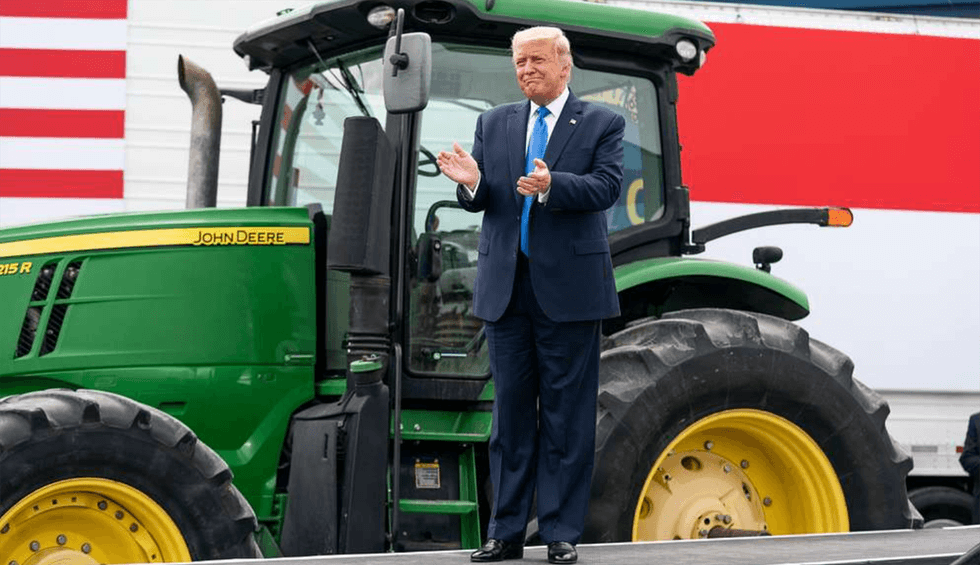
Trump's latest foray condemned for heaping even more pain on farmers

Trump's latest foray condemned for heaping even more pain on farmers

Farmers across the country warned they cannot survive for much longer as the Iran war worsens the fuel and fertilizer stocks. Industry experts said that already
Share
Rawstory2026/03/20 21:45
