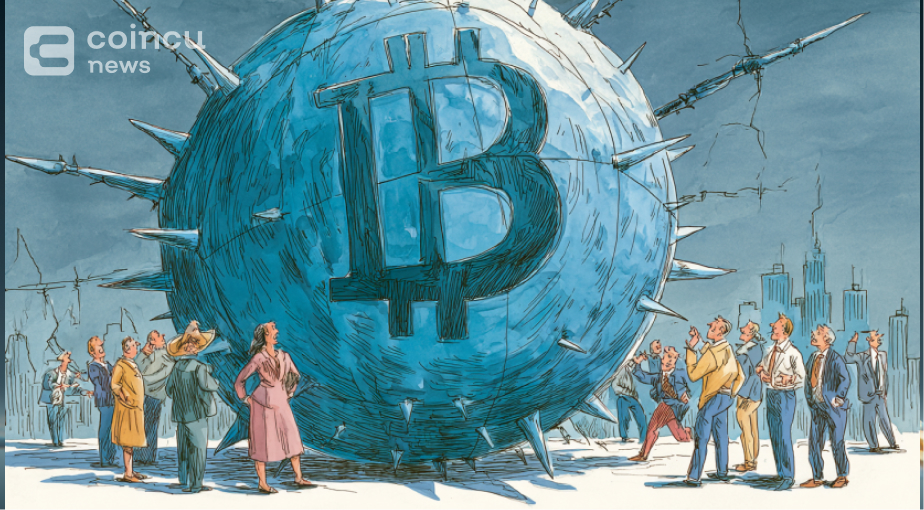
Coinbase’s top executive made waves at the World Economic Forum in Davos on Wednesday by bringing Bitcoin directly into policy discussions with global financial leaders.
Attendees were waiting for US President Donald Trump to speak at the event, and many were anticipating his usual spontaneous remarks about foreign relations and trade policies when Brian Armstrong showed up.
French central banker clashes with crypto CEO
The head of Coinbase got into a direct debate with François Villeroy de Galhau, who leads France’s central bank, about who really controls money.
“I trust more independent central banks with a democratic mandate than private issuers of Bitcoin,” the French banking official said during the Davos talk, as reported by Gareth Jenkinson. His statement reflected what many central bankers have said for years, that government institutions have more legitimacy than systems nobody controls.
Armstrong retaliated by reframing the debate. He asserted that political power is not as significant as who actually controls the money supply.
“Bitcoin is a decentralized protocol. There’s actually no issuer of it. So, in the sense that central banks have independence, Bitcoin is even more independent. No country, company, or individual controls it in the world,” Armstrong explained.
The back-and-forth represented something unusual at the World Economic Forum. For the first time in years, Bitcoin itself became the topic of serious debate, not just general discussion about blockchain or digital currencies.
In previous years, WEF discussions largely centered on financial systems that governments and banks could regulate, including central bank digital currencies. Bitcoin’s challenge to state control over money was usually left out of the conversation.
That began to change at WEF 2026, in part because journalists on the ground pressed leaders with more direct questions.
During the “Crypto at a Crossroads” panel, reporters questioned Coinbase CEO Brian Armstrong on whether the U.S. would actually move forward with a strategic Bitcoin reserve, an idea some officials have recently floated.
In response, Armstrong presented Bitcoin as a worldwide monetary network that operates on its own rules and that governments can no longer afford to ignore or avoid, rather than as a speculative wager for rapid riches.
The Coinbase executive later pointed out on social media that people assume today’s financial system is the only option. However, he noted that the current setup only started in 1971 when President Nixon ended the gold standard.
However, Trump’s expected speech remained the main event that many attendees looked forward to, given his track record of making unexpected statements about tariffs, trade deals, and foreign policy.
Trump arrived in Switzerland for Davos after his plane experienced some issues, according to reports on social media.
Banking lobby accused of blocking crypto competition through regulation
Away from the main conference, Armstrong kept criticizing traditional finance. In a CNBC interview, he accused American banking groups of using regulations to crush competition, especially regarding stablecoin rules.
He talked about the CLARITY Act, which has stalled in Congress. Armstrong claimed that banks were lobbying to prevent crypto companies from offering interest payments to customers, not because it creates financial risks, but because it threatens their business.
“Their lobbying groups and their trade arms are coming in and trying to ban the competition,” Armstrong told the network. He argued that crypto businesses should get fair treatment under regulations instead of being blocked by established banks.
Later, Armstrong said on social media that as worries about the global financial system continue to grow, all parties are now searching for broadly applicable answers, particularly for Americans.
Hedge fund veteran Ray Dalio expressed similar concerns during Davos Week, warning CNBC that “the monetary order is collapsing” due to changes in central banks’ reserve management practices and growing debt.
According to Dalio, investors are increasingly turning to digital assets like Bitcoin and gold due to their mistrust of conventional currencies. Treasury Secretary Scott Bessent stated in 2025 that confiscated Bitcoin will be transferred to the U.S. strategic reserve, suggesting that Bitcoin is gradually making its way into official thinking.
This suggests that officials are starting to view Bitcoin as a long-term financial asset, even though it does not equate to full government backing.
When considered collectively, the discussions at Davos indicate a distinct change. Bitcoin is no longer only an outsider disregarded by influential organizations. It is currently being discussed in the same systems that previously opted to ignore it in an uncomfortable but important way.
The smartest crypto minds already read our newsletter. Want in? Join them.
Source: https://www.cryptopolitan.com/coinbase-ceo-bitcoin-independence-davos/