Bitcoin’s current pullback continues to reflect on multiple major on-chain metrics, reinforcing the volatility across the market. With selling pressure still presentBitcoin’s current pullback continues to reflect on multiple major on-chain metrics, reinforcing the volatility across the market. With selling pressure still present

Bitcoin Coin Days Destroyed Plunge After Massive Coinbase BTC Transfer

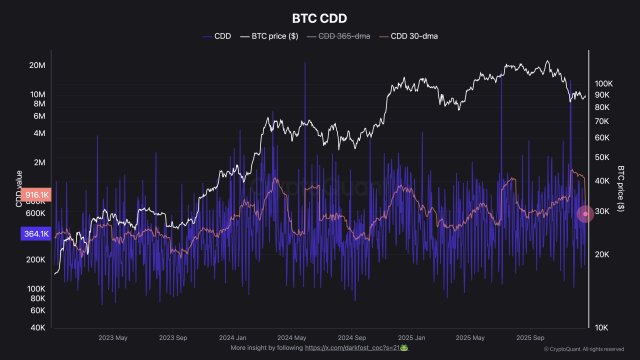
Bitcoin’s current pullback continues to reflect on multiple major on-chain metrics, reinforcing the volatility across the market. With selling pressure still present among retail and institutional investors, the BTC Coin Days Destroyed (CDD) metric has experienced a sharp decline to levels that could shape the market’s direction.

Major Coinbase Transfer Triggers Bitcoin CCD Drop

While ongoing volatility has increased within the broader cryptocurrency sector, the Bitcoin market appears to be entering a pivotal phase. This new phase, which goes beyond routine volatility or short-term price noise, is largely driven by the BTC Coin Days Destroyed, an indicator that simply measures the number of holding days of a UTXO before it is spent, after undergoing a notable drop.

Beneath the surface, key structural indicators point to a significant shift occurring, characterized by evolving on-chain patterns, shifting liquidity dynamics, and altered investor behavior. This is a crucial turning point in the current cycle since it has the potential to redefine the market’s next major direction.

In the report shared on X by Darkfost, a market expert and author at CryptoQuant, it shows that the drop in the BTC CDD metric emerged following a large BTC move from Coinbase over a month ago. As a result, all leverage data are now slowly returning to normal levels.
Bitcoin

According to the expert, the most interesting aspect of the development is that this decline has reached a level well below the previous spike. In addition to the Coinbase-related action, this implies a sign of slowdown in Bitcoin long-term holders’ activity. It is worth noting that when BTC held in the long term begins to move, it is usually in preparation for a sell-off. 

Although it may sound bad, this drop in CDD is a positive signal. This is because long-term holders continue to be the biggest possible source of selling pressure as they account for the largest share of the total supply. However, a decrease in long-term holder selling pressure aids in relieving the market and may add to the formation of a bottom if this trend persists.

When Is The Time To Buy The Crypto Asset?

After weeks of waning price action, Joao Wedson, the founder of Alphractal, has offered insights into when to purchase Bitcoin using the Financial Stress Index (FSI). Historically, this key metric has acted as a reliable signal for when to buy BTC, making it one of the most closely watched indicators.

Presently, the FSI metric has flipped into a positive territory. Wedson highlighted that each time this happens, good opportunities to acquire more BTC have emerged. However, this trend has not yet unfolded.

The indicator, which uses a wide range of factors, including volatility, spreads, and risk premiums, to gauge systemic stress in international financial markets, was created by the Office of Financial Research. Wedson stated that these kinds of metrics are uncommon in the macroeconomic environment, which is characterized by substantial data delays and sluggish decision-making.

Bitcoin
Market Opportunity
Bitcoin Logo
Bitcoin Price(BTC)
$82,725.78
$82,725.78$82,725.78
-2.59%
USD
Bitcoin (BTC) Live Price Chart
Disclaimer: The articles reposted on this site are sourced from public platforms and are provided for informational purposes only. They do not necessarily reflect the views of MEXC. All rights remain with the original authors. If you believe any content infringes on third-party rights, please contact service@support.mexc.com for removal. MEXC makes no guarantees regarding the accuracy, completeness, or timeliness of the content and is not responsible for any actions taken based on the information provided. The content does not constitute financial, legal, or other professional advice, nor should it be considered a recommendation or endorsement by MEXC.

You May Also Like

Republic Europe Offers Indirect Kraken Stake via SPV

Republic Europe Offers Indirect Kraken Stake via SPV

Republic Europe launches SPV for European retail access to Kraken equity pre-IPO.
Share
bitcoininfonews2026/01/30 13:32
cpwrt Limited Positions Customer Support as a Strategic Growth Function

cpwrt Limited Positions Customer Support as a Strategic Growth Function

For many growing businesses, customer support is often viewed as a cost center rather than a strategic function. cpwrt limited challenges this perception by providing
Share
Techbullion2026/01/30 13:07
How is the xStocks tokenized stock market developing?

How is the xStocks tokenized stock market developing?

Author: Heechang Compiled by: TechFlow xStocks offers a tokenized stock service, allowing investors to trade tokenized versions of popular US stocks like Tesla in real time. While still in its early stages, it’s already showing some interesting signs of growth. Observation 1: Trading is concentrated in Tesla (TSLA) As in many emerging markets, trading activity has quickly concentrated on a handful of stocks. Data shows a high concentration of trading volume in the most well-known and volatile stocks, with Tesla being the most prominent example. This concentration is not surprising: liquidity tends to accumulate in assets that retail investors already favor, and early adopters often use familiar high-beta stocks to test new infrastructure. Observation 2: Liquidity decreases on weekends Data shows that on-chain equity trading volume drops to 30% or less of weekday levels over the weekend. Unlike crypto-native assets, which trade seamlessly around the clock, tokenized stocks still inherit the behavioral inertia of traditional market trading hours. Traders appear less willing to trade when reference markets (such as Nasdaq and the New York Stock Exchange) are closed, likely due to concerns about arbitrage, price gaps, and the inability to hedge positions off-chain. Observation 3: Prices move in line with the Nasdaq Another key signal comes from pricing behavior during the initial launch period. Initially, xStocks tokens traded at a significant premium to their Nasdaq counterparts, reflecting market enthusiasm and potential friction in bridging fiat liquidity. However, these premiums gradually diminished over time. Current trading patterns show that the token price is at the upper limit of Tesla's intraday price range and is highly consistent with the Nasdaq reference price. Arbitrageurs appear to be maintaining this price discipline, but there are still small deviations from the intraday highs, indicating some market inefficiencies that may present opportunities and risks for active traders. New opportunities for Korean stock investors? South Korean investors currently hold over $100 billion in US stocks, with trading volume increasing 17-fold since January 2020. Existing infrastructure for South Korean investors to trade US stocks is limited by high fees, long settlement times, and slow cash-out processes, creating opportunities for tokenized or on-chain mirror stocks. As the infrastructure and platforms supporting on-chain US stock markets continue to improve, a new group of South Korean traders will enter the crypto market, which is undoubtedly a huge opportunity.
Share
PANews2025/09/18 08:00