NEW YORK–(BUSINESS WIRE)–On December 19, 2025, Grant & Eisenhofer P.A. filed a class action lawsuit on behalf of Paul Durkacz against the Canadian Imperial BankNEW YORK–(BUSINESS WIRE)–On December 19, 2025, Grant & Eisenhofer P.A. filed a class action lawsuit on behalf of Paul Durkacz against the Canadian Imperial Bank

Grant & Eisenhofer Files Securities Class Action Lawsuit Against Canadian Imperial Bank of Commerce and Royal Bank of Canada on behalf of investors in Quantum Biopharma Ltd. Securities

NEW YORK–(BUSINESS WIRE)–On December 19, 2025, Grant & Eisenhofer P.A. filed a class action lawsuit on behalf of Paul Durkacz against the Canadian Imperial Bank of Commerce (“CIBC”) and Royal Bank of Canada (“RBC”), and their broker-dealer subsidiaries (together, the “Defendants”). The action alleges that Defendants defrauded investors by placing and executing manipulative trades designed to artificially deflate the price of Quantum Biopharma Ltd. (“Quantum”) securities.

The action is brought on behalf of all persons who sold securities of Quantum between January 6, 2021 and October 15, 2025, inclusive (the “Class Period”) and were damaged thereby. The action, brought in the United States District Court for the Southern District of New York, is captioned Paul Durkacz v. CIBC World Markets Inc., No. 1:25-cv-10565 (S.D.N.Y.).

CIBC and RBC are Canadian chartered banks whose U.S. subsidiaries are registered with the Securities and Exchange Commission and operate as major market makers, routinely placing and executing securities trades for investors as well as for their own trading accounts.

The complaint alleges violations of Sections 9, 10(b), and 20(a) of the Securities Exchange Act of 1934. Specifically, the lawsuit alleges that throughout the Class Period, Defendants engaged in a manipulative and illegal trading practice known as “spoofing,” which involves submitting and then cancelling buy or sell orders without any genuine intent to execute them. The purpose of these “baiting orders” was to mislead other market participants about the true level of supply and demand for Quantum securities, or about the stock’s price volatility, thereby influencing the market price of Quantum to benefit Defendants’ own trading positions.

Defendants entered thousands of these baiting orders on U.S. stock exchanges to create the false impression that Quantum’s stock price reflected genuine supply-and-demand and volatility dynamics, while simultaneously profiting by, among other things, purchasing Quantum securities at prices artificially depressed by their manipulative and deceptive conduct.

Investors who sold Quantum securities during the Class Period are members of this proposed Class and may be able to seek appointment as lead plaintiff, which is a court-appointed representative of the Class, by complying with the relevant provisions of the Private Securities Litigation Reform Act of 1995 (the “PSLRA”). See 15 U.S.C. Section 78u-4(a)(2)(A)(i)-(vi).

If you wish to serve as lead plaintiff, you must move the Court by no later than February 23, 2026. You do not need to seek to become a lead plaintiff in order to share in any possible recovery. You may also retain counsel of your choice to represent you in this action.

If you wish to discuss this action or have any questions concerning this notice or your rights, please contact Abe Alexander at Grant & Eisenhofer at 646-722-8500, or via email at aalexander@gelaw.com.

Contacts

Media Contact:

Abe Alexander

Grant & Eisenhofer P.A.

Tel.: (646) 722-8500

aalexander@gelaw.com

Market Opportunity
Lorenzo Protocol Logo
Lorenzo Protocol Price(BANK)
$0.04372
$0.04372$0.04372
+2.65%
USD
Lorenzo Protocol (BANK) Live Price Chart
Disclaimer: The articles reposted on this site are sourced from public platforms and are provided for informational purposes only. They do not necessarily reflect the views of MEXC. All rights remain with the original authors. If you believe any content infringes on third-party rights, please contact service@support.mexc.com for removal. MEXC makes no guarantees regarding the accuracy, completeness, or timeliness of the content and is not responsible for any actions taken based on the information provided. The content does not constitute financial, legal, or other professional advice, nor should it be considered a recommendation or endorsement by MEXC.

You May Also Like

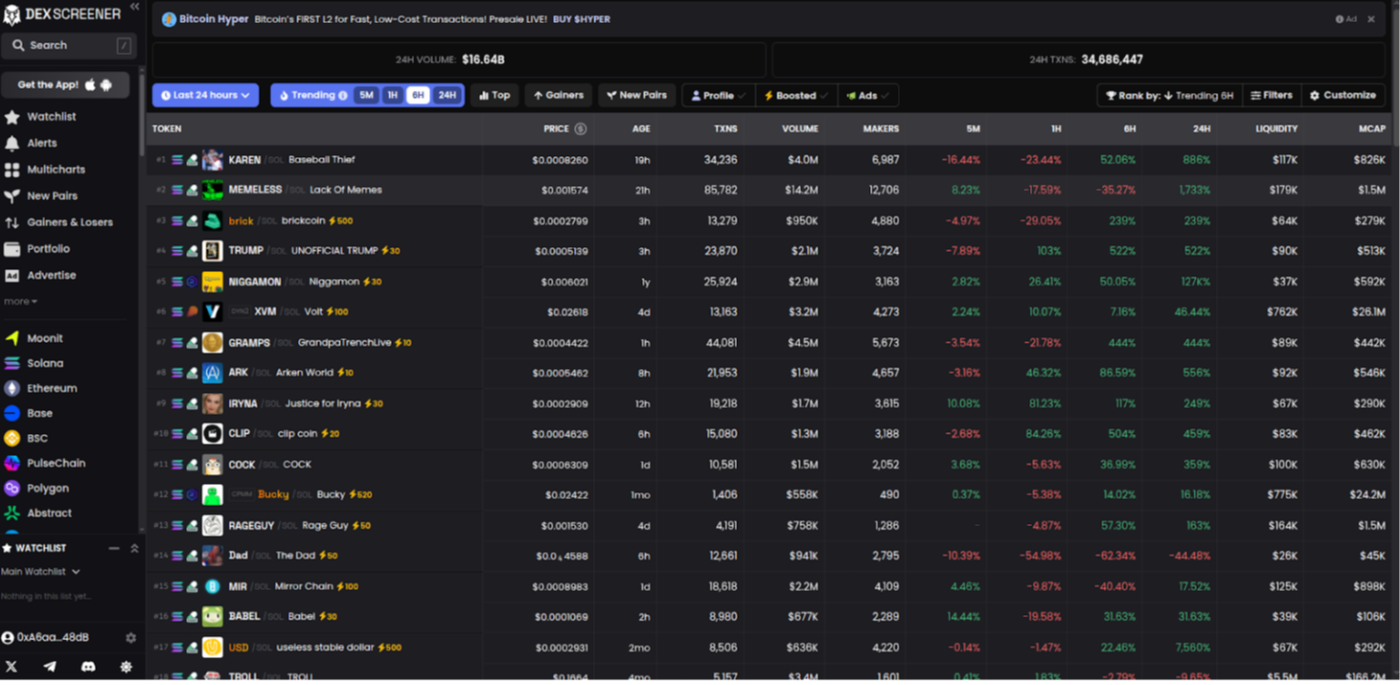
Building a DEXScreener Clone: A Step-by-Step Guide

Building a DEXScreener Clone: A Step-by-Step Guide

DEX Screener is used by crypto traders who need access to on-chain data like trading volumes, liquidity, and token prices. This information allows them to analyze trends, monitor new listings, and make informed investment decisions. In this tutorial, I will build a DEXScreener clone from scratch, covering everything from the initial design to a functional app. We will use Streamlit, a Python framework for building full-stack apps.
Share
Hackernoon2025/09/18 15:05
China Blocks Nvidia’s RTX Pro 6000D as Local Chips Rise

China Blocks Nvidia’s RTX Pro 6000D as Local Chips Rise

The post China Blocks Nvidia’s RTX Pro 6000D as Local Chips Rise appeared on BitcoinEthereumNews.com. China Blocks Nvidia’s RTX Pro 6000D as Local Chips Rise China’s internet regulator has ordered the country’s biggest technology firms, including Alibaba and ByteDance, to stop purchasing Nvidia’s RTX Pro 6000D GPUs. According to the Financial Times, the move shuts down the last major channel for mass supplies of American chips to the Chinese market. Why Beijing Halted Nvidia Purchases Chinese companies had planned to buy tens of thousands of RTX Pro 6000D accelerators and had already begun testing them in servers. But regulators intervened, halting the purchases and signaling stricter controls than earlier measures placed on Nvidia’s H20 chip. Image: Nvidia An audit compared Huawei and Cambricon processors, along with chips developed by Alibaba and Baidu, against Nvidia’s export-approved products. Regulators concluded that Chinese chips had reached performance levels comparable to the restricted U.S. models. This assessment pushed authorities to advise firms to rely more heavily on domestic processors, further tightening Nvidia’s already limited position in China. China’s Drive Toward Tech Independence The decision highlights Beijing’s focus on import substitution — developing self-sufficient chip production to reduce reliance on U.S. supplies. “The signal is now clear: all attention is focused on building a domestic ecosystem,” said a representative of a leading Chinese tech company. Nvidia had unveiled the RTX Pro 6000D in July 2025 during CEO Jensen Huang’s visit to Beijing, in an attempt to keep a foothold in China after Washington restricted exports of its most advanced chips. But momentum is shifting. Industry sources told the Financial Times that Chinese manufacturers plan to triple AI chip production next year to meet growing demand. They believe “domestic supply will now be sufficient without Nvidia.” What It Means for the Future With Huawei, Cambricon, Alibaba, and Baidu stepping up, China is positioning itself for long-term technological independence. Nvidia, meanwhile, faces…
Share
BitcoinEthereumNews2025/09/18 01:37
Ripple-Backed Evernorth Faces $220M Loss on XRP Holdings Amid Market Slump

Ripple-Backed Evernorth Faces $220M Loss on XRP Holdings Amid Market Slump

TLDR Evernorth invested $947M in XRP, now valued at $724M, a loss of over $220M. XRP’s price dropped 16% in the last 30 days, leading to Evernorth’s paper losses
Share
Coincentral2025/12/26 03:56