The post the programmable bank for the digital asset era appeared on BitcoinEthereumNews.com. Pave Bank has announced a fundraising of 39 million dollars in a Series A round led by Accel, with participation from prominent investors such as Tether Investments, Quona Capital, Wintermute, Helios Digital Ventures, Financial Technology Partners, Yolo Investments, Kazea Fund, and GC&H Investments.  This operation brings the total funding obtained by the bank to over 44 million dollars, marking a crucial step in the expansion of the world’s first programmable bank, designed to seamlessly integrate traditional finance and digital assets. Founded in December 2023 by former executives of BigPay, Monzo, and VP Bank, Pave Bank presents itself as a concrete response to the growing fragmentation of financial services. Until now, companies were forced to turn to different providers for traditional banking management, custody of digital assets, and payment or liquidity services, resulting in operational inefficiencies, compliance risks, and slowed access to liquidity.  Pave Bank overcomes these obstacles by offering a unique and regulated platform where corporate and institutional clients can manage both fiat and digital assets under one roof. Pave Bank: the innovation of the programmable bank The core of Pave Bank‘s offering is an integrated platform that combines commercial banking services—such as deposit accounts, extensive payment coverage, FX liquidity, payment card issuance, and treasury management—with institutional-level digital asset management tools, an instant settlement network, and an OTC trading desk. Instead of having to coordinate multiple providers for fiat management, custody, and liquidity, clients can operate on both fronts through a single regulatory framework, one compliance standard, and a unified interface. According to Salim Dhanani, co-founder and CEO of Pave Bank: “The global financial system is shifting towards regulated on-chain finance, and institutions need a reliable bridge between the old and the new. We have built a multi-asset bank that merges the stability and oversight of traditional finance with the… The post the programmable bank for the digital asset era appeared on BitcoinEthereumNews.com. Pave Bank has announced a fundraising of 39 million dollars in a Series A round led by Accel, with participation from prominent investors such as Tether Investments, Quona Capital, Wintermute, Helios Digital Ventures, Financial Technology Partners, Yolo Investments, Kazea Fund, and GC&H Investments.  This operation brings the total funding obtained by the bank to over 44 million dollars, marking a crucial step in the expansion of the world’s first programmable bank, designed to seamlessly integrate traditional finance and digital assets. Founded in December 2023 by former executives of BigPay, Monzo, and VP Bank, Pave Bank presents itself as a concrete response to the growing fragmentation of financial services. Until now, companies were forced to turn to different providers for traditional banking management, custody of digital assets, and payment or liquidity services, resulting in operational inefficiencies, compliance risks, and slowed access to liquidity.  Pave Bank overcomes these obstacles by offering a unique and regulated platform where corporate and institutional clients can manage both fiat and digital assets under one roof. Pave Bank: the innovation of the programmable bank The core of Pave Bank‘s offering is an integrated platform that combines commercial banking services—such as deposit accounts, extensive payment coverage, FX liquidity, payment card issuance, and treasury management—with institutional-level digital asset management tools, an instant settlement network, and an OTC trading desk. Instead of having to coordinate multiple providers for fiat management, custody, and liquidity, clients can operate on both fronts through a single regulatory framework, one compliance standard, and a unified interface. According to Salim Dhanani, co-founder and CEO of Pave Bank: “The global financial system is shifting towards regulated on-chain finance, and institutions need a reliable bridge between the old and the new. We have built a multi-asset bank that merges the stability and oversight of traditional finance with the…

the programmable bank for the digital asset era

Pave Bank has announced a fundraising of 39 million dollars in a Series A round led by Accel, with participation from prominent investors such as Tether Investments, Quona Capital, Wintermute, Helios Digital Ventures, Financial Technology Partners, Yolo Investments, Kazea Fund, and GC&H Investments. 

This operation brings the total funding obtained by the bank to over 44 million dollars, marking a crucial step in the expansion of the world’s first programmable bank, designed to seamlessly integrate traditional finance and digital assets.

Founded in December 2023 by former executives of BigPay, Monzo, and VP Bank, Pave Bank presents itself as a concrete response to the growing fragmentation of financial services. Until now, companies were forced to turn to different providers for traditional banking management, custody of digital assets, and payment or liquidity services, resulting in operational inefficiencies, compliance risks, and slowed access to liquidity. 

Pave Bank overcomes these obstacles by offering a unique and regulated platform where corporate and institutional clients can manage both fiat and digital assets under one roof.

Pave Bank: the innovation of the programmable bank

The core of Pave Bank‘s offering is an integrated platform that combines commercial banking services—such as deposit accounts, extensive payment coverage, FX liquidity, payment card issuance, and treasury management—with institutional-level digital asset management tools, an instant settlement network, and an OTC trading desk. Instead of having to coordinate multiple providers for fiat management, custody, and liquidity, clients can operate on both fronts through a single regulatory framework, one compliance standard, and a unified interface.

According to Salim Dhanani, co-founder and CEO of Pave Bank:

Automation and real-time management

Companies that choose Pave Bank can manage both fiat and digital assets in real-time, automate treasury operations, and reduce reliance on intermediaries. An exchange or a market maker, for example, can manage digital assets, fiat, and fixed-income treasury products in one place, interacting with their counterparts through the Pave Network

This approach enhances operational liquidity and reduces operational risks. Companies exploring the use of stablecoins in their operations can thus unify digital and fiat treasury with regulatory clarity and complete security, optimizing speed, control, and cost efficiency.

A sustainable and technologically advanced growth

Since its launch, Pave Bank has focused on a sustainable and technology-driven operational model, avoiding the race for growth at all costs. A remarkable achievement: the bank has reached profitability in seven of the first nine months of activity, a rare milestone for a newly licensed bank. This was made possible through the intensive use of automation and artificial intelligence in all key functions, from software engineering to compliance, from operations to treasury management. With a team of just over fifty people, the goal is to continue scaling intelligently, maintaining profitability and a central focus on risk and compliance.

Salim Dhanani highlights how Pave Bank’s clients are large companies and sophisticated institutions, who expect their bank to have the same speed and adaptability as the tech companies they collaborate with, but with the security, compliance, and oversight of a regulated financial institution. “This is the gap we are bridging,” says Dhanani.

Investor Support

Investors share the vision of Pave Bank. Rachit Parekh, partner at Accel, highlights the need for a regulated and full-reserve banking approach at the intersection of fiat and digital assets, emphasizing the role of Pave Bank as a pioneer of this infrastructural transformation. 

Ganesh Rengaswamy of Quona Capital adds that Pave’s programmable bank, with its full-reserve approach, combines the best of traditional banking and digital assets, catalyzing the adoption of stablecoins and promoting financial inclusion in global markets.

Regulation and Global Vision

The capital raising reflects the growing institutional demand for a new type of financial institution, capable of managing regulated digital assets – from stablecoins to bitcoin – while offering all the services expected from a commercial bank: instant settlement, programmable flows, and prudential supervision. Pave Bank has operated from the outset within regulatory frameworks for digital assets and, as regulations mature, works closely with authorities to ensure compliance and interoperability between different jurisdictions.

International Expansion and New Products

Looking to the future, Pave Bank intends to expand its regulatory coverage, enrich the range of programmable treasury products and institutional financial services, as well as integrate with major financial and digital asset ecosystems. The long-term goal is to become the global reference bank for companies and institutions, the meeting point between traditional and digital economy.

A Bridge Between Two Worlds: The Mission of Pave Bank

Pave Bank presents itself as a fully regulated commercial bank, built for the modern economy. It allows corporates and institutions to manage regulated fiat and digital assets side by side, thanks to an instant settlement network, stablecoin and digital asset management, programmable money flows, comprehensive payment solutions, and corporate treasury management. The mission is clear: to move money securely, intelligently, and automatically through global financial systems.

Headquartered in Singapore, with a banking license issued by the National Bank of Georgia and offices in London, Pave Bank is expanding its presence in the United Arab Emirates, the United States, Hong Kong, and the European Economic Area. A growth path that confirms the desire to be a key player in building the new global financial architecture, where tradition and innovation finally meet.

Source: https://en.cryptonomist.ch/2025/10/23/pave-bank-raises-39-million-the-revolution-of-programmable-banking-for-the-digital-asset-era/
Market Opportunity
Lorenzo Protocol Logo
Lorenzo Protocol Price(BANK)
$0.04363
$0.04363$0.04363
+2.44%
USD
Lorenzo Protocol (BANK) Live Price Chart
Disclaimer: The articles reposted on this site are sourced from public platforms and are provided for informational purposes only. They do not necessarily reflect the views of MEXC. All rights remain with the original authors. If you believe any content infringes on third-party rights, please contact service@support.mexc.com for removal. MEXC makes no guarantees regarding the accuracy, completeness, or timeliness of the content and is not responsible for any actions taken based on the information provided. The content does not constitute financial, legal, or other professional advice, nor should it be considered a recommendation or endorsement by MEXC.

You May Also Like

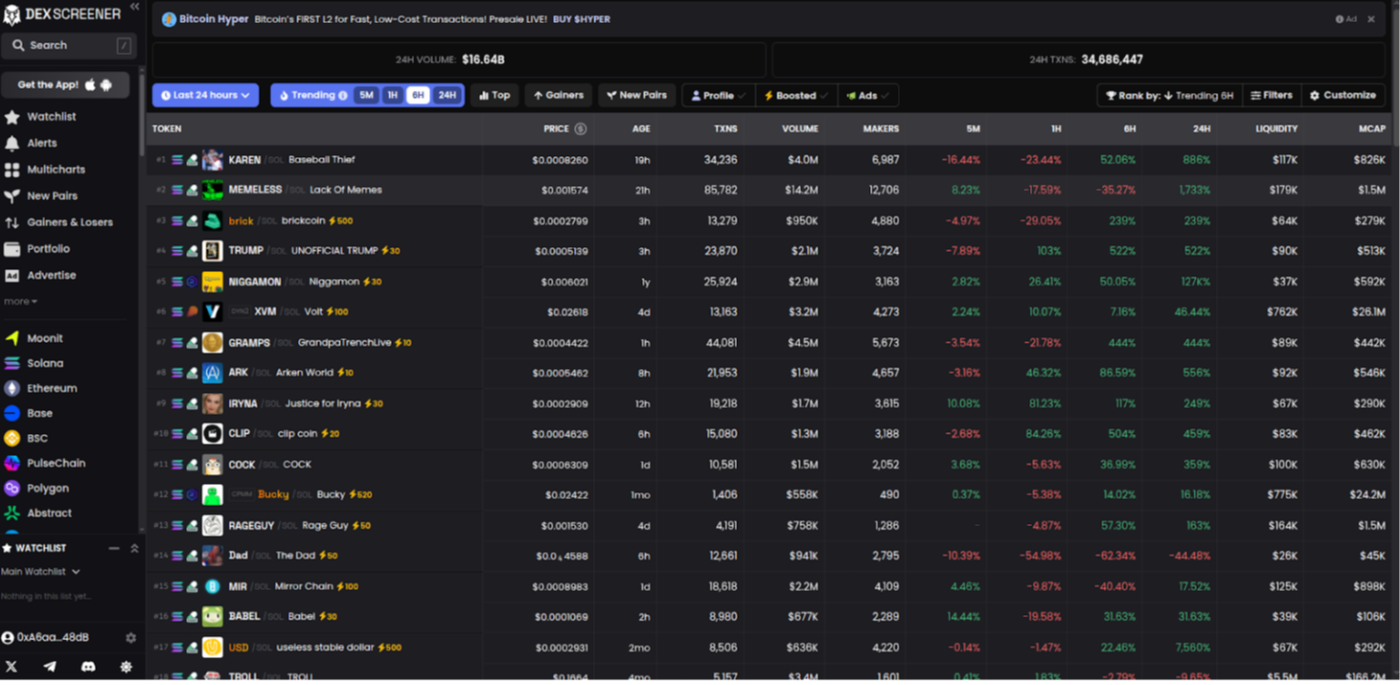
Building a DEXScreener Clone: A Step-by-Step Guide

Building a DEXScreener Clone: A Step-by-Step Guide

DEX Screener is used by crypto traders who need access to on-chain data like trading volumes, liquidity, and token prices. This information allows them to analyze trends, monitor new listings, and make informed investment decisions. In this tutorial, I will build a DEXScreener clone from scratch, covering everything from the initial design to a functional app. We will use Streamlit, a Python framework for building full-stack apps.
Share
Hackernoon2025/09/18 15:05
China Blocks Nvidia’s RTX Pro 6000D as Local Chips Rise

China Blocks Nvidia’s RTX Pro 6000D as Local Chips Rise

The post China Blocks Nvidia’s RTX Pro 6000D as Local Chips Rise appeared on BitcoinEthereumNews.com. China Blocks Nvidia’s RTX Pro 6000D as Local Chips Rise China’s internet regulator has ordered the country’s biggest technology firms, including Alibaba and ByteDance, to stop purchasing Nvidia’s RTX Pro 6000D GPUs. According to the Financial Times, the move shuts down the last major channel for mass supplies of American chips to the Chinese market. Why Beijing Halted Nvidia Purchases Chinese companies had planned to buy tens of thousands of RTX Pro 6000D accelerators and had already begun testing them in servers. But regulators intervened, halting the purchases and signaling stricter controls than earlier measures placed on Nvidia’s H20 chip. Image: Nvidia An audit compared Huawei and Cambricon processors, along with chips developed by Alibaba and Baidu, against Nvidia’s export-approved products. Regulators concluded that Chinese chips had reached performance levels comparable to the restricted U.S. models. This assessment pushed authorities to advise firms to rely more heavily on domestic processors, further tightening Nvidia’s already limited position in China. China’s Drive Toward Tech Independence The decision highlights Beijing’s focus on import substitution — developing self-sufficient chip production to reduce reliance on U.S. supplies. “The signal is now clear: all attention is focused on building a domestic ecosystem,” said a representative of a leading Chinese tech company. Nvidia had unveiled the RTX Pro 6000D in July 2025 during CEO Jensen Huang’s visit to Beijing, in an attempt to keep a foothold in China after Washington restricted exports of its most advanced chips. But momentum is shifting. Industry sources told the Financial Times that Chinese manufacturers plan to triple AI chip production next year to meet growing demand. They believe “domestic supply will now be sufficient without Nvidia.” What It Means for the Future With Huawei, Cambricon, Alibaba, and Baidu stepping up, China is positioning itself for long-term technological independence. Nvidia, meanwhile, faces…
Share
BitcoinEthereumNews2025/09/18 01:37
Ripple-Backed Evernorth Faces $220M Loss on XRP Holdings Amid Market Slump

Ripple-Backed Evernorth Faces $220M Loss on XRP Holdings Amid Market Slump

TLDR Evernorth invested $947M in XRP, now valued at $724M, a loss of over $220M. XRP’s price dropped 16% in the last 30 days, leading to Evernorth’s paper losses
Share
Coincentral2025/12/26 03:56