Bhutan’s latest Bitcoin transfers have revived one of the market’s more unusual sovereign-BTC questions: is the kingdom still mining, or is it now mainly sellingBhutan’s latest Bitcoin transfers have revived one of the market’s more unusual sovereign-BTC questions: is the kingdom still mining, or is it now mainly selling

Has Bhutan Stopped Mining Bitcoin? New BTC Moves Fuel Fresh Questions

2026/03/20 00:00
3 min read
For feedback or concerns regarding this content, please contact us at crypto.news@mexc.com

Bhutan’s latest Bitcoin transfers have revived one of the market’s more unusual sovereign-BTC questions: is the kingdom still mining, or is it now mainly selling from an older reserve? Arkham said wallets tied to Bhutan moved another $44.44 million in BTC, bringing total transfers from those addresses to $72.3 million over 24 hours, while noting that the last Bhutan-linked inflow above $100,000 was seen more than a year ago.

That detail is what turned a routine wallet movement into a bigger story. If the identified wallets are no longer receiving fresh mining rewards, the obvious interpretation is that Bhutan’s state-backed mining operation may have slowed or stopped. Arkham pushed that line directly, asking whether Bhutan had halted mining after highlighting repeated outbound transfers and the long gap in visible inflows.

The selling pattern itself is not new. Arkham had already flagged another $27.8 million BTC transfer a day earlier and said Bhutan had also moved $11 million last week, with roughly that same amount sent to an address previously used in similar transactions. According to Arkham, Bhutan has periodically sold portions of its Bitcoin in clips of roughly $5 million to $10 million, with a particularly active phase around mid-to-late September 2025.

Has Bhutan Really Stopped Bitcoin Mining?

Still, the on-chain evidence does not settle the question on its own. Bhutan kept its mining activity secret for years. It only became public through investigations tied to the bankruptcies of Celsius and BlockFi. That history leaves open a more cautious interpretation: DHI may still be operating under the radar and routing fresh mining rewards to new, as-yet unidentified wallets. In other words, the absence of inflows to the known addresses does not necessarily prove the mining has ended.

Another possible explanation is seasonality. Bhutan’s mining model is tightly linked to hydropower, and the country’s electricity production is highly dependent on weather patterns and the time of year. During the winter months, lower rainfall and reduced water levels can lead to a marked decline in power generation. In the summer, by contrast, Bhutan produces large energy surpluses. In that case, the absence of fresh inflows could reflect a seasonal drop in the amount of surplus electricity available for mining.

That distinction matters because Bhutan has never presented Bitcoin as a short-term trade. In a public statement tied to Gelephu Mindfulness City, the country said, “Bitcoin is not being held as an object of speculation. It is being set aside with purpose. This is not an experiment. It is a commitment.” Those lines suggested a strategic, state-level view of Bitcoin tied to Bhutan’s broader economic and energy model rather than opportunistic treasury management.

Even so, the recent flows raise legitimate questions about what that strategy now looks like in practice. If Bhutan is still mining, it may simply be doing so through wallets that are no longer publicly linked to the operation. If it is not, then the current transfers look less like portfolio rotation and more like continued reserve monetization from a stockpile accumulated over earlier years of hydro-powered mining.

The deeper point is not just whether Bhutan sold another tranche of BTC. It is that one of the world’s most closely watched sovereign Bitcoin holders has become harder to read at exactly the moment its visible wallets show distribution, not accumulation. Until new inflows appear or new wallet infrastructure is identified, the question Arkham raised will remain open: not whether Bhutan is moving Bitcoin, but whether it is still producing it.

At press time, BTC traded at $70,394.
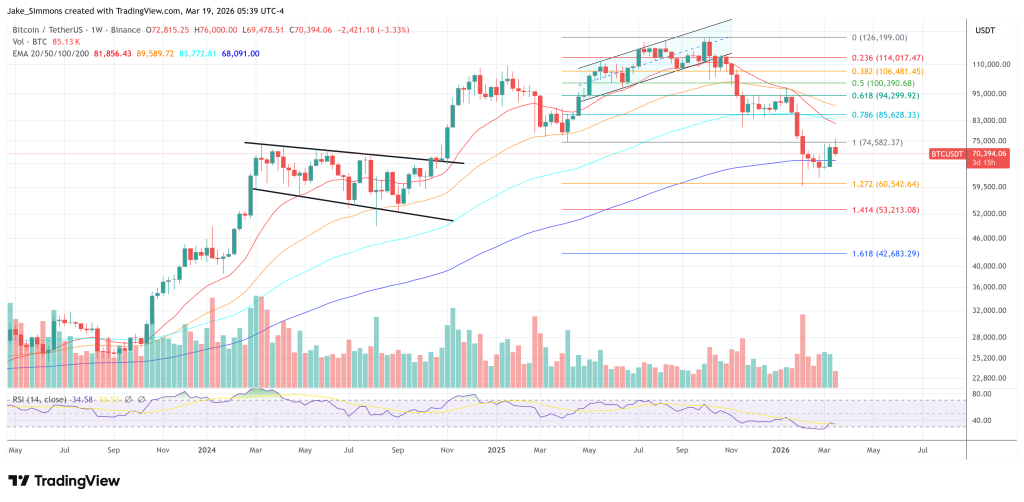
Bitcoin price chart
Market Opportunity
Bitcoin Logo
Bitcoin Price(BTC)
$70,137.67
$70,137.67$70,137.67
+1.05%
USD
Bitcoin (BTC) Live Price Chart
Disclaimer: The articles reposted on this site are sourced from public platforms and are provided for informational purposes only. They do not necessarily reflect the views of MEXC. All rights remain with the original authors. If you believe any content infringes on third-party rights, please contact crypto.news@mexc.com for removal. MEXC makes no guarantees regarding the accuracy, completeness, or timeliness of the content and is not responsible for any actions taken based on the information provided. The content does not constitute financial, legal, or other professional advice, nor should it be considered a recommendation or endorsement by MEXC.

You May Also Like

World Gold Council’s Pivotal Framework Promises Unprecedented Market Trust

World Gold Council’s Pivotal Framework Promises Unprecedented Market Trust

The post World Gold Council’s Pivotal Framework Promises Unprecedented Market Trust appeared on BitcoinEthereumNews.com. Tokenized Gold Revolution: World Gold Council
Share
BitcoinEthereumNews2026/03/20 03:58
Aave DAO to Shut Down 50% of L2s While Doubling Down on GHO
Aave DAO to Shut Down 50% of L2s While Doubling Down on GHO

The post Aave DAO to Shut Down 50% of L2s While Doubling Down on GHO appeared on BitcoinEthereumNews.com. Aave DAO is gearing up for a significant overhaul by shutting down over 50% of underperforming L2 instances. It is also restructuring its governance framework and deploying over $100 million to boost GHO. This could be a pivotal moment that propels Aave back to the forefront of on-chain lending or sparks unprecedented controversy within the DeFi community. Sponsored Sponsored ACI Proposes Shutting Down 50% of L2s The “State of the Union” report by the Aave Chan Initiative (ACI) paints a candid picture. After a turbulent period in the DeFi market and internal challenges, Aave (AAVE) now leads in key metrics: TVL, revenue, market share, and borrowing volume. Aave’s annual revenue of $130 million surpasses the combined cash reserves of its competitors. Tokenomics improvements and the AAVE token buyback program have also contributed to the ecosystem’s growth. Aave global metrics. Source: Aave However, the ACI’s report also highlights several pain points. First, regarding the Layer-2 (L2) strategy. While Aave’s L2 strategy was once a key driver of success, it is no longer fit for purpose. Over half of Aave’s instances on L2s and alt-L1s are not economically viable. Based on year-to-date data, over 86.6% of Aave’s revenue comes from the mainnet, indicating that everything else is a side quest. On this basis, ACI proposes closing underperforming networks. The DAO should invest in key networks with significant differentiators. Second, ACI is pushing for a complete overhaul of the “friendly fork” framework, as most have been unimpressive regarding TVL and revenue. In some cases, attackers have exploited them to Aave’s detriment, as seen with Spark. Sponsored Sponsored “The friendly fork model had a good intention but bad execution where the DAO was too friendly towards these forks, allowing the DAO only little upside,” the report states. Third, the instance model, once a smart…
Share
BitcoinEthereumNews2025/09/18 02:28
Shiba Inu Price Prediction 2026: SHIB Fights to Reclaim Its Glory While Pepeto Offers the 150x Early Window That SHIB Already Closed

Shiba Inu Price Prediction 2026: SHIB Fights to Reclaim Its Glory While Pepeto Offers the 150x Early Window That SHIB Already Closed

A truck driver put $650 into Shiba Inu in 2020 and quit his job after his bag grew to $1.7 million. Two brothers invested $7,900 during the COVID lockdowns and
Share
Blockonomi2026/03/20 04:32