The meme coin market has seen countless projects come and go, most of them built on borrowed imagery and hype-driven momentum. But history shows that projects without ownership over their story eventually fade either due to legal challenges, lack of brand control, or simply being replaced by the next trending meme. This is where $MANYU […]The meme coin market has seen countless projects come and go, most of them built on borrowed imagery and hype-driven momentum. But history shows that projects without ownership over their story eventually fade either due to legal challenges, lack of brand control, or simply being replaced by the next trending meme. This is where $MANYU […]

MANYU Secures IP Rights: The Black Shiba Inu That’s Building a Legacy

The meme coin market has seen countless projects come and go, most of them built on borrowed imagery and hype-driven momentum. But history shows that projects without ownership over their story eventually fade either due to legal challenges, lack of brand control, or simply being replaced by the next trending meme.

This is where $MANYU has taken a decisive step forward. By officially acquiring its intellectual property (IP) rights, MANYU has separated itself from the noise. This isn’t just about surviving the hype cycle, it’s about building a foundation that can stand the test of time.
Why IP Rights Matter in Crypto

Intellectual property is the bedrock of every great brand. Disney owns Mickey Mouse. Nintendo owns Mario. In crypto, however, many projects operate without that security. The result? Copycats, rug pulls, and missed opportunities for global collaboration.

By locking in IP rights, $MANYU has done what very few meme coins can claim:

  • Full control of its brand identity. No one can misuse or replicate MANYU’s imagery and art.
  • Legal security. Holders are backing a project that has established protections against fraud, exploitation, and theft.
  • Growth potential. With rights secured, collaborations with major brands, gaming platforms, and global companies become possible.
  • Exchange readiness. Top exchanges (especially Tier 1s) look for legal clarity, IP rights make $MANYU a far stronger candidate for listings.

The message is clear: if you don’t own the meme, you don’t own the story. And now, MANYU owns its story in full.

How Other Meme Coins Missed This Step

Most meme coins never reach this milestone, and it has consequences:

  • Doge (DOGE): The iconic Shiba Inu image that sparked DOGE’s rise is public domain. Anyone can use it, which limits DOGE’s ability to monetize or protect its brand.
  • Shiba Inu (SHIB): SHIB built one of the largest meme communities in history, but it does not own the rights to the Shiba Inu breed’s image or likeness. This leaves the project vulnerable to countless imitators.
  • Other Meme Projects: Countless meme tokens borrow IP from existing shows, brands, or viral content. This can create buzz, but it also carries serious legal risks and prevents them from being taken seriously by exchanges or partners.

MANYU has flipped the script. By securing its IP early, it ensures the meme cannot be taken away, misused, or diluted. This positions MANYU as more than just another viral token, it becomes a brand with enforceable rights.

The Process: From Idea to Execution

Acquiring IP rights is not a small task, it required time, resources, and expertise. Here’s what was accomplished to bring MANYU from concept to legally protected brand:

  • Tobias Norman INC Incorporated. The official corporate structure for MANYU was created to manage and expand the project.
  • Onboarding a legal team. A dedicated team of lawyers was brought in to ensure compliance, handle filings, and protect the brand as it expands globally.
  • Registration of IP rights. MANYU’s art, brand, and trademarks are now secured, providing official recognition and protection.
  • Legal opinions. These opinions are critical for working with exchanges and partners, ensuring that utilities, launches, and expansions are compliant.

This process transforms MANYU from a community-driven meme into a business with real protections, long-term planning, and growth potential.

A Blueprint for Bluechip Status

With IP rights secured, MANYU is no longer just a project competing for attention on social feeds. It’s now in a position to build out an ecosystem that rivals established brands.

Here’s what this unlocks:

  • Scaling as a brand. From merchandise to mainstream media, MANYU can confidently expand without legal risk.
  • Protection. The community’s investment is tied to a project with safeguards in place.
  • Strategic collaborations. Partnerships with major companies, gaming studios, and cultural icons are now possible.
  • Tier 1 listings. Exchanges prioritize projects with clarity and compliance, IP protection makes $MANYU stand out.

It’s why CoinMarketCap has already listed MANYU in its IP Memes section, recognizing it as a project that has gone further than most in securing its legacy.

Why This Changes the Game

The acquisition of IP rights is a signal, to investors, to exchanges, and to the broader crypto community, that MANYU isn’t here for a temporary pump. It’s here to lead, scale, and cement itself as the flagship Shiba Inu of Ethereum.

This is the beginning of a new chapter. MANYU is no longer just a meme coin riding virality, it’s a protected, recognized, and expandable brand with the resources to build an entire ecosystem around it.

Conclusion: More Than a Meme

Crypto has seen countless memes rise and fall. But memes that become brands, that’s where legacies are born. By securing its IP rights, $MANYU has crossed that threshold.

This move is more than paperwork. It’s proof of intent. Proof that the team is serious about building, scaling, and giving holders something more valuable than just hype: a brand with global reach and staying power.

$MANYU isn’t just another token in the endless meme wave.
It’s the black Shiba Inu building its legacy, one that can’t be copied, stolen, or forgotten.

Disclaimer: The above article is sponsored content; it’s written by a third party. CryptoPotato doesn’t endorse or assume responsibility for the content, advertising, products, quality, accuracy, or other materials on this page. Nothing in it should be construed as financial advice. Readers are strongly advised to verify the information independently and carefully before engaging with any company or project mentioned and do their own research. Investing in cryptocurrencies carries a risk of capital loss, and readers are also advised to consult a professional before making any decisions that may or may not be based on the above-sponsored content.

Readers are also advised to read CryptoPotato’s full disclaimer.

The post MANYU Secures IP Rights: The Black Shiba Inu That’s Building a Legacy appeared first on CryptoPotato.

Market Opportunity
Hyperliquid Logo
Hyperliquid Price(HYPE)
$24.27
$24.27$24.27
-1.82%
USD
Hyperliquid (HYPE) Live Price Chart
Disclaimer: The articles reposted on this site are sourced from public platforms and are provided for informational purposes only. They do not necessarily reflect the views of MEXC. All rights remain with the original authors. If you believe any content infringes on third-party rights, please contact service@support.mexc.com for removal. MEXC makes no guarantees regarding the accuracy, completeness, or timeliness of the content and is not responsible for any actions taken based on the information provided. The content does not constitute financial, legal, or other professional advice, nor should it be considered a recommendation or endorsement by MEXC.

You May Also Like

U.S. Coinbase Premium Turns Negative Amid Asian Buying Surge
U.S. Coinbase Premium Turns Negative Amid Asian Buying Surge

U.S. institutional demand falls as Asian markets buy Bitcoin dips, causing negative Coinbase premium.
Share
CoinLive2025/12/23 14:20
Crucial ETH Unstaking Period: Vitalik Buterin’s Unwavering Defense for Network Security

Crucial ETH Unstaking Period: Vitalik Buterin’s Unwavering Defense for Network Security

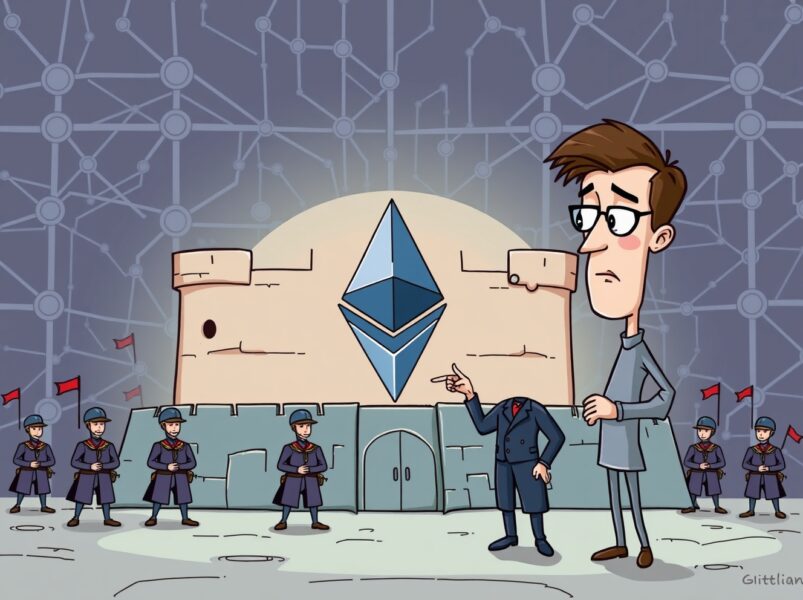
BitcoinWorld Crucial ETH Unstaking Period: Vitalik Buterin’s Unwavering Defense for Network Security Ever wondered why withdrawing your staked Ethereum (ETH) isn’t an instant process? It’s a question that often sparks debate within the crypto community. Ethereum founder Vitalik Buterin recently stepped forward to defend the network’s approximately 45-day ETH unstaking period, asserting its crucial role in safeguarding the network’s integrity. This lengthy waiting time, while sometimes seen as an inconvenience, is a deliberate design choice with profound implications for security. Why is the ETH Unstaking Period a Vital Security Measure? Vitalik Buterin’s defense comes amidst comparisons to other networks, like Solana, which boast significantly shorter unstaking times. He drew a compelling parallel to military operations, explaining that an army cannot function effectively if its soldiers can simply abandon their posts at a moment’s notice. Similarly, a blockchain network requires a stable and committed validator set to maintain its security. The current ETH unstaking period isn’t merely an arbitrary delay. It acts as a critical buffer, providing the network with sufficient time to detect and respond to potential malicious activities. If validators could instantly exit, it would open doors for sophisticated attacks, jeopardizing the entire system. Currently, Ethereum boasts over one million active validators, collectively staking approximately 35.6 million ETH, representing about 30% of the total supply. This massive commitment underpins the network’s robust security model, and the unstaking period helps preserve this stability. Network Security: Ethereum’s Paramount Concern A shorter ETH unstaking period might seem appealing for liquidity, but it introduces significant risks. Imagine a scenario where a large number of validators, potentially colluding, could quickly withdraw their stake after committing a malicious act. Without a substantial delay, the network would have limited time to penalize them or mitigate the damage. This “exit queue” mechanism is designed to prevent sudden validator exodus, which could lead to: Reduced decentralization: A rapid drop in active validators could concentrate power among fewer participants. Increased vulnerability to attacks: A smaller, less stable validator set is easier to compromise. Network instability: Frequent and unpredictable changes in validator numbers can lead to performance issues and consensus failures. Therefore, the extended period is not a bug; it’s a feature. It’s a calculated trade-off between immediate liquidity for stakers and the foundational security of the entire Ethereum ecosystem. Ethereum vs. Solana: Different Approaches to Unstaking When discussing the ETH unstaking period, many point to networks like Solana, which offers a much quicker two-day unstaking process. While this might seem like an advantage for stakers seeking rapid access to their funds, it reflects fundamental differences in network architecture and security philosophies. Solana’s design prioritizes speed and immediate liquidity, often relying on different consensus mechanisms and validator economics to manage security risks. Ethereum, on the other hand, with its proof-of-stake evolution from proof-of-work, has adopted a more cautious approach to ensure its transition and long-term stability are uncompromised. Each network makes design choices based on its unique goals and threat models. Ethereum’s substantial value and its role as a foundational layer for countless dApps necessitate an extremely robust security posture, making the current unstaking duration a deliberate and necessary component. What Does the ETH Unstaking Period Mean for Stakers? For individuals and institutions staking ETH, understanding the ETH unstaking period is crucial for managing expectations and investment strategies. It means that while staking offers attractive rewards, it also comes with a commitment to the network’s long-term health. Here are key considerations for stakers: Liquidity Planning: Stakers should view their staked ETH as a longer-term commitment, not immediately liquid capital. Risk Management: The delay inherently reduces the ability to react quickly to market volatility with staked assets. Network Contribution: By participating, stakers contribute directly to the security and decentralization of Ethereum, reinforcing its value proposition. While the current waiting period may not be “optimal” in every sense, as Buterin acknowledged, simply shortening it without addressing the underlying security implications would be a dangerous gamble for the network’s reliability. In conclusion, Vitalik Buterin’s defense of the lengthy ETH unstaking period underscores a fundamental principle: network security cannot be compromised for the sake of convenience. It is a vital mechanism that protects Ethereum’s integrity, ensuring its stability and trustworthiness as a leading blockchain platform. This deliberate design choice, while requiring patience from stakers, ultimately fortifies the entire ecosystem against potential threats, paving the way for a more secure and reliable decentralized future. Frequently Asked Questions (FAQs) Q1: What is the main reason for Ethereum’s long unstaking period? A1: The primary reason is network security. A lengthy ETH unstaking period prevents malicious actors from quickly withdrawing their stake after an attack, giving the network time to detect and penalize them, thus maintaining stability and integrity. Q2: How long is the current ETH unstaking period? A2: The current ETH unstaking period is approximately 45 days. This duration can fluctuate based on network conditions and the number of validators in the exit queue. Q3: How does Ethereum’s unstaking period compare to other blockchains? A3: Ethereum’s unstaking period is notably longer than some other networks, such as Solana, which has a two-day period. This difference reflects varying network architectures and security priorities. Q4: Does the unstaking period affect ETH stakers? A4: Yes, it means stakers need to plan their liquidity carefully, as their staked ETH is not immediately accessible. It encourages a longer-term commitment to the network, aligning staker interests with Ethereum’s stability. Q5: Could the ETH unstaking period be shortened in the future? A5: While Vitalik Buterin acknowledged the current period might not be “optimal,” any significant shortening would likely require extensive research and network upgrades to ensure security isn’t compromised. For now, the focus remains on maintaining robust network defenses. Found this article insightful? Share it with your friends and fellow crypto enthusiasts on social media to spread awareness about the critical role of the ETH unstaking period in Ethereum’s security! To learn more about the latest Ethereum trends, explore our article on key developments shaping Ethereum’s institutional adoption. This post Crucial ETH Unstaking Period: Vitalik Buterin’s Unwavering Defense for Network Security first appeared on BitcoinWorld.
Share
Coinstats2025/09/18 15:30
USD/JPY jumps to near 148.30 as Fed Powell’s caution on rate cuts boosts US Dollar

USD/JPY jumps to near 148.30 as Fed Powell’s caution on rate cuts boosts US Dollar

The post USD/JPY jumps to near 148.30 as Fed Powell’s caution on rate cuts boosts US Dollar appeared on BitcoinEthereumNews.com. USD/JPY climbs to near 148.30 as Fed’s Powell didn’t endorse aggressive dovish stance. Fed’s Powell warns of slowing job demand and upside inflation risks. Japan’s Jibun Bank Manufacturing PMI declines at a faster pace in September. The USD/JPY pair trades 0.45% higher to near 148.30 during the European trading session on Wednesday. The pair gains sharply as the US Dollar (USD) outperforms a majority of its peers, following comments from Federal Reserve (Fed) Chair Jerome Powell that the central bank needs to be cautious on further interest rate cuts. During the press time, the US Dollar Index (DXY), which tracks the Greenback’s value against six major currencies, rises almost 0.4% to near 97.60. The USD Index resumes its upside journey after a two-day corrective move. On Tuesday, Fed’s Powell stated at the Greater Providence Chamber of Commerce that the upside inflation risks and labor market concerns have posed a challenging situation for the central bank, which is prompting officials to exercise caution on further monetary policy easing. Powell also stated that the current interest rate range is “well positioned to respond to potential economic developments”. Fed Powell’s comments were similar to statements from Federal Open Market Committee (FOMC) members St. Louis Fed President Alberto Musalem, Atlanta Fed President Raphael Bostic, and Cleveland Fed President Beth Hammack who stated on Monday that the central bank needs to cautious over unwinding monetary policy restrictiveness further, citing persistent inflation risks. Going forward, investors will focus on the US Durable Goods Orders and Personal Consumption Expenditure Price Index (PCE) data for August, which will be released on Thursday and Friday, respectively. In Japan, the manufacturing business activity has declined again in September. Preliminary Jibun Bank Manufacturing PMI data came in lower at 48.4 against 49.7 in August. Economists had anticipated the Manufacturing PMI to…
Share
BitcoinEthereumNews2025/09/25 01:31
