Bloomberg Intelligence exchange-traded fund (ETF) analyst James Seyffart has compiled a comprehensive roster of dozens of crypto ETF proposals now parked at the U.S. Securities and Exchange Commission (SEC), spanning Nasdaq, NYSE Arca, and Cboe and covering products tied to bitcoin, ethereum, and a wide slate of altcoins. Issuers Crowd SEC Docket With Crypto ETF […]Bloomberg Intelligence exchange-traded fund (ETF) analyst James Seyffart has compiled a comprehensive roster of dozens of crypto ETF proposals now parked at the U.S. Securities and Exchange Commission (SEC), spanning Nasdaq, NYSE Arca, and Cboe and covering products tied to bitcoin, ethereum, and a wide slate of altcoins. Issuers Crowd SEC Docket With Crypto ETF […]

Dozens of Crypto ETFs Sit in SEC Queue, Bloomberg’s Seyffart Shows

Bloomberg Intelligence exchange-traded fund (ETF) analyst James Seyffart has compiled a comprehensive roster of dozens of crypto ETF proposals now parked at the U.S. Securities and Exchange Commission (SEC), spanning Nasdaq, NYSE Arca, and Cboe and covering products tied to bitcoin, ethereum, and a wide slate of altcoins.

Issuers Crowd SEC Docket With Crypto ETF Filings: James Seyffart

Seyffart‘s image shared on X opens with multi-asset baskets and dual-coin funds. Hashdex seeks to list two “Nasdaq Crypto Index” products on Nasdaq—both baskets combining bitcoin and ethereum—while Franklin Templeton and Bitwise have parallel bitcoin-and-ethereum baskets aiming to list on NYSE Arca/Cboe as shown in Seyffart’s table. Grayscale’s Digital Large Cap conversion (GDLC) is also queued as a basket conversion. These headline filings signal that plain-vanilla, diversified crypto exposure remains a core part of the pipeline alongside the single-asset wave.
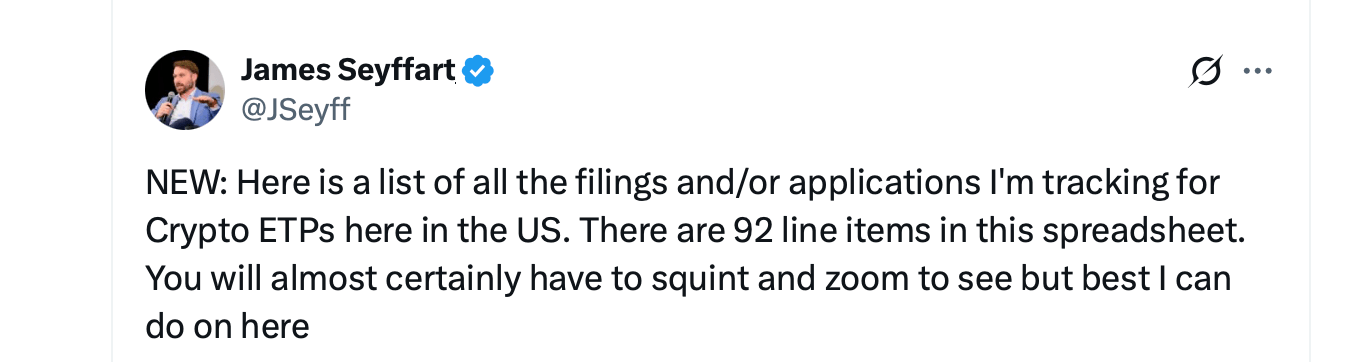
Dozens of Crypto ETFs Sit in SEC Queue, Bloomberg’s Seyffart Shows

Single-asset conversions and spot proposals dominate the middle of Seyffart’s chart. Grayscale has conversion filings for litecoin, solana, XRP, avalanche, hedera, and polkadot trusts, mirroring its current lineup, with Seyffart’s image showing NYSE Arca or Cboe as the proposed venues. Canary appears repeatedly as a placeholder filer across several single-asset spot concepts (including LTC, SOL, XRP, HBAR, and SUI), illustrating the breadth of “shell” registrations that keep optionality open while sponsors finalize partners and service providers. Coinshares, Franklin Templeton, Fidelity, Invesco and Galaxy, Vaneck, 21shares, and Wisdomtree each appear with their own SOL or XRP spot ETFs slated for Nasdaq, NYSE Arca, or Cboe.

The SOL and XRP tranche is the largest cluster. Vaneck’s Solana Trust, 21shares’ Core Solana ETF, Bitwise’s Solana ETF, Franklin Templeton’s Solana ETF, Fidelity’s Solana ETF, and the Invesco/Galaxy Solana ETF are all present; on the XRP side, the roster includes conversions and spot ETFs from Grayscale, Bitwise, 21shares, Coinshares, Franklin Templeton, and Wisdomtree, plus Canary placeholder entries. Seyffart’s image shows solana and XRP as the most frequently targeted altcoins among the 92 applications.

Beyond those two altcoins, there are also filings tied to cardano, avalanche, polkadot, and hedera. Grayscale’s Cardano Trust conversion appears, and a Vaneck Avalanche product is listed alongside a Grayscale Avalanche conversion; Bitwise has dedicated DOGE and Aptos entries, and the table notes a 21shares Polkadot ETF as well. These single-asset spot filings sit next to “American-made crypto basket” concepts and a Kraneshares “CF Large Cap Crypto” basket, reflecting a mix of index and single-coin approaches.

The list also captures ethereum (ETH)-specific structures. Alongside traditional spot ETH (and previously approved Ether ETFs), the sheet shows an “Ethereum ETF Options (ETHA)” concept and an “ethereum staking” wrapper from 21shares/Cboe and a parallel staking-enabled approach from Grayscale on NYSE Arca, indicating issuers are testing SEC tolerance for yield-bearing constructs within the ETF format. Final-decision dates in the table extend into October, with earlier deadlines delayed, consistent with recent coverage of the SEC’s review cadence.

Several entries on the image relate to conversions of existing over-the-counter (OTC) products. Osprey’s OBTC conversion appears on the sheet, alongside Grayscale’s conversions noted above, positioning those issuers to move long-standing trusts into the 1933/1934 Act ETF chassis pending exchange rule approvals (19b-4s) where required. The chart’s legend reminds readers that 1940 Act funds (derivatives-based) do not need 19b-4 approvals; that’s why many leveraged or inverse products in the lower half show no exchange rule filing.

Newcomer filings tied to Truth/Yorkville appear repeatedly: “Truth Social Bitcoin ETF” and a “Crypto Blue Chip ETF,” plus “Crypto ETP generic listing standards” stubs, all assigned to NYSE Arca or Cboe in the image. Those indicate an attempt to pre-clear templated rules for broader crypto ETP listing—an approach exchanges have used in other asset classes to streamline approvals after the first product clears.

The derivatives and levered cohort is quite extensive and mostly in the 1940 Act lane. Proshares appears with a set of solana ( SOL) and XRP futures-based ETFs including “Short Solana,” “-2X Solana,” “2X Solana,” “-2X XRP” and “2X XRP.” Teucrium adds “2X XRP” and “-2X XRP,” and Tuttle Capital floods the bottom block with “2X” funds tied to XRP, SOL, TRUMP, DOGE, MELANIA, BNB, BONK, ADA, LINK, and DOT. The sheet marks these as 1940 Act filings (no 19b-4), and one green date shows the SEC has already signed off on a 2X SOL product earlier this year.

REX-OSPREY’s shelf covers “ ETH + Staking,” BTC, SOL, XRP, BONK, DOGE and a TRUMP-themed product, all in the derivatives bucket. Separately, Bitwise shows Chainlink and NEAR proposals, a standalone Aptos ETF, and a Polkadot entry, while Vaneck’s column includes BNB and a SOL product (plus Avalanche). 21shares adds SUI and ONDO besides its SOL and XRP filings. The repeated presence of Coinbase-centric or “digital asset” baskets—Kraneshares “Coinbase 50 Index,” Coinshares “Digital Asset ETF,” and Canary’s “AXL” entry—rounds out the breadth.

The right-hand columns of Seyffart’s table track prospectus dates, 19b-4 submission dates, and first/second/third/final decision deadlines. Many entries show red dates denoting delays; a legend notes that green dates reflect approvals and yellow cells denote items in limbo. The overall count—92—has been cited across industry coverage in recent months and reflects a notable expansion from filings filed last year.

Read at face value, the slate suggests three parallel paths: continued maturation of spot products (beyond bitcoin and ethereum), conversion of legacy trusts into ETFs, and a broad, derivatives-based layer designed to give registered access to more niche exposures. Whether many of the single-asset altcoin funds ultimately list will hinge on exchange surveillance-sharing, custody arrangements, and the SEC’s comfort with market quality—issues that have guided recent deferrals and fueled staggered timelines across the table.

If approved in meaningful numbers, these filings would extend the ETF market beyond bitcoin and ethereum into a menu that includes solana, XRP, cardano, avalanche, hedera, polkadot, chainlink, NEAR, aptos, sui, BNB, and more, across Nasdaq, NYSE Arca, and Cboe.

Market Opportunity
FUND Logo
FUND Price(FUND)
$0.00921
$0.00921$0.00921
0.00%
USD
FUND (FUND) Live Price Chart
Disclaimer: The articles reposted on this site are sourced from public platforms and are provided for informational purposes only. They do not necessarily reflect the views of MEXC. All rights remain with the original authors. If you believe any content infringes on third-party rights, please contact service@support.mexc.com for removal. MEXC makes no guarantees regarding the accuracy, completeness, or timeliness of the content and is not responsible for any actions taken based on the information provided. The content does not constitute financial, legal, or other professional advice, nor should it be considered a recommendation or endorsement by MEXC.

You May Also Like

U.S. Coinbase Premium Turns Negative Amid Asian Buying Surge

U.S. Coinbase Premium Turns Negative Amid Asian Buying Surge

U.S. institutional demand falls as Asian markets buy Bitcoin dips, causing negative Coinbase premium.
Share
CoinLive2025/12/23 14:20
Crucial ETH Unstaking Period: Vitalik Buterin’s Unwavering Defense for Network Security

Crucial ETH Unstaking Period: Vitalik Buterin’s Unwavering Defense for Network Security

BitcoinWorld Crucial ETH Unstaking Period: Vitalik Buterin’s Unwavering Defense for Network Security Ever wondered why withdrawing your staked Ethereum (ETH) isn’t an instant process? It’s a question that often sparks debate within the crypto community. Ethereum founder Vitalik Buterin recently stepped forward to defend the network’s approximately 45-day ETH unstaking period, asserting its crucial role in safeguarding the network’s integrity. This lengthy waiting time, while sometimes seen as an inconvenience, is a deliberate design choice with profound implications for security. Why is the ETH Unstaking Period a Vital Security Measure? Vitalik Buterin’s defense comes amidst comparisons to other networks, like Solana, which boast significantly shorter unstaking times. He drew a compelling parallel to military operations, explaining that an army cannot function effectively if its soldiers can simply abandon their posts at a moment’s notice. Similarly, a blockchain network requires a stable and committed validator set to maintain its security. The current ETH unstaking period isn’t merely an arbitrary delay. It acts as a critical buffer, providing the network with sufficient time to detect and respond to potential malicious activities. If validators could instantly exit, it would open doors for sophisticated attacks, jeopardizing the entire system. Currently, Ethereum boasts over one million active validators, collectively staking approximately 35.6 million ETH, representing about 30% of the total supply. This massive commitment underpins the network’s robust security model, and the unstaking period helps preserve this stability. Network Security: Ethereum’s Paramount Concern A shorter ETH unstaking period might seem appealing for liquidity, but it introduces significant risks. Imagine a scenario where a large number of validators, potentially colluding, could quickly withdraw their stake after committing a malicious act. Without a substantial delay, the network would have limited time to penalize them or mitigate the damage. This “exit queue” mechanism is designed to prevent sudden validator exodus, which could lead to: Reduced decentralization: A rapid drop in active validators could concentrate power among fewer participants. Increased vulnerability to attacks: A smaller, less stable validator set is easier to compromise. Network instability: Frequent and unpredictable changes in validator numbers can lead to performance issues and consensus failures. Therefore, the extended period is not a bug; it’s a feature. It’s a calculated trade-off between immediate liquidity for stakers and the foundational security of the entire Ethereum ecosystem. Ethereum vs. Solana: Different Approaches to Unstaking When discussing the ETH unstaking period, many point to networks like Solana, which offers a much quicker two-day unstaking process. While this might seem like an advantage for stakers seeking rapid access to their funds, it reflects fundamental differences in network architecture and security philosophies. Solana’s design prioritizes speed and immediate liquidity, often relying on different consensus mechanisms and validator economics to manage security risks. Ethereum, on the other hand, with its proof-of-stake evolution from proof-of-work, has adopted a more cautious approach to ensure its transition and long-term stability are uncompromised. Each network makes design choices based on its unique goals and threat models. Ethereum’s substantial value and its role as a foundational layer for countless dApps necessitate an extremely robust security posture, making the current unstaking duration a deliberate and necessary component. What Does the ETH Unstaking Period Mean for Stakers? For individuals and institutions staking ETH, understanding the ETH unstaking period is crucial for managing expectations and investment strategies. It means that while staking offers attractive rewards, it also comes with a commitment to the network’s long-term health. Here are key considerations for stakers: Liquidity Planning: Stakers should view their staked ETH as a longer-term commitment, not immediately liquid capital. Risk Management: The delay inherently reduces the ability to react quickly to market volatility with staked assets. Network Contribution: By participating, stakers contribute directly to the security and decentralization of Ethereum, reinforcing its value proposition. While the current waiting period may not be “optimal” in every sense, as Buterin acknowledged, simply shortening it without addressing the underlying security implications would be a dangerous gamble for the network’s reliability. In conclusion, Vitalik Buterin’s defense of the lengthy ETH unstaking period underscores a fundamental principle: network security cannot be compromised for the sake of convenience. It is a vital mechanism that protects Ethereum’s integrity, ensuring its stability and trustworthiness as a leading blockchain platform. This deliberate design choice, while requiring patience from stakers, ultimately fortifies the entire ecosystem against potential threats, paving the way for a more secure and reliable decentralized future. Frequently Asked Questions (FAQs) Q1: What is the main reason for Ethereum’s long unstaking period? A1: The primary reason is network security. A lengthy ETH unstaking period prevents malicious actors from quickly withdrawing their stake after an attack, giving the network time to detect and penalize them, thus maintaining stability and integrity. Q2: How long is the current ETH unstaking period? A2: The current ETH unstaking period is approximately 45 days. This duration can fluctuate based on network conditions and the number of validators in the exit queue. Q3: How does Ethereum’s unstaking period compare to other blockchains? A3: Ethereum’s unstaking period is notably longer than some other networks, such as Solana, which has a two-day period. This difference reflects varying network architectures and security priorities. Q4: Does the unstaking period affect ETH stakers? A4: Yes, it means stakers need to plan their liquidity carefully, as their staked ETH is not immediately accessible. It encourages a longer-term commitment to the network, aligning staker interests with Ethereum’s stability. Q5: Could the ETH unstaking period be shortened in the future? A5: While Vitalik Buterin acknowledged the current period might not be “optimal,” any significant shortening would likely require extensive research and network upgrades to ensure security isn’t compromised. For now, the focus remains on maintaining robust network defenses. Found this article insightful? Share it with your friends and fellow crypto enthusiasts on social media to spread awareness about the critical role of the ETH unstaking period in Ethereum’s security! To learn more about the latest Ethereum trends, explore our article on key developments shaping Ethereum’s institutional adoption. This post Crucial ETH Unstaking Period: Vitalik Buterin’s Unwavering Defense for Network Security first appeared on BitcoinWorld.
Share
Coinstats2025/09/18 15:30
USD/JPY jumps to near 148.30 as Fed Powell’s caution on rate cuts boosts US Dollar

USD/JPY jumps to near 148.30 as Fed Powell’s caution on rate cuts boosts US Dollar

The post USD/JPY jumps to near 148.30 as Fed Powell’s caution on rate cuts boosts US Dollar appeared on BitcoinEthereumNews.com. USD/JPY climbs to near 148.30 as Fed’s Powell didn’t endorse aggressive dovish stance. Fed’s Powell warns of slowing job demand and upside inflation risks. Japan’s Jibun Bank Manufacturing PMI declines at a faster pace in September. The USD/JPY pair trades 0.45% higher to near 148.30 during the European trading session on Wednesday. The pair gains sharply as the US Dollar (USD) outperforms a majority of its peers, following comments from Federal Reserve (Fed) Chair Jerome Powell that the central bank needs to be cautious on further interest rate cuts. During the press time, the US Dollar Index (DXY), which tracks the Greenback’s value against six major currencies, rises almost 0.4% to near 97.60. The USD Index resumes its upside journey after a two-day corrective move. On Tuesday, Fed’s Powell stated at the Greater Providence Chamber of Commerce that the upside inflation risks and labor market concerns have posed a challenging situation for the central bank, which is prompting officials to exercise caution on further monetary policy easing. Powell also stated that the current interest rate range is “well positioned to respond to potential economic developments”. Fed Powell’s comments were similar to statements from Federal Open Market Committee (FOMC) members St. Louis Fed President Alberto Musalem, Atlanta Fed President Raphael Bostic, and Cleveland Fed President Beth Hammack who stated on Monday that the central bank needs to cautious over unwinding monetary policy restrictiveness further, citing persistent inflation risks. Going forward, investors will focus on the US Durable Goods Orders and Personal Consumption Expenditure Price Index (PCE) data for August, which will be released on Thursday and Friday, respectively. In Japan, the manufacturing business activity has declined again in September. Preliminary Jibun Bank Manufacturing PMI data came in lower at 48.4 against 49.7 in August. Economists had anticipated the Manufacturing PMI to…
Share
BitcoinEthereumNews2025/09/25 01:31
