Traditional perimeter-based security has become obsolete. By 2025, 60% of enterprises will phase out most of their remote access VPNs in favor of ZTNA. IBM’s *CostTraditional perimeter-based security has become obsolete. By 2025, 60% of enterprises will phase out most of their remote access VPNs in favor of ZTNA. IBM’s *Cost

Zero Trust Network Access(ZTNA) Enforcement Using Real Time Risk Scoring & Dynamic Path Segmentation

\ As organizations rapidly embrace cloud services, remote work, and distributed architectures, traditional perimeter-based security has become obsolete. Today’s users, devices, and applications operate far beyond corporate network boundaries—rendering legacy security models ineffective against modern threats.

According to Gartner, by 2025, 60% of enterprises will phase out most of their remote access VPNs in favor of ZTNA. Meanwhile, IBM’s Cost of a Data Breach Report shows that organizations with Zero Trust deployed saved an average of $1.76 million per breach.

As threats grow more dynamic and sophisticated, ZTNA itself must evolve. The next phase of Zero Trust requires access decisions that adapt in real time—driven by continuous risk assessment and enforced through dynamic path segmentation.

Why Traditional ZTNA Needs Real-Time Adaptability?

Traditional ZTNA models authenticate users and validate device posture before granting access. But after authentication, most policies remain static—unable to respond to changes in user behavior, device compromise, or emerging threats during an active session. This exposes organizations to risks that appear after access is granted.

For example, a device may become infected mid-session, or a trusted user may begin accessing unusual resources. Static controls simply cannot detect these shifts.

Real-World Example: The SolarWinds Lesson

The 2020 SolarWinds attack demonstrated exactly why static access decisions fail. Attackers compromised legitimate credentials and moved laterally through networks for months all while appearing as trusted users.

A dynamic, risk-aware ZTNA system would have:

  • Flagged anomalous behavior
  • Triggered step-up authentication
  • Restricted or revoked access

before substantial damage occurred.

Where Static ZTNA Fails: Specific Scenarios

  1. Credential theft \n A user’s credentials are stolen via phishing, but their device and session remain trusted.
  2. Insider threat \n An authenticated employee begins accessing unusual resources.
  3. Session hijacking \n An attacker takes over a valid authenticated session.
  4. Device compromise \n Malware infects a previously compliant device mid-session.

Static ZTNA cannot respond to any of these threats once initial access is granted.

Real-Time Risk Scoring: The Engine of Adaptive Access

Real-time risk scoring adds a continuous evaluation layer that monitors user and device trustworthiness throughout an active session. Instead of relying on a one-time identity check, the system calculates a composite, evolving risk score based on:

Key Risk Inputs

  • User behavior: Login anomalies, activity deviations, unusual access patterns
  • Device posture: OS version, patch level, security configuration, EDR signals
  • Environmental signals: Geolocation, connection source, network reputation
  • Threat intelligence: Known malicious IPs, IOCs, active attack campaigns

With continuous scoring, ZTNA can dynamically adjust permissions:

  • Low risk → seamless access
  • Medium risk → step-up authentication or restricted access
  • High risk → session termination or quarantine

This ensures that access privileges always reflect the current threat landscape, not outdated assumptions.

Dynamic Path Segmentation: Reimagining Secure Connectivity

Dynamic path segmentation complements real-time risk scoring by enforcing least-privilege network access at the transport level. Unlike VPNs which provide broad network exposure once authenticated—dynamic segmentation creates per-application secure pathways that exist only as long as trust conditions remain valid.

These microtunnels:

  • Are built using software-defined routing
  • Exist only for individual applications
  • Offer zero lateral movement
  • Automatically adjust or terminate based on risk changes

How Dynamic Path Segmentation Works?

\ ** How Dynamic Path Segmentation works **
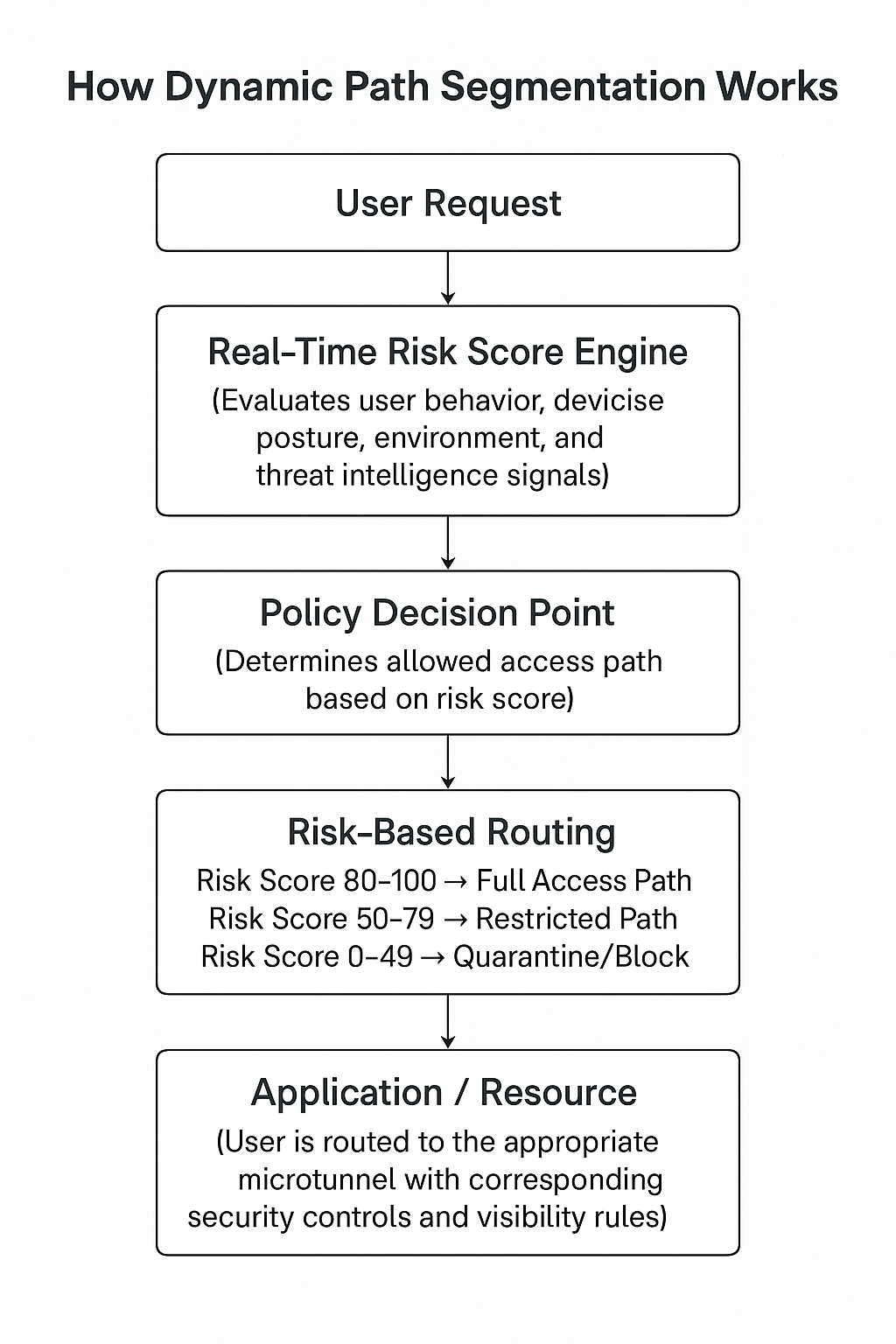
\ Each routing path corresponds to a dedicated network segment with unique security controls, logging levels, and permissions.

ZTNA + Real-Time Risk Scoring + Dynamic Path Segmentation: A Unified Adaptive Model

Together, these three components create an intelligent, self-adjusting Zero Trust architecture.

How the Unified Model Operates

  • Real-time access decisions: Authentication adapts based on the current risk score
  • Continuous monitoring: Risk scores evolve with each user action
  • Network-level enforcement: Path segmentation isolates users based on trust
  • Feedback loop: Logged events improve future detection accuracy

Access always reflects least privilege, and threats are contained before lateral movement occurs.

Implementation Considerations

When rolling out this unified model, organizations should consider:

  1. Start with visibility \n Deploy risk scoring in monitoring mode to baseline behaviors.
  2. Phased enforcement \n Introduce step-up authentication first before enabling automated blocking.
  3. Integration requirements \n Connect SIEM, identity provider, and endpoint tools to feed risk signals.
  4. False positive tuning \n Overly aggressive thresholds create friction—tune gradually.
  5. Compliance alignment \n Map risk thresholds to regulatory frameworks (PCI-DSS, HIPAA, SOC 2).

Key Integration Points

  • Identity Provider (IdP): User identity & posture
  • EDR: Device health and threat signals
  • SIEM/SOAR: Threat intelligence correlation
  • CASB: Application visibility and governance

Common Pitfalls and How to Avoid Them

1. Over-Aggressive Risk Thresholds \n Problem: Excessive false positives frustrate users. \n Solution: Start permissively in monitoring mode and tighten gradually.

2. Insufficient Signal Sources

Problem: Limited visibility results in inaccurate scoring. \n Solution: Integrate multiple data streams for holistic assessment.

3. Ignoring User Experience

Problem: High friction drives users to insecure workarounds. \n Solution: Optimize for low-risk common cases; add friction only when needed.

4. Static Policies on Dynamic Systems

Problem: Treating risk scoring as set-and-forget. \n Solution: Review thresholds and detection patterns regularly.

Conclusion

Zero Trust Network Access has become a foundational element of modern cybersecurity, but its effectiveness depends heavily on its ability to evolve alongside the shifting threat landscape. Traditional, static ZTNA models while valuable are no longer sufficient in an environment where user behavior, device posture, and external threat conditions can change at any moment. By integrating real-time risk scoring and dynamic path segmentation, organizations can elevate ZTNA from a one-time gatekeeper into a continuously adaptive security framework. This dynamic approach ensures that trust is never assumed and that access decisions reflect current conditions rather than outdated assumptions made at login.

The combination of continuous risk assessment and flexible, per-application segmentation dramatically reduces the chances of lateral movement, session compromise, or unnoticed insider threats. This unified model provides security teams with unprecedented visibility and responsiveness, enabling them to contain risks before they escalate into breaches. At the same time, it improves user experience by removing unnecessary friction for trusted interactions and only introducing additional checks when warranted by risk signals.

Looking forward, the future of adaptive ZTNA will be shaped by advances in AI, predictive analytics, and cross-organization threat intelligence. As these technologies mature, organizations will gain the ability to anticipate risks rather than simply react to them. Those who adopt adaptive ZTNA today will be better equipped to handle the increasingly sophisticated threats of tomorrow, strengthening both operational resilience and user trust.

For organizations ready to take their next step, the path forward begins with assessing current access controls, identifying risk signal gaps, and piloting real-time scoring in a targeted environment. With thoughtful implementation and ongoing refinement, adaptive ZTNA becomes not just a security enhancement, but a transformative shift in how access is governed across the enterprise.

\

:::tip This story was distributed as a release by Sanya Kapoor under HackerNoon’s Business Blogging Program.

:::

\

Market Opportunity
Intuition Logo
Intuition Price(TRUST)
$0.08538
$0.08538$0.08538
+0.55%
USD
Intuition (TRUST) Live Price Chart
Disclaimer: The articles reposted on this site are sourced from public platforms and are provided for informational purposes only. They do not necessarily reflect the views of MEXC. All rights remain with the original authors. If you believe any content infringes on third-party rights, please contact service@support.mexc.com for removal. MEXC makes no guarantees regarding the accuracy, completeness, or timeliness of the content and is not responsible for any actions taken based on the information provided. The content does not constitute financial, legal, or other professional advice, nor should it be considered a recommendation or endorsement by MEXC.

You May Also Like

Federal Reserve’s Rate Cuts May Affect Cryptocurrency Market

Federal Reserve’s Rate Cuts May Affect Cryptocurrency Market

Detail: https://coincu.com/markets/federal-reserve-2025-rate-cut-plans/
Share
Coinstats2025/09/18 02:40
Unprecedented Surge: Gold Price Hits Astounding New Record High

Unprecedented Surge: Gold Price Hits Astounding New Record High

BitcoinWorld Unprecedented Surge: Gold Price Hits Astounding New Record High While the world often buzzes with the latest movements in Bitcoin and altcoins, a traditional asset has quietly but powerfully commanded attention: gold. This week, the gold price has once again made headlines, touching an astounding new record high of $3,704 per ounce. This significant milestone reminds investors, both traditional and those deep in the crypto space, of gold’s enduring appeal as a store of value and a hedge against uncertainty. What’s Driving the Record Gold Price Surge? The recent ascent of the gold price to unprecedented levels is not a random event. Several powerful macroeconomic forces are converging, creating a perfect storm for the precious metal. Geopolitical Tensions: Escalating conflicts and global instability often drive investors towards safe-haven assets. Gold, with its long history of retaining value during crises, becomes a preferred choice. Inflation Concerns: Persistent inflation in major economies erodes the purchasing power of fiat currencies. Consequently, investors seek assets like gold that historically maintain their value against rising prices. Central Bank Policies: Many central banks globally are accumulating gold at a significant pace. This institutional demand provides a strong underlying support for the gold price. Furthermore, expectations around interest rate cuts in the future also make non-yielding assets like gold more attractive. These factors collectively paint a picture of a cautious market, where investors are looking for stability amidst a turbulent economic landscape. Understanding Gold’s Appeal in Today’s Market For centuries, gold has held a unique position in the financial world. Its latest record-breaking performance reinforces its status as a critical component of a diversified portfolio. Gold offers a tangible asset that is not subject to the same digital vulnerabilities or regulatory shifts that can impact cryptocurrencies. While digital assets offer exciting growth potential, gold provides a foundational stability that appeals to a broad spectrum of investors. Moreover, the finite supply of gold, much like Bitcoin’s capped supply, contributes to its perceived value. The current market environment, characterized by economic uncertainty and fluctuating currency values, only amplifies gold’s intrinsic benefits. It serves as a reliable hedge when other asset classes, including stocks and sometimes even crypto, face downward pressure. How Does This Record Gold Price Impact Investors? A soaring gold price naturally raises questions for investors. For those who already hold gold, this represents a significant validation of their investment strategy. For others, it might spark renewed interest in this ancient asset. Benefits for Investors: Portfolio Diversification: Gold often moves independently of other asset classes, offering crucial diversification benefits. Wealth Preservation: It acts as a robust store of value, protecting wealth against inflation and economic downturns. Liquidity: Gold markets are highly liquid, allowing for relatively easy buying and selling. Challenges and Considerations: Opportunity Cost: Investing in gold means capital is not allocated to potentially higher-growth assets like equities or certain cryptocurrencies. Volatility: While often seen as stable, gold prices can still experience significant fluctuations, as evidenced by its rapid ascent. Considering the current financial climate, understanding gold’s role can help refine your overall investment approach. Looking Ahead: The Future of the Gold Price What does the future hold for the gold price? While no one can predict market movements with absolute certainty, current trends and expert analyses offer some insights. Continued geopolitical instability and persistent inflationary pressures could sustain demand for gold. Furthermore, if global central banks continue their gold acquisition spree, this could provide a floor for prices. However, a significant easing of inflation or a de-escalation of global conflicts might reduce some of the immediate upward pressure. Investors should remain vigilant, observing global economic indicators and geopolitical developments closely. The ongoing dialogue between traditional finance and the emerging digital asset space also plays a role. As more investors become comfortable with both gold and cryptocurrencies, a nuanced understanding of how these assets complement each other will be crucial for navigating future market cycles. The recent surge in the gold price to a new record high of $3,704 per ounce underscores its enduring significance in the global financial landscape. It serves as a powerful reminder of gold’s role as a safe haven asset, a hedge against inflation, and a vital component for portfolio diversification. While digital assets continue to innovate and capture headlines, gold’s consistent performance during times of uncertainty highlights its timeless value. Whether you are a seasoned investor or new to the market, understanding the drivers behind gold’s ascent is crucial for making informed financial decisions in an ever-evolving world. Frequently Asked Questions (FAQs) Q1: What does a record-high gold price signify for the broader economy? A record-high gold price often indicates underlying economic uncertainty, inflation concerns, and geopolitical instability. Investors tend to flock to gold as a safe haven when they lose confidence in traditional currencies or other asset classes. Q2: How does gold compare to cryptocurrencies as a safe-haven asset? Both gold and some cryptocurrencies (like Bitcoin) are often considered safe havens. Gold has a centuries-long history of retaining value during crises, offering tangibility. Cryptocurrencies, while newer, offer decentralization and can be less susceptible to traditional financial system failures, but they also carry higher volatility and regulatory risks. Q3: Should I invest in gold now that its price is at a record high? Investing at a record high requires careful consideration. While the price might continue to climb due to ongoing market conditions, there’s also a risk of a correction. It’s crucial to assess your personal financial goals, risk tolerance, and consider diversifying your portfolio rather than putting all your capital into a single asset. Q4: What are the main factors that influence the gold price? The gold price is primarily influenced by global economic uncertainty, inflation rates, interest rate policies by central banks, the strength of the U.S. dollar, and geopolitical tensions. Demand from jewelers and industrial uses also play a role, but investment and central bank demand are often the biggest drivers. Q5: Is gold still a good hedge against inflation? Historically, gold has proven to be an effective hedge against inflation. When the purchasing power of fiat currencies declines, gold tends to hold its value or even increase, making it an attractive asset for preserving wealth during inflationary periods. To learn more about the latest crypto market trends, explore our article on key developments shaping Bitcoin’s price action. This post Unprecedented Surge: Gold Price Hits Astounding New Record High first appeared on BitcoinWorld.
Share
Coinstats2025/09/18 02:30
Shiba Inu (SHIB) - Complete Fundamental Analysis

Shiba Inu (SHIB) - Complete Fundamental Analysis

Shiba Inu (SHIB) Cryptocurrency: Comprehensive Overview ## Core Technology and Blockchain Architecture Shiba Inu token (ticker: SHIB) is a decentralized cryptocurrency

Share
Coinstats2026/02/02 22:55