Ethereum price breaks below the $3,000 psychological level and the point of control, increasing the risk of capitulation as bearish structure and downside liquidityEthereum price breaks below the $3,000 psychological level and the point of control, increasing the risk of capitulation as bearish structure and downside liquidity

Ethereum price loses $3,000 psychological support, raising capitulation risk

Ethereum price breaks below the $3,000 psychological level and the point of control, increasing the risk of capitulation as bearish structure and downside liquidity targets remain intact.

Summary
  • Ethereum price loses $3,000 psychological support and POC.
  • Bearish structure remains intact with lower highs and lower lows.
  • Capitulation risk increases toward the $2,500 support zone.

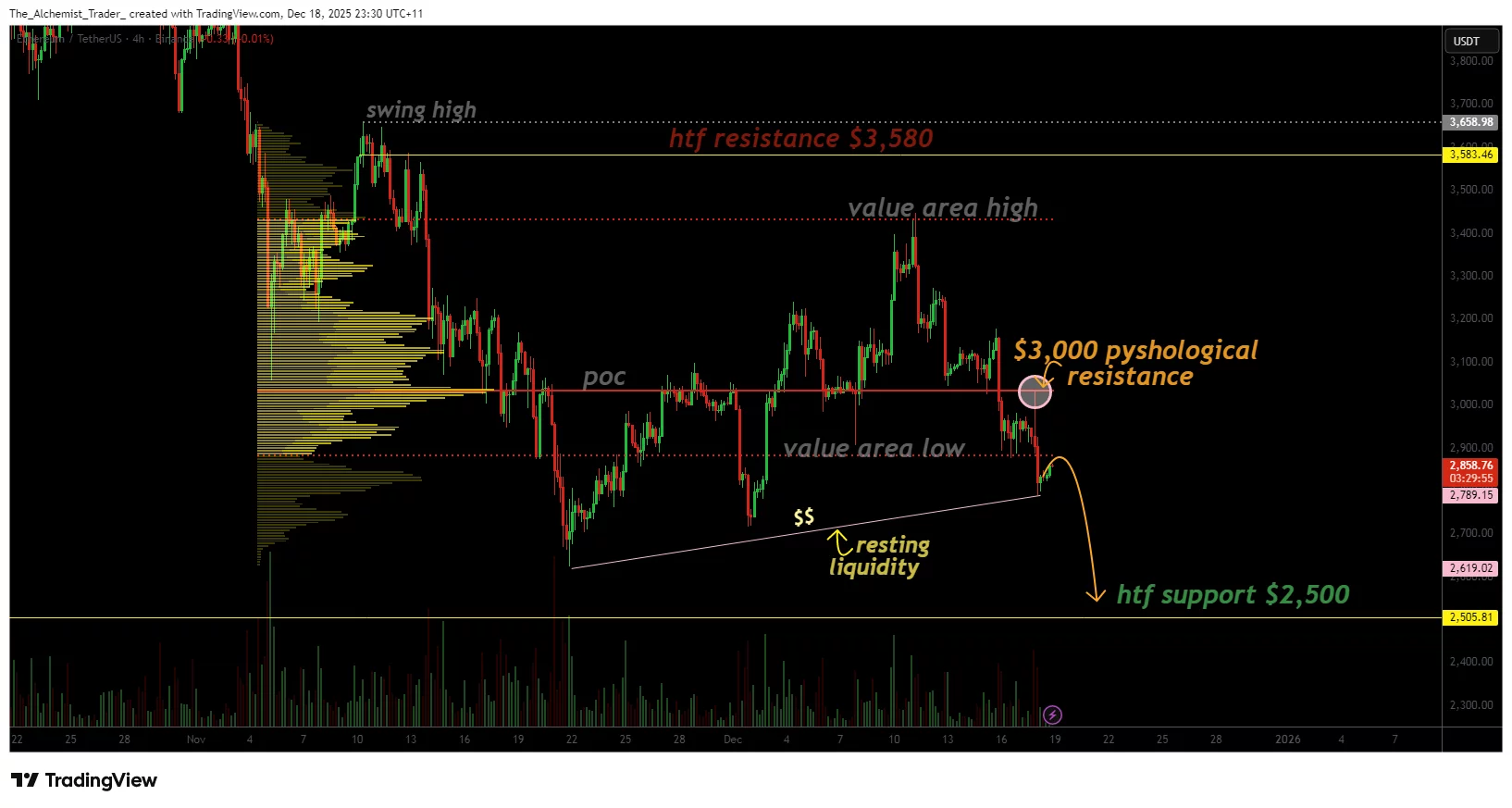
Ethereum (ETH) price is facing renewed downside pressure after losing the critical $3,000 psychological support level, a zone that also aligned with the market’s Point of Control (POC). This breakdown marks a shift in market structure, as $3,000 now transitions from support into resistance.

With price failing to reclaim this region on a closing basis, bearish momentum remains firmly in control, increasing the probability of a deeper corrective move.

Ethereum price key technical points

  • Ethereum loses the $3,000 psychological level and POC, confirming structural weakness.
  • Market structure remains bearish, with consecutive lower highs and lower lows.
  • Downside liquidity sits near $2,500, raising the risk of a capitulation-style move.
Ethereum price loses $3,000 psychological support, raising capitulation risk - 1

The loss of $3,000 represents more than just a psychological setback for Ethereum. This level previously acted as a major area of balance, where significant trading volume accumulated. Its failure on a closing basis signals a clear shift away from equilibrium and toward renewed downside exploration.

Since breaking below the Point of Control, Ethereum has attempted minor relief rallies. However, these moves have been rejected almost “to the dollar,” reinforcing $3,000 as a firm resistance zone. From a technical standpoint, this behavior suggests that buyers lack the capacity to regain control.

At the same time, sellers continue to defend lower prices aggressively, a dynamic that increases downside risk for BMNR stock as Ethereum’s technical pattern becomes more concerning.

The broader market structure remains decisively bearish. Ethereum continues to print lower highs and lower lows, a classic definition of a sustained downtrend. Within this context, the current low-time-frame rally is best viewed as another lower high, rather than the start of a meaningful reversal. Such corrective bounces are common during downtrends and often precede further downside rather than sustained recoveries.

One of the most important factors increasing capitulation risk is the presence of resting liquidity below current price levels. Since Ethereum established a local low near the $2,600 region, liquidity has steadily built beneath that area. Markets tend to seek out these liquidity pools, especially when bearish momentum remains intact and structural support levels fail.

The next major downside target sits near $2,500, a high-time-frame support region that aligns with previous consolidation and structural demand. A move into this area would likely clear out remaining downside liquidity, a process often associated with capitulation-style price action. Capitulation typically involves accelerated selling, forced liquidations, and emotional exits, marking the final phase of a corrective move.

From a price-action perspective, Ethereum’s behavior below $3,000 reflects acceptance rather than rejection. Price is consolidating below the resistance level instead of reclaiming it, which statistically favors a continuation of the decline. Prolonged consolidation below a broken key level often increases, rather than reduces, the probability of a decisive downside move.

Volume dynamics further support this view. Recent downside moves have exhibited greater participation than upside attempts, indicating that sell-side pressure remains dominant. Until Ethereum can reclaim $3,000 with substantial volume and hold above it, bullish scenarios remain secondary.

That said, capitulation zones often create conditions for longer-term stabilization once liquidity is fully cleared. While the immediate outlook remains bearish, traders should closely monitor how the price behaves if and when Ethereum approaches the $2,500 region, as strong reactions there could signal exhaustion of selling pressure.

What to Expect in the Coming Price Action

As long as Ethereum remains below the $3,000 psychological level and the Point of Control, downside risk remains elevated. Continued consolidation beneath this region increases the likelihood of a capitulation move toward $2,500, where the next major support and liquidity zone is located.

Disclaimer: The articles reposted on this site are sourced from public platforms and are provided for informational purposes only. They do not necessarily reflect the views of MEXC. All rights remain with the original authors. If you believe any content infringes on third-party rights, please contact service@support.mexc.com for removal. MEXC makes no guarantees regarding the accuracy, completeness, or timeliness of the content and is not responsible for any actions taken based on the information provided. The content does not constitute financial, legal, or other professional advice, nor should it be considered a recommendation or endorsement by MEXC.

You May Also Like

Unexpected Developments Shake the Financial Sphere

Unexpected Developments Shake the Financial Sphere

The post Unexpected Developments Shake the Financial Sphere appeared on BitcoinEthereumNews.com. Japan’s recent move to hike its interest rate to 0.75 ahead of
Share
BitcoinEthereumNews2025/12/19 22:07
Foreigner’s Lou Gramm Revisits The Band’s Classic ‘4’ Album, Now Reissued

Foreigner’s Lou Gramm Revisits The Band’s Classic ‘4’ Album, Now Reissued

The post Foreigner’s Lou Gramm Revisits The Band’s Classic ‘4’ Album, Now Reissued appeared on BitcoinEthereumNews.com. American-based rock band Foreigner performs onstage at the Rosemont Horizon, Rosemont, Illinois, November 8, 1981. Pictured are, from left, Mick Jones, on guitar, and vocalist Lou Gramm. (Photo by Paul Natkin/Getty Images) Getty Images Singer Lou Gramm has a vivid memory of recording the ballad “Waiting for a Girl Like You” at New York City’s Electric Lady Studio for his band Foreigner more than 40 years ago. Gramm was adding his vocals for the track in the control room on the other side of the glass when he noticed a beautiful woman walking through the door. “She sits on the sofa in front of the board,” he says. “She looked at me while I was singing. And every now and then, she had a little smile on her face. I’m not sure what that was, but it was driving me crazy. “And at the end of the song, when I’m singing the ad-libs and stuff like that, she gets up,” he continues. “She gives me a little smile and walks out of the room. And when the song ended, I would look up every now and then to see where Mick [Jones] and Mutt [Lange] were, and they were pushing buttons and turning knobs. They were not aware that she was even in the room. So when the song ended, I said, ‘Guys, who was that woman who walked in? She was beautiful.’ And they looked at each other, and they went, ‘What are you talking about? We didn’t see anything.’ But you know what? I think they put her up to it. Doesn’t that sound more like them?” “Waiting for a Girl Like You” became a massive hit in 1981 for Foreigner off their album 4, which peaked at number one on the Billboard chart for 10 weeks and…
Share
BitcoinEthereumNews2025/09/18 01:26
Adoption Leads Traders to Snorter Token

Adoption Leads Traders to Snorter Token

The post Adoption Leads Traders to Snorter Token appeared on BitcoinEthereumNews.com. Largest Bank in Spain Launches Crypto Service: Adoption Leads Traders to Snorter Token Sign Up for Our Newsletter! For updates and exclusive offers enter your email. Leah is a British journalist with a BA in Journalism, Media, and Communications and nearly a decade of content writing experience. Over the last four years, her focus has primarily been on Web3 technologies, driven by her genuine enthusiasm for decentralization and the latest technological advancements. She has contributed to leading crypto and NFT publications – Cointelegraph, Coinbound, Crypto News, NFT Plazas, Bitcolumnist, Techreport, and NFT Lately – which has elevated her to a senior role in crypto journalism. Whether crafting breaking news or in-depth reviews, she strives to engage her readers with the latest insights and information. Her articles often span the hottest cryptos, exchanges, and evolving regulations. As part of her ploy to attract crypto newbies into Web3, she explains even the most complex topics in an easily understandable and engaging way. Further underscoring her dynamic journalism background, she has written for various sectors, including software testing (TEST Magazine), travel (Travel Off Path), and music (Mixmag). When she’s not deep into a crypto rabbit hole, she’s probably island-hopping (with the Galapagos and Hainan being her go-to’s). Or perhaps sketching chalk pencil drawings while listening to the Pixies, her all-time favorite band. This website uses cookies. By continuing to use this website you are giving consent to cookies being used. Visit our Privacy Center or Cookie Policy. I Agree Source: https://bitcoinist.com/banco-santander-and-snorter-token-crypto-services/
Share
BitcoinEthereumNews2025/09/17 23:45